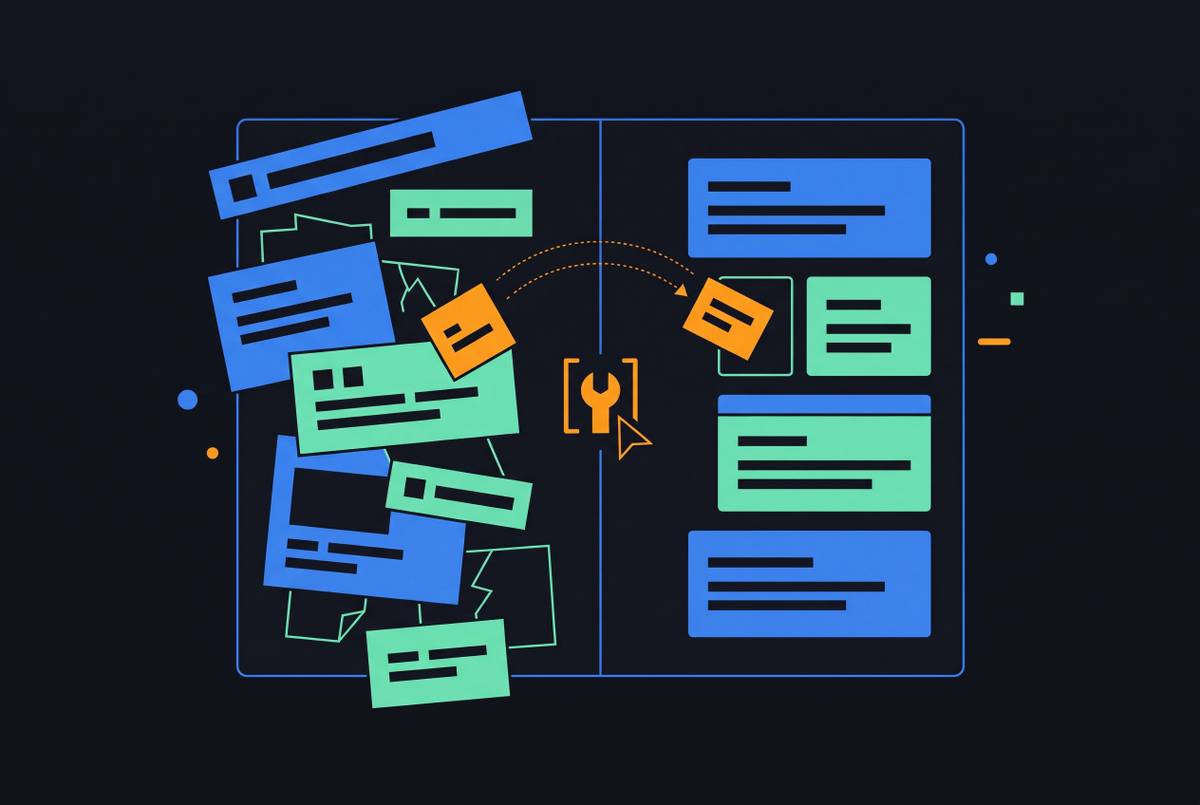
What Documentation Refactoring Tools Actually Change
Better organization alone won't keep docs aligned with evolving code.
Renata Haddad
22 stories
Better organization alone won't keep docs aligned with evolving code.
AI-generated documentation stays accurate only with infrastructure that tracks how code changes.
MDX platforms now need to serve both humans and AI agents reliably.
Documentation that explains why code exists matters far more than restating what it does.
AI agents now read more docs than humans, demanding different design choices.
Adaptive loops and multiple retrievers let agents decide when and how to search documentation.
Proper documentation structure helps agents navigate more reliably than flat retrieval alone.
Retrieval systems struggle to find the right knowledge when it matters most.
Restructuring doc teams around human-AI collaboration beats simply adding AI tools to old workflows.
Teams need to know which tools actually sync docs with code instead of just linking to it.
Automated code samples eliminate the trust damage when developers find errors in your docs.
Find your fit among hosted portals, embeddable viewers, and CLI generators.
Teams demand Git skills but rarely implement the full workflow end-to-end.
Productivity gains vanish without verification built into the workflow from the start.
Four markup languages shape what your documentation system can do as it scales.
Different AI crawlers serve different purposes, and blocking one won't stop the others.
A standardized file format helps AI agents navigate websites built for human readers.
Hallucinations arise when LLMs retrieve fragmented documentation, not from model deficiency alone.
Outdated API knowledge remains hidden when LLMs answer confidently from stale training data.
Clear documentation structure shapes how well AI systems retrieve and use your knowledge base.
Help developers feed AI agents better documentation by organizing your site's content strategically.
Separate your audiences with structure, not tone.