Versioned Documentation and LLM Context Accuracy
Stale training data makes AI confident about outdated APIs with no internal warning signal.
There is a failure mode in AI-assisted development that doesn't look like a failure at all. The model answers confidently. The code example looks plausible. The parameter names are correct, the syntax is clean, and the explanation is coherent. The only problem is that it describes how the API worked eighteen months ago.
This is not hallucination in the dramatic sense that has dominated public discourse about LLM reliability. The model isn't confabulating. It's drawing on real knowledge that no longer applies, and it has no internal signal that anything is wrong. That distinction matters enormously, because the standard mitigations for hallucination, careful prompting, retrieval augmentation, and confidence thresholds, are calibrated for a different failure. Version mismatch produces confident wrong answers, not uncertain ones. The model doesn't hedge because it doesn't know it should.
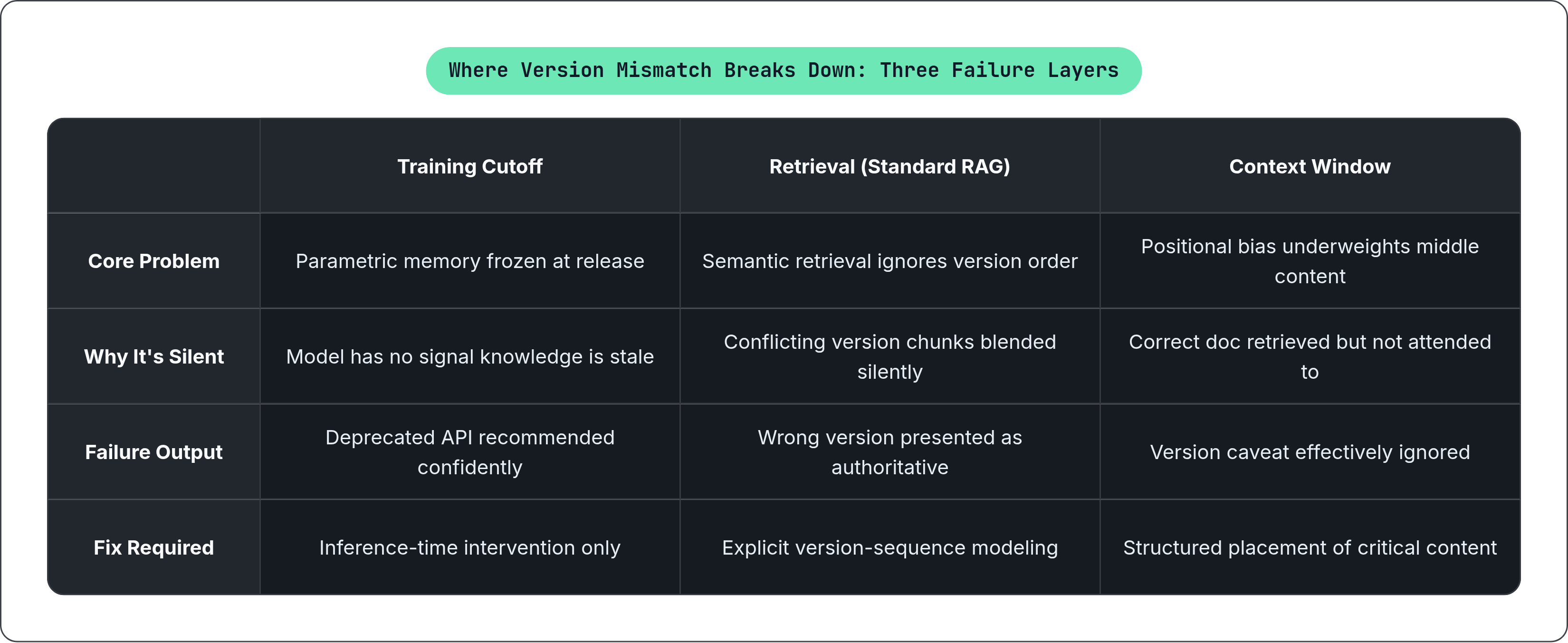
The failure has two structural sources, and they compound each other. First, the model's parametric memory is frozen at a training cutoff, meaning deprecated APIs, renamed parameters, and changed authentication flows are permanently invisible to it unless something at inference time intervenes. Second, that intervention, retrieval-augmented generation, introduces its own version confusion unless the retrieval architecture is explicitly version-aware. These two problems operate at different layers of the stack, and solving one without addressing the other still leaves the system vulnerable.
How Training Cutoffs Bake Version-Specific Knowledge into Parametric Memory
A training cutoff is exactly what it sounds like: the model knows nothing published after a specific date, and it has no internal awareness that it's missing anything. This is not a flaw that can be patched with better prompting. It is a structural consequence of how large models are built.
The stated cutoff is already a lagging indicator. OpenAI's developer documentation puts GPT-5.5's knowledge cutoff at December 1, 2025, and GPT-5.4's at August 31, 2025. Anything merged, released, or deprecated after those dates is simply absent from parametric memory. But the effective lag tends to be worse than the stated cutoff suggests. Research on LLaMA 2 found that despite its 2022 training cutoff, the model's knowledge distribution skewed toward 2019, because recent events are underrepresented in training corpora at the time of collection. The internet hasn't finished writing about recent things yet. A model trained through late 2025 may have thin coverage of software released in mid-2025, even if that software technically falls within the window.
Catastrophic forgetting is the reason base models aren't continuously updated to close this gap. Selectively adding new knowledge to a trained model destabilizes existing knowledge in ways that are difficult to predict and expensive to control. Major model versions are effectively frozen at release. The documentation-specific consequence of this architecture is empirically observable: Wang et al. (2025) studied deprecated API usage across eight Python libraries and found that LLM outputs referenced deprecated APIs at rates between 25% and 38%, attributing the pattern directly to stale parametric knowledge. The model recommends the old way because the old way is what it knows, and nothing in the inference pipeline has told it otherwise.
Training cutoffs are not going away. They are a fixed feature of how large language models are built and released. The only lever available to address their documentation consequences is at inference time, which is precisely where retrieval-augmented generation was supposed to help.
Why Standard RAG Doesn't Solve Version Mismatch on Its Own
The intuition behind retrieval-augmented generation is sound: if the model's internal knowledge is stale, ground it in current documentation at inference time. In practice, this works well for general knowledge freshness. It works considerably less well for version accuracy, and the reason is structural.
Standard RAG retrieves content based on semantic similarity. It does not check which version of a product that content describes. A query about a function's stability level might return chunks from three different release cycles simultaneously, one marking the function as experimental, another as stable, and a third noting its deprecation. The model receives all of them and has to reconcile them without knowing which is authoritative for the version the user is actually running.
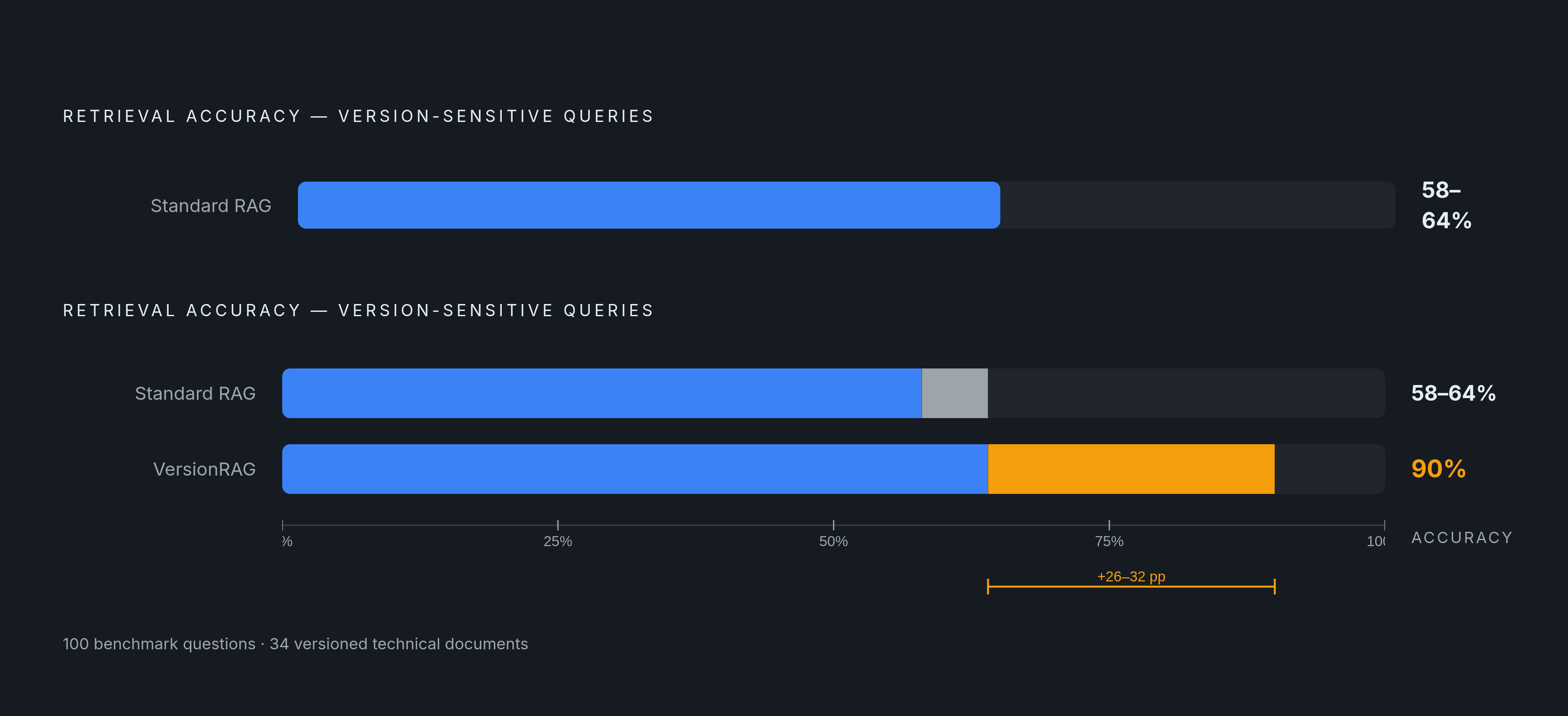
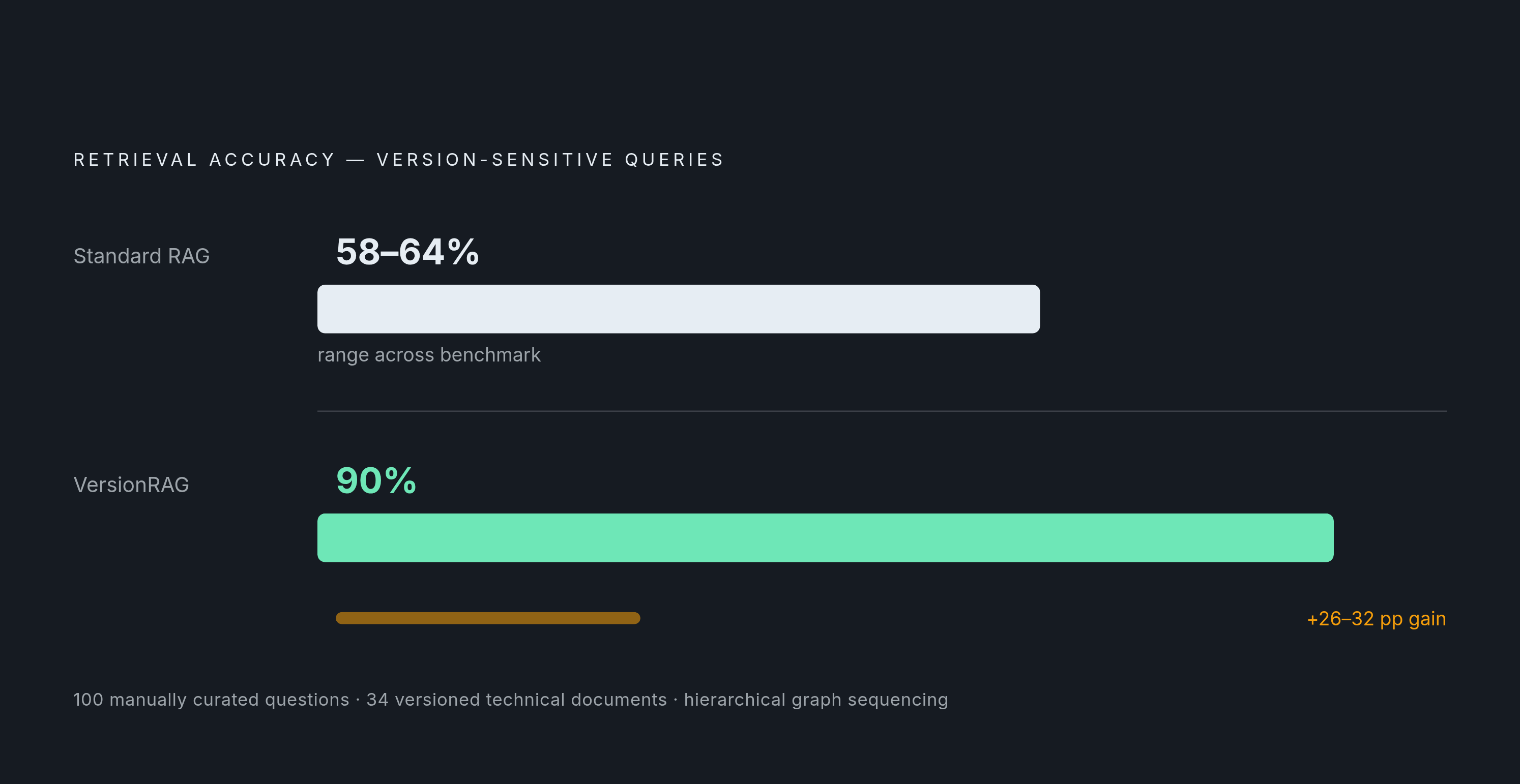
The VersionRAG paper (arXiv 2510.08109, October 2025) quantified this gap precisely. Existing RAG approaches achieved 58 to 64% accuracy on version-sensitive questions across a benchmark of 100 manually curated questions spanning 34 versioned technical documents. The researchers' version-aware approach, which explicitly modeled document evolution through hierarchical graph sequencing, improved accuracy to 90%. The difference was not better embeddings or a larger corpus. It was the explicit modeling of version sequence, the recognition that "this content is more recent than that content" is information the retrieval layer needs to propagate, not ignore.
There is a second, subtler problem layered on top of retrieval conflation. Even when the right version's document is retrieved, the model's parametric memory can override it. LLMs exhibit a fundamental tension between what was encoded during pretraining and what is supplied at inference time. Research has shown consistently that models cannot fully suppress internal knowledge even when instructed to use only the provided context. The model has learned, across billions of tokens, that a particular authentication flow works a particular way. When the retrieved document says otherwise, the model may weight its prior knowledge against the newer instruction and produce a blend, or simply default to what it learned.
Version accuracy, then, requires both correct retrieval and context fidelity. Failing either one is sufficient to produce a wrong answer, and the two failure modes are largely independent.
How Context Window Mechanics Make Version-Relevant Information Easy to Lose
Even when retrieval is version-correct and the right document is in the context window, the model may not attend to it equally. This is the "lost in the middle" phenomenon documented by Liu et al. (2023): LLMs exhibit a U-shaped attention pattern across long inputs, consistently favoring content at the beginning and end of the context while underweighting the middle. A 2024 study by MIT and Google Cloud AI researchers confirmed that this effect stems from positional attention bias rather than content quality, with performance degrading by up to 30% when the most relevant content appeared in the middle third of the context window.
For versioned documentation, the implication is concrete. Deprecation notices, version-specific caveats, and changelog annotations tend to appear in the middle of retrieved chunks, not at the top of a summary or the end of a conclusion. They sit exactly where attention is weakest. A retrieval system could surface the correct document, place it in the context window, and still have the model effectively ignore the version-critical passage because of where it landed positionally.
Context length as an advertised feature compounds the confusion. A model may nominally accept millions of tokens while reliable retrieval accuracy holds for substantially fewer; advertised capacity and practical utility are not the same metric. The o3 model's trajectory under accumulating context is illustrative here: accuracy fell from 98.1% to 64.1% when early incorrect attempts remained in conversation history. That degradation was not a reasoning failure. It was a context conflict problem, where prior content suppressed the model's ability to use later, correct information.
The practical consequence for documentation workflows is that placing version information in context is necessary but not sufficient. Where that information sits, how it is structured, and how much noise surrounds it all determine whether the model will actually use it.
How Fast Software Ships Now and Why That Outpaces How Docs Are Maintained
Code and documentation run on separate update cycles by default, and the gap between them has widened considerably as development velocity has increased. A developer merges a pull request that renames a parameter or deprecates an endpoint. No automated process notifies the documentation pipeline. No ticket is filed. The drift begins accumulating immediately, silently, and without a timestamp.
GitHub recorded 986 million commits in 2025. The volume of change that documentation pipelines must track has grown to a scale that manual maintenance cannot realistically match. AI-assisted development tools accelerate this further. Teams shipping with Claude Code, Codex, and Cursor move faster than teams without them, which means more version transitions in shorter intervals and a narrower window before documentation falls behind the codebase.
Terminology drift compounds the problem in a way that's easy to underestimate. An API might shift its reference from "master branch" to "main branch" over several releases, with older language persisting in vector indices long after the change. A query about "main branch workflows" may surface instructions that were written for a different conceptual model. The terminology divergence degrades retrieval accuracy before the underlying content is even wrong in a traditional sense.
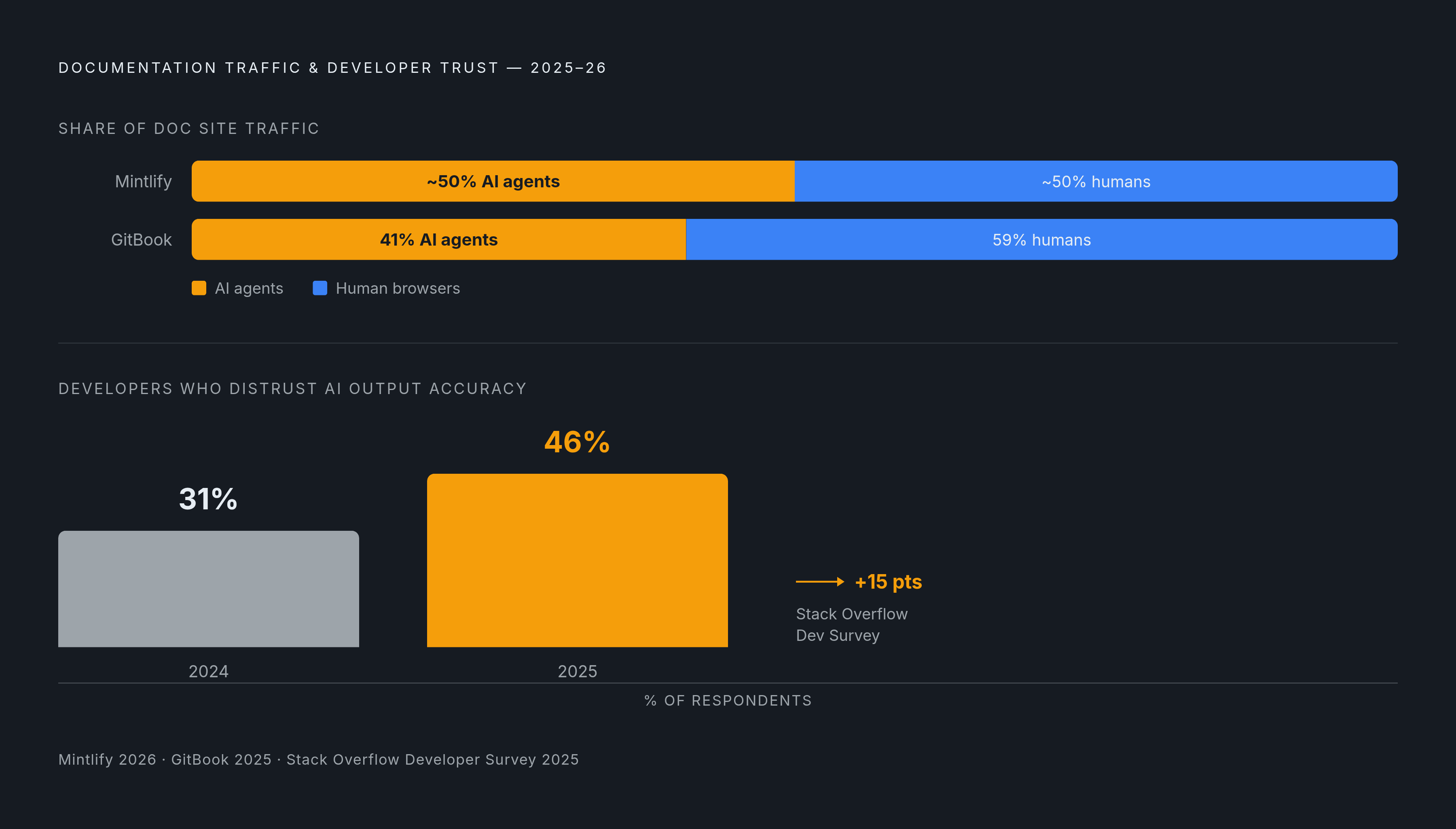
Developer trust is already reflecting this erosion. The Stack Overflow Developer Survey (2025) shows 46% of developers don't trust the accuracy of AI outputs, up from 31% in 2024. That increase tracks almost exactly with the period when AI coding tools became ubiquitous in professional workflows. The tools got more capable and more widely used, and distrust increased alongside adoption. That is not a coincidence.
Why the Stakes Are Higher Now That AI Agents Are Primary Documentation Consumers
Documentation has always had a reader. That reader is no longer exclusively human. AI coding agents inside Cursor, Claude Code, and GitHub Copilot now consume documentation during active code generation, and they read differently than developers do.
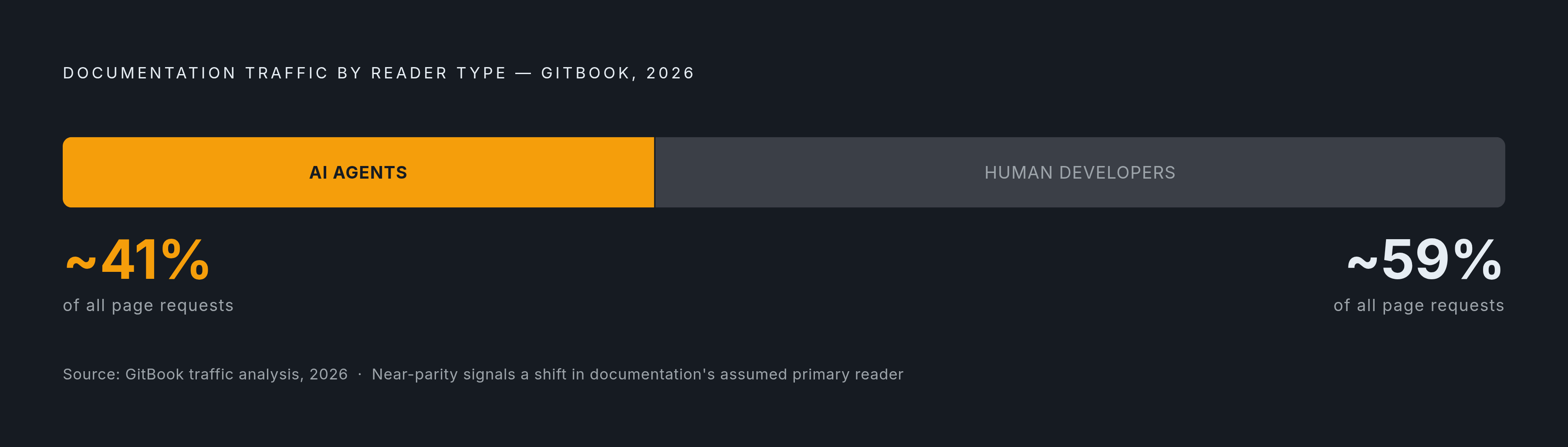
Available data from 2026 indicates that nearly half of traffic to documentation sites now originates from AI agents rather than human browsers. GitBook's traffic data puts 41% of documentation page requests as coming from AI agents. The documentation written to onboard a developer now spends more time being parsed by an agent than being read by a person.
The behavioral difference matters. A human developer scanning a code example might notice that it looks dated, might cross-reference a changelog, might search a forum for confirmation. An agent does not notice. It retrieves what the retrieval system surfaces, passes it into generated code, and moves forward. Version errors propagate silently into output, into integration code, into production systems, without a human having reviewed the intermediate step.
The scale of that propagation is the new variable. A Gartner forecast from 2024 projected that over 30% of the increase in API demand by 2026 would originate from AI and LLM tools. Stale or version-incorrect reference documentation doesn't mislead one developer and stop there. It produces incorrect integration code across every agent-assisted workflow touching that API. IBM's 2024 analysis attributed 72% of enterprise AI failures to inadequate context quality rather than model capability. In agent workflows where documentation is the primary context source, version currency becomes a reliability variable, not a documentation quality metric. That is a meaningful reclassification.
What Version-Aware Documentation Infrastructure Looks Like in Practice
The foundational shift required is not a better prompt template or a more aggressive reindexing schedule. It is treating documentation as infrastructure that updates in synchrony with code, rather than as editorial content that trails it. API references generated directly from OpenAPI or API definition files are the clearest implementation of this principle. When the definition file changes, the documentation changes. Drift is prevented structurally rather than caught manually, which is the only approach that scales with the commit volume the industry now operates at.
CI/CD integration for documentation follows from this naturally. The same pipeline that ships code should trigger documentation updates and flag breaking changes before they reach production. This is not a documentation team's workflow. It is a deployment pipeline responsibility, the same way database migrations and environment variable changes are.
The llms.txt specification addresses the agent-specific consumption problem. Implemented by over 844,000 websites as of October 2025 per BuiltWith's tracking, it gives AI agents a structured index they can parse efficiently without processing navigation chrome, JavaScript, and layout elements that consume tokens without adding information. The versioning risk inside llms.txt is easy to overlook: AI coding assistants cache these files, so a stale version can persist for days or weeks after the underlying documentation has been updated. The file must be regenerated automatically on every documentation publish, not maintained as a separate artifact.
Retrieval architecture is where the deepest technical investment is warranted for teams operating at scale. The VersionRAG approach, with its hierarchical graph modeling of document evolution, offers a concrete reference point: 97% fewer tokens consumed during indexing than GraphRAG, with accuracy improvements from the mid-60% range to approximately 90% on version-sensitive queries. The efficiency gain matters practically, because approaches that are accurate but prohibitively expensive don't survive production deployment.
For teams not yet ready to rebuild their retrieval architecture, there is a lower-cost floor available at the prompt layer. An explicit instruction to answer only from provided context, paired with a fallback instruction acknowledging when the retrieved context is insufficient, reduces parametric override without requiring infrastructure changes. It is not a complete mitigation; the research on parametric versus contextual knowledge conflicts suggests the tension cannot be fully resolved through prompting alone. But it removes the most common failure mode for a low implementation cost.
Document structure is a retrieval variable that practitioners undervalue. Skipped heading levels break the hierarchical models that LLMs use to map content relationships. Inconsistent terminology across version cycles, using "API key," "access token," and "auth credential" interchangeably across different pages and releases, forces the model to infer whether these terms are synonyms or distinct concepts. That inference introduces noise at a point where precision is exactly what's needed. Structural consistency across versions is not an editorial preference. It is part of the retrieval accuracy stack.
The cumulative picture here is of a problem that was always present in technical documentation, knowledge going stale, terminology shifting, APIs deprecating, but that has become structurally consequential in a new way because the primary reader is now a system that cannot notice the staleness for itself. The solution is not to write better documentation in the traditional sense. It is to build infrastructure that makes version accuracy a property of the pipeline, not a goal of the prose.