Choosing a Markup Language for Technical Documentation
Your markup language choice will shape tooling, contributors, and future migrations for years.

The docs-as-code movement has moved from a niche philosophy practiced by forward-thinking engineering teams to something closer to a default operating model for developer-facing documentation. Technical writers are now expected to work fluently in version control, maintain documentation pipelines alongside engineers, and make consequential decisions about tooling that used to belong exclusively to infrastructure teams. That shift has elevated one decision in particular: which markup language to use.
The markup language is no longer just a writing tool. It shapes what the toolchain can do, who can contribute, and how content survives format changes as the organization grows. A poor fit compounds over time. Workarounds accumulate, contributor friction increases, and migrating out of an entrenched format is expensive in ways that aren't obvious until you're already inside the problem. That raises an important question: how do you make a format decision that holds up before you've learned what you needed to know?
I want to be direct about something: this piece is not going to recommend a winner. The right format is contingent on your specific constraints, and anyone who tells you otherwise is selling simplicity at the expense of accuracy. What I can offer is the map I wish I'd had earlier, built from the kinds of decisions that felt obvious in retrospect and costly in the moment.
The four formats that actually matter for technical documentation
Not every format deserves serious consideration. Proprietary formats, Confluence storage format, Word documents, and their relatives belong to a different conversation, one about knowledge management platforms rather than documentation engineering. For teams working in a docs-as-code model, four formats do the real work.
Markdown started as a blogging tool, created by John Gruber in 2004 to let writers produce HTML without writing HTML. That origin is not incidental. It explains why Markdown's feature set stops where it does, and why its adoption curve is shaped the way it is: near-universal, fast, and shallow.
AsciiDoc was created in 2002 specifically for technical books and publications. That distinction matters more than it might appear. It was designed from day one to produce structured, multi-format output without HTML workarounds, which is a fundamentally different design intention from Markdown's.
reStructuredText, often abbreviated reST, actually predates Markdown. It was developed for Python documentation and is maintained under a formal specification by the Docutils project. It is semantically richer than Markdown and was built to handle the specific constructs that software documentation requires.
DITA XML is an OASIS standard developed for enterprise technical documentation. It is structured, component-based, and built for large-scale content reuse and multi-channel publishing. It is also the most demanding of the four, in terms of both learning curve and tooling investment.
Each occupies a distinct niche. The sections that follow map those niches to the decisions that actually surface in real documentation work.
Where Markdown earns its dominance and where it runs out
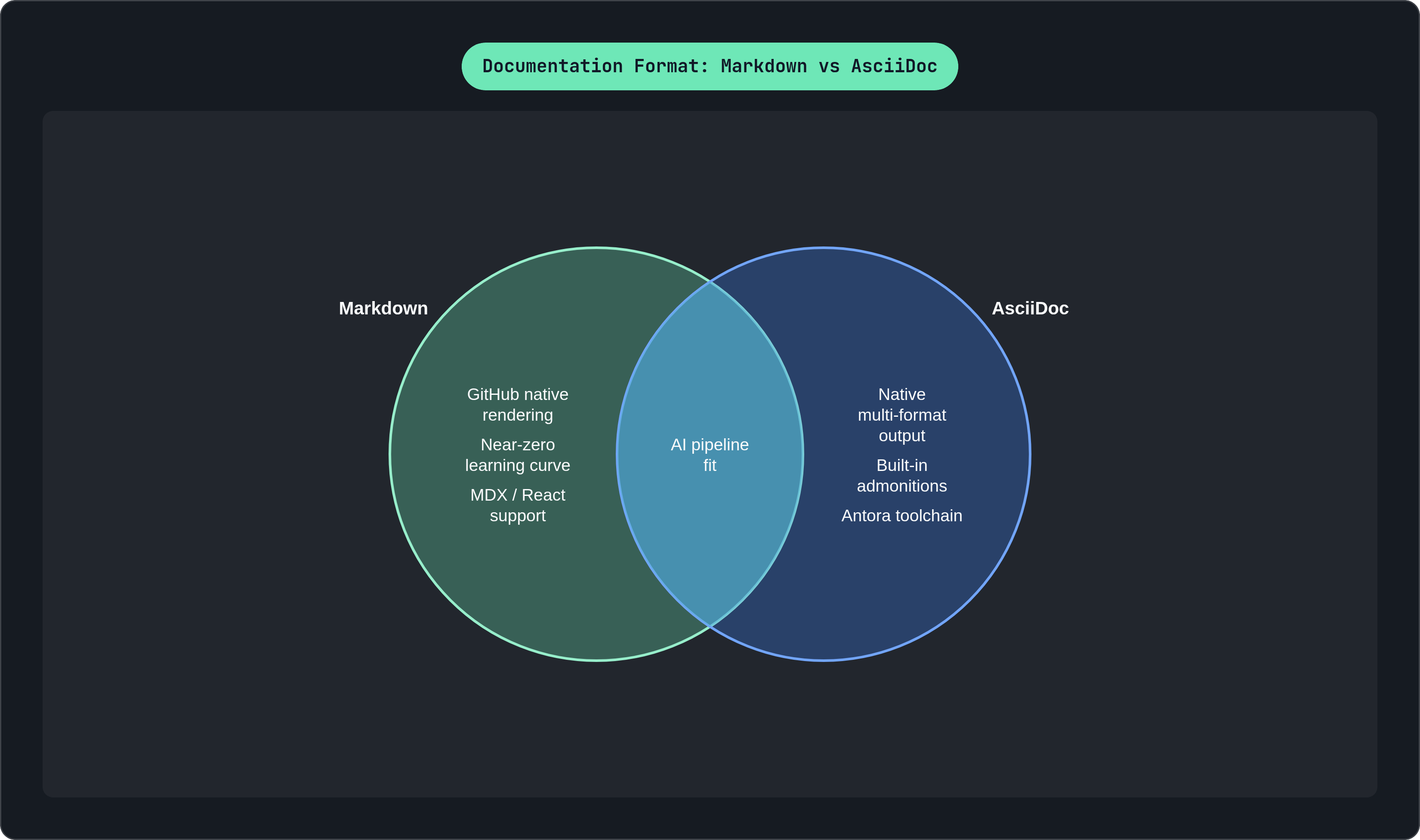
Markdown's dominance in developer-facing documentation is not accidental, and it is not undeserved. Near-universal editor support, native rendering on GitHub, and compatibility with almost every static site generator out of the box: these are real advantages that compound in open-source and API documentation contexts. Most developers already know the syntax. Open-source projects with large, transient contributor bases lose very little to onboarding friction. That is a real and measurable advantage when documentation velocity matters.
The ceiling, however, is structural rather than cosmetic. The base Markdown specification lacks admonitions, cross-references, document includes, variables, conditional content, and footnotes. These are not edge cases for technical documentation teams; they are routine requirements. But what if your project starts small and structured, then scales into those requirements over time? That is exactly the scenario where the format decision becomes expensive to revisit.
Every static site generator fills those gaps differently. A MkDocs-extended Markdown file is not portable to Docusaurus without rework. Docusaurus uses MDX, which extends Markdown with JSX and enables interactive components and live demos, but also adds a React dependency that not all teams want or can maintain. GitHub Flavored Markdown, Python Markdown, MultiMarkdown, and other dialects introduce subtle incompatibilities that tend to surface at migration time, when the cost of discovering them is highest.
It is also worth considering that MkDocs entered maintenance mode in late 2025, which represents a meaningful ecosystem risk for teams currently running on it. Docusaurus, maintained by Meta, is the most actively developed Markdown-native static site generator at this writing.
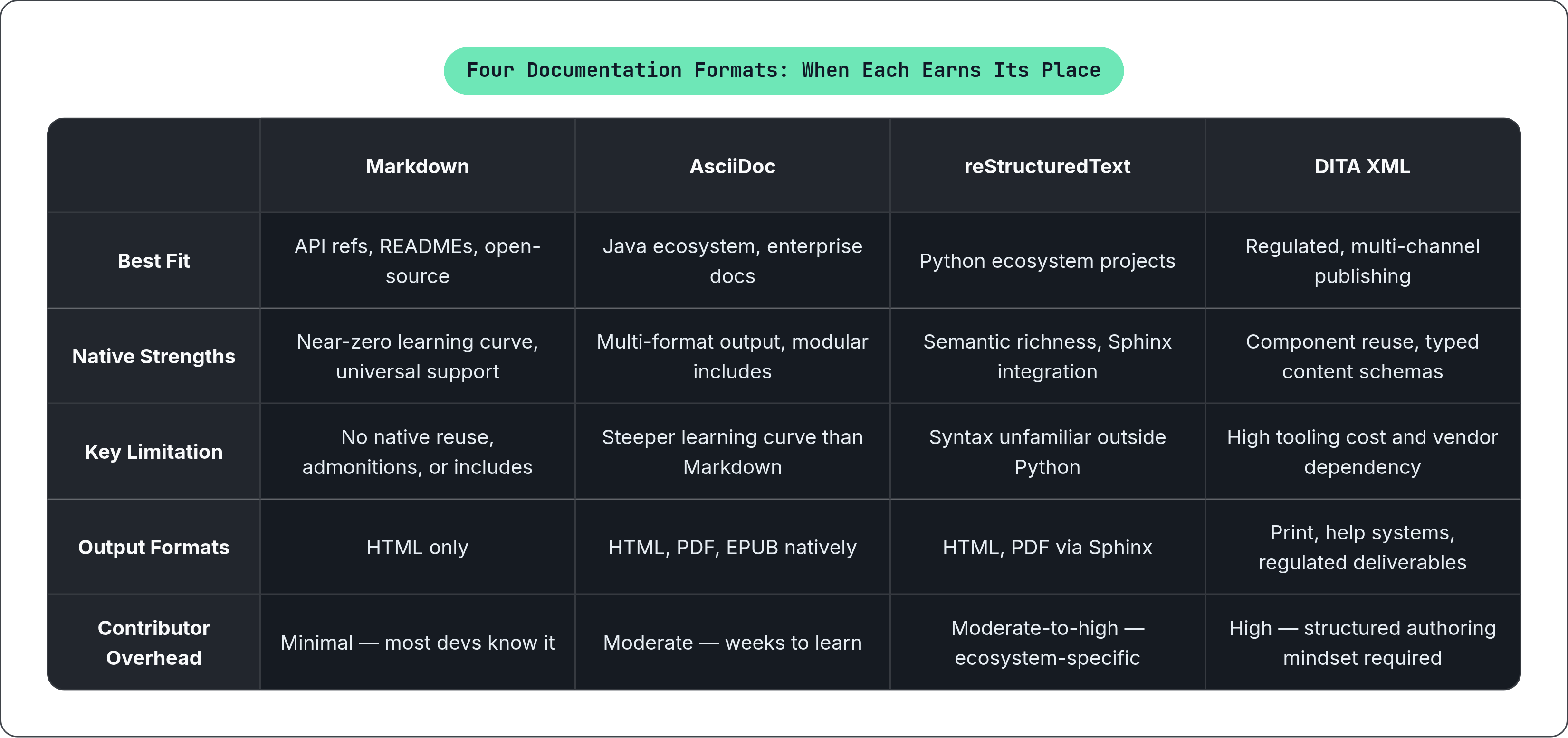
The summary: Markdown is the right default for API references, READMEs, and single-output HTML sites where the audience is technical and the content set is bounded. It becomes a liability when reuse, multi-format output, or regulatory structure enters the picture. The mistake is not choosing Markdown; the mistake is choosing Markdown and then discovering, six months in, that your requirements were never in its wheelhouse.
AsciiDoc as the middle ground between Markdown's simplicity and XML's structure
The "middle ground" positioning of AsciiDoc is sometimes treated as marketing language. Having worked in documentation environments that spanned both ends of the spectrum, I'd argue it's actually precise.
What's native in AsciiDoc that Markdown requires workarounds to approximate: admonitions (notes, warnings, tips) without embedded HTML; cross-references, index entries, and tables of contents; document includes and modular assembly that let large documentation sets be split into components and composed; and multi-format output to HTML5, EPUB3, and DocBook from a single source. PDF output requires a separate Asciidoctor PDF extension, but the core multi-format capability is built in rather than bolted on.
AsciiDoc also benefits from substantially less fragmentation than Markdown. It has fewer competing dialects, and the AsciiDoc Working Group at the Eclipse Foundation is currently developing a formal language specification that will further reduce processor inconsistencies over time. Asciidoctor, the reference processor available in Ruby with ports in Java and JavaScript, and Antora, the purpose-built static site generator for AsciiDoc documentation sites, form a coherent toolchain with native versioning and search integration.
The trade-off is real: AsciiDoc has a steeper learning curve than Markdown. Writers who are used to the minimal syntax of Markdown will notice the difference, particularly in the first few weeks. It is, however, shallower than reST or DITA. For teams in the Java ecosystem, or for enterprise and open-source projects that need output flexibility without committing to XML, AsciiDoc sits in a useful position.
reStructuredText's specific strengths and the conditions that justify its complexity
reST's heritage is both its clearest strength and its clearest constraint. It was developed specifically to document Python, and that origin shapes everything about when it makes sense and when it doesn't.
The distinguishing feature is semantic richness. reST has built-in syntax for notes, warnings, and Python-specific constructs, including classes, functions, and modules, that Markdown can only approximate through extensions. The directives system is extensible and formally specified, which means that the structure you're working with in reST is consistent across implementations in a way that Markdown dialects are not.
Sphinx is the critical dependency that makes reST worth considering at all for documentation teams. It powers the official Python documentation and is the default across the scientific Python ecosystem; CPython, NumPy, SciPy, scikit-learn, pandas, Django, and Flask all run on it. Sphinx generates comprehensive API documentation, indexes, and cross-references automatically from source code, which is a capability that Markdown-native toolchains have struggled to replicate cleanly. Sphinx 9.1.0 was released in late 2025, signaling that the ecosystem remains actively maintained rather than coasting.
There is a practical escape valve worth knowing about: the MyST Parser allows Markdown files inside a Sphinx project, which means teams can access Sphinx's power without requiring every contributor to learn reST syntax. This hybrid approach has real merit for projects where contributor breadth matters.
The barrier remains the syntax itself. reST reads less naturally to contributors unfamiliar with the ecosystem, and the training investment is not trivial. Outside the Python context, AsciiDoc typically delivers comparable features with more approachable syntax. The decision rule, then, is fairly clean: if you are already in the Python ecosystem and running Sphinx, reST is the path of least resistance. If you're not, the overhead is harder to justify.
When DITA XML is worth the investment and when it isn't
DITA is where this conversation gets difficult, because the arguments for and against it are both legitimate, and the difference often comes down to whether teams are asking the right question about their own requirements.
DITA is an OASIS standard, formalized in 2005, built on XML. The key distinction from every format discussed so far is that it enforces content typing rather than just formatting. Topics must conform to typed schemas: task, concept, reference. That is not an aesthetic constraint; it is the mechanism by which DITA delivers its core capability.
What DITA does that no lightweight format can match: component-level content reuse through a component content management system, allowing the same procedure to live in one place and publish to multiple manuals without duplication; multi-channel publishing at scale, where the same source produces product documentation, help systems, training materials, and regulatory submissions simultaneously; and human- and machine-readable structure that makes documentation content queryable and processable in ways that Markdown files are not.
The cost of entry is real, and it is not just a learning curve. Writers must adopt a structured authoring mindset in which topics conform to typed schemas rather than flowing as prose. Implementation typically requires specialized tooling, including a CCMS and DITA-aware editors, which adds both budget and vendor dependency. Migration from legacy content requires planning that can span months.
DITA has become the dominant XML format for technical documentation in industries with complex compliance and multi-channel publishing requirements: hardware manufacturers, aerospace, enterprise software teams managing large product families. That dominance is not arbitrary; it reflects where DITA's feature set actually earns its cost.
One might argue that any sufficiently disciplined team could replicate DITA's reuse and multi-channel capabilities using lighter formats and custom tooling. That argument is worth taking seriously. But it conflates the capability with the cost of building and maintaining it. The right question isn't "is DITA better?" It is: "does this documentation set actually require what DITA provides?" For a team shipping a developer API, the overhead is unjustifiable. For a team publishing simultaneously to print manuals, embedded help systems, and regulatory submissions, DITA's payoff is concrete and the alternatives involve painful compromises.
The decision dimensions that cut across all four formats
Ecosystem fit often settles the question before the evaluation even begins in earnest. A Python project should treat Sphinx and reST as the default; deviating requires a clear justification. A Java project or enterprise documentation team will find the strongest tooling and community support in AsciiDoc. A developer API or open-source project with a broad contributor base will generally find that Markdown's low friction outweighs its structural limitations. Large-scale regulated documentation is where DITA's structure earns its cost.
Contributor base composition matters independently of ecosystem. Projects with many occasional or first-time contributors benefit from Markdown's near-zero learning curve in ways that are concrete, not theoretical: lower barrier to entry means more contributions and less maintenance burden on core maintainers. Projects with a dedicated technical writing team can absorb AsciiDoc or reST's steeper syntax without losing velocity, because the investment is made once and amortized across the team.
Output format requirements function as a hard filter. HTML-only output: Markdown is sufficient. HTML plus PDF plus EPUB from a single source: AsciiDoc handles this natively, without a separate authoring pass. HTML, print, help systems, and regulated deliverables: DITA.
Content reuse and modularity requirements deserve explicit consideration. If the same content appears in multiple places and must stay in sync, single-sourcing becomes a genuine requirement rather than a nice-to-have. Markdown's lack of native include directives is a meaningful weakness in this context. AsciiDoc's include directives and DITA's component model both address this problem, at different levels of formality and overhead.
It is also worth considering an emerging dimension that teams building on modern infrastructure are starting to take seriously: AI pipeline compatibility. Structured formats produce more semantically consistent output that is easier to parse, index, and integrate into automated workflows. Markdown's inconsistency across dialects creates noise in processing pipelines; extensions and competing flavors fragment the structure that automated agents need to navigate reliably. Teams building documentation that feeds into AI-assisted search, agent workflows, or automated publishing are increasingly finding that the predictability of AsciiDoc, reST, or DITA reduces friction in ways that compound over time, which is the structural problem Mintlify, a self-updating knowledge infrastructure platform for dev teams and AI agents, was designed to address by keeping docs in sync with the tools that consume them.
Making a defensible choice and knowing when to revisit it
A defensible choice is one you can explain in terms of your actual constraints: ecosystem, contributor base, output requirements, and scale. It is not a choice that follows the most popular option by default, and it is not a choice made under the assumption that the most sophisticated option is the most impressive.
The most common mismatch I've seen is teams reaching for Markdown because it's familiar, then spending months patching its feature ceiling with extensions that create the very complexity they were trying to avoid. The second most common mismatch is teams adopting DITA for documentation sets that don't require component reuse or multi-channel publishing, then absorbing the tooling cost without the corresponding payoff.
There are clear signals that a format has been outgrown. Writers are regularly embedding raw HTML or wrestling with extension incompatibilities. Cross-references and reused content are being maintained manually across files. A new output format requirement can't be satisfied without a separate authoring pass. Documentation content can't be reliably ingested by automated tools because structure is inconsistent across the file corpus.
Migration is possible. It is not free. The cost of migrating out of an entrenched format should be factored into the initial decision, not discovered afterward. That calculation doesn't need to be precise; it needs to be accurate.
The durable principle, and the one I keep returning to after years of watching teams make this decision well and badly, is this: documentation formats serve the documentation workflow, not the other way around. The right format is invisible to readers and friction-free for contributors. Both conditions require that the format actually fits the job, not that it was the most familiar option at the moment someone first opened a terminal.