What AI Actually Does to Code Documentation
AI-generated documentation stays accurate only with infrastructure that tracks how code changes.
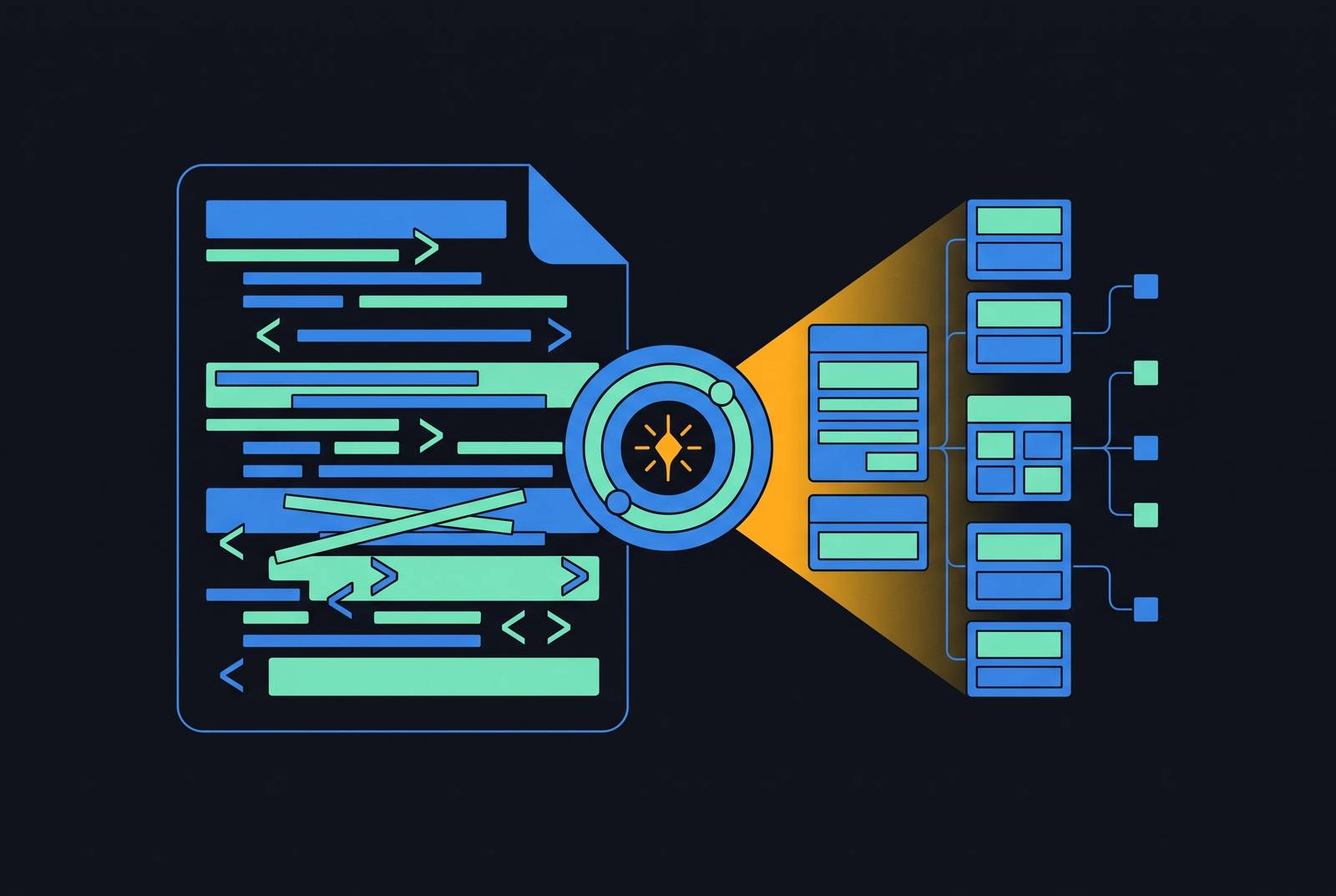
AI has made code documentation fast to generate, fluent, and structurally consistent. Keeping documentation accurate after the code changes is harder, especially when agents use it to build more software. Documentation now needs more than good prose. It needs infrastructure that keeps its claims connected to the system it describes.
Why documentation became AI's strongest use case in software development
Sonar's 2026 State of Code survey found that developers rated writing documentation as AI's most effective task, ahead of explaining code, generating tests, and refactoring. It was also one of the most widely adopted uses. Developers are using AI for documentation because it does something they find useful.
Turning readable source code into an explanation is mostly a synthesis task, which token-prediction models are well suited to do. A function provides names, parameters, return behavior, and a sequence of operations from which a model can construct a description. Describing how the code works may not require a choice about how the wider system should behave, as changing mission-critical logic would. The source supplies much of the material.
The same survey found that creating documentation is the top use case for developers who already use agentic AI. Agents can take on the documentation task rather than simply complete a sentence a developer has started. The distinction is important because it changes how much documentation can be produced without a person composing each explanation.
How good AI-generated documentation actually is at the surface level
The strongest part of AI documentation is its regularity. A model can describe each function in the same way, covering parameter names, return types, and exception notes without leaving those choices to each author's habits. Handwritten documentation often varies with the attention available when it was written. Generated documentation can make that basic coverage much more consistent.
That consistency has practical value for readers. Predictable structure makes it easier to locate a parameter's meaning or distinguish a return value from an error condition. Fluency also reduces the work of deciphering an explanation before assessing it. These are substantive improvements, even though they do not establish that every claim is correct.
What, then, does a high rating for documentation generation establish? Sonar's effectiveness finding supports the claim that developers value the output, but satisfaction is not an independent test of every documented behavior. Parameter coverage and structural consistency can be inspected directly, while accuracy calls for comparison with the code and its context. Surface quality is real and measurable, which makes the deeper omissions harder to detect.
What AI documentation consistently fails to capture
A source file exposes an implementation. A model can describe a parameter's default value without knowing the security assumption behind it. It can explain a sequence of operations without knowing which performance tradeoff made that sequence preferable to a rejected alternative. The artifact is visible. The decision history may not be.
This is an information availability problem. The missing reasoning may be in pull request discussions, design documents, or engineers' heads. A more capable model may produce a plausible but unsubstantiated explanation of why a particular team made a particular choice.
A generated description may accurately explain how to call an API while saying little about when not to use it, which constraints shaped it, or what misuse would mean. An unfamiliar reader therefore receives a mechanical interface without all the knowledge needed to exercise judgment. That reader could be a developer or an agent.
The documentation needs to be correct, and the available information needs to support the decision the reader needs to make. Correctly describing a default does not explain whether changing it is safe. Documentation can be faithful to the source and still be incomplete for its intended use.
How documentation drift turns a generation win into an infrastructure liability
The same speed that makes AI documentation attractive makes maintenance harder. When descriptions are cheap to generate, there is more text to keep in step with changes to the code. A page can be accurate when created and become misleading after the behavior it describes changes. Its fluency gives no warning that this has happened.
Documentation written by people could always drift too. But a developer who wrote a comment could recognize when a later change invalidated it, while a technical writer could maintain contact with the engineers responsible for a page. Those relationships provided an ownership loop, however imperfect. Generation alone supplies no equivalent connection between a code change and the documentation affected by it.
Anthropic's 2026 Agentic Coding Trends Report describes agents taking on implementation, testing, debugging, and documentation as development cycles shorten. Sonar's survey also finds that developers expect the share of AI-assisted or generated code in their commits to rise sharply through 2027. Together, these trends imply a growing maintenance burden as more code changes create more opportunities for descriptions to diverge. Manual attention must cover an expanding surface.
Queen's University's agentic code review study found that reviews took less work, but their quality did not improve along with that gain. That finding limits the reassurance that a quicker review pipeline can offer. Keeping descriptions synchronized requires a dependable connection between changes and their consequences.
Why agents reading stale documentation compounds the problem differently than humans did
Stale documentation changes role when an agent uses it as a specification for implementation. A human reader may question an explanation, notice its age, or compare it with source code. An agent that accepts the same explanation as authoritative can instead build on the outdated claim. The defect is no longer confined to the page.
Consider the mechanism in general terms. If documentation describes an API behavior that has changed, an implementation based on that description may preserve the old assumption. The text can still make sense on its own throughout this process. What fails is its correspondence with the current system, and that failure can pass from an explanation into code.
Microsoft's early-2026 rollout study of Claude Code and Copilot CLI found that adopters merged roughly a quarter more pull requests than they would have otherwise. This establishes that agents contribute to committed output at organizational scale. It does not show that those changes contain documentation-related errors. With agents contributing at that scale, engineers need to check the quality of the information those agents use.
The consumption model therefore changes the stakes. Once agents become primary readers, documentation is an input to software production as well as a record of it. Accuracy must be judged partly by whether the information supports correct downstream action. An outdated page is not merely a source of friction for someone trying to understand a library.
Why trust in AI tools is falling even as usage grows, and what that signals about documentation
Sonar's survey found that a large majority of professional developers do not fully trust AI-generated code, while roughly half do not always check it before committing. Usage and confidence have come apart. Developers can get enough help from a tool to keep using it while still doubting the work it produces. Verification then becomes a separate task.
The same survey found that the work of checking the output holds back the gains in productivity that developers expect. Microsoft's rollout study likewise notes falling trust by the end of 2025 and describes developers as “willing but reluctant.” Anthropic's report adds a related distinction, finding that developers can “fully delegate” only a small share of tasks even while AI participates in roughly the majority of their work. Assistance is not the same as dependable autonomy.
These findings expose a broader tension between producing work and establishing that it is sound. Documentation is particularly vulnerable because code ordinarily receives review before merging, whereas documentation rarely receives equivalent scrutiny. Its readable surface can make the need for verification less apparent.
How would a reviewer validate an explanation of an unfamiliar system? Checking the prose is insufficient. The reviewer may need to compare behavior, constraints, and decision history with what the page claims. That is precisely the context the documentation was supposed to make accessible.
What making documentation accurate over time actually requires
Better models and prompts can improve a first draft, but maintenance requires hooks between code changes and documentation state. Automated detection of divergence and pipelines that surface stale content before agents consume it address a different failure from awkward wording. They connect the description to the thing being described.
Synchronization also has to account for the earlier information gap. Updating the description of an interface does not, on its own, keep a record of why it was designed that way. Knowledge infrastructure needs access to relevant design context as well as current code if it is to support explanations of constraints and tradeoffs.
Integration into agent workflows is equally important. Accurate documentation that is disconnected from the workflow does not protect an agent using an outdated account elsewhere. The aim is a living source of truth that updates with the system and feeds the work that depends on it. Formatting helps make that knowledge usable, while synchronization keeps it grounded. Neither function substitutes for the other.
Anthropic's report predicts that faster onboarding and more dynamic project staffing will depend on reducing the time needed to understand a codebase. That benefit requires documentation that is up to date. An engineer or agent cannot reliably get up to speed by learning a system that no longer exists. The infrastructure standard is therefore about preserving a usable relationship between knowledge and implementation over time.
The practical shift teams need to make: from documentation as output to documentation as infrastructure
Generation quality remains useful, but it cannot be the whole test. A good initial description remains dependable through change detection, synchronization with code state, and integration into agent workflows.
That shift also changes what counts as completion. A documentation task cannot be considered finished solely because text has been generated and committed. Its ongoing value depends on how the system responds when the underlying code evolves. Teams need to check how documentation will be kept up to date as carefully as they check the first output, with more than an informal promise to keep it accurate.
The timing of that investment deserves attention. Microsoft's study found that agentic coding tools spread through social networks within engineering organizations, so more engineers can start using them faster as they see their peers do so. Documentation infrastructure needs to precede agents becoming its primary consumers.
The generation win is worth keeping intact. It frees documentation from some of the inconsistency and effort that made adequate coverage difficult. The next standard is more demanding and more useful, asking whether a team can keep an explanation true as its software changes.
Sources
- State of Code Developer Survey report 2026
- Adoption and Impact of Command-Line AI Coding Agents: A Study of Microsoft's Early 2026 Rollout of Claude Code and GitHub Copilot CLI
- 2026 Agentic Coding Trends Report How coding agents are reshaping
- From Human-Centric to Agentic Code Review: The Impact of Different Generations of Generative AI Technology on Review Quality