Documentation Platforms Optimized for Both Human Readers and AI System Consumption
AI agents now read more docs than humans, demanding different design choices.
Documentation was written for people, for decades, without much debate about it. That assumption no longer holds structurally, because AI agents have overtaken humans as the primary consumers of technical documentation, and platforms that still design around a human-only reader are optimizing for a shrinking slice of their actual traffic. The diagnostic problem is that most teams cannot say, with any precision, who or what is reading their docs right now, in what proportion, or what those readers actually need to succeed. Without that basic accounting, a team can't design for either audience effectively, since every formatting decision, every choice about how much context to front-load, ends up guessing at a readership that was never measured.
That gap between what teams assume and what's actually true has become the defining diagnostic problem in documentation right now. A team might believe its docs are in good shape because pageviews look healthy or support tickets have dropped. But if half or more of those "views" are agent fetches parsing HTML for a single API parameter, a metric that looks fine on a dashboard can be masking a structural failure it produces without anyone noticing. That mismatch, between self-assessment and actual machine-readiness, is what the rest of this piece tries to unpack.
Differences between what human readers and AI agents need from documentation
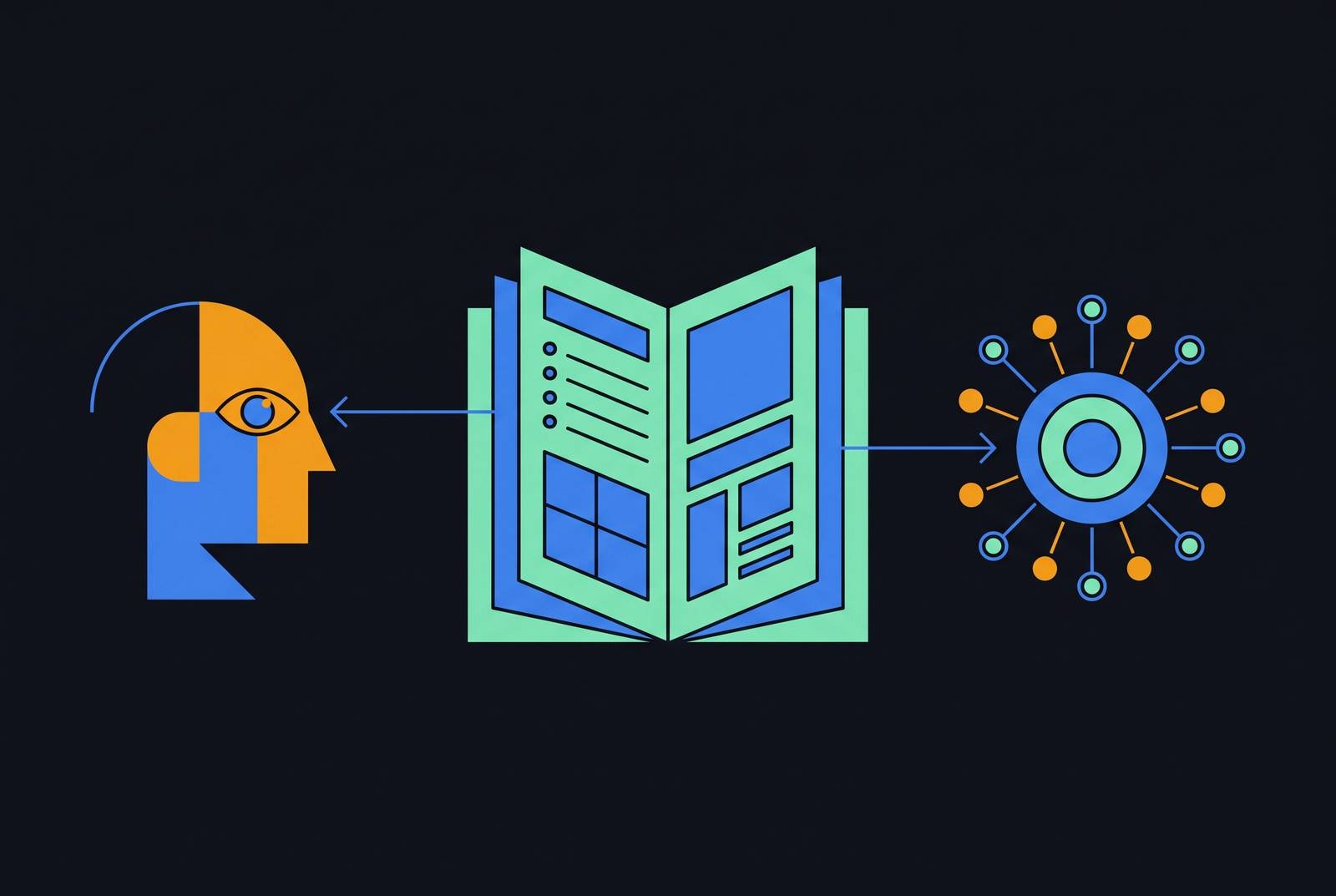
Dachary Carey of MongoDB stated the tension in the State of Docs Report 2026: good for humans is not good for agents, tokens are expensive, and context is a public good. Agents need the smallest possible unit of documentation that lets them finish a task, nothing more. Humans need something closer to the opposite.
Human readers benefit from narrative framing: an architectural overview that explains why a system is shaped the way it is, progressive disclosure that lets a newcomer skim before going deep, and the ability to backtrack, scroll, and tolerate a little ambiguity while the picture comes together. Long-form guides and rich visual layout serve people well precisely because people are patient in ways machines are not.
Agents operate under a harder constraint. They work within fixed token limits, and when a page runs too long, it gets silently truncated rather than flagged as too big to handle. That means agents need atomic, self-contained content units, answers that don't depend on five other pages being read in sequence first. And they parse structure, not style: clean Markdown will get an agent further than HTML loaded with JavaScript, ads, and nav chrome.
That difference produces a genuinely counterintuitive result. Christopher Gales, also writing in the State of Docs Report, points out that FAQs were on their way out as a format, unloved by nearly everyone in the documentation community for feeling lazy or unstructured. But it turns out FAQs are close to the ideal shape for machine consumption: a clear question, paired with a clear answer, trivially parseable, with no narrative scaffolding to strip away first. A format practitioners were quietly retiring may be one of the best-suited formats for the audience that now reads the most.
None of this means writing every page twice, once for people and once for machines. It means making structural, formatting, and integration choices that serve both audiences without forcing a compromise on either one.
The three technical standards that define AI-ready documentation in 2026
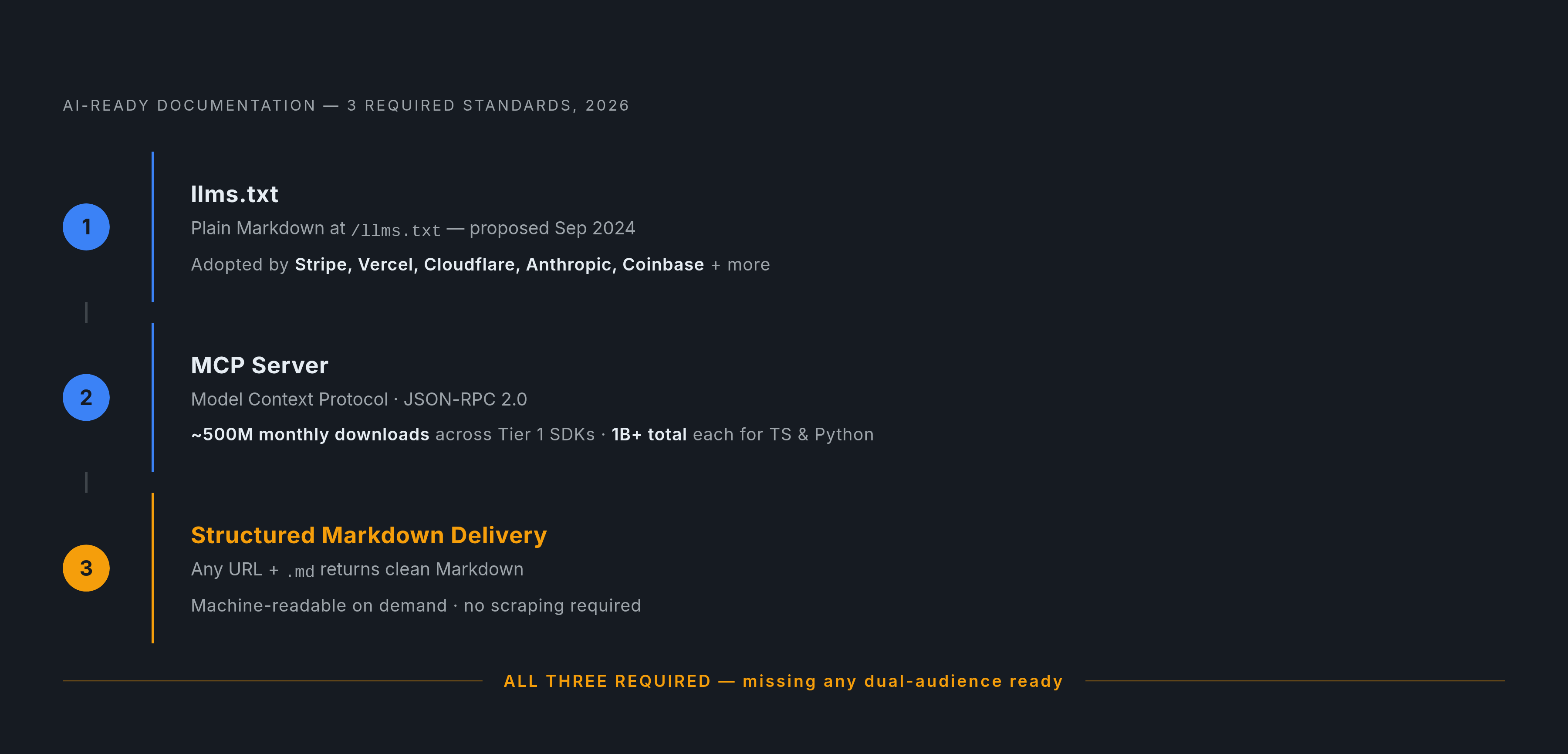
Given all that, what does "AI-ready" actually mean in practice, beyond a vague sense of being modern? The GitBook Blog offered a working definition: a documentation platform counts as AI-ready only if it supports llms.txt output, exposes an MCP server, and delivers structured Markdown, and it needs all three, not just one.
The first standard, llms.txt, is a plain Markdown file hosted at /llms.txt that summarizes a site's most important content for large language models, stripped of the HTML, JavaScript, and ad noise that would otherwise eat into a model's context budget. Jeremy Howard, co-founder of Answer.AI, proposed the convention in September 2024. The problem it solves is concrete: a mid-sized documentation site can easily exceed what fits inside a model's context window once its HTML has been parsed, and a curated llms.txt file tells an agent what matters most before it wastes tokens crawling navigation menus. Companies whose users build with AI coding assistants, where a hallucinated API endpoint is a real and costly failure, have shipped it in production: Stripe, Vercel, Cloudflare, Anthropic, Coinbase, Pinecone, and Cursor.
That said, llms.txt comes with a real caveat. It is a community convention, not a standard backed by the W3C, the IETF, or any recognized standards body, and as of the first quarter of 2026, no major AI company had publicly committed to reading or acting on it in production. Google's John Mueller confirmed in 2025 that no Google Search system reads the file at all. So why do companies like Stripe and Anthropic bother? Writing one forces a team to sit down and articulate, in plain language, which pages actually matter and what the site is for, which turns out to be useful independent of whether any given crawler reads it. A related file is skill.md, defined by the Agent Skills specification and used by the MCP extension for Skills, maintained by the Skills Over MCP Working Group under the Model Context Protocol organization.
The second standard is the Model Context Protocol, or MCP, which standardizes how AI applications talk to external tools and context using JSON-RPC 2.0 messages, borrowing design ideas from the Language Server Protocol. OpenAI announced MCP adoption in March 2025, starting with the Agents SDK before extending support to the ChatGPT desktop app and the Responses API, and adding MCP support to ChatGPT apps by September of that year. The specification has kept moving since. Its most recent version, dated 2026-07-28, is a substantial architectural revision, introducing a stateless protocol core, Multi Round-Trip Requests, header-based routing, cacheable list results, tighter authorization, and a formal extensions framework. Adoption at this point is not a niche curiosity: across Tier 1 SDKs, downloads run close to half a billion a month, and both the TypeScript and Python SDKs have individually crossed a billion total downloads. Applied to documentation specifically, an MCP server on a docs site gives tools like Cursor and VS Code a structured, queryable interface into that content, rather than forcing them to scrape rendered HTML the way a search engine might.
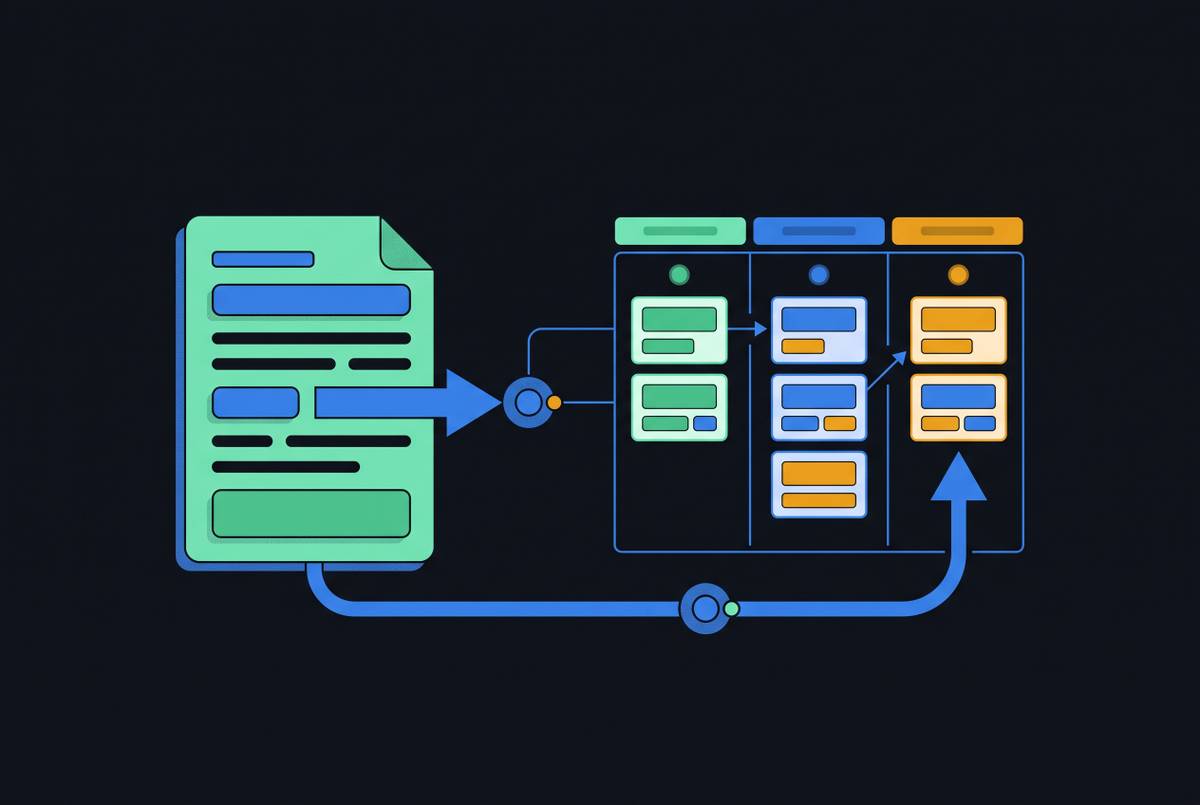
The third standard, structured Markdown delivery, is the simplest to describe and arguably the easiest to implement. Docs served as Markdown rather than HTML consume fewer tokens per page and parse more reliably, since there's no markup to strip before the actual content becomes usable. One practical pattern many teams use: appending.md to any documentation URL to expose a Markdown version of that same page, which gives agents a consistent, structured target without standing up a whole separate content pipeline.
Together, these three form something closer to a checklist than a wish list. A platform that can't do all three, however well, is not yet dual-audience ready, no matter how polished its human-facing feature set.
The organizational readiness problem behind the technical gap
If the technical standards are documented, openly specified, and increasingly well adopted, most organizations still fall short of meeting them. The answer has less to do with technology than with how knowledge is actually organized inside a company. More than half of surveyed organizations report that their knowledge lives scattered across five or more separate surfaces, docs sites, help centers, community forums, changelogs, and internal wikis among them, and fewer than a third rate most or all of that scattered knowledge as AI-ready.
That scattering compounds a second problem: a shift in where the actual bottleneck sits. AI tools have made drafting documentation faster than it has ever been, but humans remain the final gate before anything publishes, which means the constraint has moved. It used to be writing. Now it's reviewing, maintaining, and structuring content so it serves both audiences at once, and that kind of work resists the same speedups that drafting enjoyed.
Engineering teams shipping frequently, especially those leaning on AI-assisted coding tools to move faster, run into a related and sharper version of this problem. Docs decay faster than any human reviewer can manually track, because the code underneath is changing faster than it used to, and no amount of good intentions scales against that rate of change. What those teams need is detection and automation built into the pipeline itself, something that notices when a doc has gone stale the moment the underlying code diverges from it.
None of this is a problem platform choice alone can fix. An organization without a clear owner for its documentation, without someone accountable for keeping five scattered surfaces in sync, will struggle no matter which vendor it signs with. But the right platform can shrink the burden considerably, which is exactly the lens the next two sections apply.
Criteria for evaluating documentation platforms for dual-audience use
Two broad categories exist in this market, and confusing one for the other leads to disappointment. Code-to-docs generators read source code or API specifications and produce documentation automatically, examples in this category include tools like DeepWiki. Retrieval infrastructure layers, by contrast, sit on top of documentation that already exists and make it queryable by AI systems across multiple channels, which is the approach a tool like Kapa takes. Neither replaces a full authoring platform; each solves a narrower, adjacent problem.
For a full platform serving both humans and agents, a handful of questions matter more than the rest. Does it auto-generate llms.txt, an MCP server, and Markdown endpoints out of the box, or does it require manual configuration? Does its collaboration model support both Git-based workflows for engineers and visual editing for non-technical contributors, without either group feeling like a second-class citizen? For API-first products specifically, does it generate accurate, structured API references, not just prose walkthroughs sitting beside an API? And on pricing, which AI-readiness features sit behind an enterprise tier, and which come free at the entry level?
A platform can have every technical box checked in its marketing copy while gating the actual functionality behind a sales call, which defeats much of the purpose for a smaller team trying to move fast. A platform that scores well on human-facing polish, clean typography, nice search, a pleasant editor, but has none of the three technical standards in place is optimizing for the minority of its traffic in 2026. Good design for people is not evidence of readiness for the audience that now reads more of the content.
How full-stack documentation platforms handle the dual-audience requirement
GitBook fits teams where engineers, technical writers, and product managers all need to contribute to the same body of documentation without friction, and it's noted as the only tool in its category that handles both Git-based and visual editing workflows without compromise, straight out of the box. On the AI-readiness front, it auto-generates both an llms.txt file and an MCP server for every docs site it hosts, and its AI traffic analytics, launched in February 2026, show which AI tools are actually crawling a given site and what they're querying for. Its authoring layer, GitBook Agent, monitors support tickets and product changes, drafts updates in response, and opens them for human review rather than publishing unilaterally, while also linting human-written content against a house style guide before it goes live. An embedded AI Assistant can also be deployed inside a product itself, or a marketing site, not just the documentation pages, and the platform offers a free tier to start.
Fern targets API-first products aiming for documentation styled after Stripe's developer experience, generating client SDKs across more than nine languages, docs, and a CLI, all from a single API definition, so the same source produces both the machine-consumable output and the human-readable guide. It auto-generates llms.txt and confirms MCP server support, with a built-in "Ask Fern" AI chat metered by credits. Its Team plan caps at five seats, it has no AI authoring agent for keeping docs current against code changes, and pricing above the entry tier requires a sales conversation. Fern is now part of Postman, which matters for teams already living in that ecosystem.
It ships an AI Writing Agent, though llms.txt and MCP server support are not confirmed in available sources, and pricing again requires contacting sales. It's the right fit where governance and workflow control outweigh AI-agent delivery as the top priority.
Mintlify, a developer documentation platform built for AI agents and engineering teams, approaches dual-audience support from the architecture up: its self-updating docs system is designed to automatically maintain the structured, token-efficient content agents need while still preserving the narrative framing that makes a page readable by a person. It's one credible option among the platforms discussed here, built specifically on the premise that this piece opened with: the audience reading documentation has changed, and that change requires the infrastructure supporting it to change as well.
Kapa, not a full authoring platform, sits on top of docs a team has already published elsewhere rather than asking them to migrate anywhere. It provides MCP support, an embeddable AI chat deployable across several channels, and analytics on the questions agents and users ask along with the gaps those questions expose. That makes it the right fit specifically for teams whose documentation already exists and simply needs an AI-queryable layer added on top, not replaced. Best for: API-first developer products that prioritize interactive API references and developer experience. It is the category leader for interactive API docs, used by Anthropic, Cursor, and Perplexity. On AI-readiness, MCP server support is confirmed, llms.txt is not confirmed in sources, Agent Owlbert handles linting and audits, and no AI traffic analytics are reported.
Code-to-docs generators versus a full platform
This category solves a narrower but sharper problem than a full platform does. These tools read source code, API specifications, or commit history directly, and generate or update documentation from that source, which catches docs drift at the point of detection rather than waiting for it to surface downstream in a publishing workflow.
DeepWiki, built by Cognition, the team behind Devin, auto-generates a browsable wiki along with an "Ask Devin" question-and-answer interface for any public GitHub repository. More than 50,000 popular repositories come pre-indexed already, making it arguably the strongest free option available for understanding an entire public codebase at zero cost. It re-indexes on a schedule rather than in real time, which makes it better suited to exploration and onboarding than to production documentation that needs to stay current hour by hour. It doesn't offer llms.txt or structured Markdown delivery as platform features, but it does provide an official MCP server at mcp.deepwiki.com/mcp.
DocuWriter.ai connects directly to Git repositories, whether hosted on GitHub, GitLab, Bitbucket, or Azure DevOps, and automatically scans code on every commit, updating documentation, diagrams, and API references as the underlying codebase changes. That commit-triggered model is the clearest expression of what this category is for: catching drift the moment it happens, rather than relying on a human to remember to update a page months after the code it describes has already moved on.
The choice between a full platform and a code-to-docs generator, in the end, comes down to what's actually breaking. If the problem is that docs decay faster than anyone can track by hand, a generator tuned to source code is the more direct fix. If the problem is coordinating multiple contributors, serving both audiences at once, and controlling how content gets published, that points toward a full platform instead. Most organizations, given how scattered their knowledge already is, will eventually need some combination of both.