Agentic RAG Architecture for Documentation Retrieval
Agent decides what to retrieve, how to search, and whether results actually answer the question.
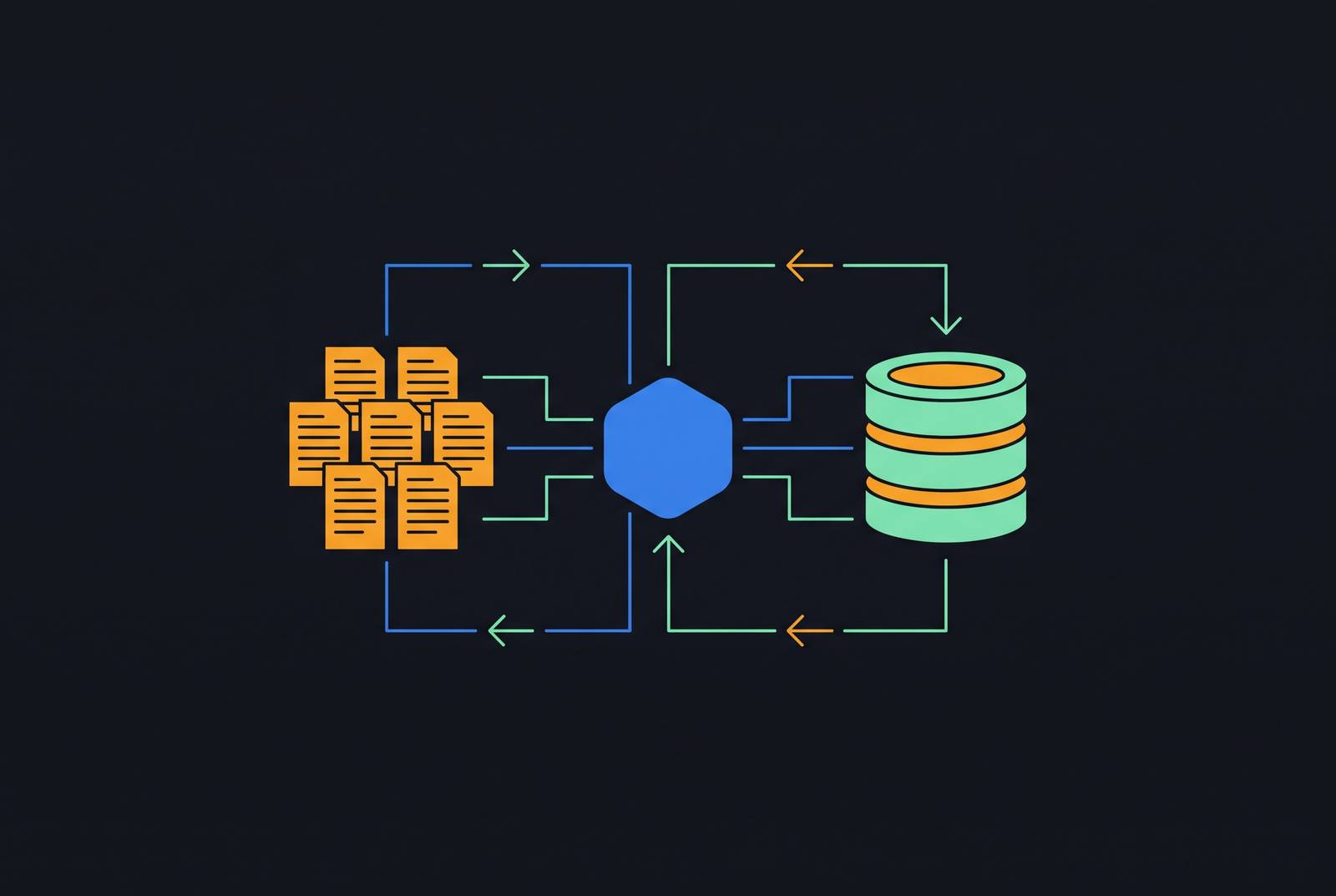
Agentic RAG treats documentation retrieval as a decision problem. Instead of firing off one retrieval call and generating an answer regardless of what came back, an agent decides whether to retrieve at all, how to phrase the query, which source to hit, and whether the evidence it got back is actually good enough to answer with. That shift, from a fixed pipeline to a governed loop, is what separates agentic RAG from the retrieve-once systems most teams shipped over the preceding several years.
Classic RAG has a simple shape: query comes in, one retrieval call goes out, the model generates from whatever came back. There's no mechanism for the model to flag "this isn't enough" or "I need different search terms." For a FAQ bot answering "what's your return policy," that's fine. For documentation, it breaks down in three specific ways. Multi-part questions that need evidence from more than one section get answered from whichever section happened to rank highest. Ambiguous follow-ups in a multi-turn session ("what about the second one?") can't be resolved without rewriting the query against conversation history, something a single retrieval pass has no way to do. And knowledge that spans versions or modules, v2 authentication versus v3 authentication for instance, doesn't fail loudly. It returns a plausible-looking chunk from the wrong version, and the model generates confidently from it. That's the worst kind of failure, because nothing in the output signals that anything went wrong.
The loop, the policy, and the decision points make RAG "agentic."
Classic RAG is a function. Agentic RAG is a loop with a policy. A function maps input to output in one pass. A policy, in the reinforcement learning sense, is a decision rule an agent applies at each step to choose an action given the current state. Applied to retrieval, the state is the accumulated evidence and conversation context, and the actions are things like rewrite the query, pick a different retriever, retrieve again, or stop and generate.
Four decisions that a classic pipeline hardcodes get handed to the agent instead: whether to retrieve at all (some questions don't need it), how to phrase the retrieval query (a user's words and the retriever's ideal query aren't always the same string), which retriever or tool to invoke, and whether the returned context is sufficient to generate from or needs another pass.
This isn't a metaphor borrowed loosely from robotics. Researchers have formally modeled agentic retrieval-generation loops as finite-horizon partially observable Markov decision processes, where the agent can't see the full state of the corpus at once (hence "partially observable") and has a limited number of steps before it has to commit to an answer (the "finite horizon" part). Research on agentic retrieval organizes this pattern around core axes including reflection, planning, tool use, and multi-agent collaboration. Those axes map almost exactly onto the rest of this piece, which isn't a coincidence. The architecture layers described below are, in effect, implementations of that taxonomy.
The components that implement the loop: planner, tool layer, and self-correction
Three pieces sit on top of a classic RAG pipeline to make it agentic. A planner, or router, takes the incoming query, figures out what kind of question it is, and decides on a retrieval strategy and which tool to send it to. A tool layer actually executes retrieval, but "retrieval" here isn't one retriever, it's a palette the planner picks from. And a self-correction loop, often implemented as a distinct reflection agent, sits between retrieval and generation, checks whether the accumulated context is sufficient, and either lets generation proceed or kicks the query back for refinement.
The tool palette matters because documentation queries aren't uniform. Dense vector search handles semantic similarity well and is the default choice for conceptual questions like "how does caching work in this system." But dense search is weak on exact strings, and documentation is full of them: error codes, version numbers, API endpoint names. That's where BM25 or other sparse, term-matching retrievers earn their keep. Hybrid retrieval, BM25 and dense search fused together (commonly through Reciprocal Rank Fusion), has become close to the default baseline for documentation retrieval by 2026, beating either method alone in benchmarks including BEIR, MTEB, and Anthropic's Contextual Retrieval work. A cross-encoder reranker (Cohere Rerank and BGE Reranker are among the commonly cited options) often sits as a second stage on top of hybrid retrieval and adds a meaningful bump, somewhere in the 5 to 15 MRR point range on harder query sets. Beyond that, an agent might fall back to web search when the internal corpus is stale on a recent release, or route to a SQL or structured query tool when the question is really asking for a count or comparison rather than a passage.
Should one agent own all of this, or should responsibilities split across several? Both patterns appear in production, and the honest answer is that most teams reach for multi-agent decomposition before they need it. A single-agent router is the right call when the tool set is small and the query distribution is fairly uniform: there's no sense spinning up a five-role system to choose between two retrievers. Multi-agent decomposition earns its complexity only when the task genuinely splits, one agent parsing PDFs, another querying a structured database, a third synthesizing the combined output into something coherent. The AutoGen pattern is a commonly cited reference architecture here: planner, routing agent, retriever agent, executor, critic, each a distinct named role rather than one model wearing five hats. Anything less complex than that split, and the multi-agent version is usually just latency and cost with no accuracy to show for it.
What's easy to miss is that the agent isn't just switching between retrievers, it's tuning a broader set of knobs: top-k depth, reranker depth, chunk size. Systems that treat these as part of the learned policy, rather than fixed hyperparameters, report retrieval-quality gains in the 15 to 20% range over static configurations. Much of the value in agentic RAG doesn't come from any single clever technique. It comes from letting configuration itself become adaptive.
Query rewriting and multi-hop chaining for documentation's layered knowledge
Query rewriting is the agent rephrasing or expanding a user's question before sending it to the retriever, on the premise that what a user types and what the retriever needs to match well are often two different strings. HyDE (Hypothetical Document Embeddings) is one approach: generate a hypothetical answer to the question, then embed that hypothetical answer instead of the raw query. It works because documentation is often written in vocabulary that doesn't match how users phrase problems, and a hypothetical answer, even a wrong one, tends to land closer to that documentation vocabulary than the original question does.
Step-back prompting takes the opposite move: rewrite the query to something more general, retrieve against that, then specialize. This handles questions that assume context the retriever doesn't have on its own. Decomposition splits a multi-part question into sub-queries, runs each separately, and synthesizes the results, which targets the multi-part documentation failure mode described earlier directly.
Multi-hop retrieval chains these together into a sequence: retrieve an initial set of passages, generate an intermediate reasoning step from them, use that intermediate result to build a refined query, then retrieve again. Repeat until the evidence looks sufficient. Take a question like "what changed in the authentication module between v2 and v3?" A single retrieval pass can't answer this, because no single chunk contains both versions' behavior. Hop one has to locate the v2 spec, hop two has to locate the v3 spec, and only after both are in hand can the model actually compare them. Documentation systems run constantly into information that isn't wrong but is scattered across artifacts a single query can't reach at once.
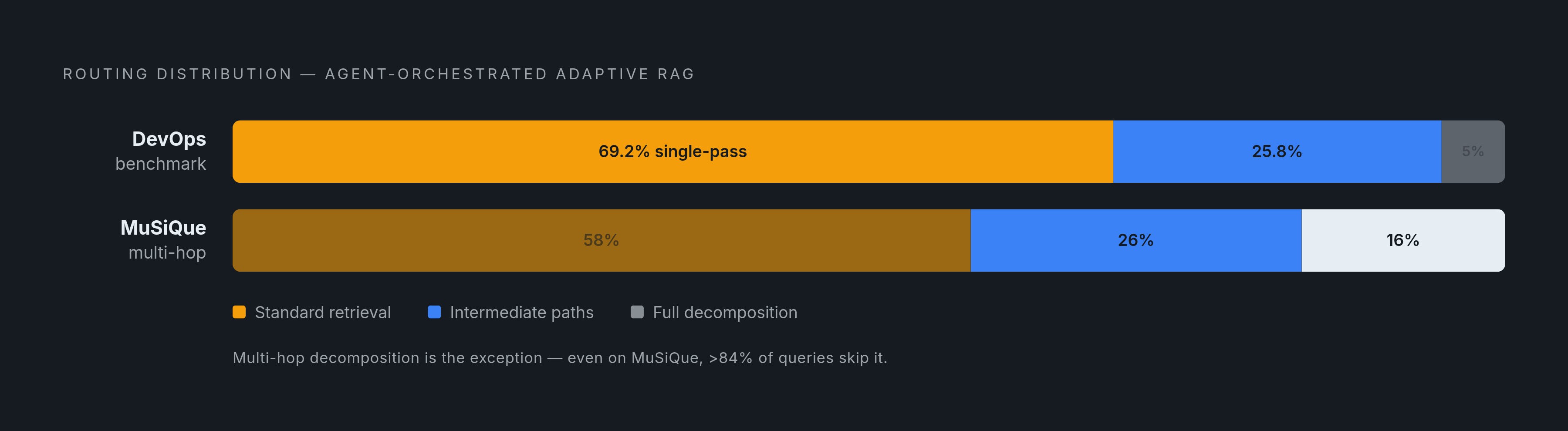
But how often does this actually trigger? Less often than the architecture diagrams suggest, and that's the point most people get backwards about multi-hop RAG: they assume decomposition is the default mode rather than the exception. Evidence from Agent-Orchestrated Adaptive RAG shows the agent is fairly disciplined about it. On a benchmark drawn from a technical operations domain, 69.2% of queries route through standard retrieval with no decomposition needed, and only about 5% require full decomposition. On MuSiQue, a benchmark centered on multi-hop questions, that decomposition rate climbs to roughly 16%. The agent reserves decomposition selectively rather than applying it to every query out of caution. It's reserving the expensive multi-hop machinery for the queries that actually need it and defaulting to single-pass retrieval everywhere else.
Self-reflection and corrective loops, how the agent decides it has enough
Self-RAG is the paper most often cited as the canonical implementation of self-reflection in retrieval. The model generates special reflection tokens as it goes: tokens that signal whether external evidence is even needed for this query, whether the passages retrieved so far are actually relevant, and whether the draft response being built is supported by that evidence. Instead of a black-box judgment, sufficiency becomes something the model expresses explicitly, token by token.
In architectural terms, this shows up as a reflection agent, a distinct role sitting between retrieval and generation. It evaluates the quality and completeness of accumulated context and makes a binary-ish call: terminate the loop and generate, or send the query back for another round with a refined phrasing. Corrective RAG builds on this by scoring each retrieved chunk individually and, when the overall retrieval is judged weak, triggering fallback strategies (web search, decomposition, a rewritten query) rather than letting the model generate on evidence it already knows is thin.
What counts as "sufficient" when the domain is documentation specifically? A few concrete checks recur. Every sub-question from a decomposed query needs a corresponding retrieved passage, not just some of them. The passages that came back need to be from the correct version or module, since a technically relevant chunk from the wrong release is arguably worse than no chunk. The draft answer needs to trace back to the retrieved evidence in a way that survives a groundedness check: the model isn't filling gaps with plausible-sounding but unsupported claims. None of these are exotic requirements. They're the kind of due diligence a careful human editor applies to a draft before publishing it, formalized into a loop.
Agentic RAG's place in the broader 2026 retrieval taxonomy
Agentic RAG isn't the only architecture on the table, and reaching for it when a simpler system would do is a mistake teams make more often than the marketing around "agentic" anything would suggest. The spectrum, roughly in order of complexity: naive RAG is a fixed retrieve-once pipeline, and it's genuinely the right choice for something like an FAQ bot with stable, shallow knowledge that doesn't need multi-hop reasoning. Corrective RAG adds an evaluator and fallback behavior on top of that, suited to high-stakes single-hop Q&A where a wrong answer is costly but the underlying queries aren't structurally complex. Modular RAG composes retrievers, rewriters, and rerankers as interchangeable blocks without committing to a full agentic loop, a middle ground for teams that want some sophistication without the overhead of a planning agent. Agentic RAG, full policy-driven loop included, earns its keep on multi-hop research tasks and documentation corpora complex enough that a fixed pipeline keeps guessing wrong.
GraphRAG deserves mention as a structural alternative rather than a competitor. Instead of retrieving chunks, it extracts entities and relationships into a knowledge graph and answers queries through graph traversal. Microsoft's open-source GraphRAG implementation is the commonly cited reference here. It suits a different kind of question, "what are the main themes across these 200 documents," that chunk-based vector retrieval genuinely struggles with regardless of how many agentic loops get wrapped around it. The two approaches complement each other more than they compete. Nothing stops an agentic loop from calling a graph traversal as one of its tools.
Cache-Augmented Generation runs in the opposite direction entirely, betting on speed instead of adaptability. By skipping retrieval altogether and working from cached context, CAG reportedly completes queries in 2.33 seconds against roughly 94.35 seconds for standard RAG on benchmark comparisons, a difference on the order of 40 times faster. That's a genuinely large gap, but it only pays off when the knowledge base is static and the queries are repetitive: a password-reset chatbot is the standard example, unlike a documentation set that changes with every release.
That's the actual fork in the road. CAG optimizes for latency against knowledge that doesn't move; agentic RAG optimizes for correctness against knowledge that does. Documentation corpora sit almost entirely on the agentic RAG side of that line. They change with every product release, and the questions users ask against them rarely stay uniform enough for a cache to keep up.
Benchmark evidence for what the agentic loop delivers on documentation tasks
Numbers matter more here than architecture diagrams, and Microsoft's AgenticRAG results are among the strongest publicly reported evidence for what the loop actually buys. On BRIGHT, a benchmark built around hard reasoning-intensive retrieval, the system reports 49.6% recall@1, a substantial improvement over the best embedding-only baseline. On WixQA, factuality reaches 0.96, a 13% relative improvement. On FinanceBench, answer correctness hits 92%, landing within a narrow margin of a system given oracle access to the true supporting evidence, about as close to a ceiling as a retrieval system can realistically get.
The ablation results are where things get genuinely interesting. The single largest factor behind these gains is the shift from single-shot retrieval to agentic tool use itself. It's the shift from single-shot retrieval to agentic tool use itself, which the ablation credits with a several-fold improvement. Multi-query search and in-document navigation add further gains on top of that, but they're second-order next to the core architectural change. For documentation specifically, that ablation carries a clear implication, and it cuts against how most teams actually spend their engineering time: the loop is the lever, the embedding model is secondary. Teams tuning embedding choice before they've built any retrieval-sufficiency check are very likely optimizing the wrong variable first.
The routing data from the DevOps and MuSiQue comparison mentioned earlier reinforces this from a cost angle. Since 69.2% of DevOps queries route through cheap standard retrieval and only the complex tail triggers decomposition, agentic overhead scales with query difficulty rather than applying uniformly to every request. That matters operationally: agentic RAG doesn't mean every query pays the price of a five-agent pipeline. It means the expensive machinery only spins up when the question actually demands it.
One more data point belongs here, because it comes from a genuinely resource-constrained setting rather than a well-funded benchmark run. Sumyk and Kosovan built a pipeline under real limits, a single GPU and a nine-hour compute budget, using BGE-M3 paired with a BGE reranker. It achieved 0.9219 document identification accuracy and 0.8111 page proximity accuracy, and agentic retry mechanisms improved final answer accuracy even in cases where retrieval quality remained the dominant bottleneck. That last detail matters most: the loop still adds value on top of an imperfect retriever, which is closer to the reality most documentation teams actually operate in than a fully tuned benchmark environment.
Reliability risks the agentic loop introduces
None of this comes free. Every decision point handed to the agent, whether to retrieve, how to rewrite, when to stop looping, is also a point where the system can make the wrong call. Unlike a fixed pipeline's failures, agentic failures tend to look confident rather than obviously broken. A loop that decides it has enough evidence when it doesn't produces an answer indistinguishable, on the surface, from one built on solid grounding. Mishra et al. lay out systemic risk categories along these lines, covering how compounding errors across multiple retrieval hops, ungrounded stopping decisions, and tool-selection mistakes can each degrade output quality in ways hard to catch from the outside.
That compounding effect deserves emphasis for anyone actually running one of these systems against a documentation corpus. A multi-hop chain that goes wrong on hop one doesn't just produce a wrong answer. It can produce a wrong answer that hop two then builds on and reinforces, compounding an early mistake into something that reads as thoroughly researched. Guarding against that means instrumenting the loop itself, not picking a better reranker: logging which queries triggered decomposition, which reflection checks passed or failed, and which final answers actually trace back to grounded evidence versus which ones the model simply asserted with confidence. The architecture that makes agentic RAG powerful for documentation, its willingness to keep working until it judges the evidence sufficient, is the same architecture that makes a bad sufficiency judgment expensive to catch after the fact.