Writing Technical Documentation for Dual Audiences
Structure, not tone, solves the dual-audience documentation problem.
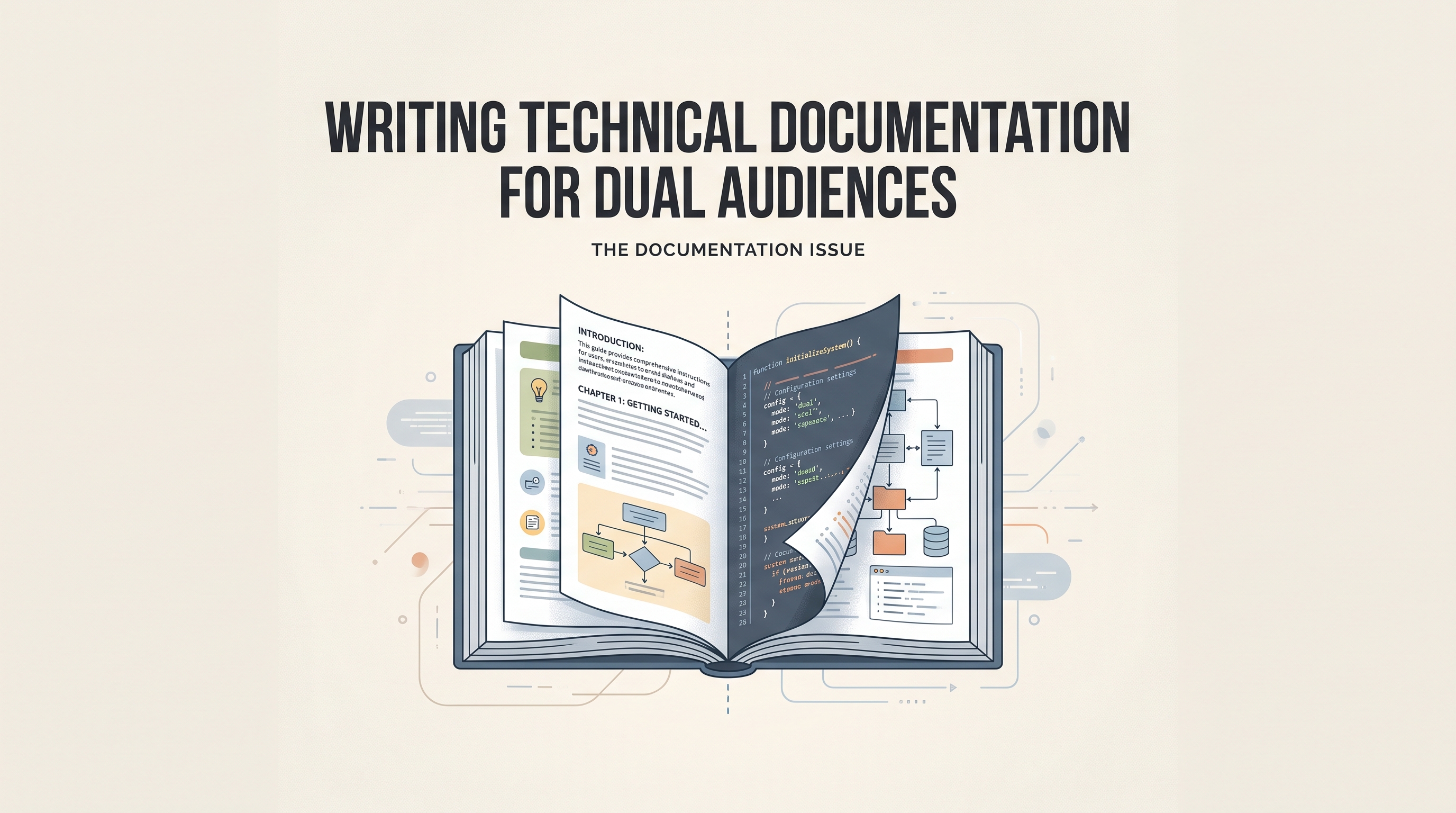
The instinct that precedes every failed dual-audience documentation project is generous, even logical: cover all bases. Write something everyone can use. The result, as anyone who has spent serious time in technical writing already knows, is a document pitched at no one in particular, simultaneously condescending to engineers and impenetrable to executives. I have produced this document. I have also inherited it from predecessors who believed, as I once did, that the problem was register, that the solution was finding a tone somewhere between dense specification and business-casual summary.
That assumption is wrong. The fix is not a middle register. It is structure.
This is not a small distinction. Register is a matter of word choice and sentence complexity; structure determines whether a reader can navigate to what serves them without wading through what doesn't. Google's technical writing curriculum identifies part of the root cause: proximity to the subject, project familiarity, and time since last exposure all determine what a reader actually needs from documentation, and those variables differ sharply across audiences. The "curse of knowledge" compounds this further. Writers who understand a product deeply forget what it was like not to. They reach for explanations calibrated to their own current fluency, leaving gaps precisely where newcomers fall through. The structural approach, building documentation with deliberate layers each audience can navigate independently, is the only response to that problem that doesn't require the writer to inhabit every reader's head simultaneously.
The Two Audiences and What Each Actually Needs
"Technical audience" and "non-technical audience" are not monoliths. Treating them as such is how the problem starts. Technical readers include developers integrating an API, DevOps engineers configuring infrastructure, system administrators, and service technicians. Each of these carries different baseline knowledge, different failure modes, and different tolerances for ambiguity. Non-technical readers span executives, product managers, clients, and business analysts configuring workflows; they share an orientation toward outcomes rather than mechanisms, but their decision contexts vary substantially.
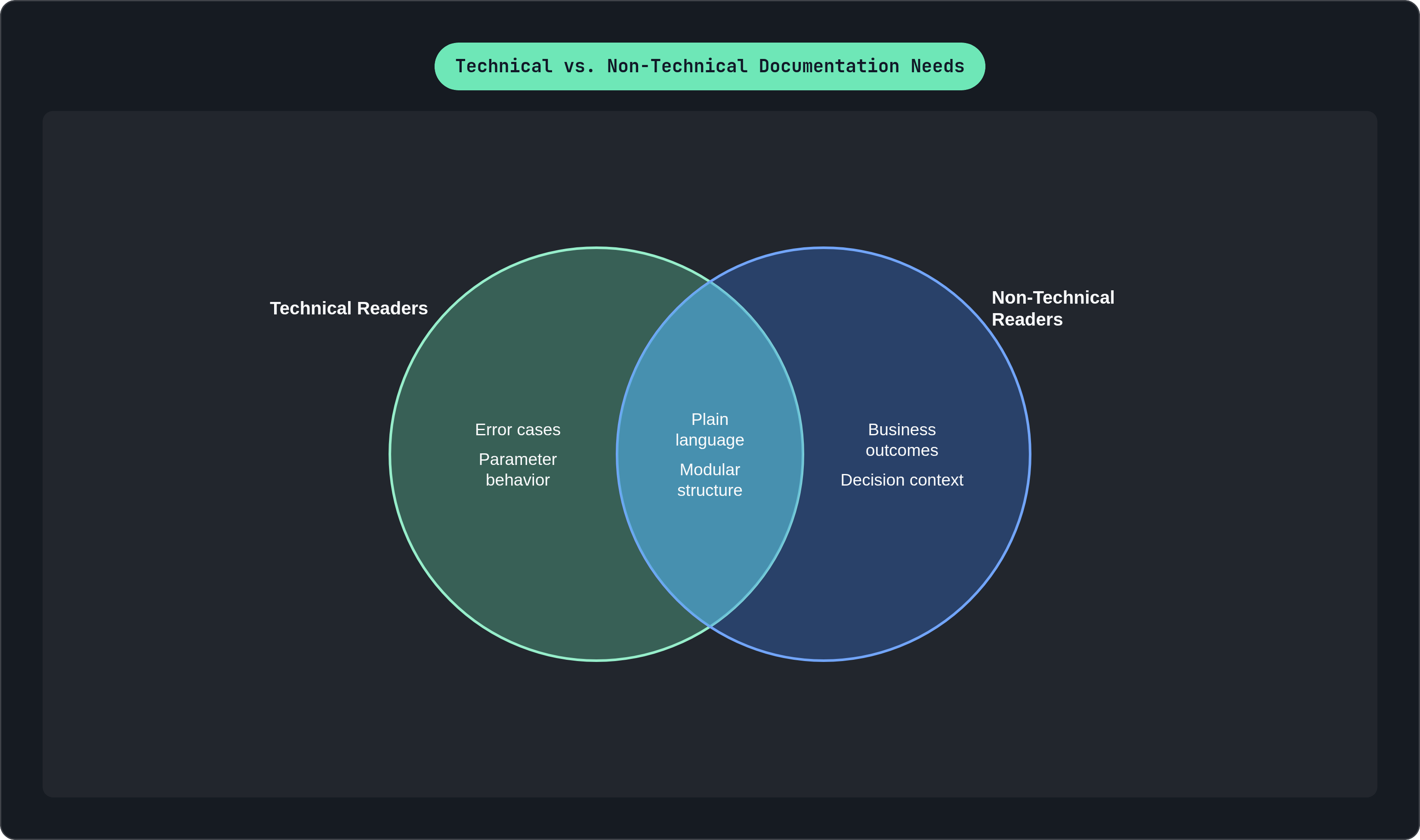
What technical readers want is specific: implementation detail, error cases, parameter behavior, system responses under edge conditions. What non-technical readers want is contextual: outcomes, business relevance, enough information to make a decision without needing to understand the underlying architecture. The UK Home Office engineering guidance offers a clean frame for this. It distinguishes conceptual information (what something is), task-based information (how to do something), and reference information (lookup data). These three types map almost directly onto what each audience is trying to accomplish at any given moment. Developers navigate toward reference and task content; executives navigate toward concept. A single sprawling document that interweaves all three forces both groups to do extra work.
There is a situational dimension here worth taking seriously. Audience is not a fixed property of a person; it is a property of a person in a particular moment. A product manager may need the executive summary today, assessing whether a feature is worth building, and the API error codes next quarter, writing acceptance criteria for an integration. Documentation architecture should accommodate the same reader arriving in different modes, rather than assigning them permanently to one layer.
Building Accurate Reader Profiles Before Writing a Word
Personas are a practical tool, not an academic exercise. A persona is a fictional but representative profile that makes an abstract audience segment concrete at the keyboard, giving the writer something to test each sentence against. The exercise of building personas surfaces assumptions that remain invisible when the audience is described only as "users." A frontend developer integrating an API has specific knowledge prerequisites, specific tasks, and a specific tolerance for detail that differs meaningfully from a product manager assessing feature scope, a DevOps engineer handling infrastructure setup, or a business analyst configuring AI prompts. Each of those profiles implies a different entry point, a different vocabulary, and a different definition of documentation success.
Two questions sharpen every content decision once personas are in place: What does this reader already know? What do they need to do with this information? The first question determines how much background a section can assume; the second determines what kind of content belongs in that section at all.
Audience analysis is not a one-time step. The assumptions baked into initial personas decay as the product changes and as the actual user base evolves. Feedback loops, including usability tests, surveys, and analytics identifying sections rarely visited or frequently abandoned, surface mismatches between what the writer assumed and what readers needed. Even a quick usability test with five people from the target audience often exposes missing prerequisites, unclear steps, or terminology gaps before a larger documentation effort goes to production. The cost of this check is low relative to the cost of documentation that systematically fails its intended readers.
In regulated industries, healthcare, finance, legal, audience analysis carries an additional function. It surfaces compliance requirements specific to reader type. A document consumed by a compliance officer operates under different obligations than the same information presented to an engineer. Personas need to include role and operational context, not just a technical sophistication level.
Modular Writing as the Structural Foundation
The core idea behind modular documentation is simple: break content into independent, typed units rather than long monolithic documents. The classic three types formalized by DITA, the Darwin Information Typing Architecture, are concept (what it is), task (how to do it), and reference (lookup data). Each type serves a different reader need. Each can be assembled or navigated independently. Mixing definitions, step-by-step procedures, and reference tables on a single page forces every reader through content that only some of them need, at precisely the moments when friction is most costly.
DITA's conditional publishing capability takes this further. It allows a single content source to generate different outputs for different audiences. Technical parameters appear in developer documentation and are filtered out of end-user guides automatically. The architecture encodes audience separation as a structural property of the content, not as an editorial decision made anew each time a document is updated. The business implication is not trivial: audience fidelity no longer depends on any individual writer remembering to preserve it.
Teams do not need to implement DITA to benefit from modular thinking. The same principle applies in Markdown-based docs-as-code setups, in wikis, in any system where content organization is a deliberate choice rather than an artifact of how the page happened to be written. Stripe's documentation illustrates this at scale. High-level payment flow guides and dense API references are separated by design. Each audience arrives at the appropriate layer without having to navigate through the other. That separation did not happen by accident; it reflects architectural decisions made before a word was written.
The maintainability argument for modularity is equally compelling. When the product changes, a modular content set is easier to audit. A change in one component is bounded to the relevant concept, task, or reference topic. It does not require rewriting a sprawling page where all three types were interleaved.
Progressive Disclosure: Managing Depth Without Losing Either Audience
Progressive disclosure, as defined by the Nielsen Norman Group, defers advanced or rarely used content to a secondary layer, making the primary layer easier to absorb and less prone to cognitive overload. Applied to documentation, this means leading with a high-level overview and offering links to in-depth guides, tutorials, and API specifications for readers who need them.
The mechanism is clean. An executive or product manager reads the overview and has what they need to make a decision. A developer follows the link into full implementation detail. Neither group wades through the other's content. The architecture does the routing.
There is a practical constraint here that documentation designers routinely underestimate. Disclosure layers should be limited to fewer than three, with clear navigation paths at each level. Too many nested layers recreate the cognitive load problem they were designed to solve. A reader who cannot reliably predict where they are in the hierarchy, or how far the relevant content is from where they entered, loses confidence in the documentation architecture and falls back on search, which is a failure state.
Progressive disclosure and modularity are complementary but distinct. Modular structure separates content types across pages or sections; progressive disclosure manages depth within a single page. Code examples illustrate where this distinction matters most for technical readers. The right starting point is the ideal success response, the happy path, presented first. Error cases, such as 401 unauthorized or 400 bad request, belong in a secondary layer. Developers building error-handling logic need both; presenting them in the right sequence respects how that work actually unfolds.
Plain Language as Clarity, Not Concession
There is a persistent, damaging misconception in technical writing communities: that plain language is a strategy for non-technical readers, a simplification that technical readers tolerate or reject. Nielsen Norman Group research contradicts this directly. Their data shows that the majority of users, including expert users, prefer plain language; the preference strengthens as the underlying issue grows more complex. Plain language is not a concession. It is a clarity strategy that serves every audience.
The scanning behavior documented in NNG eye-tracking research reinforces this. A substantial portion of web page visitors scan rather than read, a finding that held when the research was replicated decades after the original studies. This has structural implications regardless of who the audience is: front-load key information, use short paragraphs, deploy headers and bullets. These are not accommodations for unsophisticated readers; they are accurate responses to how people actually consume text on screen.
Jargon is the specific hazard to manage. It signals in-group membership and filters out valid readers who lack that particular vocabulary, including experienced practitioners from adjacent disciplines who have every reason to be reading the documentation. The mitigation is practical. When multiple distinct roles are addressed within a document, role-based pronouns ("the administrator configures...") prevent collapsing all readers into a single undifferentiated "you" that fits none of them precisely. Abbreviations should be expanded on first use; acronym sets are not universally shared even within technical organizations. A brief "Who this is for" statement at the document's opening lets readers self-qualify immediately, sparing both the writer and the reader from mismatched expectations.
There is an international dimension that documentation efforts often neglect until it becomes expensive. Plain language reduces translation burden and cultural friction. Idioms and culturally specific references create ambiguity that compounds in localized versions, introducing errors that are difficult to trace back to their source.
Formatting and Navigation as Routing Infrastructure
Structure signals audience before a reader processes a single sentence. Section headers that describe content rather than label it, "Configuring webhook retries" rather than "Advanced settings," give readers enough information to decide whether to enter a section or skip it. Consistent information typing, so that readers learn to recognize what kind of content they are entering based on how it is organized, builds navigational confidence over time.
Bridging language manages transitions between audience layers within a single document. Phrases that signal a shift into technical depth, done clearly and briefly, tell non-technical readers they can stop here and tell technical readers that the specificity they need is coming. This requires discipline. Bridging language used too often becomes noise; used precisely, it is genuinely useful routing infrastructure.
Visuals serve the two audiences differently, and sometimes more efficiently than prose. Architecture diagrams and flowcharts compress what would require multiple paragraphs to explain, providing orientation value for executives and confirmatory value for engineers already familiar with the system. Code blocks with syntax highlighting serve technical readers directly; multi-language examples extend accessibility without adding conceptual overhead.
At the site or documentation library level, role-based navigation makes the structural investment visible. AWS organizes its documentation around user roles and services. Readers enter from a role-specific entry point and follow a path built for their context. Taxonomy and consistent tagging enable this: a developer searching for error-handling behavior finds the reference material; a product manager browsing for capability summaries finds the concept layer. The navigation architecture encodes the same structural logic that the writing architecture does, making the whole system coherent rather than requiring readers to assemble it from pieces.
Keeping the Structure Intact When the Product Changes
The biggest practical failure in dual-audience documentation is not poor initial structure. It is that structure collapses as the product evolves and no one has defined who owns the update. The carefully separated layers, concept, task, reference, executive overview, technical depth, drift apart at different rates as different teams make incremental changes. Eventually the documentation reflects several different versions of the product and several different implicit audiences, none of them clearly.
Docs-as-code practices address part of this. Integrating documentation into version control, typically Git, keeps documentation in lockstep with code changes and makes engineers more likely to contribute or review because the toolchain is already familiar to them. IBM Cloud's migration from DITA to Markdown is instructive here: the key criterion for that decision was whether engineers, internal and external, would actually contribute in the chosen markup language. Toolchain adoption is not an implementation detail; it is a prerequisite for sustained accuracy.
Governance requires defined ownership, not aspirational ownership. Subject matter experts, technical writers, and product managers need explicit roles in creation, review, and update cycles. Without that definition, the concept layer and the reference layer drift on separate timelines, maintained by different people with different information, and the structural coherence that made the documentation useful to begin with quietly disappears.
SME collaboration is a recurring friction point worth treating as a design problem rather than a personnel problem. Subject matter experts carry the knowledge that keeps technical content accurate, but they are rarely available on documentation timelines. Structured asynchronous review processes, specific questions, bounded review windows, clear ownership of sign-off, reduce dependence on last-minute availability and make the collaboration more likely to happen at all.
Documentation built in modular, typed units is easier to audit when a feature changes. The scope of what needs updating is bounded to the relevant module rather than distributed across a sprawling page that mixed all content types together. That is the structural dividend of making good architectural decisions at the beginning: the investment compounds. Documentation that updates reliably in sync with product changes is not a matter of discipline alone; it is a matter of whether the structural choices made at the start make reliable updates achievable.
The premise that documentation for two audiences requires finding a middle ground between them is, in my experience, the longest-running error in this discipline. The reader who needs a decision-oriented overview and the reader who needs implementation specifics are asking for fundamentally different content, and no compromise register serves both well. Building structure that serves both is harder than finding a compromise register, but it is the only approach that avoids failing one group by design.