Code Samples in API Docs That Actually Stay Current
Automated code samples eliminate the trust damage when developers find errors in your docs.
Code samples in API documentation break constantly, and telling developers to just be more careful has never fixed it. What actually holds up is building systems where staying current is the default setting rather than a virtue someone has to practice.
Most teams still treat documentation freshness as a discipline problem, something you solve with reminders, a checklist, maybe a Slack bot that pings someone every Monday. It doesn't work. Ask anyone who's tried to run docs this way for more than a year, and they'll tell you the checklist gets skipped the week a release ships late, which is exactly the week it mattered most.
Code samples are fragile in a way prose simply isn't. A sentence like "this endpoint accepts an ID" ages fine even after a couple of schema tweaks; it's vague enough to survive, while a code sample either runs or it doesn't. It hardcodes exact parameter names, exact field names, an exact response shape, an exact path, and if any one of those shifts underneath it, the sample fails silently until some poor developer copies it into their editor and watches it blow up. Now multiply that across every language a docs team supports: Python, Node, Ruby, Go. One API change doesn't produce one broken example. It produces four, or six, or however many SDKs you're committed to maintaining.
Release cadence makes it worse. Teams ship multiple times a day now, and no manual documentation process moves at that speed; drift doesn't take months, it shows up within days, sometimes before anyone on the docs side even hears that a field got renamed. Third-party dependencies pile on more risk still: a sample leaning on a specific SDK version or an auth library is exposed to breaking changes that nobody on the docs team watches for, because why would they, that's not their repo.
Code itself resists this kind of tracking too. It doesn't read top to bottom the way prose does. Variables get declared before they're used three functions later; a call shows up before the definition it depends on, and explanatory text has to jump around just to keep pace. Knowing exactly which sample touches which field takes active bookkeeping, not the kind of casual awareness you'd hope for, and there's no compiler warning on a documentation page. Nothing turns red until a developer actually runs the thing and it just doesn't work.
How widespread the problem actually is, in numbers
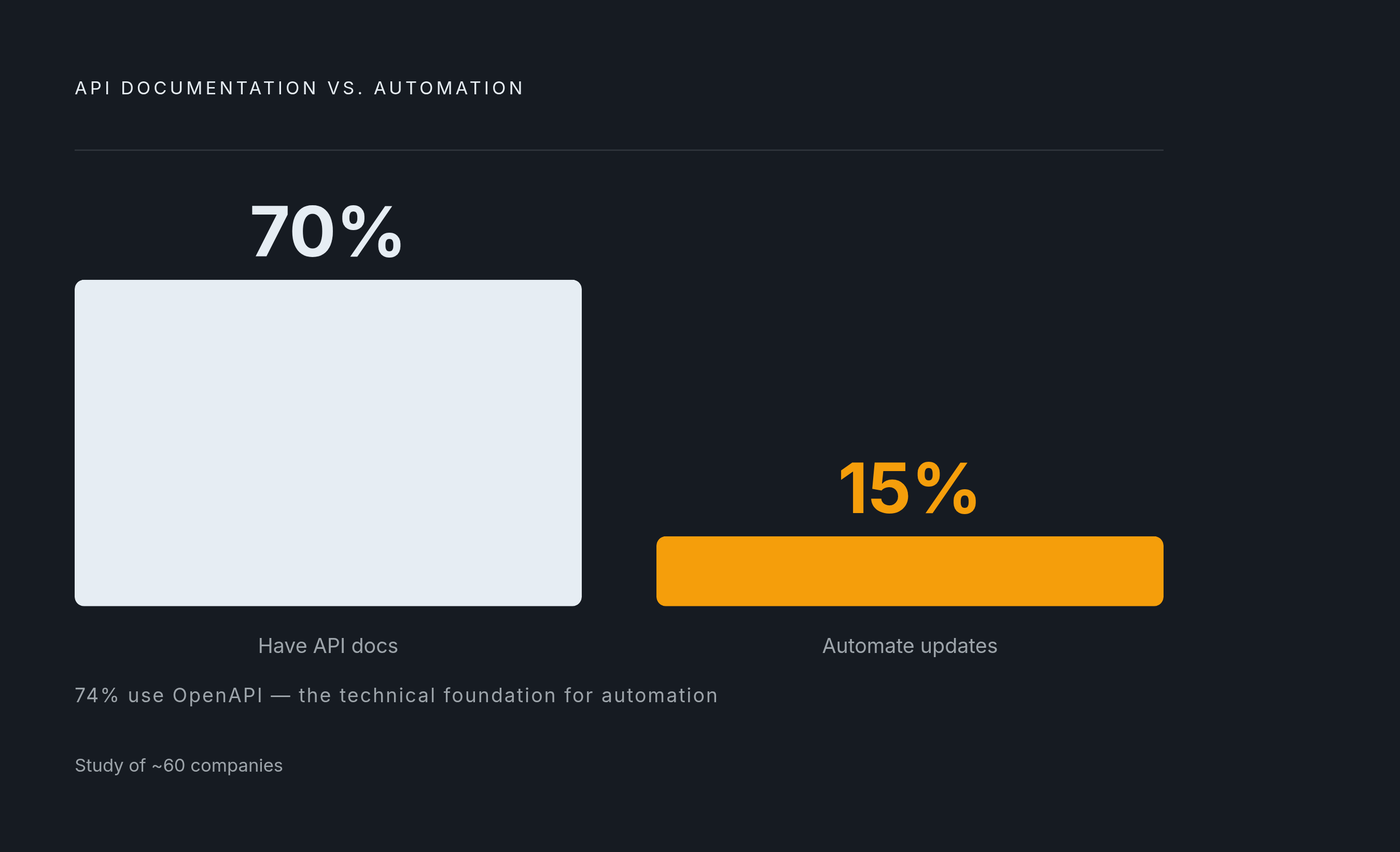
The gap between having documentation and maintaining it is bigger than most teams want to admit. One study of roughly 60 companies found 70% had API documentation in place, but only 15% used any form of automation to keep it current. Sit with that ratio for a second: the overwhelming majority of teams publishing docs are relying on a human, somewhere, to notice drift and go fix it, by hand, forever.
The downstream friction shows up in how developers actually describe their work. Postman's 2025 State of the API Report surveyed more than 5,700 developers, architects, and executives and found 93% face blockers like duplicated effort, poor discovery, and outdated context. Outdated context is the documentation problem, just wearing a different name on the consumer's side of the interaction instead of the publisher's.
Ownership structure explains a chunk of why this persists. State of Docs 2025 found 40% of API documentation is owned by engineering teams with no dedicated technical writer anywhere in the loop. So the people best positioned to catch when a sample no longer matches the code, meaning the engineers who just changed the code, are also the people with the least reason to stop what they're doing and fix the docs. They're already three tickets deep into the next sprint.
Worth noting: 74% of companies offering APIs use the OpenAPI specification, per that same State of Docs 2025 data. That number matters past documentation on its own, because OpenAPI is the base layer every automated fix in this piece depends on. No spec, nothing for a pipeline to generate from.
And the stakes keep climbing. Postman 2025 found 65% of organizations now generate revenue directly from their APIs, and 69% of developers spend more than 10 hours a week on API-related work. Stale samples aren't some minor annoyance hitting a handful of hobbyists anymore. They're a revenue risk landing on a large, expensive, easily-frustrated population of engineers who bill by the hour somewhere.
What actually happens when a developer hits a broken code sample
Picture it. A developer copies a sample, runs it, gets an error. Now what? They don't know if the sample's outdated, if their own environment's misconfigured, or if the API itself has a bug, and sorting out which one it is burns time, sometimes a genuinely painful amount of it, before any real work resumes.
The trust damage that follows is out of proportion to the size of the original mistake. One broken sample rarely stays contained to that one page in a developer's head. It calls the whole site into question: if this example is wrong, what else is? That's an expensive reputational tax to pay for something as small as a renamed field.
AI coding assistants have widened the blast radius considerably. When these tools train on or reference documentation that's gone stale, they don't just repeat the error once, they propagate it into generated code at scale, often with nobody noticing where it came from. A 2023 Snyk survey found more than 50% of organizations experienced outages or security issues tied to AI-generated code built on outdated APIs. As these assistants become a standard part of how people write code, stale documentation stops being a one-to-one problem. It becomes a multiplier.
Research out of the University of Glasgow, published alongside Microsoft's Educator Developer Blog in 2025, documents that breaking changes contribute to system instability, and that outdated documentation makes ongoing maintenance measurably less efficient. These read as engineering productivity losses with a traceable cause behind them, more than as soft complaints about developer experience.
There's a cost that shows up regardless of how any of this feels in the moment: broken samples generate support tickets, forum threads, GitHub issues, each one eating engineering time that could've gone toward the next release instead. The maintenance work doesn't vanish if a team skips paying for it upfront. It just shows up later, downstream, usually at a worse exchange rate, and teams absorbing this cost reactively are quietly funding a hidden tax on every release they ship.
Using the API spec as the source of truth that everything else derives from
Here's the move that unwinds most of this: if a code sample gets generated from the API specification rather than typed by a person, it can't drift from that spec. It's a direct rendering of the spec, expressed as code someone can actually run.
OpenAPI is the natural anchor, given that 74% of companies already use it. It describes every endpoint, every parameter, every field name, every response schema in a format machines can read and act on. Once that's true, a spec change doesn't require a writer to remember which five samples reference the field that just got renamed. Regeneration becomes a pipeline step. The only human decision left is whether to change the spec at all, not whether someone happens to remember every downstream place that change needs to land.
Stripe is a good illustration here. Stripe generates its OpenAPI specification automatically once an API is finalized, then uses that spec to produce SDKs, Postman collections, mock servers, and the code examples that show up in the docs. Nobody at Stripe sits down and writes a code example separately from the spec; the example is a byproduct of the spec, a parallel artifact nobody has to maintain by hand.
Twilio runs something similar. Its API documentation conforms to the OpenAPI Specification, and that same spec lets developers mock the API locally to emulate real calls before touching a live endpoint. The spec pulls double duty: documenting the API and powering the testing, off the same underlying source.
A handful of tools have built entire products around this exact pattern. Fern generates code examples directly from an API specification across multiple languages, and those examples update automatically whenever the spec changes; The growing ecosystem of tools built around this pattern is a decent signal that the industry sees this as the direction the whole field is heading. Stainless and Speakeasy take a related approach, generating idiomatic SDKs straight from an OpenAPI spec, with documentation examples falling out as a side effect rather than a separate task someone owns. Tools in the Redoc family consume a spec and render human-readable reference docs, keeping parameter tables and examples synchronized by construction, not because someone remembered to update a table.
None of this is free, though. It needs a spec that's actually accurate, which means the spec itself needs the same version-control discipline source code gets. Garbage in the spec produces garbage samples out, just automatically now instead of by hand. This shrinks the maintenance problem down to one much smaller surface rather than making it disappear. That's real progress, but it's not a fix-all, and pretending otherwise does nobody any favors.
Storing docs in version control alongside the code that can break them
Spec-driven generation handles a lot. It doesn't handle everything, since conceptual guides, migration notes, and narrative explanations still need a human to sit down and write them, and those still need a system that keeps them honest. That's docs-as-code: documentation files live in the same repository as the API implementation, subject to the same pull request, review, and merge process as the code itself.
The enforcement mechanism here is blunt, and that's the point. A pull request changing an endpoint can't merge until the matching documentation changes ride along with it. Drift stops being a future task somebody might get around to. It becomes a build failure, right now, before anything ships.
This also solves a scattering problem the data makes plain. Postman's 2025 report found 93% of teams face blockers tied to information spread across Confluence, Slack, GitHub, and email, with no single version anyone can call authoritative. Docs-as-code consolidates all of that into one place with a commit history you can actually trace, which sounds boring until you've spent forty minutes trying to figure out which of four Slack threads has the real answer.
Branch structure can mirror API versioning directly. A v2 branch of the API gets a v2 branch of its docs, and when a deprecated endpoint gets pulled from the code, its samples get pulled from the docs at the same moment, through the same process, not on some separate schedule nobody's tracking.
There's a review-culture piece worth naming too. Requiring a technical writer or documentation reviewer on every API-changing pull request spreads responsibility for accuracy across the team instead of pinning it all on one overworked person. Operationally this tends to mean documentation written in Markdown or something close to it, sitting right beside the API code; linters and schema validators running in CI to catch broken links, malformed code blocks, schema mismatches; changelogs generated straight from commit history so you can see exactly which samples got touched in which release.
Here's the limit, and it's worth being blunt about it: version control enforces process; it doesn't verify correctness. A developer can update a sample and still get it wrong, and the pull request merges fine anyway, because nothing in this system actually runs the code to check. That gap is exactly what the next layer exists to close.
Running code samples as tests on every build
This is the piece that catches what process alone lets through. Code samples get pulled straight out of the documentation and run against a staging or sandbox environment as part of the CI/CD pipeline. Throw an error, return something unexpected, the build fails. A broken sample stops being a support ticket that surfaces three weeks later and becomes a deployment blocker that surfaces in minutes.
One documented case makes the payoff concrete. Before this kind of validation was in place, a refactor quietly dropped an optional field a downstream service depended on, and it slipped past manual review without a single person catching it. After automated validation went in, a lint rule flagged the schema change, and a workflow test failed before merge when a dependent step checked the missing field against the OpenAPI schema. The pull request got blocked in under five minutes. What would've been a production incident and a multi-hour rollback became a five-minute fix instead, caught before it ever left the building.
A few implementation patterns keep showing up. Python's doctest framework searches documentation and docstrings for embedded test cases, runs them, reports what fails; any language with a test runner can rig up an equivalent by pulling fenced code blocks out of the docs and executing them the same way. Tools like Schemathesis go further, using the OpenAPI spec to generate property-based test cases automatically, probing boundary values, type mismatches, constraint violations that a person writing tests by hand would rarely think to try. The spec becomes a living contract that both the docs and the implementation answer to, updated continuously rather than checked against occasionally.
CI/CD platforms like GitHub Actions and GitLab CI can trigger these documentation test runs on any push that touches an API file or a docs file, and quality gates set to fail the build on a failed documentation test are what make this policy real instead of aspirational. A rule nobody enforces isn't really a rule, it's a suggestion with extra steps.
None of this works without a few things true first. Samples need to live in an extractable, executable format, meaning fenced code blocks with language tags, plain and legible rather than screenshots or paraphrased prose dressed up to look like code. There needs to be a stable staging environment or sandbox for these tests to actually hit, and test credentials need to reach CI without ever getting committed into the repo itself, which is its own small discipline problem worth getting right.
Coverage here stays realistic, not total. Some samples involve complex user state, payment flows, third-party webhooks that resist clean automation and need mocking strategies instead of straightforward execution. The goal was never eliminating manual verification entirely. It's catching most silent breaks before a developer ever runs into them, which is a different, more achievable bar, and a good one.
What these systems look like working together, and where to start
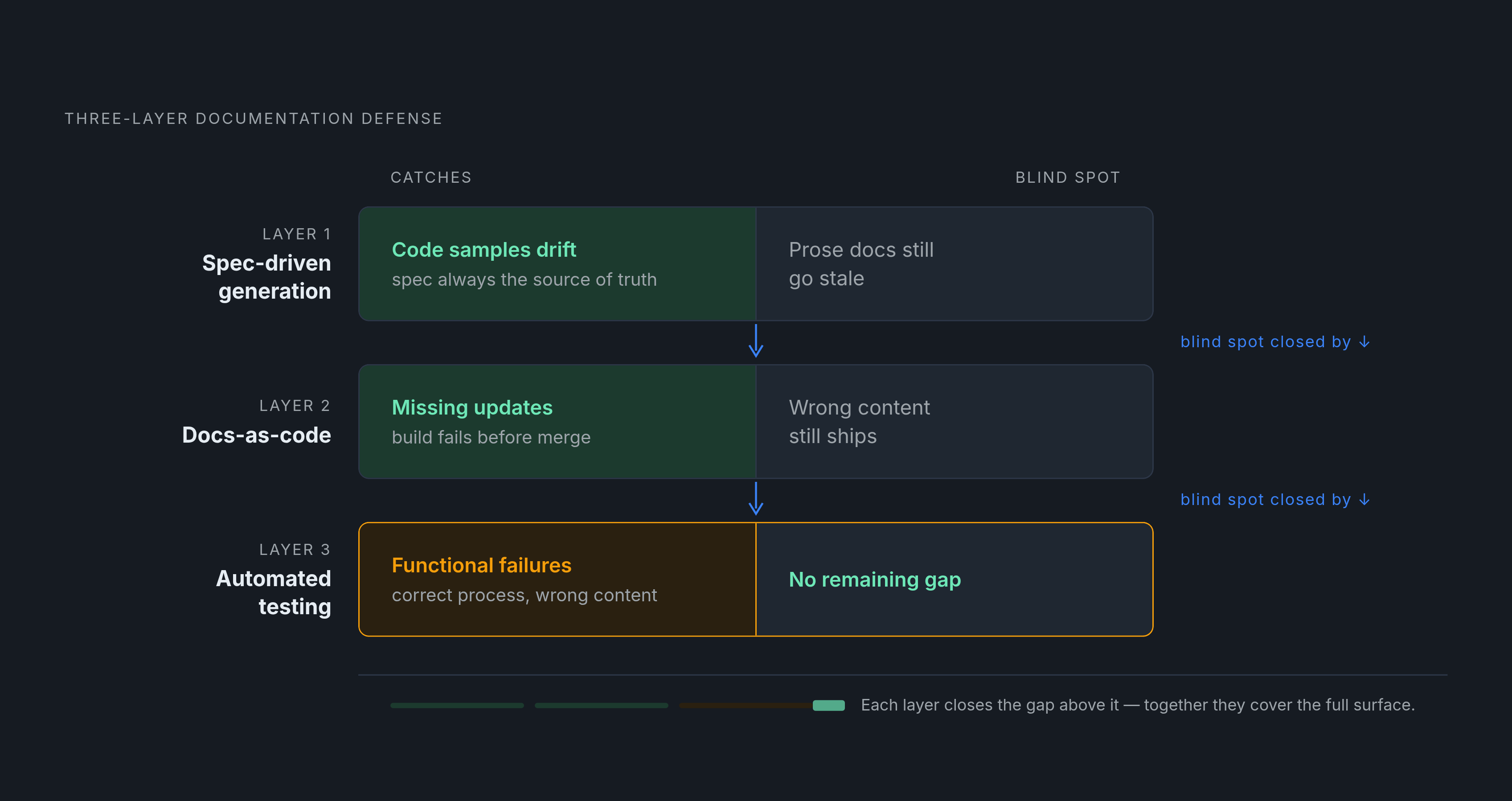
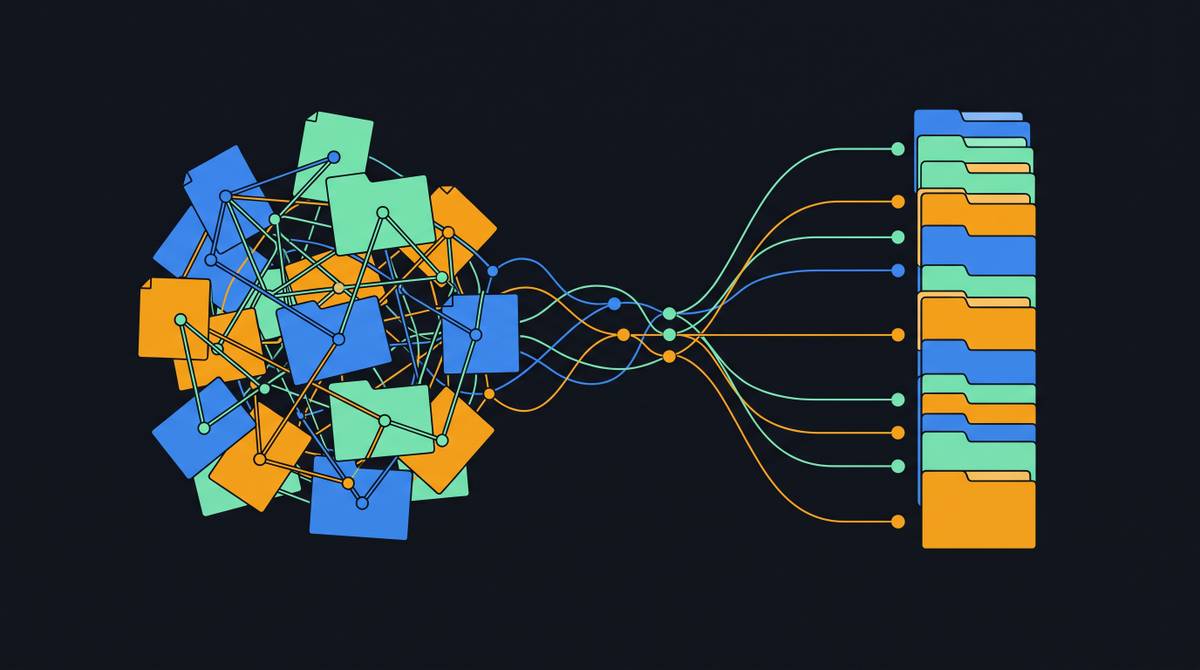
None of these three systems does the whole job by itself. Spec-driven generation shrinks how much hand-authored content can even drift in the first place. Docs-as-code enforces update discipline at the process level, turning drift into a build failure instead of a silent gap nobody notices. Automated testing catches the functional failures that slip through when someone follows the process correctly but still gets the content wrong. Each one covers a blind spot the others leave wide open.
They don't need to land all at once, and trying to stand up all three in the same quarter is probably the wrong way to start. Sequencing beats completeness here. Docs-as-code is the cheapest entry point: move documentation into version control, add a documentation-update line item to the pull request checklist, and that alone is a real improvement with zero tooling cost attached. From there, look at which samples can be generated straight from the OpenAPI spec and stop hand-writing those, which frees up writer time for the conceptual content that actually needs a human brain behind it. Automated testing comes last, once samples sit in an executable format and a staging environment exists to run them against; the first two steps are what keep this last one's scope from becoming unmanageable.
What this sequence really asks for is a mindset shift. Freshness moves from a culture question, something enforced through reminders and hoping people care, toward an engineering constraint enforced by tooling that doesn't care how slammed anyone is this particular week.
One more thing worth naming, even briefly. As AI coding assistants become a normal part of how developers work, documentation infrastructure that feeds current, validated samples directly into those tools, alongside a rendered webpage a person happens to read, looks like the logical next step. A documentation system that's always accurate can be always usable by automated tooling too, alongside the humans clicking through the page. Some platforms, like Mintlify, are built specifically to serve docs as knowledge infrastructure for both developers and AI agents.
Postman's 2025 data found 82% of organizations have adopted some level of API-first thinking, treating their APIs as products in their own right. Documentation is part of that product. The same engineering rigor that governs the API itself, version control, automated testing, one source of truth, ought to govern the examples meant to represent it.
The teams that keep their documentation accurate over years, not months, generally aren't the ones with the most disciplined engineers. They're the ones that built systems where the easiest path forward happens to be the same path that keeps everything current, so nobody has to be a hero about it every single week.