Structuring Documentation Content for LLM Comprehension
Organize documentation by how LLMs will chunk and retrieve it, not just for human readers.

There is a version of this problem I encountered early in my career that I did not recognize as a problem at the time. A team I was embedded with had spent months building a knowledge base for an internal support agent: organized by product line, written by subject matter experts, reviewed by technical writers. The documentation was, by any human standard, excellent. The agent was, by any operational standard, unreliable. It would hallucinate configuration values that had never existed, omit steps that were present in the source material, and occasionally stitch together procedures from unrelated products as though they were a single workflow. Nobody could explain it, and so everyone blamed the model.
The model was not the problem. The documentation was, but not for the reasons anyone expected. The headings were evocative rather than descriptive. Terminology drifted across pages. Sections assumed familiarity with what came before them. None of this mattered to a human reader with context and patience. To a retrieval system pulling isolated chunks into a language model's context window, it was noise at every level.
What follows is an attempt to describe, as precisely as I can, what structural decisions in documentation actually do to LLM comprehension, and why teams that treat documentation quality as a human-reader problem are solving for the wrong audience.
What happens between a user query and a retrieved answer
The retrieval-augmented generation pipeline, reduced to its mechanics: documents are segmented into chunks, embedded as vectors, stored in a database, and at query time the chunks most semantically similar to the query are retrieved and passed into the model's context window as the basis for its answer. The model does not search the knowledge base. It reasons over whatever arrives in that window.
This is worth sitting with. The quality of the answer is bounded by the quality of the chunk. Not the quality of the document as a whole, not the quality of the knowledge base in aggregate. The chunk. A vague heading produces a chunk with no anchor concept, which produces a retrieval match against the wrong query, which produces an answer synthesized from noise. Shi et al. (2023) demonstrated this empirically: irrelevant retrieved passages do not merely fail to help, they actively degrade generation quality. Bad retrieval corrupts the generation step downstream. But what if the documentation itself is the source of that noise — not the model, and not the retrieval strategy?
The corollary is that large, sprawling context is not a solution. As context grows noisier and broader, models become more likely to overlook or misinterpret the information they actually need. Focused, well-bounded chunks outperform voluminous but disorganized ones, because the model's effective comprehension does not scale linearly with the amount of text it receives.
Documentation authors are, in this system, upstream of everything. Every structural decision they make constrains what any chunking strategy can subsequently do.
Heading hierarchy as a navigational contract with the retrieval system
Headings are not cosmetic. In chunking systems, heading levels signal where one topic ends and another begins. They are the primary structural signal a retrieval pipeline uses to group related content. When that hierarchy is malformed, the pipeline makes bad grouping decisions, and the model inherits those bad groupings as its context.
Skipping levels is a common failure: an H1 followed directly by an H3, with no H2 to establish the intermediate concept. To a human reader who can see the page, the visual gap signals a relationship. To a chunking system reading markup, there is no signal, only an inheritance problem: which parent concept does this H3 belong to? The answer is ambiguous, and ambiguity at this level means chunks may be attributed to the wrong topic entirely.
The practical rule is straightforward: H1 to H2 to H3, each level stepping down exactly one from the last. More important, and more often violated, is uniqueness. If two sections in a document both carry the heading "Overview" or "Parameters," a retrieved chunk carries no positional information. The model cannot distinguish them. Heading text should name the specific concept covered, not the section's role in a template. "Authentication token expiry" is retrievable; "Important Note" is not.
A 2025 ACM Web Conference paper (arXiv:2411.02959) found that HTML outperforms plain text for modeling retrieved knowledge in RAG pipelines. The reason is structural: heading tags, list nesting, and table markup carry relational information that flat text loses. Teams that strip markup from documentation before ingestion, in the belief that clean text is simpler for the model to process, are removing the signals the retrieval layer relies on to understand hierarchy. The formatting is not decoration; it is data.
Consistent terminology and what ambiguity costs at retrieval time
If the same concept is called "workspace" in one section, "project" in another, and "environment" in a third, an LLM treating those as distinct tokens will retrieve inconsistently. A query about "workspace" may never surface the content written about "environment." The information exists in the knowledge base; the retrieval system simply cannot connect the query to it.
This is not a model failure. It is a documentation failure. And it compounds. A 2024 arXiv survey (arXiv:2510.06265) identifies out-of-distribution shortcut learning as a key contributor to hallucination: the model, encountering ambiguous or inconsistent signals, falls back on statistical patterns from training rather than the retrieved content. Inconsistent documentation creates precisely the ambiguous signal that triggers this. The hallucination is downstream of the terminology problem. That raises an important question: if the hallucination is traceable to source material, how much of what teams attribute to model failure is actually a documentation discipline failure?
Pronoun drift compounds it further. Vague pronouns, "it," "this," "the above," function in linear human reading because the reader carries context forward. In a retrieved chunk, that context does not exist. "It" has no referent. The fix is mechanical: replace pronouns with the noun they reference in any content that will be chunked. Treat each major section as potentially the only section the reader will see.
The 2025 Stack Overflow Developer Survey found that 46% of developers do not trust AI output accuracy, up from 31% the prior year. That erosion of trust is partly a model capability story, but it is also a documentation quality story. The outputs that erode trust frequently trace back to source material that gave the model no clean signal to work from.
Modern documentation platforms offer linting that flags terminology inconsistencies automatically. This is not a manual audit problem if tooling is in place. A glossary enforced at the platform level turns a discipline problem into a workflow, tools such as Mintlify, a self-updating knowledge infrastructure platform for dev teams and AI agents that keeps docs in sync with the product automatically, apply this kind of structural discipline at the platform level rather than leaving it to manual review.
Writing each content unit as if it will be read without its neighbors
The isolation test is the most useful heuristic I have found for auditing documentation destined for retrieval. Before publishing any section, read it as if arriving at it cold, with no prior context, no knowledge of what comes before or after. If it does not make sense under those conditions, it will fail when retrieved.
Explicit context is the remedy for implied context. Prerequisites should be stated at the top of each section. The subject should be named explicitly rather than inherited from document position: "the rate limiter," not "it." Terms should be defined on first use within each major section, not only on first use in the document as a whole. The document's linear structure is irrelevant to retrieval; the section's internal completeness is not.
Code examples deserve specific attention. A properly formatted, labeled code block with a language tag and an explanatory introductory line is meaningful at a chunk boundary. A bare snippet with no tag and no surrounding prose is opaque. The model cannot reliably infer language, purpose, or context from syntax alone at retrieval granularity.
Visual content presents a version of the same problem. In text-only RAG pipelines, an unlabeled figure is invisible at query time. The alt text or caption is the retrievable content. If a diagram is central to understanding a procedure, the caption must carry that understanding in text.
A 2025 survey of context engineering (arXiv:2507.13334) frames structured inputs as the primary lever shaping LLM behavior during inference. The section-level writing practices described here are the upstream source of that structure. The model works with what the document gives it, and the document gives what the writer decided to make explicit.
How chunking strategy translates documentation structure into retrievable units
Chunking is where the writer's structural decisions meet the retrieval system's mechanics. The strategy chosen at ingestion determines whether the structure the writer built is preserved or destroyed.
Fixed-size chunking is the simplest approach: text is divided into chunks of a specified token count, typically 256 to 512 tokens with 10 to 20 percent overlap, regardless of where sentence or paragraph boundaries fall. It is appropriate for prototyping and low-stakes applications. It breaks sentences mid-thought and ignores semantic boundaries, which means even well-written documentation loses structural coherence at ingestion.
Recursive chunking attempts to preserve structure by splitting on paragraphs before sentences, sentences before words. It respects the natural divisions the writer created and is the recommended default for well-structured technical documentation, and the default in frameworks like LangChain. For teams whose documentation is already organized by topic with clean section breaks, this strategy rewards that organization directly.
Semantic chunking groups sentences by meaning rather than by token count. Benchmarks have shown meaningful lifts over naive baselines in some configurations. Renyi Qu et al. (2025) found, however, that computational costs are not always justified by consistent performance gains across document types. The trade-off is worth evaluating against the complexity and variability of the documentation at hand.
Hierarchical and hybrid chunking combine strategies to handle multi-format documents, those mixing prose, code, and tables, where a single strategy will mishandle at least one content type. For teams managing heterogeneous knowledge bases, this is often the most defensible production choice.
Sliding window overlap, carrying 50 to 100 tokens across chunk boundaries for 512-token chunks, partially compensates for content that does not isolate concepts cleanly at section edges. It is a useful buffer, not a substitute for well-written sections. An emerging approach, Sequential Hierarchical Agglomerative Chunking, merges adjacent sentences by semantic similarity while enforcing structural constraints, maintaining narrative continuity without requiring a predefined chunk count. For teams with long, multi-topic documents, this direction is worth tracking.
The consistent finding across strategies is that well-structured source documentation improves retrieval quality regardless of which strategy is applied. Semantic chunking performs best on documents already organized by topic. Recursive chunking produces better output when heading hierarchy is clean. The writer's decisions upstream constrain every strategy downstream.
Structured formats give retrieval systems an explicit map of content relationships
The 2025 ACM Web Conference finding on HTML is worth returning to here in a different register. The reason HTML outperforms plain text in RAG is not that models are trained on more HTML, though they are. It is that HTML encodes relationships. A heading tag signals hierarchy. A list tag signals membership in a set. A table encodes the relationship between a parameter name and its value. Plain text conveys the same information visually, but the relational structure must be inferred by the model rather than read directly.
API documentation in YAML or JSON is, in this sense, already well-suited to retrieval. Each object is a discrete semantic unit. Template-based parsing can extract components without ambiguity. The attribute-value format maps cleanly to the kinds of queries a developer or agent is likely to issue: "what is the type of the user_id parameter," "what are the required fields for this endpoint."
Where content is naturally relational: configuration options, parameter descriptions, behavior comparisons, structured format is more precisely retrievable than the same information embedded in flowing prose. This is not an argument for eliminating prose from documentation. It is an argument for reserving prose for genuinely discursive content and using structured formats where the content is itself structured.
For teams not using multimodal retrieval, visual content without text equivalents is invisible at query time. Vision-capable models can interpret charts and table structures, but text-only RAG pipelines operate on embeddings of text. A diagram with no caption and no surrounding description contributes nothing to retrieval.
LLMs can also be used to enrich chunk metadata automatically: generating keywords, classifications, and summaries that improve retrieval precision without requiring manual tagging at scale. Teams building or auditing large knowledge bases should evaluate whether the ingestion pipeline includes a metadata generation step; the improvement to retrieval targeting is often disproportionate to the implementation cost.
What documentation cannot fix: the ceiling on LLM comprehension in specialized domains
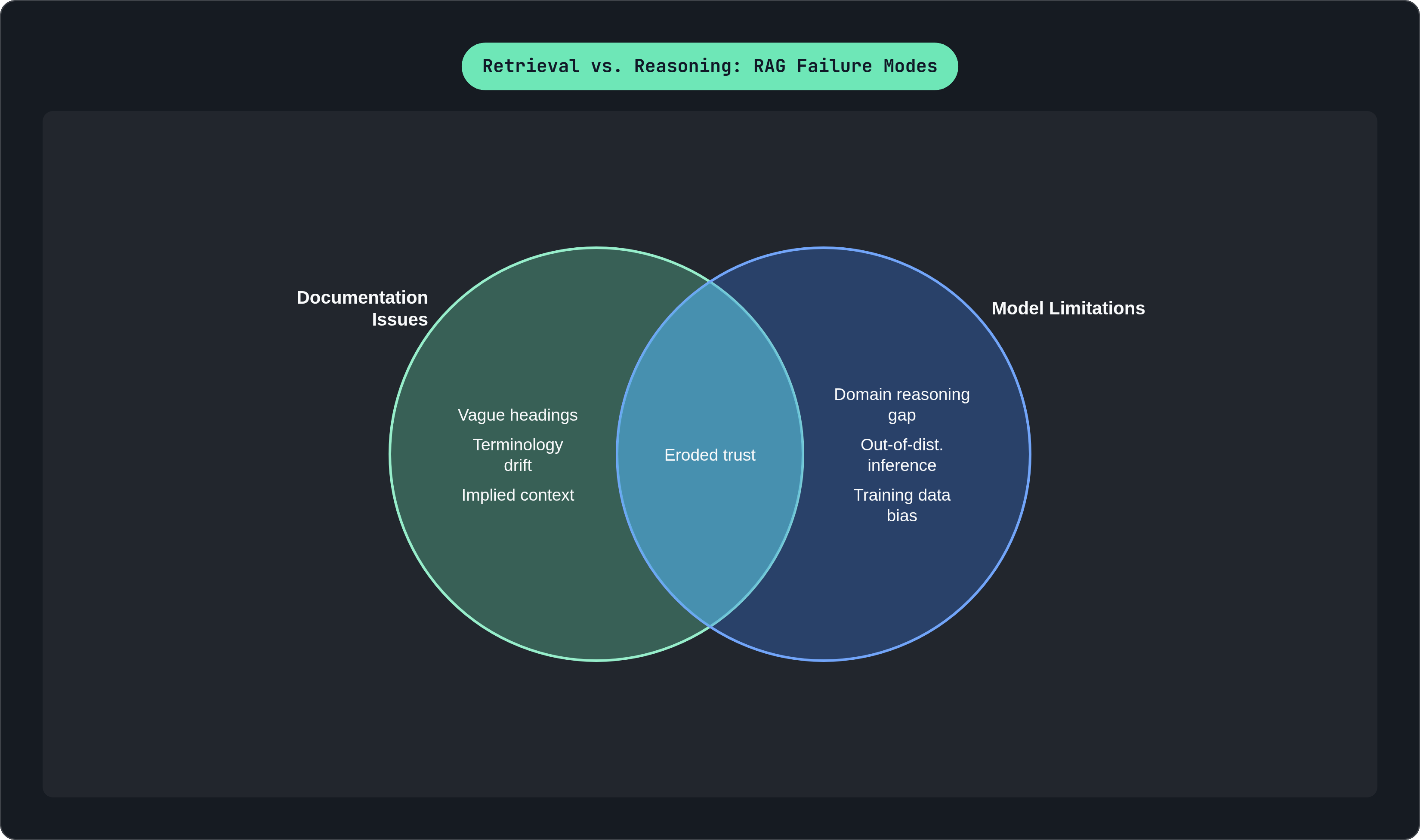
A 2025 Scientific Reports study found LLMs lag behind physicians by approximately 40% on flexible out-of-distribution inference. The figure is specific to clinical reasoning, but the principle generalizes: well-structured documentation improves retrieval accuracy, which is the process of finding the right chunk. It does not improve reasoning accuracy, which is the process of correctly applying what was retrieved. These are separate failure modes. It is also worth considering what that distinction means for teams who have invested heavily in documentation structure but continue to see downstream errors — they may be solving the retrieval problem while the reasoning problem remains untouched.
Documentation structure addresses the first. The second is a model capability problem, and beyond a certain threshold of domain complexity, no amount of structural discipline in the source material closes that gap. Renyi Qu et al.'s finding that semantic chunking's performance gains are not consistently justifiable by computational cost is, I think, pointing at the same phenomenon from a different angle: retrieval quality improvements have diminishing returns, and the bottleneck shifts to model reasoning before the retrieval problem is fully solved.
For high-stakes domains, medical, legal, safety-critical engineering, the practical implication is a system design point rather than a documentation point. Structure the documents to give the model the best possible retrieval signal. Design the system to treat model output as an accelerant for human judgment, not a replacement for it. The documentation work is necessary; it is not sufficient.
For well-scoped, technical knowledge bases, the situation is more tractable. API documentation, configuration references, SDK guides: these are domains where the gap between good and poor documentation structure is large and directly addressable. The physician-benchmark ceiling is substantially less relevant when the query space is narrower and the reasoning required is more mechanical. Here, documentation discipline compounds directly into system performance.
A documentation audit sequence for teams preparing content for LLM consumption
The sequence matters as much as the steps. Structure first, then vocabulary, then chunk tuning. Attempting all three simultaneously produces incomplete fixes at each layer and makes it difficult to attribute retrieval failures to their actual causes.
Step 1: Heading audit
Check for skipped levels and repair the hierarchy so each level steps down exactly one from the last. Replace generic headings, "Overview," "Notes," "Introduction," with concept-specific labels that name the topic covered. Verify that no two sections share the same heading text within a document. This step alone removes a significant class of retrieval mismatch.
Step 2: Terminology pass
Build or surface a glossary and enforce one term per concept across the entire knowledge base. Use linting to flag synonyms and inconsistent usage automatically rather than relying on manual review at scale. Replace all vague pronouns with their explicit referents in sections that will be chunked; each major section should be legible as a standalone unit.
Step 3: Isolation test on each major section
Read each section as if arriving cold. If it does not state its subject, prerequisites, and scope explicitly, add opening context. Add language tags and explanatory introductory lines to all code blocks. Verify that all visual content has a text equivalent that carries the relevant meaning.
Step 4: Format review
Convert relational prose to structured format where the content warrants it: parameter tables, option comparisons, configuration references. Preserve HTML markup in ingestion pipelines rather than stripping to plain text; the structural tags carry semantic information that flat text loses.
Step 5: Chunking strategy selection
Match the strategy to the document type. Recursive chunking for well-structured prose; semantic chunking for broader knowledge bases where computational cost is justified; hybrid approaches for multi-format content. Validate chunk size against the 256 to 512 token default with 10 to 20 percent overlap, and adjust based on tested retrieval performance rather than assumption. Test small, focused documents separately before applying chunking universally; for some document shapes, chunking degrades retrieval accuracy rather than improving it.
Maintenance as a structural requirement
Documentation that drifts out of sync with the product it describes degrades every downstream retrieval. The structural practices described here set a baseline. The baseline erodes without ongoing update discipline. For teams treating their knowledge base as a production system rather than a publishing artifact, the maintenance question is not optional: it is the condition under which the audit work retains its value.
The team I described at the beginning eventually rebuilt their knowledge base from the documentation audit up, not the model down. The agent did not change. The improvement was substantial. That is either encouraging or humbling, depending on how long your team has been attributing retrieval failures to the model.