What Documentation Refactoring Tools Actually Change
Better organization alone won't keep docs aligned with evolving code.
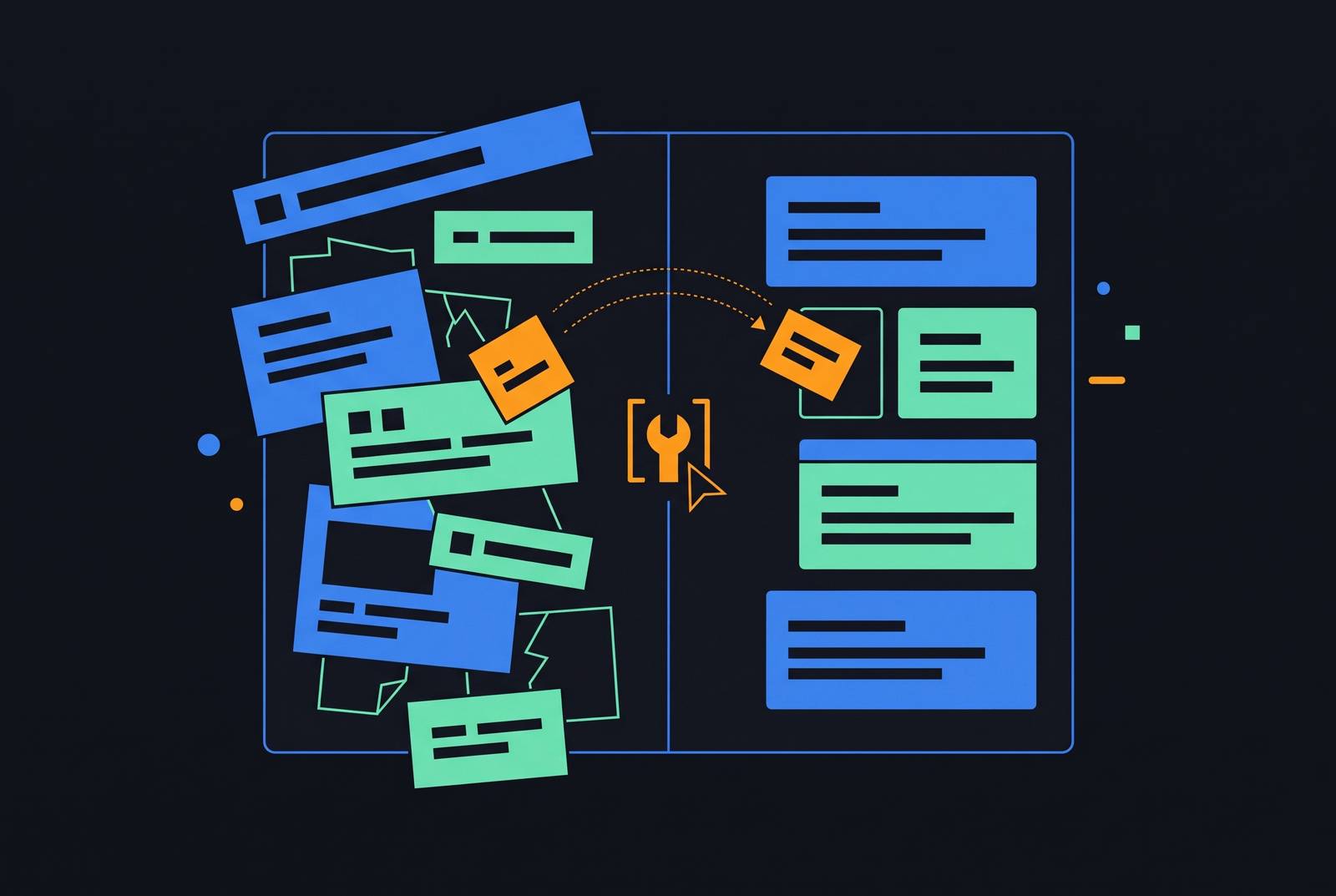
Documentation refactoring tools change how people organize, find, and understand information. Keeping that information synchronized with an evolving system requires more than these tools by themselves, a boundary that is key to deploying them effectively, particularly when AI agents depend on documentation as a source of knowledge.
Why documentation refactoring tools solve a narrower problem than teams expect
Teams buy a refactoring tool expecting it to keep documentation synchronized with the system, only to find that better-organized documentation can still describe yesterday’s system. The expectation gap starts with the purchase. Information can be hard to understand and out of step with reality at the same time, and each condition can persist after the other is resolved.
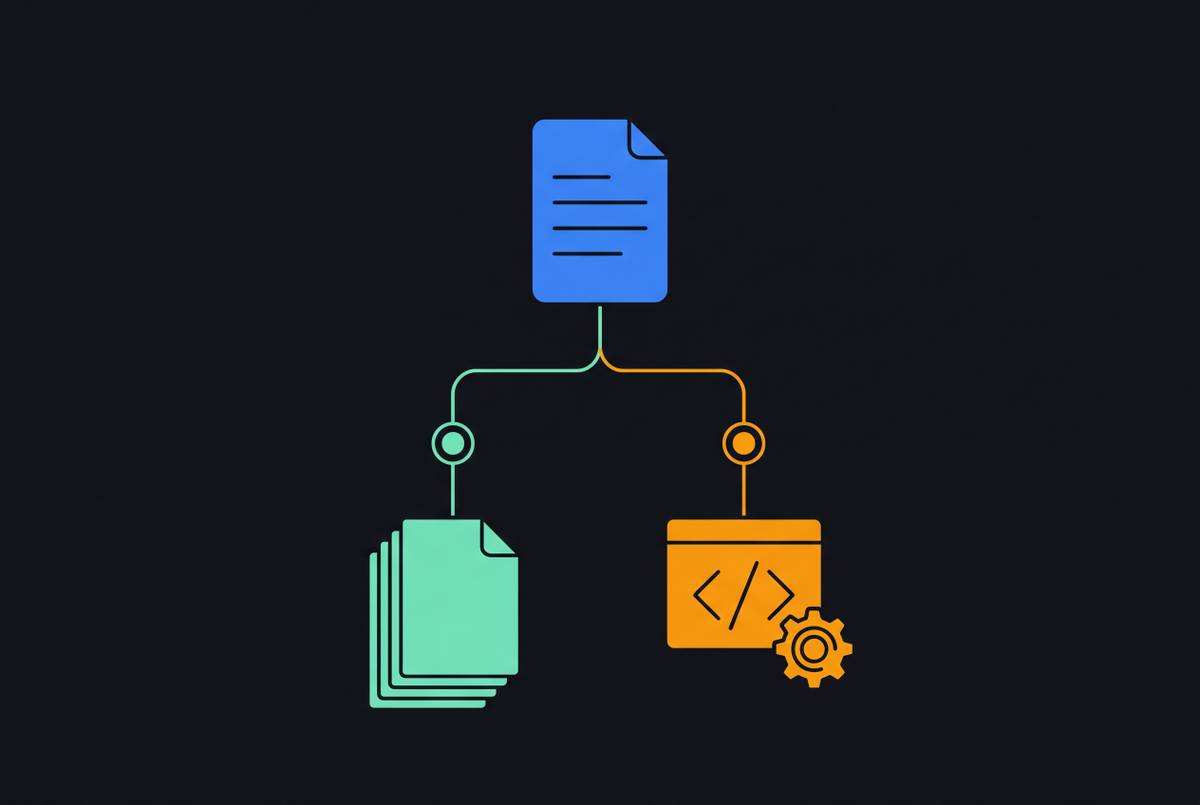
Two distinct problems travel under the documentation refactoring label. One concerns the structural quality of written documentation, including its organization, naming, and consistency. The other concerns code-level documentation that records how software behaves and changes. Both expose the distance between what a system does and what people have written about it, but tools that improve one are not interchangeable with tools that improve the other.
That difference is easy to miss because documentation debt rarely stops software from running. Onboarding breaks down, teams do the same work twice, or developers avoid code they do not understand. A tool that makes the code easier to navigate can reduce those costs without establishing whether the explanation attached to it remains accurate after the next change.
What documentation refactoring tools are actually built to do
The category divides into two functional modes, namely analysis and execution. Analysis-first tools expose internal structure and dependencies where reliable documentation is missing. They map complexity and identify hotspots where code rot concentrates, helping teams prioritize work by quantifiable risk. They reveal where intervention may be useful. They do not directly automate the transformation.
Execution tools make the changes. In software, refactoring means altering internal structure without modifying external behavior, whether through a targeted operation or incremental modernization across a repository. AI-assisted execution can also explain functions and generate documentation for legacy systems. That can reduce the fear of touching old code, but an explanation generated during a refactor is still tied to that moment.
Written documentation has a similar split between writing content and checking it. State of Docs 2026 shows technical writers spending more time editing AI-generated content and fact-checking and validating it. The useful mental model is therefore not “a tool that fixes documentation,” but a tool that either exposes a problem or performs a transformation whose results still need assessment.
The leading tools and what each one is genuinely suited for
Gemini Code Assist is a fit for integration with Google Cloud projects. Its free individual tier was discontinued June 2026, while paid tiers are billed monthly with lower rates on an annual commitment. Integration is its distinguishing fit here. That is a different selection criterion from the depth of a language-specific refactoring engine or the ability to map dependencies across a large system.
IntelliJ IDEA gives teams that use Java and other languages on the same runtime automated rename, extract, signature change, and migration operations designed to keep behavior the same. Its integration with Gradle, Maven, Git, and CI/CD suits teams working within that ecosystem. There is a free core tier, and the paid Ultimate subscription has a 30-day free trial. Visual Studio is a fit for enterprise-scale integrations and has a free plan, a free trial, and a paid tier. ReSharper focuses on.NET refactoring and has a 30-day free trial and a paid tier.
CodeScene identifies where refactoring effort should go. Its behavioral code analysis combines authorship and knowledge distribution with change frequency to identify complex code that receives frequent development attention. Its Code Health™ metrics and visual reports quantify technical debt in monetary terms for non-technical stakeholders. Standard and Pro tiers are billed yearly or monthly, with a free trial and demo available. NDepend also offers monetary debt estimates for.NET-heavy stacks, with money amounts available as an alternative to person-time.
Sourcegraph focuses on understanding large codebases, with a free demo, a free trial, and enterprise pricing available. Smart TS XL reconstructs execution paths across heterogeneous systems, including batch jobs, online transactions, and integration flows. It stands out for showing behavioral dependencies that appear at runtime, so teams can base refactoring decisions on risk. For agentic execution, an agent-enabled editor supports multi-file refactoring with visual diff review, while GitHub Copilot Agent fits teams spanning multiple editors. These tools serve different scopes.
What a large-scale agentic refactoring actually looks like in practice
CodeScene’s case study describes coding agents refactoring a large C codebase of hundreds of thousands of lines over three weeks. The effort produced thousands of commits across hundreds of files and modified the majority of lines in the codebase. Its Code Health score moved from 5.6 to 10.0. The three weeks were measured. The company’s comparison with a pre-AI timeline, however, is its own estimate.
The project settled on Claude Opus for the bulk of the work because it was significantly better than Codex with Sol at capturing and documenting discovered refactoring patterns in an emerging playbook. That detail gives the documentation work a concrete role in the transformation. The agents were not merely producing isolated edits. They were recording patterns that the project uncovered as it proceeded.
Scale nevertheless depends on more than model choice. Tools built for individual developers can lose context across modules on large diffs, while enterprise-grade tools use indexing, distributed processing, and incremental passes that follow dependency graphs. More fundamentally, the case study used a replay-trace harness that compared a state hash frame by frame. That was the behavioral oracle for judging correctness. Without an equivalent harness, agents can produce changes faster than anyone can verify that the system still behaves as intended.
The paradox: AI refactoring tools are also generating the debt they promise to fix
AI-assisted development can help remove structural debt and also create it. Faster generation changes both the time needed to produce code and the incentives around cleanup. When a feature takes a fraction of its former development time, the refactoring pass that would have occurred during hand-written development can be skipped. Speed does not guarantee structural improvement.
Missing context compounds that problem. A model given a single function has no information about its connections to the wider codebase, the contracts it must honor, or the modules that depend on it. The result may be locally plausible but globally broken. Duplication is a characteristic symptom, as an AI generates a utility without knowing that a similar one exists two modules away.
CodeScene’s benchmark found that existing AI solutions delivered functionally correct refactorings in only 37% of cases tested against real-world code. That finding does not negate the controlled case study. An agent needs enough context to make suitable changes, and the correctness of those changes needs to be assessed. Understanding that boundary is a reason to deploy the tools carefully.
What refactoring tools genuinely leave unchanged: the synchronization problem
Synchronization is the problem of documentation drifting away from system behavior as code evolves. It is distinct from documentation quality. A page can be clearly written, consistently organized, and easy to find while describing behavior that no longer exists. A page that is hard to read may still be accurate. Refactoring primarily changes the structure through which people understand information.
The distinction becomes sharper when behavior changes. A refactoring tool may improve internal structure while keeping external behavior the same, but that change does not set up a way to detect a later change in behavior and update the documentation that describes it. Generating an explanation at the time of a refactor does not close that gap. What connects the next system change to the written account of it?
Enterprise constraints make the answer harder. Production stability, audit traceability, and parallel-run requirements limit what teams can change, when, and how, but those constraints do not themselves document what changed. State of Docs 2026 found that roughly a third of those who responded still use Git repositories as their main documentation tool, while nearly half use dedicated HAT tools. Neither choice, by itself, creates documentation that updates in step with system behavior.
AI agents can write documentation and unit tests and suggest ways to improve structure, but people still need to check their work. Decoding a complex function is not the same as understanding the architectural context of specific business needs. The same report names AI/prompt engineering, information architecture, and content strategy as the most important skills for technical writers. Those priorities reflect a shift from authoring alone toward designing and validating the structure of knowledge. People still have to handle synchronization unless the infrastructure is built to do it.
How the gap between refactoring and synchronization shapes what teams actually need
Refactoring tools and live documentation infrastructure have related but separate jobs. The former reduce structural debt, improve readability, make information easier to discover, and enforce consistency at a scale that people cannot maintain manually. Their analysis can also translate debt into terms that stakeholders can act on. Those are substantial gains. They do not include automatic detection that a behavioral change has made an existing explanation wrong.
The gap becomes more consequential when AI agents consume documentation as a knowledge source. If that documentation drifts, downstream agents can compound its errors at the speed of inference. Indeed, the central question for an agent-consuming workflow is not only whether the reference is usable, but whether it still describes the system.
CodeScene’s benchmarks project significantly lower token consumption for comparable tasks on uplifted codebases, making structural quality a potential input optimization for AI systems. That projection is limited to the codebase. It strengthens the case for refactoring without expanding what the tool has demonstrated.
Knowledge infrastructure addresses the remaining responsibility by making documentation searchable, actionable, and automatically integrated into AI workflows, with continuous synchronization between system behavior and its written account. For teams deploying agents, static, siloed documentation is therefore more than an inconvenience. It is a barrier to giving those agents dependable context.
How to choose and combine these tools given what each one actually does
For analysis and prioritization, CodeScene or Smart TS XL fits teams that need to see where debt and behavioral complexity build up before they commit to changes. NDepend suits.NET-heavy stacks where monetary debt estimates help secure stakeholder buy-in. Sourcegraph fits the task of navigating and understanding a large codebase before changing it. The decision begins with what is unknown.
For execution, an integrated coding tool suits multi-file agentic refactoring where generation and cleanup belong in one tool and visual diff review is useful. GitHub Copilot Agent fits teams that span editors and cannot standardize on a single IDE. IntelliJ IDEA or ReSharper fits Java or.NET teams seeking deep automated refactoring within an existing IDE workflow. At enterprise scale, these choices need a behavioral verification harness.
Teams should look at their size and how complex their codebase is before comparing features. Tools built for individual productivity can lose context at the scale where safe changes depend on architectural dependencies. Having more features does not keep a tool from losing that context.
For teams whose agents consume documentation, the additional requirement is infrastructure that detects behavioral change and updates the written reference in sync. Refactoring improves the structure of what those agents ingest, while synchronization keeps it current. Effective deployment assigns those responsibilities explicitly rather than expecting one tool to perform all three jobs of prioritization, transformation, and maintenance. The boundary is the basis for choosing a combination that addresses the actual problem.