AI-Assisted Technical Writing Without Accuracy Loss
AI speeds technical writing when verification is built into the workflow from the start.
A CNN and Google study cited by Exploding Topics in September 2025 found that business professionals produced 59% more documents per hour when using AI drafting, summarization, and formatting tools. Nielsen Norman Group's 2025 research found that writers using AI spend roughly 30% less time on tasks and produce up to 50% more content. Numbers like these have a way of ending conversations before they get interesting.
The study worth sitting with is METR's randomized controlled trial: 16 experienced developers, 246 real-world tasks, and a finding that review time frequently exceeded generation time, producing net productivity losses in a meaningful share of cases. I have watched this play out firsthand. A writer generates a first draft in ten minutes, then spends forty minutes tracing a technical claim back to the source material. The speed at generation is real. So is the loss at verification. What determines which number you end up reporting is whether review was designed into the process from the start or left to individual judgment at the end.
These two findings are not actually in conflict. They describe the same tool operating under different conditions. The 59% gain and the net loss can coexist in the same organization, sometimes in the same quarter, depending on whether anyone bothered to treat verification as a designed workflow step rather than an informal afterthought.
The Two Distinct Accuracy Risks: Hallucination and Staleness
Hallucination gets most of the attention, and the concern is warranted. Large language models produce content that sounds credible but may be fabricated: invented references, phantom methods, unsupported causal claims, terminology that drifts from source material without the writer noticing. A 2024 survey by MasterBlogging found that 63% of marketers report AI content frequently includes inaccuracies or bias. Technical documentation raises the stakes considerably, because the person reading it is trying to accomplish something specific and a wrong instruction carries immediate operational consequences.
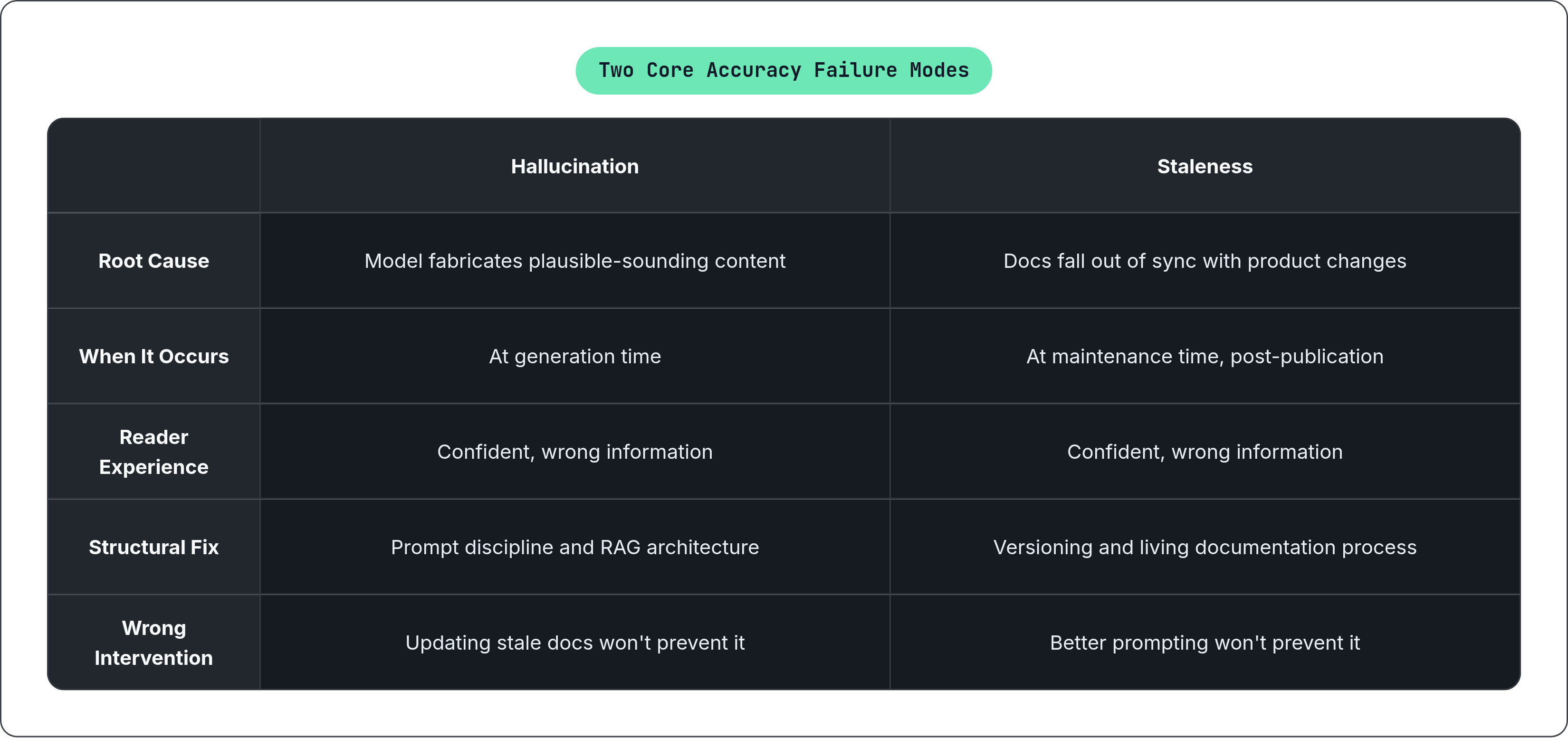
Staleness is the second failure mode, and in practice it is harder to attribute. AI agents increasingly use documentation as their primary source of truth. When a developer queries an AI assistant about an API endpoint, the agent retrieves the docs and surfaces their contents. If those docs are outdated, the agent's output is wrong, not because it hallucinated, but because it faithfully reproduced stale material. From the developer's perspective, the experience is identical: confident, wrong information delivered without qualification.
This is where the distinction starts to matter for workflow design. If a team cannot tell whether they have a hallucination problem or a staleness problem, they will apply the wrong intervention. Hallucination is addressed at generation time, through prompting discipline and retrieval-augmented generation. Staleness is addressed at maintenance time, through keeping documentation synchronized with the product as it evolves. Sophisticated prompting standards combined with no versioning process produces accurate content on day one and wrong content by month three. The two failure modes require different structural solutions at different stages. Conflating them as a single "AI accuracy problem" is how teams end up solving neither.
What AI Handles Well in a Technical Writing Workflow, and What It Cannot Replace
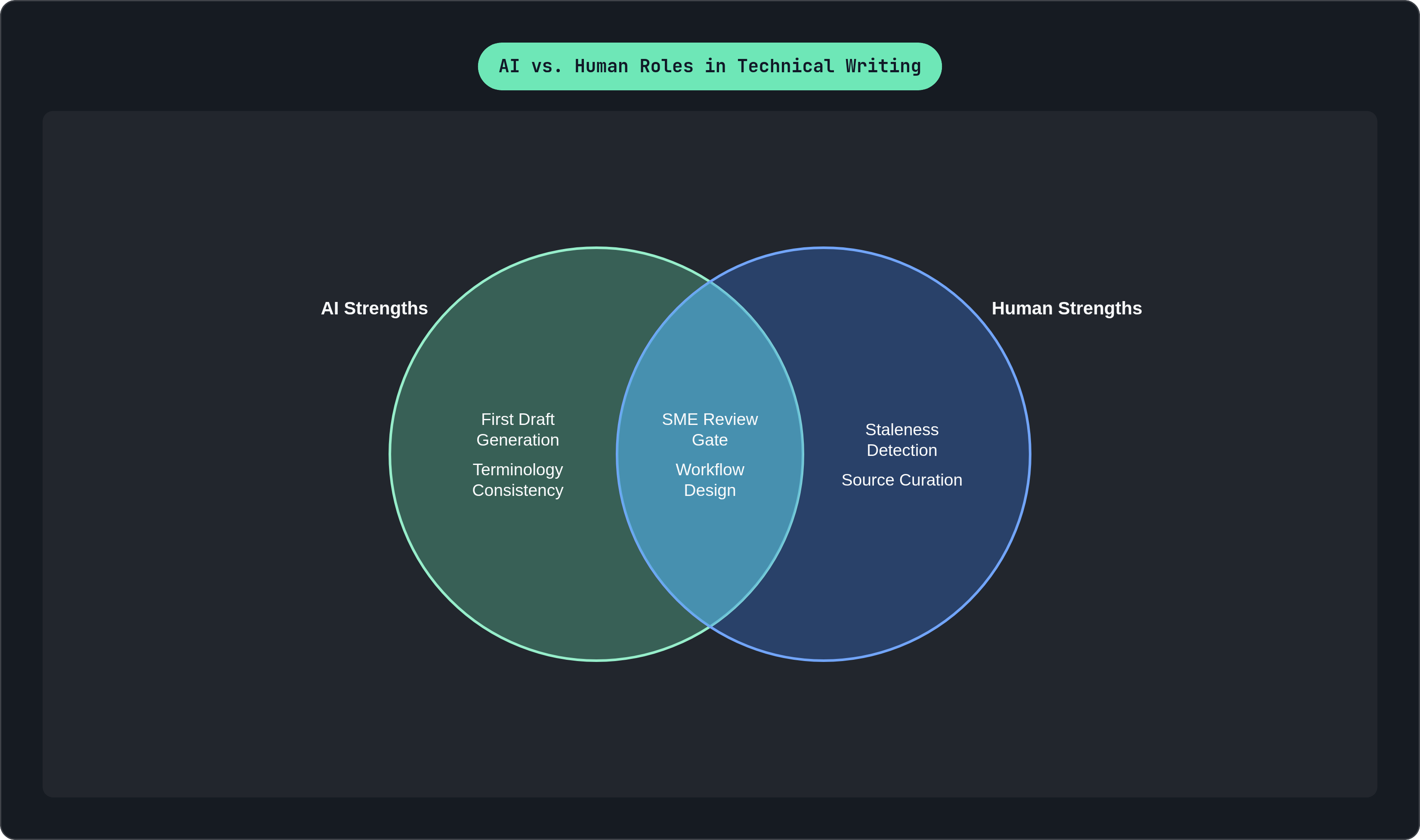
The clearest wins are structural. Generating first drafts from verified source material, whether API specs, SME interview transcripts, support ticket threads, or OpenAPI schemas, is a legitimate use case where AI performs well when properly constrained. Terminology enforcement and consistency checking across large content sets are also strong fits, as is readability flagging and audience restructuring without loss of technical detail.
API documentation is a particularly good match. Endpoint descriptions are consistent and structured by nature. When the model is grounded in an authoritative OpenAPI file and engineering notes rather than a blank prompt, it is doing something closer to reading comprehension than creative writing, which significantly reduces fabrication risk. Translation and localization accelerate under AI assistance, though human review remains essential for domain-specific terminology, compliance language, and cultural fit.
What AI cannot do is provide subject-matter expertise or judge what a reader actually needs to know. If the underlying source material is incomplete, AI reproduces that weakness at scale, faster and with more apparent confidence than a human writer would. General-purpose models produce readable text that sometimes misses key technical distinctions or invents plausible-sounding details that do not match how the product actually behaves. These gaps tend to surface in version-specific parameters, deprecation notices, and authentication flows: exactly the places where developers extend the most trust to documentation.
Generation and structure are AI's domain. Verification is not. These are not interchangeable, and treating them as such is where most AI documentation initiatives break down.
Building the Structured Workflow: How Each Stage Controls for a Specific Failure Mode
Source Preparation Before Prompting
The highest-leverage intervention in the entire workflow is the least glamorous one: grounding the model before it generates anything. Feed it verified inputs, the spec, the OpenAPI file, the SME transcript, the relevant support tickets. A structured outline developed before prompting further constrains what the model reaches for. Most hallucinations are preventable at this stage, before a first draft exists. Skipping it and relying on post-generation review to catch errors is precisely the pattern that produces the METR result.
Prompt Engineering for Technical Accuracy
A dependable prompt sets a role, supplies context, states the task plainly, and defines the output format. Zero-shot and few-shot prompting, where examples of correct terminology and structure are provided directly in the prompt, reduce terminology drift. Chain-of-thought reasoning, asking the model to explain its logic rather than simply produce output, surfaces assumptions that can be verified before they propagate into a final draft. Constraining vocabulary and format at prompt time is quality control applied at the point of origination, not bureaucratic overhead.
Retrieval-Augmented Generation as a Structural Safeguard
Retrieval-Augmented Generation retrieves relevant content from authoritative sources and injects it into the model's context window before generation begins. This transforms the model's task from creative production to comprehension and synthesis, which meaningfully reduces fabrication. RAG addresses hallucination at the architectural level rather than the prompt level, and teams building serious documentation infrastructure in 2025 are treating it as a default rather than an advanced option.
SME Review as the Accuracy Gate
SME review is not optional polish. It is where factual correctness gets verified against how the product actually behaves, and no prompting discipline or RAG architecture substitutes for that. Subject-matter experts identify discrepancies, technical inaccuracies, and gaps that require domain knowledge to catch. As AI handles more drafting work, technical writers increasingly own the coordination of this review: testing documented procedures, confirming behavior, integrating SME feedback into the content system.
A well-structured workflow makes this step faster and more focused. The draft is already grounded and organized; the expert is not solving a blank-page problem. They are verifying a structured draft against their knowledge of the product, which is a fundamentally different task.
Structured Authoring and Content Reuse
Consider what happens to accuracy not at the moment of generation, but six months later, when the product has changed and the documentation has not. Topic-based, structured authoring breaks content into discrete, reusable components with clear hierarchy and metadata. In a component content management system, a correction made once propagates to every document that reuses that component, eliminating the failure mode where a stale fact persists across a dozen documents because no one tracked down every instance. Well-structured content also improves AI accuracy downstream: the more reliably content is organized, the more reliably AI tools can retrieve and reproduce it correctly.
Tools That Support the Workflow at Each Stage
No single tool covers all five stages. The workflow requires assembling components that match the team's output type and the failure modes most likely to occur.
For content governance and consistency, Acrolinx enforces style, terminology, and consistency at scale, operating between generation and SME review to reduce terminology drift before content ships.
For structured authoring and component content management, Paligo uses topic-based, single-source authoring built on DocBook, with a professional plan starting around $4,800 per year, suited to teams that need structured reuse across large documentation sets. Heretto combines DITA expertise with an AI copilot called Etto that supports drafting, summarization, and compliance checks; it is particularly suited to regulated environments where audit trails and content governance are non-negotiable.
For API documentation built on a design-first approach, Stoplight provides a visual OpenAPI editor that generates the spec serving as the source of truth for documentation, mocking, and testing simultaneously. Keeping API docs grounded in the actual contract rather than a downstream interpretation of it addresses the staleness problem at the source.
For teams building AI-native documentation infrastructure, self-updating docs platforms are built as knowledge infrastructure for both human developers and AI agents. These tools offer access controls, collaboration, and enterprise reliability alongside self-updating behavior that keeps documentation synchronized as products evolve. When the docs are current, the agents are current. When the docs are stale, that problem surfaces in agent output rather than accumulating silently through every query the agent answers.
What the Hybrid Model Actually Looks Like in Practice, and Why It Outperforms Both Extremes
Surveys of AI users consistently show increased productivity and improved writing quality as self-reported outcomes. The METR finding is what happens when you measure instead of ask. It points at something most teams prefer not to examine closely: the difference between using AI and building a workflow around it is not cosmetic, and the gap between those two things tends to become visible at the worst possible moment.
The fully manual approach cannot scale to the output demands of modern software development. Unstructured AI generation produces volume without reliability. The hybrid model, AI for generation and structure, humans and systems for verification, does not simply trade speed for accuracy. It is a different configuration, one that addresses the failure modes of both extremes rather than averaging them.
In practice this looks like: AI generating a first draft from verified source material, structured prompts, and RAG-grounded context. Content governance tooling catching terminology and consistency problems before SME review begins. SME review serving as the accuracy gate, faster to conduct because the draft is already structured. Structured authoring and living documentation infrastructure ensuring that when the product changes, the documentation changes with it, and that what AI agents retrieve downstream reflects the current state of the product rather than the state it was in at launch.
The technical writer's role shifts in this model. Judgment, verification, and source curation become the core competencies. Looking back at those aggregate productivity studies, the gains they report are largely a function of eliminating unstructured verification labor, not generating text faster. The workflow that makes review efficient is what makes the speed real. Most teams skip that part, and that omission is, consistently, what separates the teams still reporting gains six months in from the ones quietly rebuilding their documentation from scratch.