Roles and Workflows for AI-Native Documentation Teams
Rebuilding workflows for AI collaboration matters more than which tools you choose.
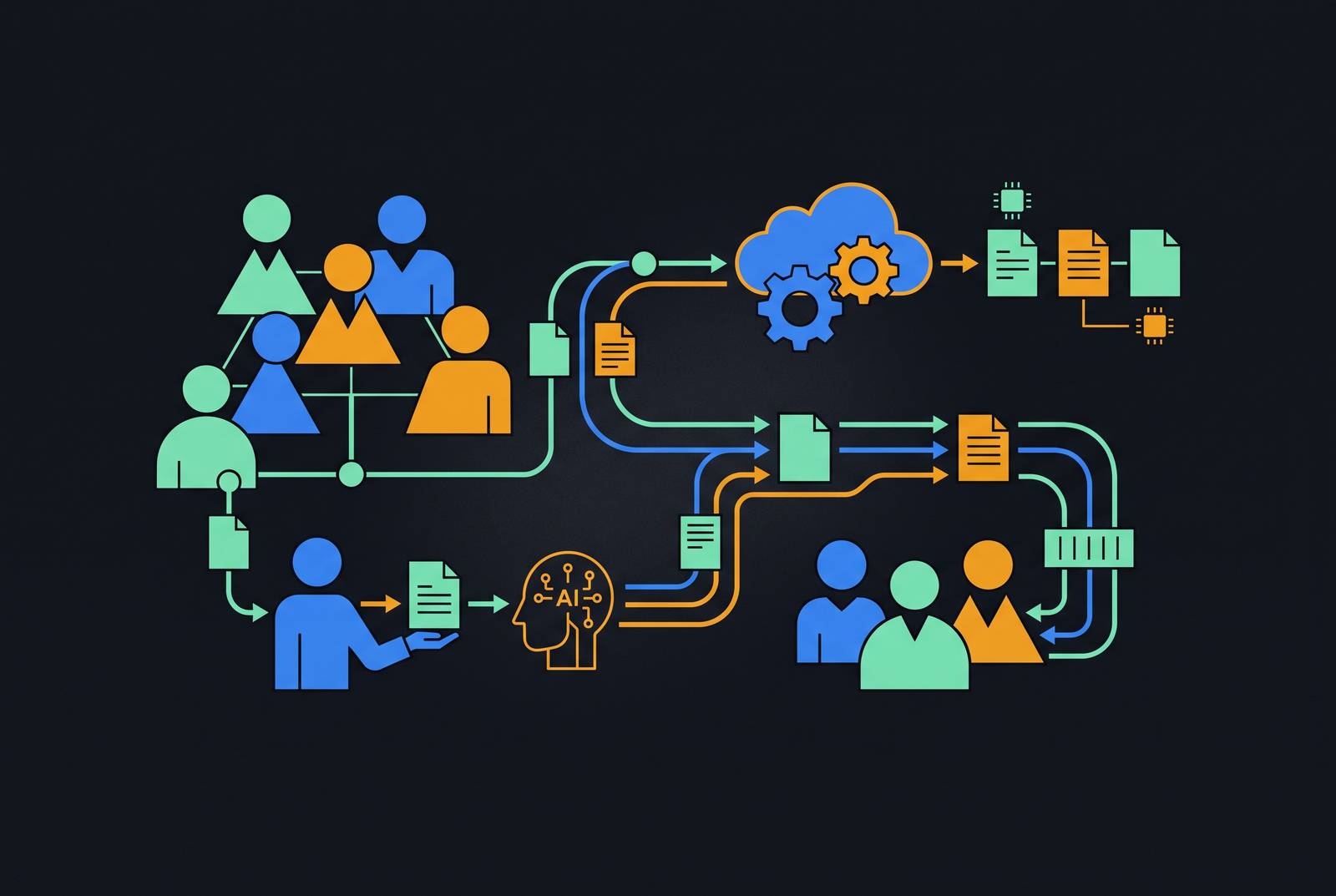
AI-native documentation teams are not defined by which AI tools they use. They are defined by whether roles, workflows, and review processes were rebuilt from scratch to make human-AI collaboration auditable, or whether a copilot got bolted onto a structure designed for a world before large language models existed. That distinction determines whether a team scales with AI or just gets faster at doing the same work the same way.
Per the 2026 State of Docs Report, regular AI usage among documentation practitioners jumped from 60% to 76% in a single year, and the share who say they never use AI dropped from 25% to 11%. AI in documentation has crossed into the mainstream. McKinsey's 2025 global survey found something similar at the organizational level: 88% of companies use AI regularly in at least one business function, but only about a third say those programs have scaled past pilot stage. That gap between trying AI and rebuilding around it is exactly where most documentation teams are stuck right now. And the stakes are higher than they look, because documentation increasingly feeds the AI agents that products themselves depend on. Static, siloed knowledge isn't just an inconvenience anymore. It's a reliability problem for every system that reads it.
Where the writing actually stops being the bottleneck
Ask any technical writer what actually eats their week, and drafting is rarely the honest answer. The real time sink was always what happens before a draft starts and after it exists: chasing down what changed in the product, figuring out who to ask, and then checking the finished piece against reality one more time. Drafting was never the bottleneck people thought it was. It just felt that way because it was the visible part.
The 2026 State of Docs data backs this up in a useful way. Yes, 78% of practitioners say AI makes documentation faster, and the top use cases (drafting at 62%, brainstorming at 58%, style enforcement at 50%) all sound like writing tasks. But look at where the actual leverage sits: release notes generated from code diffs, FAQ generation, alt text, translation, and batch template application across hundreds of articles at once. None of that is writing in the traditional sense. It's pattern-matching and mechanical labor that used to eat entire afternoons.
The single highest-leverage capability might be drift detection: an AI system that can flag "these 12 articles describe a UI that no longer exists." That's not a writing task at all. It's a systems task, and it turns documentation review from a quarterly fire drill into something closer to continuous monitoring. In a docs-as-code pipeline, AI can analyze a codebase and produce first-draft API docs and changelogs, check hundreds of pages against a style guide in seconds, and flag exactly which pages need updates when the underlying code changes, often drafting the fix itself.
The practitioners named in the 2026 State of Docs Report show what this looks like in practice. Ian Alton at Airbyte, the sole dedicated technical writer there, built a two-phase agentic QA loop: one agent reviews open pull requests pre-release and proposes documentation updates, and a second agent runs post-merge, validating docs against the actual source code and flagging what no longer matches. Mirna Wong at dbt Labs automated an agent that scans code changes, detects which ones are customer-facing, and auto-creates documentation issues so nothing customer-relevant slips through unnoticed. Marco Spinello at Booking.com uses AI for batch work, applying a single documentation template across 30 to 50 articles in one pass instead of doing it article by article.
Put those three together and a pattern falls out on its own: when AI takes over drafting and batch mechanics, a writer's limited attention should go toward judgment calls, not toward retyping the same paragraph 40 different ways across 40 articles.
The core job change: from drafting to validation
Here's the clearest single number in the whole discussion. Among heavy AI users surveyed for the 2026 State of Docs Report, 56% report doing "less writing, more editing." Among people who never use AI, that number is 10%. That's not a marginal shift, it's a different job.
AI is unlikely to replace technical writers outright. What it does is convert the role from producing text to reviewing, curating, and vouching for text that something else produced. That's a meaningfully different skill set, and it's worth being precise about what it actually requires, because "editing" undersells it. It means checking AI drafts against a genuine source of truth, whether that's source code, a spec document, or a changelog. It means watching for hallucination, for content that's been silently truncated, for facts that drifted from what's actually true. It means maintaining the surrounding context system, the product knowledge, the style examples, the structural patterns, that makes AI output usable in the first place. And it means knowing where to draw the line and say: this part needs a human to write it from scratch.
Ian Alton's framing on this is worth sitting with: "When we talk about an agent that is hallucinating, we're really talking about an agent that's starving for context." That reframes the writer's job. Feeding the system good context isn't preparation for the real work of reviewing output, it is the real work.
A related, more mechanical failure mode is worth naming: agents can run into hard token limits and silently truncate long pages without any warning that content got cut. Agents also tend to favor smaller, more atomic content units than a human reader typically prefers. Validation, then, isn't only about catching wrong facts. It's about catching structural failures that a human skimming a finished page might not notice at all.
One consequence of all this: the hiring bar is inverting. Technical depth is becoming the differentiator, and pure writing fluency, once the whole qualification, is turning into table stakes. A writer who can catch a hallucinated API parameter matters more than one who can turn a phrase.
The specialist roles emerging around human-AI collaboration
If validation is the new center of the job, new roles are forming around the edges of it, and they're worth naming individually rather than lumping under "AI-augmented writer." Across the industry, organizations are already investing in training writers on AI system design, prompt engineering, and workflow automation, and a rough taxonomy of specialist roles is emerging that maps closely to what practitioners like Alton and Wong have been building through improvisation.
The Document Engineer, sometimes called a Documentation Architect, defines what context AI needs and makes sure it's actually available, building documentation platforms rather than individual documents. This role owns information architecture: making sure AI-generated chunks of content form something coherent and navigable, rather than a pile of disconnected fragments nobody can find. Fluid Topics describes this as the architect of an intelligent documentation ecosystem, which sounds grand, but the daily work is closer to plumbing than architecture in the romantic sense.
The AI Content Strategist develops content plans built specifically for AI-driven platforms, which means understanding how natural language processing and the underlying algorithms shape what gets generated and how it gets surfaced. This is different from traditional content strategy in a specific way: the strategist has to model how an AI system will process and present the content, not just how a human reader will. Directing AI well is a genuinely rare skill right now, rare enough that it commands a senior profile on its own.
Prompt Engineer, in a documentation context, is not about clever one-off phrasing. It's about building repeatable, systematic approaches to getting consistent output from AI writing systems. Per Index.dev, companies using structured prompt engineering report 40% fewer hallucinations and 60% better brand alignment in AI-generated communications, numbers that suggest this is closer to an engineering discipline than a knack.
The AI Workflow Engineer designs and keeps the actual toolchain running: the drift detection triggers, the auto-draft pipelines, the QA loops. This role owns the pipeline itself, not any single piece of output, and makes sure AI-generated components actually fit into the team's existing systems instead of floating apart from them.
The Knowledge Engineer curates the knowledge base that AI systems pull from, owning the retrieval layer directly. This is a natural next step for someone coming from QA engineering or from traditional technical writing, and it's arguably the role most directly responsible for preventing the kind of context starvation Alton points to. If the AI doesn't know something, it's usually because this role hasn't fed it in yet.
The AI Ethics or Compliance Writer handles a set of problems that didn't really exist before generative AI: who's liable when generated content is wrong, how attribution works when a machine wrote the first draft, how bias creeps into generated material. That's a different set of concerns from conventional legal or regulatory writing, closer to product risk than compliance boilerplate.
The Technical Curator surveys an entire technical domain and turns scattered, half-documented knowledge into something structured. Domain expertise is the entry price for this role, which makes it the place where deep subject-matter knowledge has the most leverage in an AI-native team. One analysis (Lying Dragon, writing on Medium) calls it the "ultimate move" for a documentation specialist navigating the AI era, and it's hard to argue otherwise: it's the role that can't be faked by a model with no lived context on the product.
None of these are hypothetical job titles floating around a conference deck. They're names for gaps that practitioners have already been filling on the fly, gaps that show up the moment a team tries to scale AI use past a single enthusiastic early adopter.
How team structure determines AI readiness before any tools are chosen
Before any team picks a tool, its existing structure already predicts how well AI adoption is going to go. That's a strange thing to say out loud, but the data supports it plainly.
Per the 2026 State of Docs Report, centralized documentation teams remain the most common structure at 35.6%, while a hybrid model (a central team paired with decentralized support elsewhere in the org) sits at 16% and is growing. Meanwhile 22% of organizations have no formal documentation team at all. Ownership is spread more widely than the job title suggests, too: technical writers lead documentation ownership at 55%, but Product (44%) and Engineering (39%) trail closely behind, and Customer Support (29%) now appears as an explicit category, confirming that documentation has become a cross-functional job whether or not anyone planned it that way.
Here's where it gets interesting. Organizations with no formal documentation team lag noticeably on AI-powered feature adoption compared to teams with formal structure. They lag on regular AI usage for content creation too. And the governance gap is the widest of all: unstructured teams trail meaningfully on AI governance guidelines compared to structured ones. Formal structure isn't just administrative tidiness. It's the precondition for AI adoption actually sticking.
That matters more as ratios get leaner. At some companies, writer-to-product-manager ratios have grown extraordinarily thin for the surface area a documentation team is supposed to cover. At that ratio, AI augmentation stops being a nice-to-have efficiency play. It's the only way coverage is mathematically possible. AI-native teams are trending toward smaller senior cores that, with AI augmentation, cover what used to require much larger writing staffs. Gartner has made a broader prediction along similar lines: by 2030, 80% of organizations will restructure large engineering teams into smaller, more agile units augmented by AI, and there's no obvious reason documentation organizations would be exempt from that same structural logic.
The growth of the hybrid model is probably the clearest signal of where this is all heading: a small senior core owning governance and quality, supported by AI-generated output and by distributed contribution from engineering and product rather than a large in-house writing staff.
The talent hollow risk in senior-only hiring models
Here's the uncomfortable part of the leaner-team story. As AI takes over the drafting and boilerplate work that junior writers traditionally cut their teeth on, the economic argument for hiring entry-level technical writers gets weaker in the short term, and a lot of organizations are responding by going senior-only and freezing junior headcount entirely.
That's efficient for exactly as long as the current cohort of senior writers keeps working. But what happens in five years, when the current senior tier moves on, retires, or gets poached, and there's no one behind them who's spent three years learning the craft? That collapse timeline is widely estimated at 3 to 5 years, roughly the gap between when hiring freezes start and when the resulting talent shortage becomes impossible to ignore.
Call it the talent hollow problem, and the argument against it isn't sentimental, it's arithmetic. Every senior Document Engineer, Knowledge Engineer, or Technical Curator working on a team in 2030 has to have started somewhere. If nobody enters the field at the junior level in 2026, there's no pipeline to draw from later, full stop.
The fix isn't reviving the old junior writer job description wholesale. It's redefining what an entry-level role actually does inside an AI-native workflow. Junior writers can review AI output and contribute to QA as a structured way of learning the craft, rather than starting from a blank page the way writers did a decade ago. Entry-level Knowledge Engineers can build and tag knowledge bases under senior supervision, which teaches the retrieval layer from the inside. And prompt engineering itself is trainable at entry level, a skill that builds naturally toward a senior AI Content Strategist or Workflow Engineer role down the line.
Teams that solve this now, rather than treating junior hiring as a cost to cut, are building toward a real compounding advantage: a full-spectrum team by 2029, while competitors who went senior-only are stuck trying to hire specialists who, by then, simply don't exist in enough supply.
Workflow design for auditable human-AI collaboration
What separates an AI-native workflow from an AI-assisted one, in concrete terms? Per Howdy's 2026 operating model guide, the diagnostic comes down to a handful of specifics: work starts from a structured spec with testable acceptance criteria, context gets assembled on purpose rather than left to chance, agent output is required to carry evidence and provenance, CI blocks any merge that causes an eval regression, and permissions follow a least-privilege model rather than blanket access.
For documentation specifically, that plays out as something close to a two-gate system, matching the pattern Ian Alton built at Airbyte. A pre-release gate has an AI agent review open pull requests, propose documentation updates, and flag gaps before code even ships. A separate post-merge QA gate has a different agent validate the finished documentation against the actual source code after the merge, catching whatever slipped through the first pass.
Auditability, in practice, means every AI-generated draft carries its own metadata trail: what prompt produced it, what context it was given, what a human changed afterward. That trail matters for three separate reasons, debugging when something goes wrong, compliance review when someone asks how a piece of content came to exist, and training the next writer who joins the team and needs to understand how the system actually works. Per Unicrew's 2026 guide, documentation standards need to shift specifically because output is now AI-generated, and that metadata is the thing that makes the shift auditable rather than just faster.
Human-in-the-loop placement matters just as much as the gates themselves. Humans should step in when confidence is low, when the stakes are high, or when the content touches something security-critical or compliance-sensitive, not reflexively on every single draft that comes through. That's a judgment call, and it's one more reason governance matters: structured teams have AI guidelines in place at a substantially higher rate than unstructured ones, which suggests governance isn't a policy added on top of a good team. It's what a good team produces almost automatically once it has real structure.
There are specific failure modes worth designing against directly, rather than hoping they don't happen. Silent truncation, where an agent hits a token limit and cuts content without flagging it, is one Dachary Carey has pointed to directly at MongoDB. Context starvation, the hallucination problem Alton describes, happens when an agent lacks the product knowledge, style examples, or structural patterns it needs to get something right. And there's a habit worth naming plainly: vibe editing, where a human reviewer glances at AI output, it looks fine, and they approve it without actually checking it against the source. That's the documentation equivalent of vibe coding, and it defeats the entire point of having a human in the loop to begin with.
One more thing worth sitting with here: documentation increasingly feeds other AI systems downstream, serving as their living source of truth. That means the reliability of every agent that reads a knowledge base is only as good as the process that produced it. A sloppy, unaudited docs pipeline doesn't just produce bad documentation anymore. It produces bad answers everywhere that documentation gets consumed.
What knowledge infrastructure makes the whole system work
Every piece of this, the validation-first job, the specialist roles, the auditable gates, depends on one thing underneath it: whether the AI actually has good context to work from. Ian Alton's framing bears repeating here, because it's the through-line for the whole piece. An agent that hallucinates isn't broken in some mysterious way, it's starving for context it was never given.
That reframes what "knowledge infrastructure" actually means for a documentation team. It's not a wiki. It's not a shared drive of old specs nobody updates. It's a maintained, tagged, retrievable body of product knowledge, style patterns, and structural examples that an AI system can actually pull from when it drafts something, tools like Mintlify, a self-updating docs platform for dev teams and AI agents, are built to serve exactly that retrieval layer, and that a human can point to when checking whether a draft got it right. Build that well, and the roles described earlier, the Knowledge Engineer, the Document Engineer, the Technical Curator, have something real to work with. Skip it, and every one of those roles is just doing damage control on a system that was never given what it needed to succeed in the first place.
Sources
- Building AI-Native Development Teams in 2026: A Practical Guide
- AI-Native Engineering: Definition, Roles, Workflow, and Operating Model (2026) | Howdy
- Building AI-Native Engineering Teams: Structure Guide
- 10 Emerging AI Roles You’ll Be Hiring in 2026
- lyingdragon.medium.com
- 6 Technical Documentation Trends to Watch in 2026
- AI in technical writing: complete guide for 2026