OpenAPI and AsyncAPI spec-driven documentation generators
Different generators interpret the same spec into vastly different reading experiences.
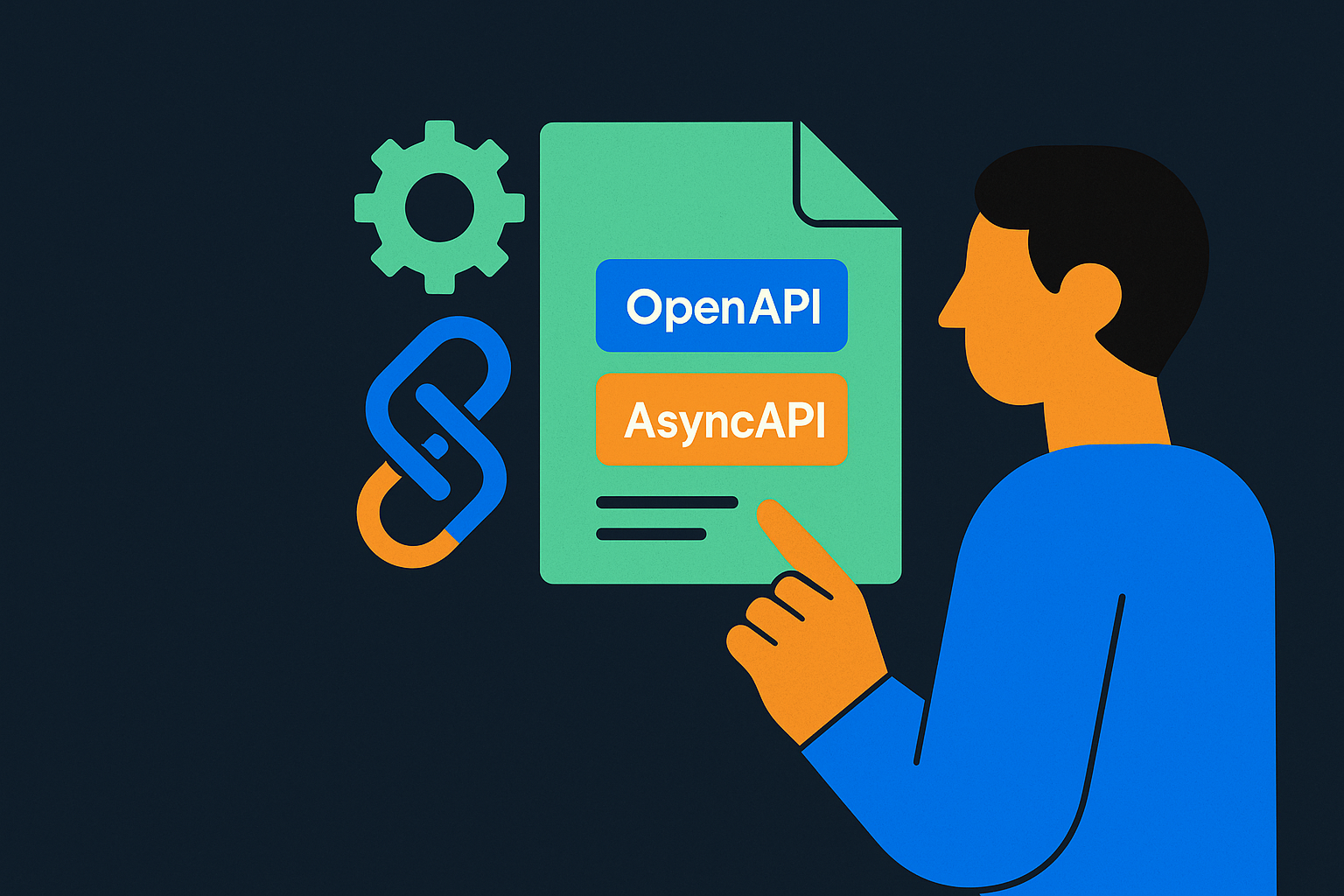
An OpenAPI or AsyncAPI file describes an API completely enough that software can read it and spit out working documentation, no human required to write a page by hand. That's the whole premise behind spec-driven documentation, and it's why the choice of generator matters almost as much as the spec itself: hand the same YAML file to five different tools and you'll get five different reading experiences back. This piece walks through how each major category of generator, from browser renderers to hosted platforms, actually interprets the spec it's handed, and what a team should weigh when picking one for their pipeline.
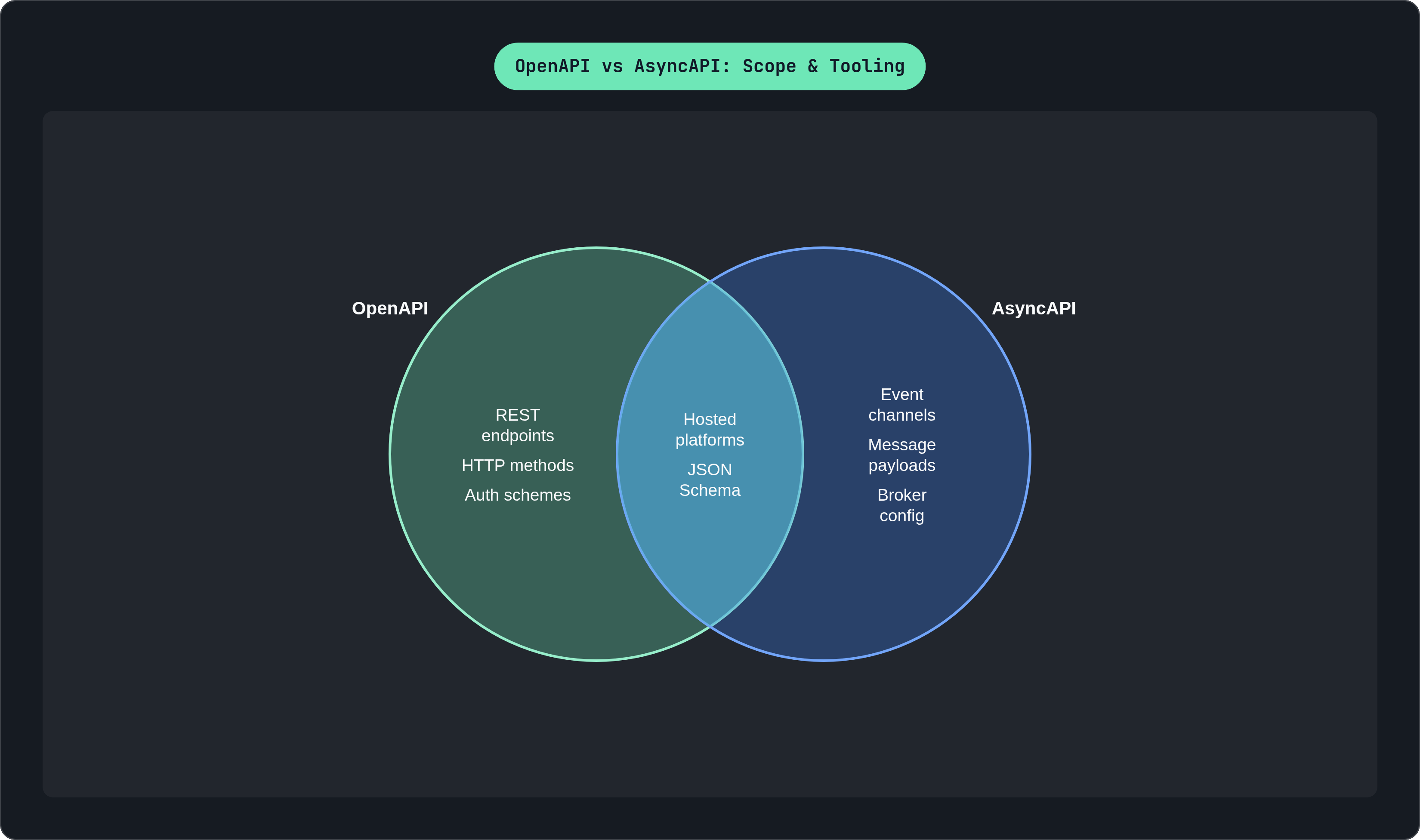
OpenAPI, maintained by the OpenAPI Initiative under the Linux Foundation, is the standard way to describe RESTful APIs: endpoints, HTTP methods, request and response shapes, status codes, authentication schemes. AsyncAPI does the equivalent job for event-driven systems, covering channels, message payloads and headers, protocol bindings, and broker configuration for things like Kafka, MQTT, AMQP, and WebSockets. The rule of thumb holds up in practice: synchronous request-response traffic belongs in OpenAPI, and anything asynchronous or event-driven belongs in AsyncAPI. Most production systems need both, since REST handles commands and queries while AsyncAPI covers the events and streams running alongside them. Whatever the spec doesn't capture, narrative context, architectural rationale, changelog history, has to come from extensions, overlays, or supplementary docs. No generator invents what the file doesn't say.
How recent spec releases change what generators can render
OpenAPI's spec line moved forward on September 19, 2025, with OAS 3.2.0. It's a minor, backward-compatible release, so every valid 3.0 or 3.1 document still means what it always meant. But three additions in that release change what a generator can actually put in front of a reader, and I think they're worth sitting with for a second rather than skimming past.
The Tags object picked up summary, parent, and kind fields, which let a generator build nested sidebar hierarchies instead of dumping everything into one flat alphabetical list. A generator that reads those fields can group fifty endpoints into a taxonomy that mirrors how the team actually thinks about their API. One that ignores them just gives you an unsorted column and calls it navigation. Streaming media types got first-class support through itemSchema, so server-sent event shapes can be documented straight from the spec instead of tucked into a paragraph of prose somewhere. And QUERY joined the list of built-in HTTP methods, which sounds like a footnote until you realize any generator that hasn't implemented it will just drop QUERY endpoints from the rendered output. Silently. No warning, no broken build, just gone.
Tooling support for 3.2.0 is still catching up, understandably. Support for 3.1.x and 3.0.x is mature and close to universal at this point, and a lot of frameworks still default to 3.0 even when the team's actual spec has moved past it. OpenAPI 4.0, nicknamed "Moonwalk," is a longer-horizon redesign still taking shape, with pieces of it getting backported into the 3.x line along the way.
AsyncAPI's path looked different but rhymes. Version 3.0 shipped in November 2023 and moved operations to the top level with explicit send and receive actions, clearing up the publish/subscribe ambiguity that made 2.x specs genuinely confusing to read the first time through. The current line sits at 3.1.0, but a good chunk of tooling still only targets 2.6.0. That gap matters more than the version numbers suggest: a team writing specs in 3.1 but rendering through a 2.6-only generator can quietly lose webhooks, nullable type handling, and JSON Schema alignment from their docs, with nothing telling them it happened. Before committing to a generator, check its changelog for the newest spec version it actually validates against, not whatever it advertises on the landing page. Those two numbers don't always match.
How pure OpenAPI renderers interpret the spec into a browsable UI
All three major pure renderers read the identical OpenAPI file. What splits them apart is what happens after parsing: layout, interactivity, theming, and how closely each one tracks the newer corners of the spec.
Swagger UI is the tool that made interactive OpenAPI docs feel like the default expectation in the first place, and it still moves something like 3 million weekly downloads, dwarfing everything else in raw install count. But it's partially broken on OpenAPI 3.1, which stings given that 3.1 is the version that brought full JSON Schema alignment to the spec. Microsoft dropped the Swashbuckle and Swagger UI default from ASP.NET Core templates starting in.NET 9, about as clear an institutional signal as this ecosystem sends anyone. SmartBear, meanwhile, rebranded SwaggerHub as "API Hub" in January 2025, folding its Stoplight and PactFlow acquisitions into one commercial platform. None of this means Swagger UI stops working tomorrow. It means legacy install volume and fitness for a brand-new project are two separate questions, and teams sometimes conflate them without realizing it.
Redoc takes a different approach: a three-panel layout, navigation on the left, description content in the center where inline Markdown renders in full, request and response samples on the right. It runs around 1 million weekly downloads and has cleared 25,000 GitHub stars. Redoc leans on a couple of extensions that push past what the bare spec offers, x-logo for branding and x-tagGroups for nested sidebar organization, and that second one becomes close to essential once an API grows past a couple dozen endpoints. The free version skips a built-in try-it console; that lives behind the commercial hosted tier. Redoc has also been among the earlier adopters tracking OAS 3.2 fields, which fits its whole profile: large, complicated APIs where the reading experience and navigation structure matter more than an embedded client sitting on the page.
Stoplight Elements offers React components for embedding API docs into a site you already have, which is the right shape if your team already runs a web presence and wants documentation folded into it rather than living as a separate portal somewhere else. Development has slowed noticeably since SmartBear's acquisition, so picking it today comes with a maintenance question attached that wasn't there a couple years back.
What code-plus-doc generators produce from the same spec file
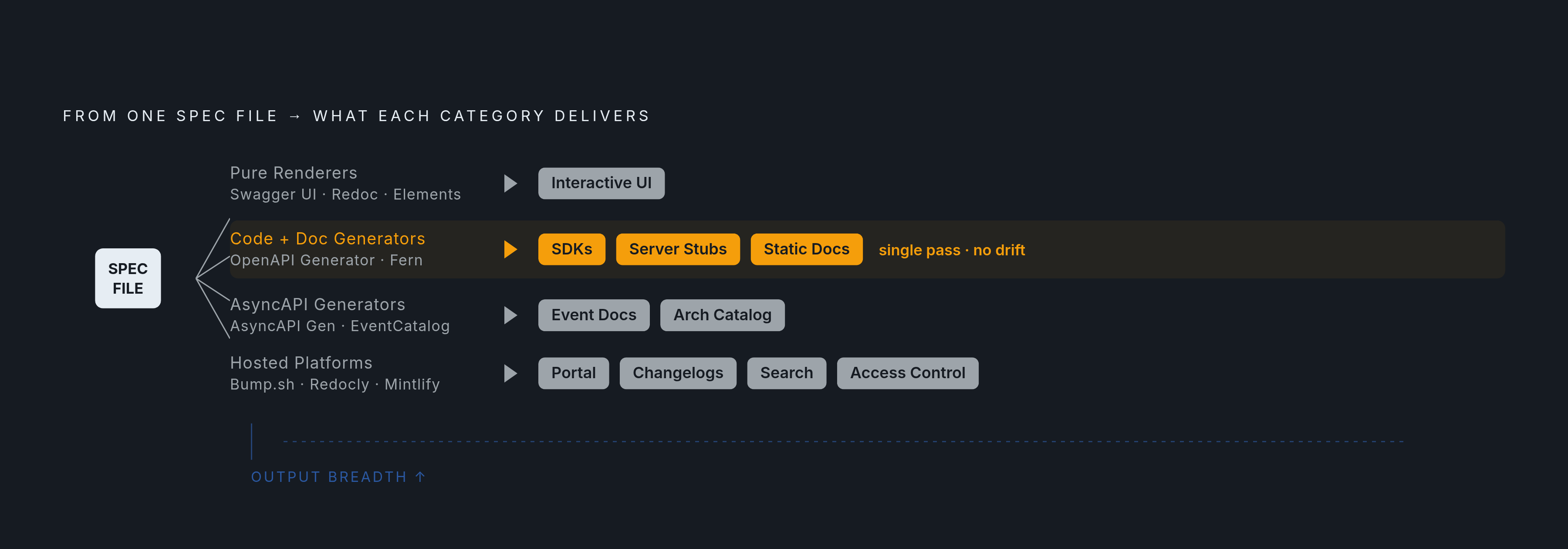
This category does something structurally different: parse the spec once, emit several artifacts from that single pass, client SDKs, server stubs, and documentation, all from the same run. The appeal is obvious the moment you've watched code and docs drift apart on a project where they're generated separately and nobody notices for three sprints.
OpenAPI Generator dominates this category by sheer volume: roughly 600,000 weekly downloads through its NPM CLI wrapper, and something like 30 million downloads via its Docker image. It's community-driven, open source, and covers hundreds of language and framework combinations, which is really the entire feature. The documentation output, static HTML or Markdown, is genuinely just one artifact among several, and teams needing rich, interactive reference docs will find those templates fairly plain next to what a dedicated renderer turns out. The real payoff sits in the CI/CD story: a commit to the spec triggers regeneration of code and docs in the same pass, so the two never fall out of sync the way they do when they're maintained on separate tracks by separate people.
Fern sits at the other end of the same category, with SDK generation as the primary output and documentation treated as downstream rather than the headline. The tool bundles SDK generation and doc output together, so the two arrive as a single artifact rather than as two separate projects somebody has to stitch together later.
The trade-off across this whole category comes down to doc quality against pipeline integration. Code-plus-doc generators win on automation and staying in sync; dedicated renderers win on the actual reading experience. Teams shipping client libraries alongside their API should start here. Teams whose only deliverable is the documentation portal itself probably shouldn't.
How AsyncAPI generators approach a structurally different spec
Confluent's 2025 Data Streaming Report found that 86% of IT leaders name data streaming a top strategic priority. That number matters here because it turns the documentation gap around event-driven APIs into a real operational problem, not a niche complaint from a handful of infrastructure teams.
The official AsyncAPI Generator is template-driven and runs through the AsyncAPI CLI, offering an HTML template built on the AsyncAPI React component and a Markdown template that slots into an existing static-site pipeline or sits alongside code in a repo. Custom templates are supported too, the most flexible path and also the one demanding the most setup work up front. It's the right pick for a team that wants to own its pipeline end to end. It is not the tool for a team that wants something running by end of day.
AsyncAPI Studio, at studio.asyncapi.com, is browser-based and lets you validate a document, preview its documentation, and generate templates from a live spec. It's built for authoring and validation, not for serving as the production documentation layer itself.
EventCatalog comes at the problem from a different angle entirely: architecture rather than field-level reference. It ingests AsyncAPI specs and builds a browsable catalog of events, channels, services, and domains, complete with architecture diagrams, ownership assignment, and automatic versioning. It answers "what does our event-driven system actually look like" rather than "what fields does this message carry," which makes it useful in organizations where a lot of teams are consuming event contracts they didn't write and have no other way to discover.
A handful of ecosystem-specific tools round this out. There's a library for ASP.NET Core that mirrors the Microsoft.AspNetCore.OpenApi developer experience but for AsyncAPI, FastStream in the Python world (solid for Kafka and RabbitMQ, thinner everywhere else), and Go tooling that uses reflection to turn message structs into JSON Schema and assemble them into an AsyncAPI document. Compare any of this to the OpenAPI generation that Django REST Framework or FastAPI hand you basically for free, and the maturity gap is obvious. There's no universal AsyncAPI library that just plugs into whatever messaging framework a team happens to run. Before adopting any of these, confirm it supports AsyncAPI 3.x and actually reads the protocol bindings for the transport in question. Plenty of tooling in this space still only understands 2.6.0.
How hosted platforms use the spec as a foundation rather than a ceiling
This category treats the spec as a starting point, not the finished product. The spec supplies structural accuracy; the platform supplies everything else a developer portal needs, guides, search, versioning, changelogs, access control.
Bump.sh reads both OpenAPI and AsyncAPI specs and rebuilds reference docs on every CI deploy. Its standout feature is automatic structural diffing between spec versions, so API consumers see exactly what changed release to release without anyone on the API team writing a changelog by hand. That's a feature built for the people consuming the API, not just the people producing it, and it shows.
Across this whole category, the pattern holds: the spec handles structural correctness, and the platform handles the actual documentation experience around it. Teams that blur those two responsibilities together tend to underinvest in one or the other, and it usually shows up as either thin docs or a portal that's pretty but wrong.
Matching generator type to pipeline, team, and API shape
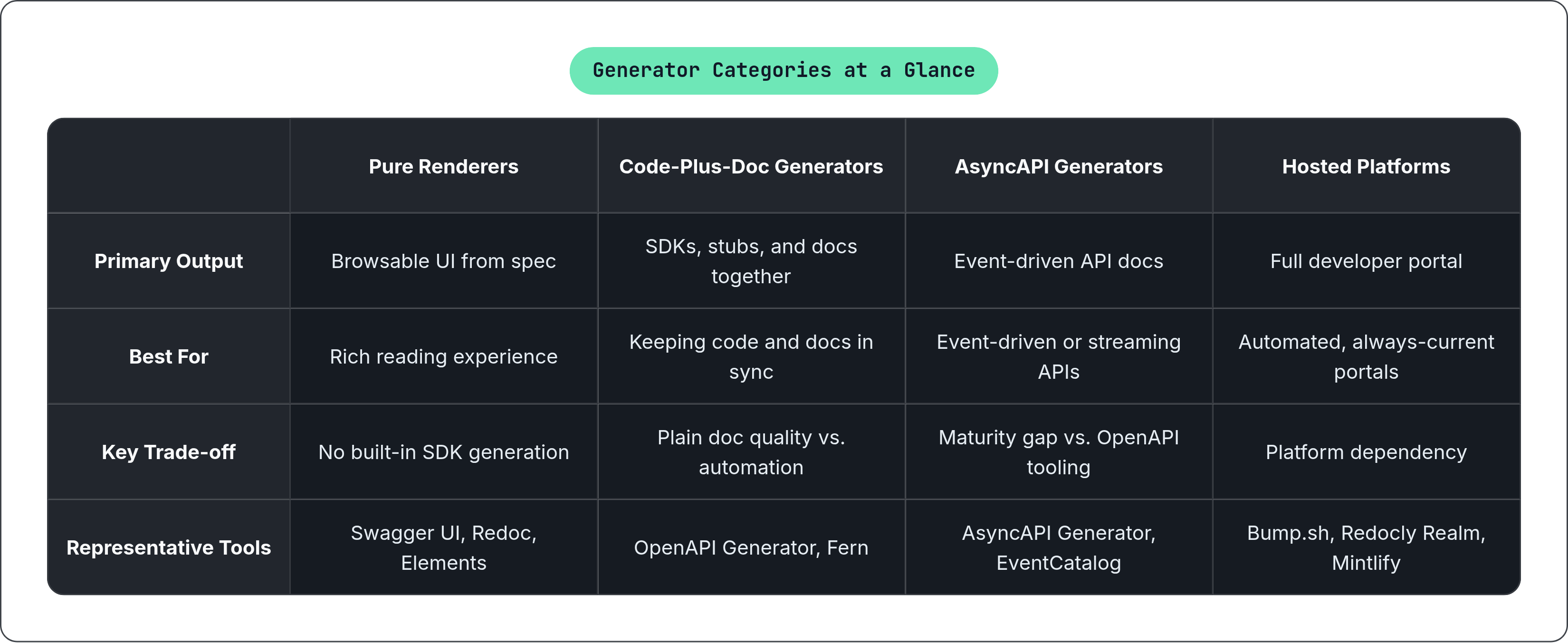
Here's the thing worth sitting with after all that: this was never really about crowning one tool the best. It's about matching a tool to constraints the team already has, a language stack, a CI setup, the actual shape of the API in question.
Start with what the spec covers. A REST or HTTP API points toward the OpenAPI ecosystem, renderers, hosted platforms, code-plus-doc tools alike. An event-driven or message-broker system points toward AsyncAPI tooling, and needing both at once is normal, not a sign something got architected wrong. If a team is actively leaning on OAS 3.2.0 features, nested tags, streaming media types, the QUERY method, that alone should rule out any generator still capped at 3.0 support, since those endpoints and structures will simply disappear from the rendered output otherwise.
From there, ask what the output actually needs to do. A polished reading experience for a large API argues for a dedicated renderer. Tight sync between SDKs and docs argues for a code-plus-doc generator. A documentation system that has to stay current automatically as the product changes points toward a hosted platform built around that exact premise. Look closely enough at any of these tools and you'll find they're optimized for genuinely different jobs, not competing for the same one, which is why walking through them by category tells you more than ranking them ever would.