Automatically Syncing Docs with Product Changes
Keeping docs in sync with code ships faster teams and cuts integration delays.
Most engineering teams ship code weekly, sometimes daily. Documentation updates run on a monthly or quarterly cycle, if that. That mismatch in cadence is why documentation drifts out of date on nearly every team that hasn't specifically engineered against it, and the gap compounds sprint over sprint until the docs describe a product that shipped last month rather than the one a user is staring at right now.
Across major documentation surveys, API documentation teams consistently name keeping docs current as their single biggest problem, ahead of writing quality, ahead of structure, ahead of tooling choice. Sit with that ranking for a second. The writer usually knows how to write clearly. The update never gets scheduled, or gets scheduled after the code that made it necessary has already shipped, been reviewed, and moved into production.
The mechanism is worth walking through slowly. A pull request merges, the sprint ends, the next sprint starts. Updating the doc that described the old behavior isn't on anyone's board anymore, and it wasn't dropped out of neglect. It just never had a slot. Drift is quiet that way. No alarm goes off when a doc goes stale, nobody gets paged, and the gap only surfaces when someone, a new engineer, an external developer, an on-call responder at 2 a.m., acts on information that was true two releases ago and finds out the hard way that it isn't true now.
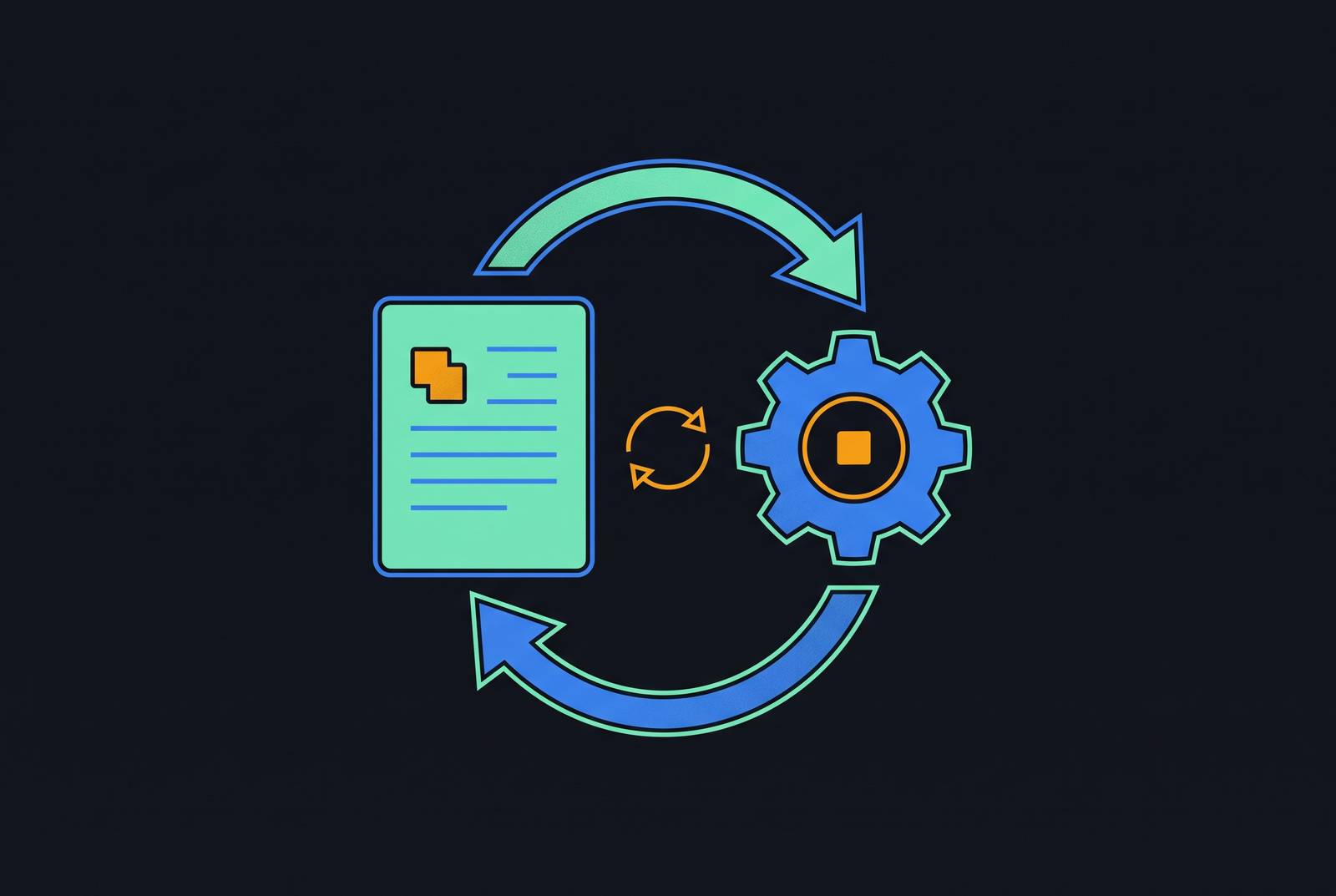
So if the root cause is a cadence mismatch, the fix has to run at the cadence of code, at the same speed as the sprint-by-sprint reality that produced the mismatch in the first place. That's the argument this piece makes, section by section: docs drift because they sit on a different clock than the product, and the only fix that actually holds is putting them on the same one.
What stale documentation actually costs, in concrete terms
Start with the blocking number: 73% of API integrations get blocked by documentation gaps, while only 58% of organizations say they actively keep their docs current. That 15-point spread isn't abstract. It's lost engineering hours, sprint after sprint, spent by someone integrating against an endpoint that no longer behaves the way the reference page claims it does.
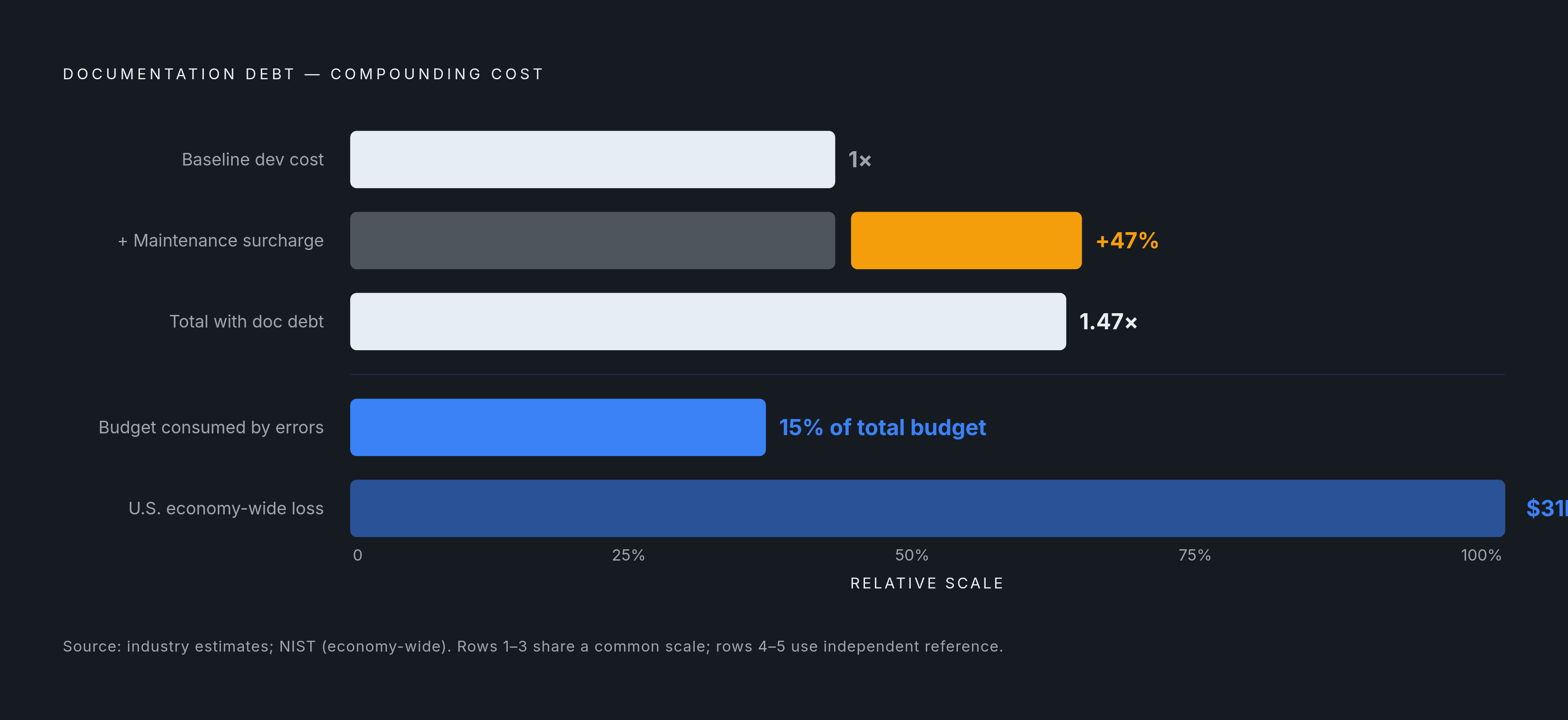
Developers feel this directly. 69% report losing more than 8 hours a week to friction of exactly this kind, with missing or wrong documentation named as a main cause, and poor documentation has been estimated to cost engineering organizations up to $2 million a year. A NIST analysis went further and pegged documentation-related costs across the U.S. economy at roughly $31 billion annually, with documentation errors eating up around 15% of total software development budgets. That's a line item large enough to justify its own review, and most teams never give it one.
Documentation debt compounds the same way technical debt does. A study published on arXiv found that documentation debt adds roughly 47% in extra maintenance effort and about 48% in extra cost on top of what the original development would have cost. The longer a team waits to fix a stale doc, the more expensive the eventual fix gets, because more code gets built on top of the wrong assumption in the meantime.
There's a cost that doesn't show up in any of these figures directly: shadow docs. When the official reference can't be trusted, teams build their own parallel notes, wiki pages, Slack pins, personal READMEs, just to have something reliable. That splits the trust problem in two instead of solving it; now there are two sources of truth, neither fully maintained, and reconciling them later is its own project. Add the support tickets that trace back to a documentation error rather than an actual code bug, and the real cost is the hours spent debugging a problem that was never in the code to begin with.
How documentation quality connects to software delivery performance
Google's DORA research from 2024 found that high-quality documentation correlates with 25% higher team performance, ranking it alongside the core delivery metrics DORA has used for years to separate elite engineering teams from the rest. That's a real claim. It says documentation predicts delivery performance rather than sitting off to the side of it.
The mechanism isn't mysterious once it's spelled out. Teams that ship fast aren't necessarily bigger teams with more headcount thrown at the problem. They're teams where a developer can find the answer to a question without waiting on a Slack reply from whoever happens to know. Reliable docs cut down on context-switching, cut down on the interrupt-driven question that pulls a senior engineer out of deep work for ten minutes, and shorten onboarding, because a new hire reads the doc instead of shadowing someone for a week.
Stack Overflow's 2025 Developer Survey found that 68% of developers learning something new reach for technical documentation first, ahead of AI tools, ahead of online courses. Docs are the first stop for most learning moments most developers have. So when the docs are stale, the primary workflow suffers, not some secondary one.
DORA's 2024 report also tied AI adoption to documentation quality directly: a 25% increase in AI adoption correlated with a 7.5% boost in documentation quality scores. That's a measurable move on a metric teams already track. Which raises the real question this piece needs to answer next: given that documentation quality clearly moves delivery performance, what's the actual architecture that gets a team there reliably, rather than accidentally?
Why docs-as-code is the right architectural response, and where it stalls
The idea behind docs-as-code is simple enough to state in one line: store documentation in Git next to the code, run it through the same CI/CD pipeline, apply the same version control, the same pull request review, the same automated build process. Docs update as a side effect of shipping instead of as a separate task someone has to remember afterward.
That framing lines up exactly with the cadence problem from the opening. If drift happens because docs run on a slower clock than code, the fix is putting docs inside the clock that already works, the one teams have already spent years building tooling and discipline around. Nobody has to convince an engineering team to take CI/CD seriously; they already do. Docs-as-code just asks documentation to ride inside that seriousness instead of sitting outside it.
Here's where it gets uncomfortable: GitKraken's 2025 State of Developer Workflows report found that only 12% of teams have actually implemented a standardized documentation workflow end-to-end, and the 2025 State of Docs report found 77% of teams running homegrown documentation methods instead of anything close to an established framework. So there's a real gap between what nearly everyone agrees is the right principle and what teams have actually built. "Treat docs like code" gets nodded at in nearly every engineering all-hands. Very few teams have the pipeline that makes it true, and that gap is the whole story of this piece.
The bottleneck isn't buy-in; nobody needs convincing that stale docs are bad. The bottleneck is that most teams stop at putting Markdown files in a repo and call it finished, when that's step one of the system, not the whole of it. Storing docs in Git next to code doesn't sync anything by itself; it just puts the files in the same place. What actually closes the gap is the automation layer sitting on top of that: something that watches for code changes and validates, updates, or at minimum flags the affected doc, every time, without anyone having to remember. That layer is worth breaking down piece by piece.
The four automation mechanisms that close the sync gap in practice
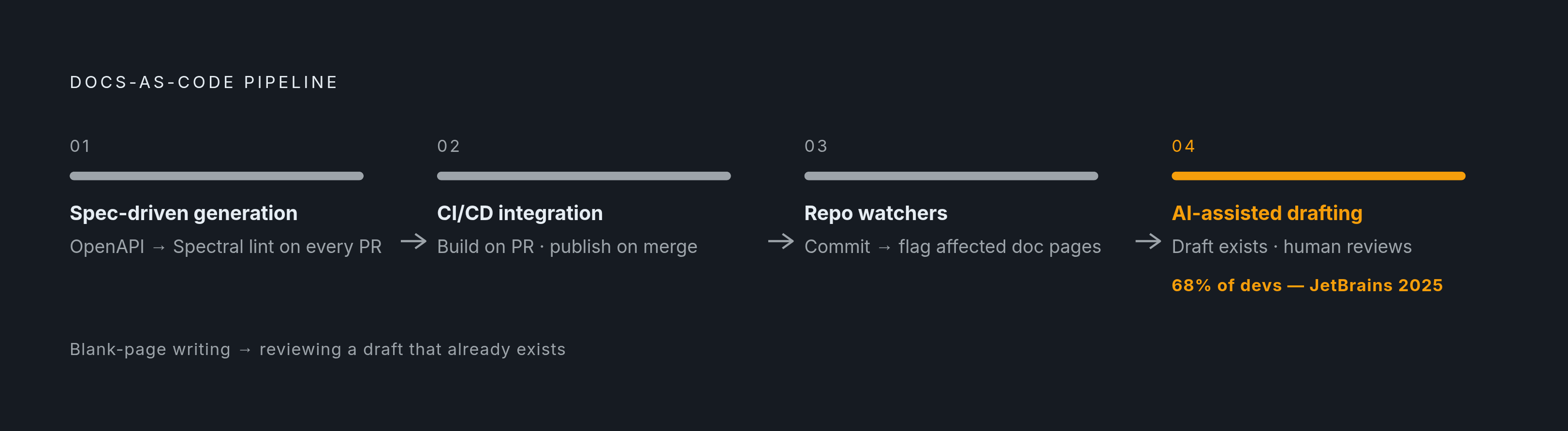
Four mechanisms show up across the tools and teams doing this well, and they tend to work together rather than substitute for each other.
Spec-driven API reference generation treats the OpenAPI specification as the single source of truth. One file generates the interactive reference docs, the client SDKs, the server stubs, and the validation tests. The trick isn't generating the spec once at kickoff and moving on; it's keeping that spec current every time the underlying code changes, then validating it inside the same pipeline that already runs unit tests and ships builds. Spectral handles OpenAPI linting, and GitHub Actions or GitLab CI can run that validation in parallel with the rest of code review, posting results as a comment right on the pull request.
CI/CD pipeline integration means documentation builds trigger the same way code builds do, on pull request, with automatic publishing after merge. Nobody remembers a manual deployment step for the docs site separately from the app deployment. The feedback is immediate, too: a developer sees a doc validation failure sitting right next to a failed test, before merge, not two weeks later when a user opens a ticket about a broken example. GitHub Actions, GitLab CI, and Jenkins all support this pattern without much custom scripting.
Repository watchers add a layer that actively maps code changes to documentation pages. When a commit touches a UI component or an API endpoint, the watcher checks which doc pages reference that piece of the system and either updates them automatically or flags them for review. Either way, the team finds out the same day, not the next time someone happens to notice the doc looks wrong. Tools like DocuWriter.ai run this kind of monitoring across GitHub, GitLab, Bitbucket, and Azure DevOps, so it isn't limited to teams standardized on a single git host.
AI-driven change detection and draft generation is the newest of the four, and arguably the one doing the most work right now. When code changes, an AI layer identifies which docs are affected and drafts the revision itself; the human's job shifts from writing the update from a blank page to reviewing and correcting a draft that already exists. The JetBrains Developer Ecosystem Survey from 2025 found 68% of developers now use AI tools to help write documentation. That's close to standard practice at this point. And detection, honestly, is the harder half of the problem: writing the update once someone knows it's needed is comparatively easy, but figuring out which of two hundred doc pages just went stale because of one merged PR is where manual workflows fall apart, and exactly where AI tooling adds the most value.
Underneath all four sits one principle worth naming on its own: reusable content, stored once. A fact that lives in a single place gets updated once and propagates everywhere it's referenced. A fact copied into three different docs, three formats, three teams' notes, is a fact that will eventually disagree with itself. That's just what happens to duplicated information, given enough time.
Tools that implement these mechanisms in 2025–2026
No single tool covers all four mechanisms equally well, and the right pick depends on which kind of drift is actually hurting a given team: API reference drift, internal knowledge decay, or narrative doc lag trailing behind product changes.
For API reference sync specifically, GitBook's "computed content" framework, launched in May 2025, lets a team upload an OpenAPI spec and have the reference docs update automatically every time that spec changes, cutting manual maintenance considerably. It has a free tier, with paid plans starting at a low per-user monthly rate. Fern takes a docs-as-code approach aimed at API-first teams specifically. Stoplight focuses on API design and governance, with documentation output being a downstream benefit of getting that design layer right.
For codebase-aware internal documentation, DeepDocs runs as an AI agent that watches a codebase and proposes documentation updates automatically when code changes, with no manual review cycle to trigger.
For narrative and product documentation, Archbee is a documentation platform that supports both public-facing docs and private internal portals, with API synchronization features aimed at keeping technical references current. A newer category worth watching is knowledge infrastructure platforms that treat documentation as a living source feeding both human readers and AI agents at once, Mintlify, a self-updating docs platform used by teams at Anthropic and Coinbase, sits in this space, which matters more by the month as agent traffic on documentation sites grows.
For teams that want to own the whole stack, Docusaurus remains a widely used open-source option for teams that want to own the full documentation stack. It gives full control over hosting and deployment, which makes sense for teams with the engineering capacity to build the automation layer on top of it rather than buy it off the shelf.
The real selection question is which mechanism matches the specific drift vector actually hurting the team, and whether the tool plugs into the CI/CD pipeline already running or demands a second parallel workflow that developers will quietly stop maintaining within two quarters. Bet on the second outcome by default; that's what usually happens when a tool sits outside the pipeline instead of inside it.
Documentation now has a second reader: the AI agent
By 2026, documentation has two audiences, not one. Human developers still scan headings and copy code samples the way they always have. AI coding agents, meanwhile, inside tools like Cursor, Claude Code, and Copilot, are reading the same pages programmatically, and agent traffic on documentation sites is growing steadily alongside human traffic.
That changes what a stale doc actually breaks. For a human reader, an outdated doc causes confusion, maybe an hour lost tracking down what changed. For an AI agent, an outdated doc causes a wrong output delivered with full confidence, because the agent has no way of knowing the page it just read describes last quarter's API. It doesn't hedge. It doesn't flag uncertainty. It acts on what's in front of it, full stop.
That reframes what "good documentation" even means. Accuracy and sync used to be quality goals, the kind of thing a docs team aspired to and got graded on at review time. For any team shipping AI-powered features now, they're closer to correctness requirements, the same category as a passing test suite. An agent working off outdated API docs generates an integration that looks plausible and doesn't work; an agent working off docs actually in sync with the shipped code produces something usable on the first try.
None of this changes the four mechanisms laid out earlier. Spec-driven generation, CI/CD integration, repository watchers, AI-assisted drafting, all of it still applies. What changes is the cost of skipping it. AI-generated code now makes up a significant and growing share of what engineering teams ship, and documentation is following the same curve. Writers are increasingly spending less time drafting from scratch and more time reviewing AI-generated content, which is exactly the shift the four mechanisms above are built to support.
Making sync a property of the pipeline, not a task on the backlog
Documentation drift doesn't happen because teams forget. It happens because sync gets treated as a task that follows shipping, something to circle back to, rather than a property built into the act of shipping itself. That's the reframe this whole piece has been building toward, one section at a time.
In practice, building sync into the pipeline looks like a handful of concrete changes. Pull request templates that include a documentation check as an actual merge requirement, not a checkbox someone can skip and merge anyway. CI/CD steps that validate spec accuracy before merge, not after the release has already gone out. Repository watchers that surface affected doc pages the moment a relevant file changes, instead of relying on the original author to remember what they documented three sprints back. AI-generated draft updates that land in a review queue, so a human corrects a draft instead of starting from nothing.
Here's the trap worth naming directly: framing this as "we need to get better about updating docs" keeps teams losing that fight, because discipline doesn't scale against a cadence mismatch. The code ships weekly; a process reminder, however well-intentioned, can't outrun that clock on its own, and only a pipeline running at the same speed can.
Across the major documentation reports from 2024 through 2026, one finding keeps repeating: the maintenance problem is now bigger than the creation problem. Teams have gotten reasonably good at writing docs for something new. Keeping those docs true six months later is where nearly everyone still struggles, and tooling investment should follow that shift instead of lagging behind it.
The DORA evidence points consistently in one direction: teams that get documentation quality right perform better across the delivery metrics that matter, on top of running nicer documentation sites. Documentation acts as a multiplier on everything else the engineering org is already trying to do. The end state worth building toward is simple to describe, even if it takes real engineering effort to reach: a merged pull request propagates to documentation automatically, as what the pipeline does by default, not as a feature anyone has to ask for.