Evaluating AI Documentation Platforms for Agent Workflows
How to pick documentation tools built for agents, not just bolted-on chatbots.
Documentation now does two jobs, and most platform reviews still grade it like it does one. Confuse "docs written for agents to read" with "docs that capture agent workflows" and you'll end up picking the wrong tool, then wondering why it doesn't do what the sales page promised. This piece works through what actually separates a platform built for machine readers from one that bolted on a chatbot and called it a day, and it names names: which tools handle which job, and where the whole category still comes up short.
The AI agent market was worth $7.84 billion in 2025. MarketsandMarkets projects it hits $52.62 billion by 2030, a 46.3% compound annual growth rate. That's fast enough that whatever a company picks this year for tooling shapes what's even possible three years out. McKinsey surveyed 1,993 companies between June and July of 2025 and found 62% actively experimenting with agents, but a separate IDC and AWS study from November 2025, covering more than 900 organizations, found only 3% have actually scaled agentic AI across multiple departments. Fifty-nine points sit between playing with agents and running them for real, and that gap isn't mainly a model problem. Somewhere in there is infrastructure, the plumbing that decides whether an agent can find, trust, and act on knowledge a company already wrote down. Documentation is one piece of that plumbing, and it's the piece nobody's looked at closely.
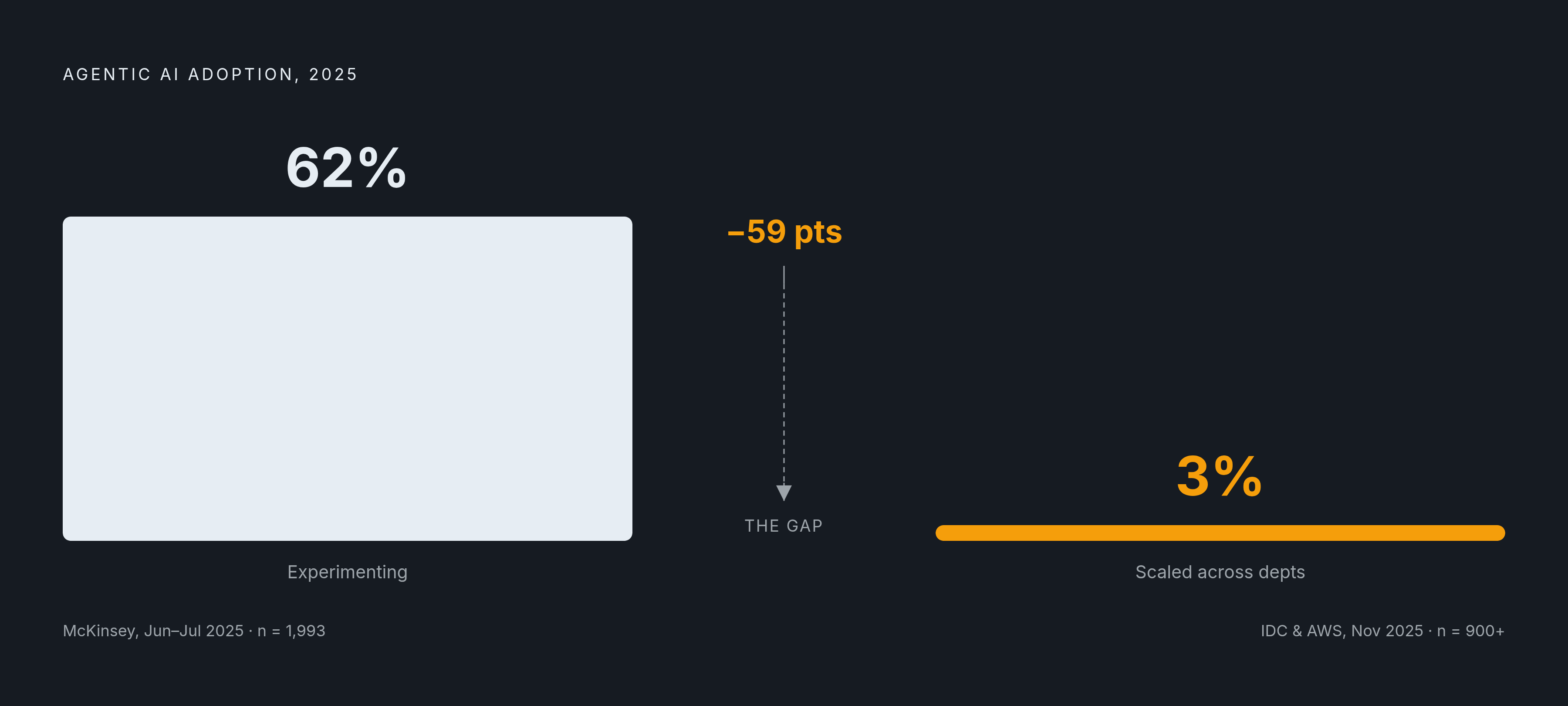
Documentation has two distinct jobs in an agentic system, and conflating them causes the wrong evaluation
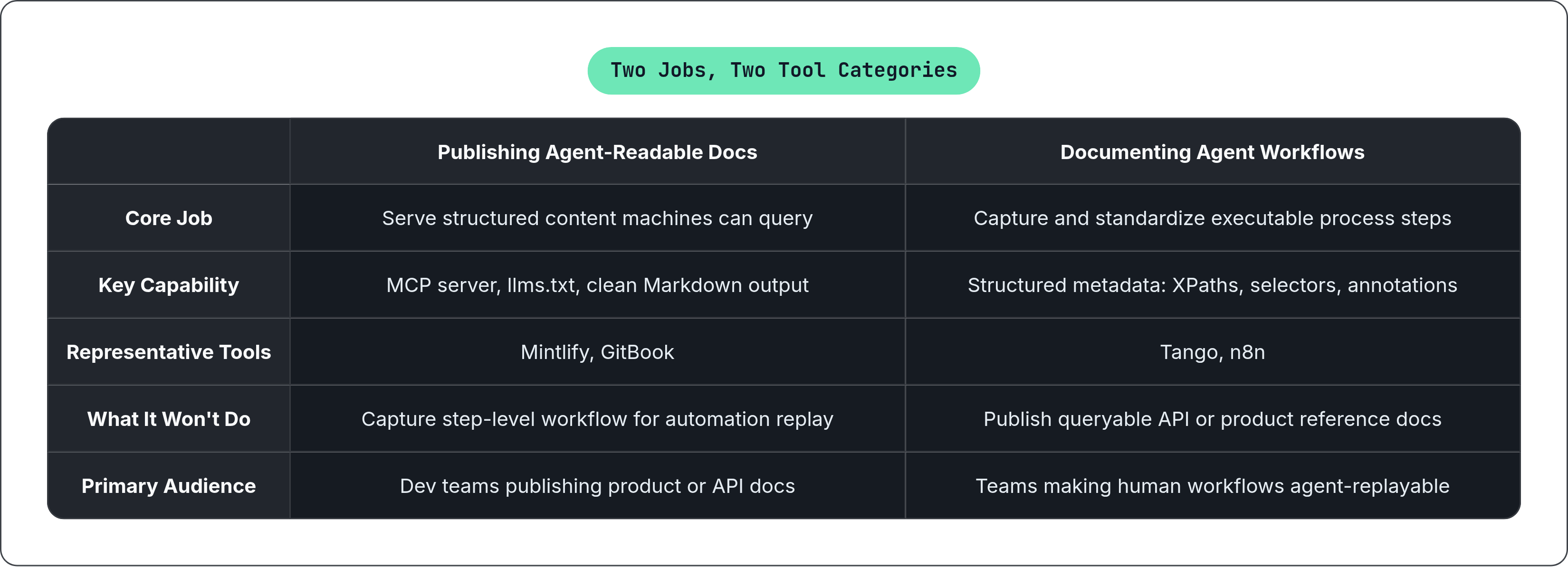
Ask ten people what "AI documentation" means and you'll get answers describing two different problems that happen to share a word.
The first problem is publishing docs for agents to read. This is product and API documentation, the kind a developer used to pull up in a browser tab, except now the reader is often Cursor, Claude Code, or some other coding agent grabbing content mid-task.
The second problem is documenting agent workflows. That means capturing and standardizing the actual steps an agent, a human, or both are supposed to run through, so the process makes sense to a person and to a machine at the same time.
A tool built for the first job, say a developer docs platform with a Model Context Protocol integration, does nothing for the second. It won't capture a step-by-step process with the metadata an automation tool needs to replay it later. Flip it around and a tool built for workflow capture won't help you publish clean, queryable API reference docs either. Picking one while trying to solve the other burns real evaluation time chasing a feature that was never going to show up, and this happens more than it should, mostly because both get marketed under the same "AI-ready" banner.
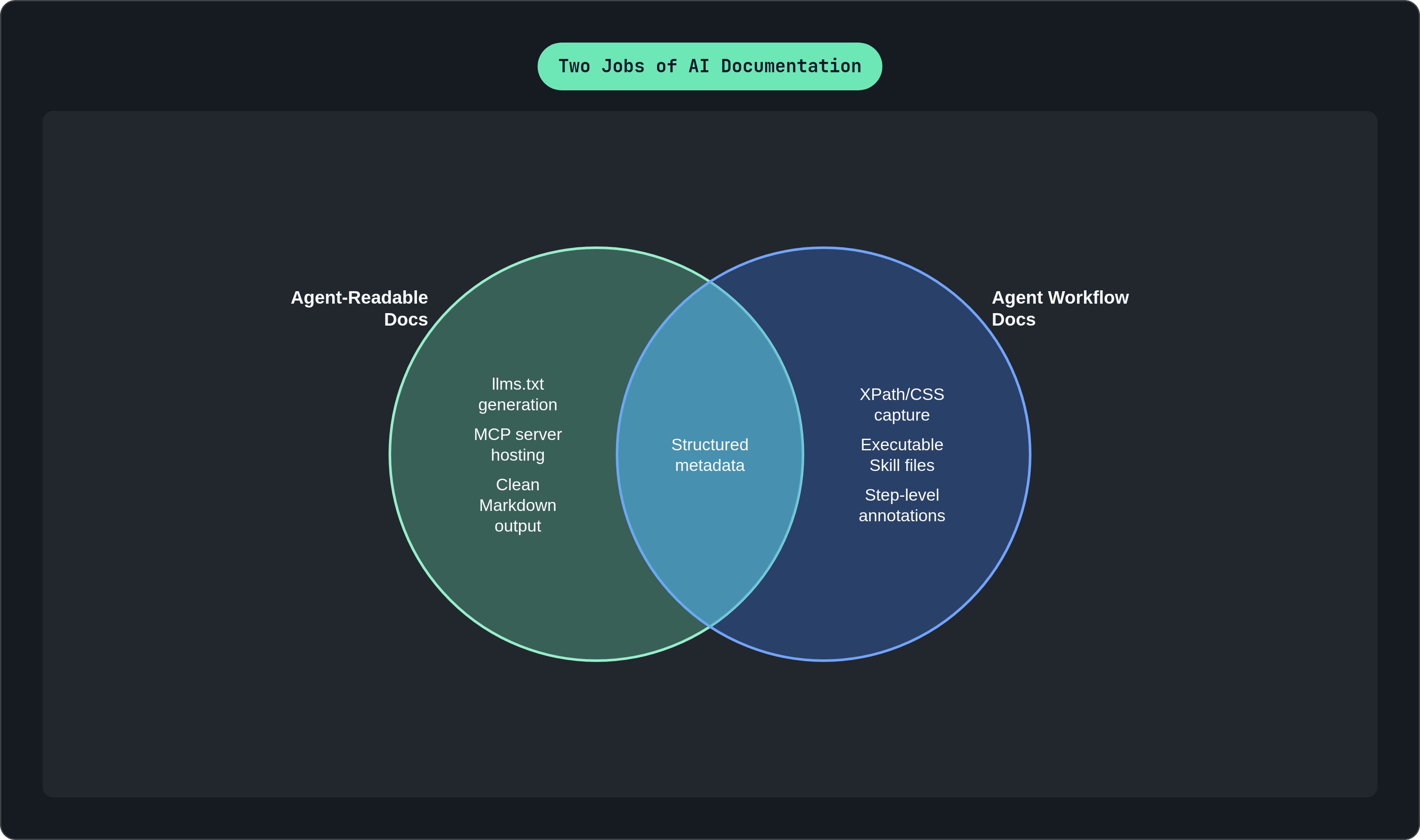
One requirement sits underneath both jobs, though: the knowledge has to be something a machine can query, not just something a person can read. That's the line between a platform genuinely built for agents and one that's merely agent-adjacent, the kind that added a chatbot widget and called it finished. The rest of this piece covers both categories and names which job each platform is actually built for.
What changed when AI agents became a second class of reader for documentation sites
Documentation spent most of its history optimized for one kind of reader: someone scrolling a page, scanning headings, hitting Ctrl-F to jump to a section. That assumption doesn't hold anymore, not for a growing and already substantial share of traffic.
Mintlify reported in 2026 that nearly half of traffic to documentation sites comes from AI agents, tools like Cursor, Claude Code, and ChatGPT, rather than human browsers. For API-first products the share runs even higher. Close to half the audience for a lot of docs sites is no longer a person at all, a strange sentence to write and an even stranger one to build a docs strategy around if you haven't yet.
Agents don't scan pages the way a person does. They query them, minus the visual habits a human brings to a page, and an agent working through a coding task doesn't care about a layout built for eye movement. It wants a clean, structured answer to a specific question, in a form it can parse without guessing. HTML wrapped in navigation bars, cookie banners, and JavaScript that only renders content client-side is genuinely hostile to that kind of parsing. Hitting a page like that with an agent produces noisy, half-broken output, or the thing fails quietly and nobody notices until three tasks downstream go wrong for no obvious reason.
GitBook found that 76% of practitioners now use AI regularly to help write documentation, up 16 percentage points from 2025. That's a real jump, and it's tempting to read it as progress on the problem this piece is actually about. Using AI to write docs faster solves a different need than writing docs an AI agent can reliably consume at runtime. They're adjacent improvements, not the same improvement, and mixing them up is the exact category error the first section was getting at.
The old scorecard doesn't transfer. Readability scores, SEO rankings, visual polish, these were reasonable stand-ins for quality back when humans were the only readers. They tell you almost nothing about whether an agent hitting an MCP endpoint gets back something it can actually use.
The emerging standards that determine whether an agent can actually read your docs
Two standards have become the baseline for agent-readable documentation, and they do different jobs.
The first is llms.txt, a small file sitting at a site's root that tells an agent what content exists and roughly how to find it. Think of it as a table of contents written for a machine instead of a person, a "read" layer that points an agent toward where to look rather than handing it anything directly.
The second is Model Context Protocol, or MCP, which Anthropic introduced in late 2024 and which OpenAI, Google, Cursor, and Cline have since adopted. MCP gives an agent a standardized way to query and interact with external tools and data dynamically, at runtime, instead of leaning on whatever it happened to learn during training. If llms.txt is the "read" permission, MCP is closer to "execute": a live channel, distinct from a static map.
Why does that distinction matter so much? Because it fixes something baked into how large language models work: training data is a snapshot, and snapshots go stale. An analysis on arxiv.org frames MCP this way, as a standardized channel that lets agents reach current, governed content instead of leaning on outdated pretraining knowledge. Without something like MCP, an agent is guessing off whatever was true when it was trained, which for a fast-moving API could mean months out of date, and the agent has no way of knowing that.
Google's Agent2Agent protocol, introduced in 2025, sits a layer above this. A2A lets autonomous agents collaborate across separate systems using standard web protocols like HTTP, SSE, and JSON-RPC. It matters most for teams running multi-agent pipelines, where one agent needs to hand context to another without a person relaying it by hand.
A documentation platform that doesn't auto-generate llms.txt and doesn't host an MCP server isn't agent-ready by current standards, no matter how polished the human-facing side looks. These have stopped being nice-to-have extras. They're becoming the baseline interoperability layer for documentation, the same way REST APIs became the default expectation for web integrations a decade back. A platform missing them isn't lagging on a feature; it's missing the entry ticket.
The evaluation criteria that actually separate agent-ready platforms from agent-adjacent ones
Pull from practitioner frameworks and the common patterns around MCP and retrieval-augmented generation integration, and a handful of criteria keep separating platforms that work for agents from ones that just say they do.
Start with AI readiness in the literal sense. Does the platform auto-generate llms.txt and llms-full.txt? Does it host its own MCP server? Does it serve clean Markdown through content negotiation, or does an agent hitting the page just get raw HTML, chrome and all?
For workflow documentation specifically, structured metadata capture matters a lot, and it's the piece most tools skip entirely. Per Tango's framework, that means capturing XPaths, CSS selectors, step-level annotations: the granular detail an agent needs to execute a process, not just read a description of one.
Then there's automated currency. Does the documentation update itself in step with product changes, triggered by a pull request or a changed API spec, or does someone have to remember to go do it by hand? That question gets its own section later, because it's the criterion most reviews skip and it might be the single most consequential item on this list.
RAG-readiness matters too. Can an agent query governed content through retrieval-augmented generation without a team standing up and babysitting a separate vector database next to the docs platform?
Native pipeline integration deserves real weight as well. Is the knowledge available inside the agent's actual working environment, an MCP endpoint a coding agent calls mid-task, say, or does a human still have to go look something up and paste it in? That second option defeats a good chunk of the point of having an agent do the task at all.
Analytics on agent traffic rounds this out. Does the platform show which agents are visiting, which pages they're actually reading, which queries come back empty? Without that feedback loop, a team is guessing at where the gaps are instead of knowing.
Enterprise governance can't be an afterthought either. Granular permissions, audit logging, certifications like SOC 2 or ISO 27001, all of it matters more, not less, once agents are pulling documentation at runtime. An agent with access to sensitive docs needs the same access controls any API would need, and pretending otherwise because "it's just an agent" is how a leak happens.
Notice what's missing from that list. Visual design, WYSIWYG editor quality, SEO meta-tag controls, social sharing buttons, these dominate human-docs product reviews and barely register for agent evaluation. That's not a knock on those features; they're just answering a different question than the one this piece is asking.
Automation doesn't mean cutting humans out entirely, either. Even inside a fully automated update pipeline, the real question is whether a review gate sits before publication, or whether changes go live unchecked. Speed without a checkpoint is its own kind of risk, and it's a risk that compounds quietly.
Platforms built for publishing agent-readable developer and product documentation
Mintlify auto-generates llms.txt, llms-full.txt, and a skill.md file at the root of a documentation site, and serves pages as clean Markdown through content negotiation, so an agent gets structured content instead of HTML noise. It auto-hosts an MCP server for every docs site it powers, so tools like Cursor, Claude Code, and Windsurf can query live documentation mid-task without anyone building a separate integration by hand. Its Workflows feature, paired with the Mintlify agent, automates documentation updates off engineering signals: pull requests, Slack messages, Linear issues, API calls, webhooks, with a human review gate before anything actually publishes. AI traffic analytics show which agents are visiting, which pages they read, which queries come back empty, closing the loop between documentation gaps and the agent failures those gaps cause downstream. It also runs bi-directional Git sync, so engineers work directly in MDX while non-technical contributors use a web editor, both drawing from the same source. Pricing starts at a Hobby tier at no cost a month and scales to custom Enterprise pricing.
GitBook takes a bundled approach. It ships a proactive AI Agent, an embeddable AI Assistant, auto-generated MCP servers, and llms.txt output, all inside one managed product, so human readers and AI agents draw from the same source without a team maintaining separate pipelines on the side. Its MCP analytics view shows which AI tools are crawling the docs and what they're actually querying, useful for the same reason mentioned two paragraphs up: fixing what you can't see failing isn't possible. GitBook holds SOC 2 and ISO 27001 certification, offers granular permissions, and provides dedicated migration support, a strong governance posture for bigger teams. By its own framework, GitBook positions itself as bundling its proactive AI Agent, embeddable AI Assistant, MCP servers, and llms.txt output into one product instead of several stitched together.
What it comes down to is what a team weighs most. Automated update workflows wired directly to engineering signals, plus native MCP hosting, make the first platform the stronger pick when documentation currency and pipeline integration top the list. GitBook's bundled AI Agent and compliance certifications fit a team that wants one vendor covering the whole stack, governance built in from day one.
Neither platform touches the second job. Structured process capture for automation needs a different category of tool entirely, which is where the next section goes.
Platforms built for documenting the workflows agents execute
Tango captures a process automatically as someone completes it. A person runs through a workflow once, doing whatever they'd normally do, and Tango generates a structured guide off that single pass. Each captured workflow carries structured metadata (XPaths, CSS selectors, step-level annotations), the layer most documentation tools skip but that agents and automation platforms actually need to execute a process reliably instead of just describing it in prose. Those workflows export as agent instructions or as executable Skill files, which moves a team from a document describing the process to something an agent can run, without rebuilding it from scratch. Tango fits teams that need to capture workflows humans already do and make them replayable by agents, not teams whose main job is publishing API or product reference docs.
n8n sits in a different lane entirely. It's open-source, self-hostable workflow automation software with first-class AI nodes, more than 400 integrations, and native LangChain support. Because it can be self-hosted, teams running heavy volumes of automation can do it at low server cost, a big part of why it's become a default choice for high-volume automation work. Pricing runs free for self-hosted deployments up to a low monthly fee for the cloud starter tier. n8n fits teams that need to wire agents into external systems through visual workflows. A team whose main need is documenting a process in the first place will find it a poor match, and forcing that fit rarely ends well.
The distinction here isn't subtle once you see it. Tango documents what a workflow is, a structured capture built for both human and agent comprehension, while n8n executes the workflow as the integration layer that actually moves data between systems. Both jobs matter, and they aren't the same job. Picking one tool while expecting it to do the other's work usually produces a platform that's excellent at one thing and mediocre at the thing you actually needed.
Agent development frameworks and where documentation infrastructure fits into them
Before a team even gets to picking a documentation platform, there's a prior question worth asking: can the agent architecture query that documentation at all? A beautifully agent-ready docs platform delivers zero value if the framework underneath has no mechanism to reach out and retrieve anything at runtime.
Based on more than 18 production deployments tracked by Alice Labs through the second quarter of 2026, a rough production-readiness picture has emerged among the major frameworks. LangGraph 1.0 leads for complex, stateful workflows where an agent needs to track state across many steps. The Claude Agent SDK is strongest for teams building production agents natively on Anthropic's models. CrewAI 1.14 offers the fastest path to role-based, multi-agent prototypes, and CrewAI reports it's used by 65% of the Fortune 500; its Discovery feature mines large volumes of past agent runs to surface automation opportunities, ranked by effort, value, and readiness. Microsoft's Agent Framework 1.0, arriving in April 2026 and merging what used to be Semantic Kernel and AutoGen into one product, fits teams already committed to a.NET or Microsoft stack best (AutoGen alone had passed 50,000 GitHub stars before the merge happened). LlamaIndex Workflows 1.0 leads for agents that need to stay grounded in retrieval-augmented generation, and Pydantic AI V2 is the strongest option for teams wanting type-safe Python.
Two more frameworks sit outside that ranking but are worth naming. OpenAI's Agents SDK, a lightweight Python framework released in March 2025, has passed 26,000 GitHub stars and works across more than 100 different LLM providers, a real advantage for teams that don't want to lock into one model vendor. Dify, a low-code platform with more than 100,000 GitHub stars, offers a visual interface with built-in retrieval-augmented generation, function calling, and ReAct support. It's the lowest-barrier option for teams without deep in-house machine learning engineering.
Whatever framework an agent runs on, though, if it can't reach current, governed documentation through something like MCP at runtime, it's working off stale pretraining data no matter how sophisticated the framework is underneath. The choice of agent framework and the choice of documentation infrastructure aren't really two separate decisions. They're coupled whether a team treats them that way or not.
How to evaluate documentation currency — the criterion most platform reviews skip
Nearly 80% of organizations deploying generative AI, per McKinsey's 2025 research, are layering it onto processes that already exist instead of redesigning how the work actually flows. Only about 21% have rethought the underlying workflow at all. That statistic explains a lot about why outdated documentation keeps showing up as a recurring failure point: teams bolt AI onto a documentation process that was already lagging behind the product, and the lag doesn't disappear just because an AI layer now sits on top of it.
Why does this failure mode hit so much harder with agents than it did with human readers? A person hitting a stale doc page usually has some instinct that something's off: an API parameter that doesn't match what's showing up in the console, a screenshot that looks a version behind. An agent has no such instinct, retrieving stale documentation and acting on it with the exact same confidence it would have with current documentation, because from where the agent sits, there's no difference between the two. The failure is silent, and it shows up downstream, usually as a task that quietly fails or spits out the wrong thing with no obvious cause anyone can point to.
What does automated currency look like when a platform does it well? Documentation updates get triggered by real engineering events, a merged pull request, a changed API spec, a closed Linear ticket, rather than sitting around waiting for someone's quarterly review cycle to roll around. A draft-and-review workflow sits between the trigger and publication, so a human still signs off before the updated docs go live, which keeps things accurate without requiring anyone to remember to start the update themselves. And the content needs to be version-aware: an agent needs to know which version of an API a doc is actually describing, not just that a doc covering that endpoint exists somewhere on the site.
Platforms leaning on manual authoring workflows, even with AI writing assistance layered on top, don't solve this. They just move the bottleneck. Instead of "someone has to write this," the bottleneck becomes "someone has to remember this needs updating," which is arguably harder to catch, since a missing update doesn't announce itself the way a missing document does.
So here's the question worth putting to any vendor, before signing anything: what triggers a documentation update, and how long does it take from a product change happening to that change reaching the docs an agent is going to query tomorrow? An honest answer involving someone's calendar reminder is worth knowing before an agent spends a week working confidently off a doc that stopped being true two releases ago, not after.