OpenAPI Specification Structure and Authoring Workflow
How OpenAPI 3.2 refines API documentation structure and authoring workflows.

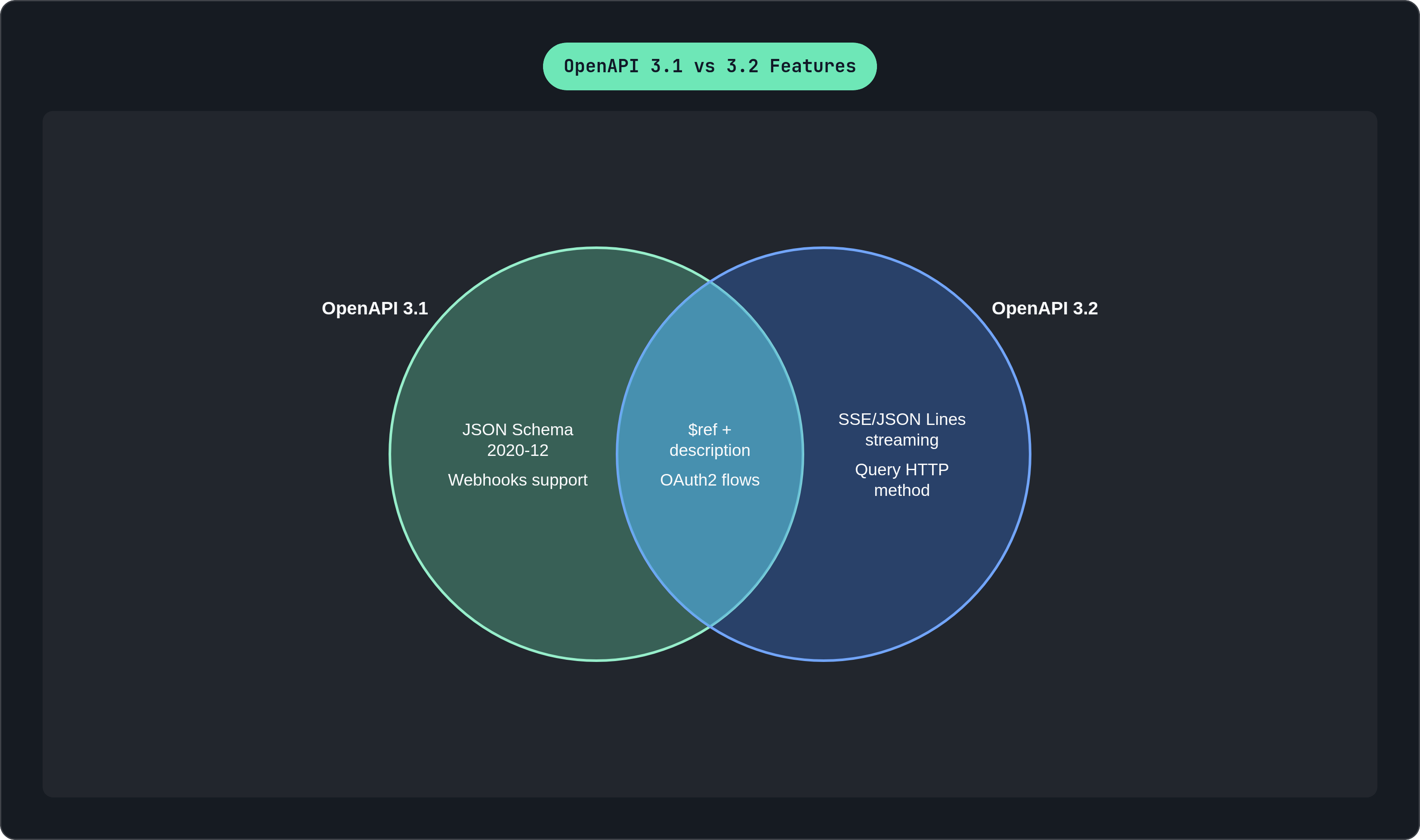
OpenAPI 3.1.0, released in February 2021, was a landmark release for one specific reason: full alignment with JSON Schema Draft 2020-12. Before 3.1, OAS maintained its own divergent Schema Object vocabulary, inspired by JSON Schema but not actually compatible with it, which meant validators and tooling had to maintain separate implementations. Closing that gap was not cosmetic; any standard JSON Schema tooling can now operate directly on OAS schema definitions without a translation layer in between.
Beyond JSON Schema alignment, 3.1 introduced webhooks as a first-class top-level element, added SPDX license identifiers to the Info Object for machine-readable license declaration, and allowed descriptions alongside $ref objects, which 3.0 prohibited. That last change sounds minor until you are annotating a large spec mid-project and realize that 3.0 forced you to choose between a $ref and a contextual description. You cannot have both. It is an annoying wall to run into.
OpenAPI 3.2.0, released in September 2025, builds on 3.1's foundation rather than restructuring it. The additions worth knowing are first-class streaming media type support for SSE and JSON Lines, structured tag navigation for large API catalogs, a dedicated query HTTP method for safe idempotent payload-driven lookups, the OAuth2 deviceAuthorization flow, a summary field on the Response Object, and components.mediaTypes for reusable content definitions. The Example Object gains dataValue and serializedValue, letting you show structured data and its literal serialized payload side by side.
The query method eliminates a genuinely frustrating workaround. Teams describing complex search operations have overloaded POST for years, which violates HTTP semantics because POST signals a non-idempotent state change. Now those operations have a proper home in the spec.
The breaking changes between 3.0 and 3.1 that teams hit most often are specific enough to name. In 3.1, exclusiveMaximum and exclusiveMinimum must be numeric values; the boolean form valid in 3.0 is rejected outright. And, format: binary and format: base64 no longer define file payloads. Instead, you use contentEncoding and contentMediaType. These surface in file upload and download operations, which appear in most non-trivial APIs, so the migration friction is real and not theoretical.
The practical baseline is that any tool your team relies on should fully support 3.1 at minimum. Per SQMagazine figures, 28% of organizations use Swagger tooling and 20% use OpenAPI Generator, which gives you a sense of which version ranges actually need to work in production environments. Tools still anchored to Swagger 2.0 or OpenAPI 3.0 are operating behind the ecosystem, and specs written to accommodate them accumulate technical debt in the form of workarounds the spec language solved years ago.
The Anatomy of an OpenAPI Document: The Root Object and Its Required Fields
The root object is the top-level container for the entire specification. Three fields are required: openapi (the version string), info (API metadata), and at least one of paths, components, or webhooks. Everything else hangs off the root as optional, though "optional" is relative here, because a spec without paths is a spec that describes no operations, which raises the question of what exactly you have written.
The Info Object deserves more deliberate treatment than it usually gets. title, version, and description are the obvious fields, but contact and license get skipped constantly, even on APIs published well beyond the internal team. Documentation generators and API portals surface Info Object fields as the entry point for consumers; a spec that omits contact leaves the consumer with no path to the maintainer. The SPDX identifier support in 3.1 means license can carry a machine-readable identifier like Apache-2.0 rather than a freeform string, which matters for any tooling that surfaces license information programmatically.
The root also carries servers (base URLs and environment overrides), tags (grouping for UI navigation), and externalDocs. In 3.2, a name field on Server Objects and a top-level $self URI make multi-environment documentation easier to navigate. A servers array with distinct entries for development, staging, and production, each with clear names, is the kind of authoring decision that costs ten minutes and saves hours of consumer confusion.
Specification Extensions, prefixed with x-, can appear on the root object and on most other objects throughout the document. They are the recognized mechanism for vendor-specific metadata. Undocumented extensions accumulate the same way undocumented code does, and well-disciplined teams document their extension vocabulary somewhere visible before that happens.
Paths, Operations, and Parameters: Where the API's Behavior Is Actually Described
The Paths Object maps URL path templates to the operations available on each. A path like /users/{id} maps to an Operation Object, which carries the full description of a single API interaction.
Each path supports the standard HTTP verbs: GET, POST, PUT, DELETE, PATCH, HEAD, OPTIONS, TRACE, and in OAS 3.2, the new query method discussed in the version section above. Within each Operation Object, operationId deserves specific attention because code generators use it for method naming in generated SDKs and clients. Leave it generic or auto-generated, and the resulting code surfaces names like postUsers and postUsers1, which nobody wants to trace through six months later. Name them deliberately: createUser, listUserOrders, updateBillingAddress. The downstream effect on generated code quality is concrete.
Parameters carry four distinct in values, each with different semantics. Path parameters (in: path) are always required because they are part of the URL template; marking them required: false is an error the spec will accept but your consumers will not understand. Query parameters (in: query) are filters or controls appended to the URL, and their required/optional distinction is meaningful. Header parameters (in: header) carry metadata the client sends, often custom trace or correlation identifiers. Cookie parameters (in: cookie) see less frequent use but are fully supported and matter for session-driven APIs.
One of the most common gaps in production specs is the Response Object. A spec that defines only a 200 response describes the happy path and leaves everything else undefined, which means a consumer reading that spec has no way to know whether a missing resource returns 404 or 422 or some custom code. Defining 400, 401, 404, 422, and 500 responses, even with simple schemas, transforms the spec from a partial description into something that can actually guide both consumers and test automation. In 3.2, the summary field on Response Objects means you no longer need a full description for routine cases, which reduces exactly the friction that causes authors to skip error responses in the first place.
Schema Objects within parameters and responses draw on JSON Schema Draft 2020-12 vocabulary. The OAS Schema Object is a superset of JSON Schema, including OAS-specific extensions like discriminator and xml while remaining fully compatible with standard JSON Schema tooling.
The Components Object and Why Reuse Is the Difference Between a Spec and a Maintenance Problem
The Components Object is a library of reusable definitions: schemas, parameters, responses, request bodies, headers, security schemes, links, callbacks, examples, and in 3.2, media types. Objects defined in components have no effect unless something outside components references them via $ref.
Why does this warrant its own section? Because inline duplication is the mechanism by which a well-written spec becomes an inconsistent one. If you describe a User schema inline in your GET /users/{id} response and again inline in your POST /users request body and again in your PATCH /users/{id} response, you now have three independent definitions that drift apart the first time someone updates one and forgets the others. The spec no longer describes a coherent data model; it describes three loosely related schemas that once were identical.
The practical rule is straightforward: if a type appears once, inline is acceptable. As soon as it appears twice, move it into components and reference it, so both usages update from a single definition. Applied consistently, that rule is what makes a spec maintainable as the API evolves.
What belongs in components:
- Shared data models, meaning any schema that appears in more than one operation's request or response
- Standard error envelopes like
ErrorResponseandValidationError, defined once and referenced across all 4xx and 5xx responses - Common parameters, particularly pagination controls (
page,limit,cursor) and trace headers that repeat on every authenticated operation - Security scheme definitions, which the
securityfield at root or operation level then references by name
In 3.2, components.mediaTypes extends this reuse to content definitions. If your API consistently returns application/hal+json with a specific structure, you define that pattern once and reference it rather than repeating it across every operation that uses it.
The downstream payoff is broader than cleanliness. Code generators, linters, and documentation tools all resolve $refs before they process the spec, so a well-factored Components Object means those tools see a consistent, canonical set of types. The resulting generated code, linting reports, and rendered documentation all reflect a unified model rather than a patchwork of near-identical inline schemas.
Splitting Large Specs Across Files with $ref and Knowing When to Bundle
$ref supports both internal references (pointing to #/components/schemas/User within the same document) and external references (pointing to a relative file path or an absolute URL). Functionally, there is no difference between a schema defined inline in the main file and one pulled in from an external file; the resolved spec is identical either way.
But, what actually warrants splitting a spec across multiple files? Readability is one consideration: multiple shorter files with meaningful names are easier for a distributed team to navigate than a single document that has grown to several thousand lines. Reusability across unrelated specs is another; lower-level schemas shared between a user-facing API and an internal service API can live in one external file rather than being duplicated in both. Parallel authoring matters in larger teams, where different squads can own different files without every merge touching the same document.
To understand why scale matters here, consider a documented case of a spec many thousands of lines as written, where bundling produced a 676-line document. Dereferencing the same spec, replacing every $ref with a full inline copy of its value, produced many thousands of lines. The dereferenced form is not just large; it is a maintenance problem, because every change to a shared schema now requires hunting through thousands of lines of inlined copies.
Two compilation strategies serve different purposes. Bundling consolidates external $ref contents into the main file's components while keeping $ref pointers intact; the document stays compact and is the right default for most pipelines. Dereferencing replaces every $ref with a fully inlined copy, producing a flat document that some tools require as input. Treat it as a last resort, because the output is large and not intended for human editing.
Some OpenAPI-based tooling accepts only a single file, which means multi-file specs need a bundling step before those tools run. Adding a bundling step to your CI pipeline using something like swagger-cli bundle or an equivalent is the standard solution. The bundled artifact is what gets passed to validators, documentation generators, and SDK generators.
Invest in multi-file organization once the spec is large enough that a single file causes navigational friction or generates regular merge conflicts on the same sections. Splitting prematurely adds tooling overhead before the complexity justifies it.
Security Scheme Authoring: Defining Schemes Once and Applying Them Globally or Per Operation
The Security Scheme Object lives in components/securitySchemes, defined once, referenced by name wherever the security field appears. Supported scheme types span HTTP authentication (Basic and Bearer), API key (as a header, query parameter, or cookie), mutual TLS, OAuth2 flows, and OpenID Connect Discovery. In 3.2, the OAuth2 deviceAuthorization flow joins the existing set of implicit, password, client credentials, and authorization code flows.
On the implicit flow: it is approaching deprecation per OAuth 2.0 Security Best Current Practice. Authorization Code with PKCE is the recommended default for most use cases in 2025, and specs still defining implicit flow for browser-based clients are describing a pattern the security community is actively moving away from. If legacy clients require it, flag that in your spec's documentation so consumers understand the context rather than inheriting the pattern.
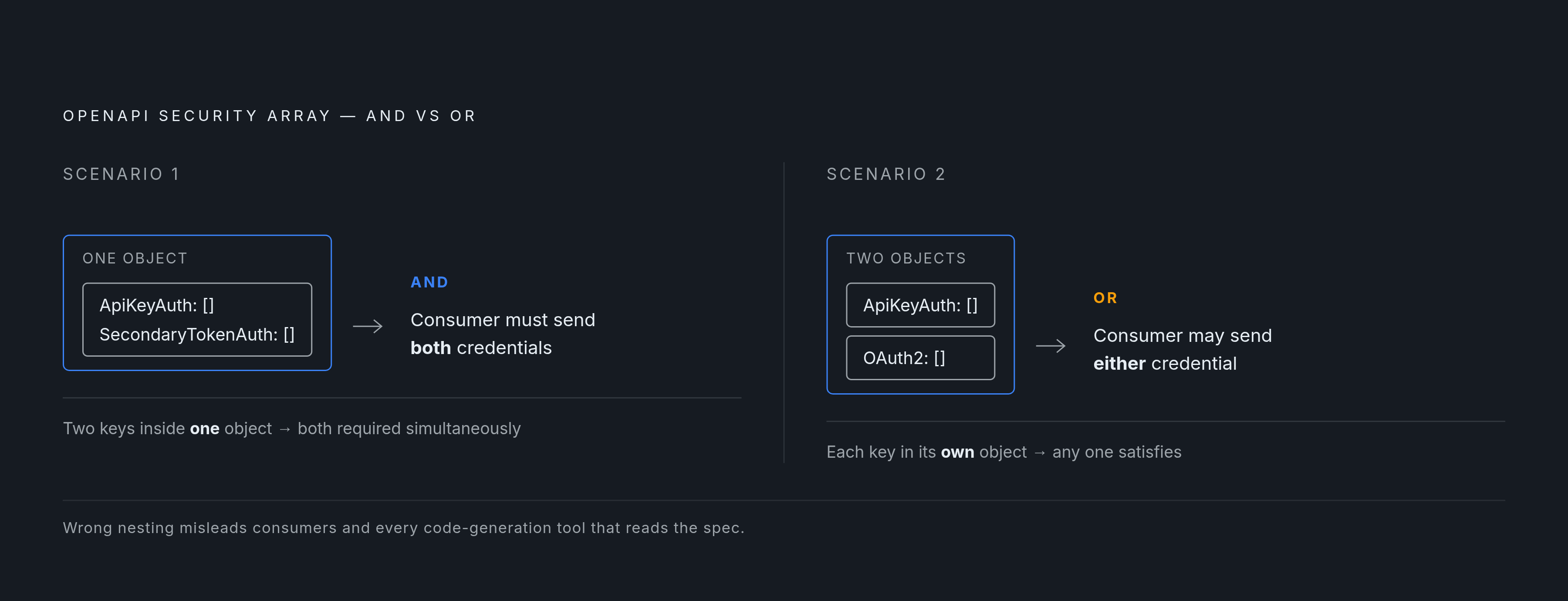
The AND/OR composition semantics of the security field are the most commonly misunderstood aspect of security scheme authoring. Multiple scheme entries inside a single object in the security array express AND logic: the consumer must satisfy all of them simultaneously. Multiple objects in the security array express OR logic: the consumer can satisfy any one of them. So a security array containing two separate objects, one with ApiKeyAuth and one with OAuth2, means the consumer can authenticate with either. An array containing one object with both ApiKeyAuth and SecondaryTokenAuth means the consumer must provide both at once. Expressing that distinction incorrectly misleads every consumer who reads the spec and every tool that generates client code from it.
The security field at the root level applies globally, and an operation-level security field overrides the global setting for that specific operation. A common authoring gap is that teams define security globally, then fail to explicitly set an empty security: [] array on operations that are intentionally public, leaving the spec ambiguous about whether those endpoints require authentication. That ambiguity shows up as incorrect authentication logic in generated clients, which is a frustrating class of bug to diagnose because the spec looks correct at a glance.
Equally worth attending to: pairing security scheme definitions with the appropriate error responses. A spec that defines OAuth2 schemes but omits 401 and 403 responses from its operations describes authentication without describing what happens when it fails.
Design-First vs. Code-First: What Each Workflow Actually Produces and Where Each One Drifts
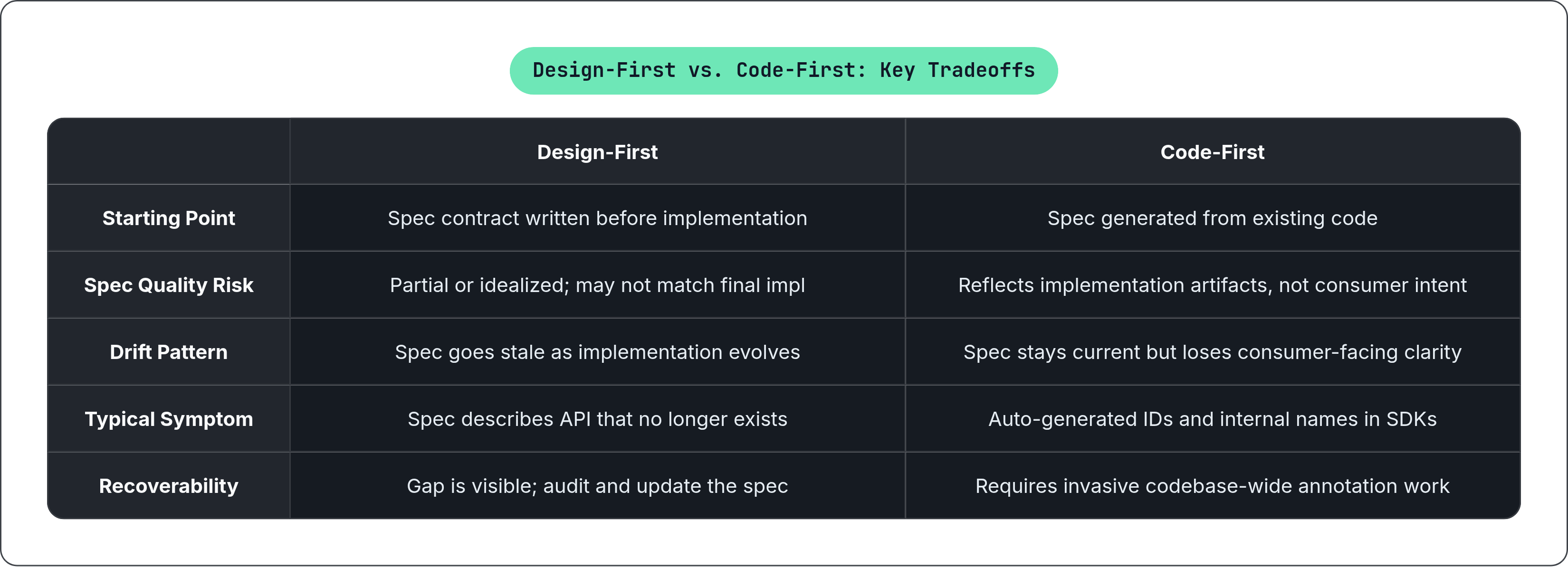
Design-first means writing the spec contract before building the implementation: endpoints, inputs, outputs, error codes, all defined in OpenAPI first, then used as the target the server and clients are built to satisfy. Code-first means building the API in code and generating or annotating the spec from the implementation, usually through framework-level tooling that inspects routes and type annotations.
The OpenAPI Initiative's stated position favors design-first, and the reasoning is specific: the number of API patterns expressible in code exceeds what can be faithfully described in OpenAPI. Starting from code risks producing a spec that is a partial or imprecise description of what the implementation actually does, because generation tooling maps from code constructs to spec constructs, and some implementation patterns have no clean mapping. The spec becomes a projection of the code rather than a first-class artifact.
But, what does design-first drift look like in practice? The spec is treated as a design deliverable, finalized before implementation begins, then left static as the implementation evolves. Six months later, the spec accurately describes an API that no longer exists in that form. It is historically correct and currently wrong. This is the most common failure mode for design-first teams, and it is rarely dramatic; it accumulates one untracked change at a time until the gap between spec and reality is too wide to close quietly.
Code-first drift looks different. The spec stays synchronized with the implementation because it is generated from the implementation, but it drifts away from being a useful consumer contract because it reflects implementation artifacts rather than consumer-facing intent. Auto-generated operationId values like UsersControllercreateUser0 appear in generated SDKs. Internal type names and database field names surface in schema definitions. Security schemes get omitted because the framework generates them incompletely. The spec is technically accurate and practically misleading.
Which failure mode is more recoverable? A stale design-first spec can be audited against the live API and updated; the gap is visible if you look for it. A code-first spec lacking consumer-facing intent requires retrofitting annotations and configuration throughout the codebase, which is more invasive work. Code-first drift tends to be more systemic because it is embedded in tooling defaults rather than human process. You have to actively fight the generator to produce a spec worth reading.
Some teams land on a hybrid approach: use design-first to establish the contract, then use code-first tooling to validate that the implementation remains consistent with it, running the generated spec through a diff against the authored spec on every build. That pipeline catches drift in both directions. Whether that overhead is warranted depends on team size, API surface area, and how consequential a breaking contract change is for the consumers on the other end. For a public API with paying customers, the answer is usually yes.