Developer portal tools that auto-generate API references from OpenAPI and AsyncAPI specs
How to choose portal tools that keep API docs in sync with your specs.
Enterprise engineering teams run an average of 1,800 APIs, but only 58% of those are formally documented, according to a 2024 Forrester study. That gap is a security blind spot and a source of duplicated work, which is why developer portal tooling has turned into its own crowded, fast-moving category. Every vendor in this space claims to auto-generate docs from your OpenAPI spec, and that claim used to carry weight on its own. Today, the real differences show up in rendering quality, spec coverage, how freshness gets enforced, and how well a tool plugs into CI/CD and, increasingly, AI coding agents, and that's what this piece actually digs into.
Specs drift from docs constantly. A renamed query parameter or shifted response schema can quietly persist in published docs long after the code has moved on. Auto-generation fixes this structurally, since nobody has to remember to update a table by hand. But structural fixes carry their own failure modes, and understanding those failure modes is really what choosing a documentation platform comes down to. Pick one of these tools and you're signing up for a maintenance model that will outlast the decision itself, often by years.
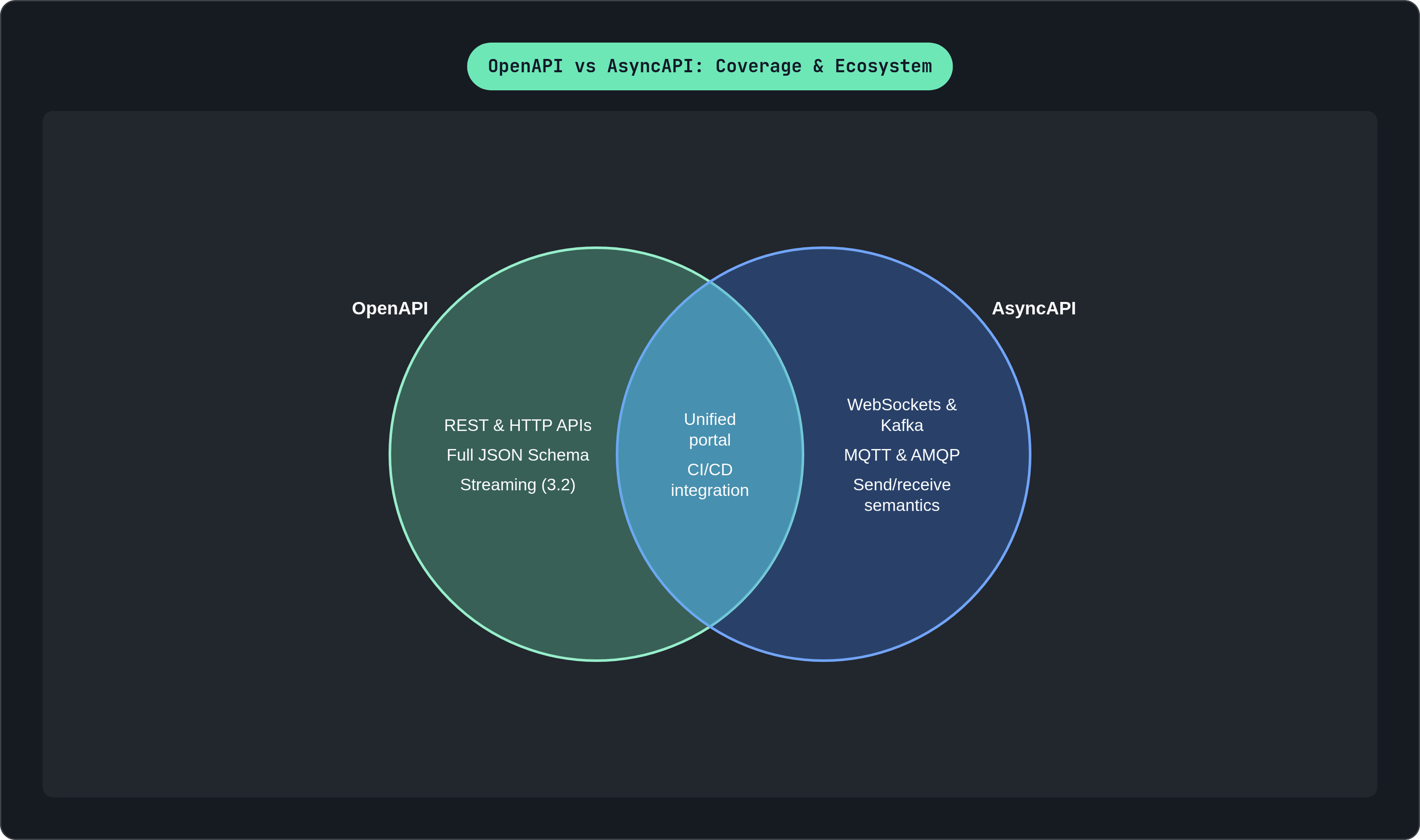
What OpenAPI and AsyncAPI each cover, and why most production systems need both
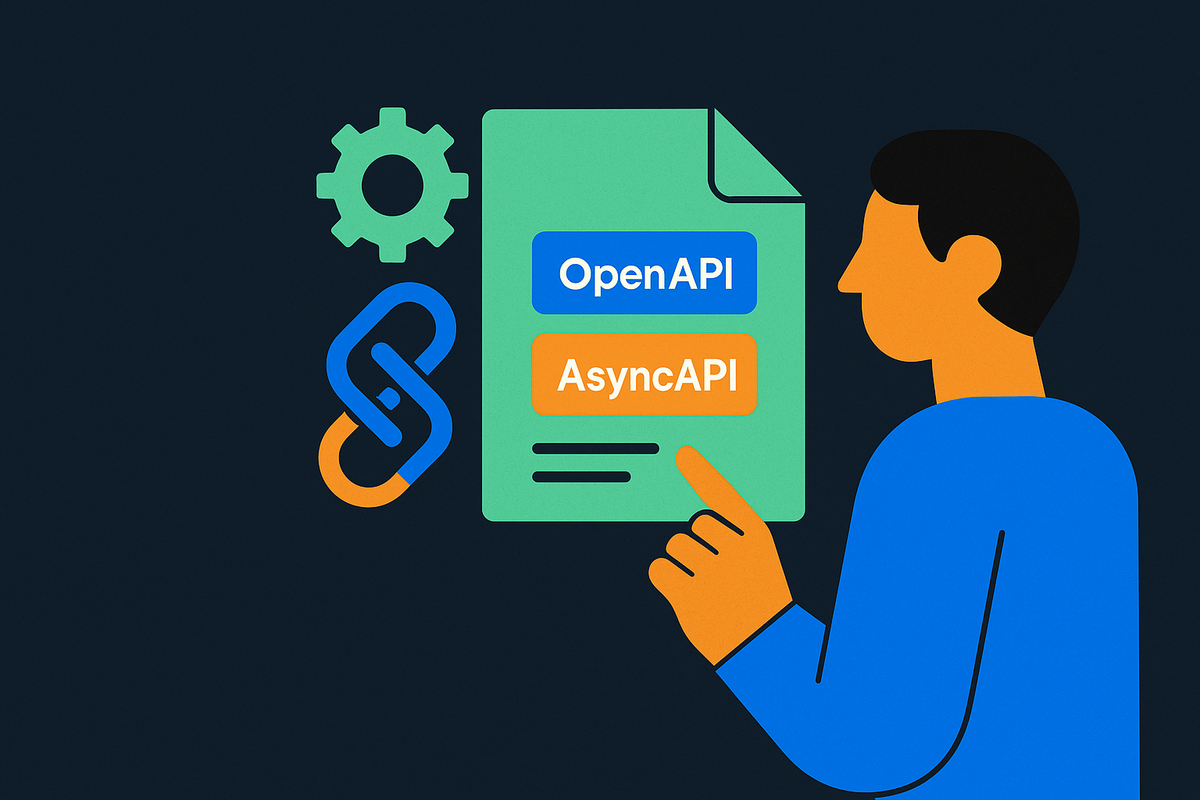
OpenAPI, now at version 3.1 with 3.2 released in September 2025, is the standard for REST and HTTP request-response APIs. Any tool that wants to render endpoint references, parameter tables, request bodies, and response schemas credibly has to support it. Version 3.1 mattered more than a routine point release usually does, because it brought full JSON Schema compatibility into the spec. That one change lined up validators, linters, and mock-data tools across the ecosystem in a way 3.0 and the old Swagger 2.0 format never managed. A tool still stuck on 3.0-only support is, plainly, behind.
3.2 goes further: native support for streaming responses (Server-Sent Events, JSON Lines) and structured tag navigation for large API catalogs. If you're shipping real-time features, check for 3.2 support before you commit to a rendering tool. Not every platform has caught up yet.
AsyncAPI covers the message-based side of the world that a request-response spec was never built for: WebSockets, webhooks, Kafka, MQTT, AMQP. AsyncAPI 3.0 is production-ready and now sits under Linux Foundation governance, with Salesforce, SAP, Adidas, and Deutsche Telekom among the adopters. Worth flagging for anyone migrating from 2.x: the old publish/subscribe action model, which confusingly meant opposite things depending on whether you were describing the application or the broker, got replaced by explicit send/receive semantics in 3.0. That's a conceptual break, not a cosmetic one, and it changes how specs read and how tools render them.
And here's the catch nobody advertises: AsyncAPI's tooling ecosystem is somewhere around five to ten times less mature than OpenAPI's. Fewer validators, fewer linters, fewer mock-generation tools. Most portal platforms built OpenAPI support first and AsyncAPI second, and you can tell.
If your system has both a REST layer and an event backbone, and most systems of any real size do, keep both specs in the same repo and publish through one unified portal instead of two disconnected doc sites. Anything else fragments the picture a developer needs. So ask the practical question when you're evaluating a tool: does it treat AsyncAPI as a first-class citizen, or as something bolted onto an OpenAPI-first product as an afterthought?
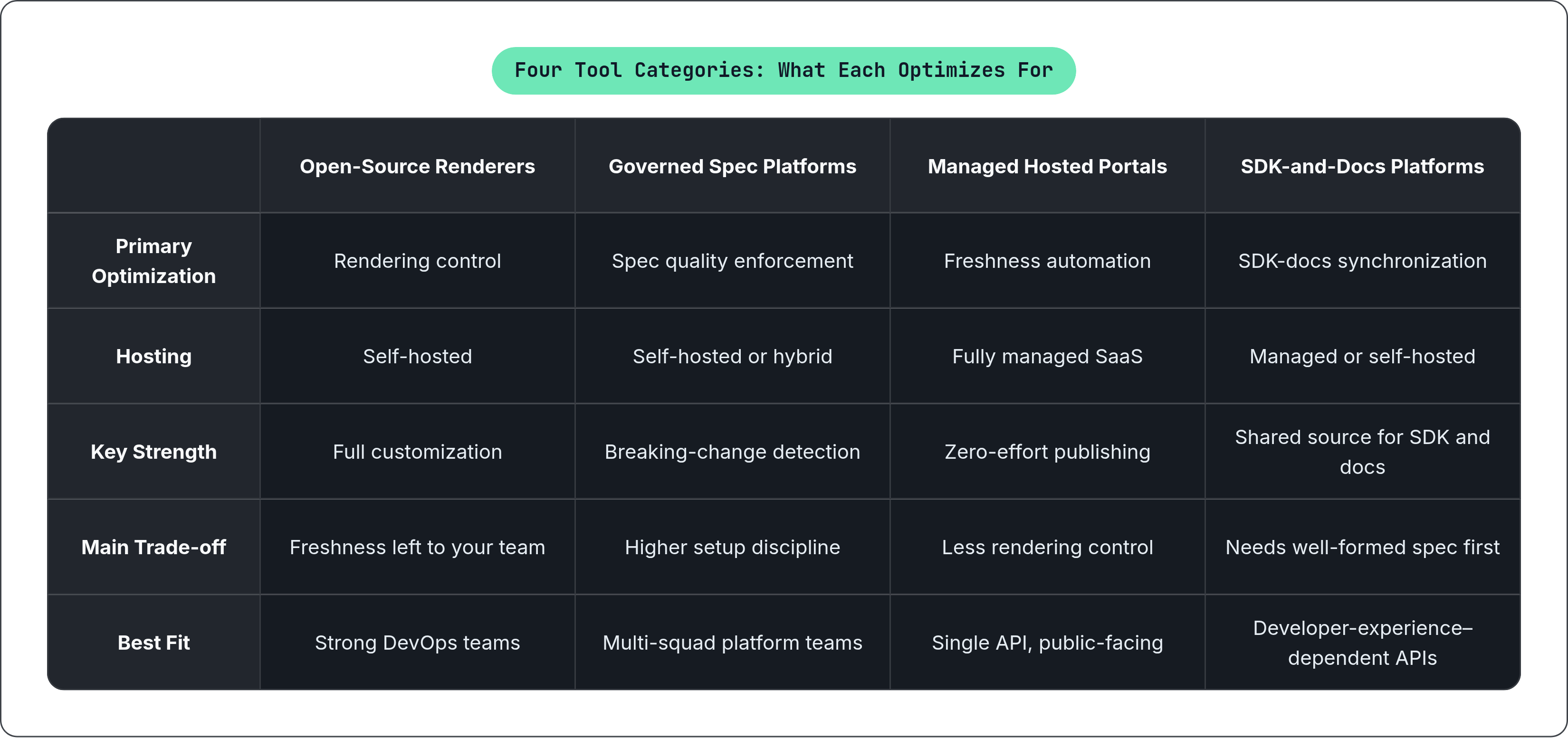
The four categories of tools in this space and what each one optimizes for
Map the market and four categories fall out. Each optimizes for something different, and mixing them up is the single most common mistake I see teams make.
Open-source renderers and embeddable components sit at one end: free, self-hosted, they render a spec into a doc page with no built-in hosting, versioning, or changelog management. Fine for teams that want full control over rendering and already have a deployment pipeline they trust.
Hosted managed portals sit at the other practical end for most teams: SaaS platforms handling hosting, theming, search, the whole developer experience. They vary a lot in how they keep docs current, which turns out to be one of the more important comparison points later in this piece.
Spec-first governance platforms treat the OpenAPI file itself as the source of truth and layer on linting, breaking-change detection, CI/CD hooks, and collaboration workflows. Built for teams where the quality of the spec matters as much as the rendered output.
And then there are SDK-and-docs platforms, which co-generate client SDKs in multiple languages alongside the reference docs, all from one spec, so the SDK and the docs can't drift apart because they share a source.
The real decision is which category matches how your team actually maintains software, not which renderer looks nicest in a demo. Pick a bare renderer when you actually needed governance tooling, or pick a managed portal when your developers really needed SDKs, and you'll be retrofitting the whole setup within a year. That retrofit costs real money. Ask the category question honestly up front and you skip it entirely.
Open-source renderers: Swagger UI, Redoc, and Scalar compared
Swagger UI is the widest baseline in the industry. It's installed in more developer environments than any other renderer, mostly because it's been around the longest and ships as the default in so many frameworks. That ubiquity comes at a cost, though: the aesthetics have aged, and customizing past the default three-panel layout means real CSS work, not a config flag.
Redoc positioned itself as the cleaner alternative and pulled it off. The three-panel layout reads well, the open-source version is free and actively maintained, and OpenAPI support, including 3.1, is solid. For a lot of teams, Redoc became the obvious upgrade path off Swagger UI's dated interface.
Scalar has the most active development trajectory among open-source renderers heading into 2026, and the reason is worth sitting with for a second. It blurs the line between documentation and an actual API client. Its "Try It" functionality is the most capable in this category, letting a developer fire real requests at a real API from inside the docs page. It also ships a desktop client that reads and modifies the OpenAPI document directly, instead of exporting a separate Postman-style collection that someone then has to keep in sync by hand. It covers both OpenAPI and AsyncAPI, it's open source, it embeds into any framework, and its default theming, with zero customization, is the cleanest of the group.
Stoplight Elements rounds out the field as another embeddable component option for teams evaluating this category.
Here's the limit worth naming plainly: all of these tools turn a spec file into something readable, but the pipeline connecting a spec change to a published update (deployment, cache invalidation, notification) still sits on your team. Open-source renderers make sense for internal tooling, for teams with strong DevOps practices already in place, or as one piece inside a larger custom-built developer hub. The freshness problem itself is left for your team to solve.
Spec-first and governance platforms: Redocly and SwaggerHub
Rendering a spec well and maintaining a spec well are two different problems, and larger organizations eventually run headfirst into the second one. That's the whole reason governance platforms exist. They build linting into the publishing pipeline, so a malformed spec gets caught before it reaches a developer. They add breaking-change detection, flagging removed fields or renamed parameters before those changes ship to consumers who didn't ask for them. And they hook into CI/CD directly, so spec validation becomes part of the pull request review instead of a manual step someone forgets on a Friday afternoon.
Redocly reports over one million weekly downloads and more than 212,000 users, with coverage spanning OpenAPI 2.0 through 3.1 and 3.2, plus AsyncAPI and the newer Arazzo specification, about as broad a coverage set as exists on the market right now. Its product suite splits rendering, collaboration, developer experience, and internal API cataloging into separate components rather than one monolithic tool. AsyncAPI support covers the fundamentals well enough for WebSocket and message-based APIs, though it doesn't run as deep as the OpenAPI side; that tracks with the broader maturity gap between the two formats mentioned earlier. There's also an AI reviewer in early access that checks OpenAPI and AsyncAPI descriptions for breaking changes and cross-references Markdown prose against the spec it describes, flagging inconsistencies. It's an early feature, and a genuine example of AI pointed at the spec-to-docs consistency problem directly.
SwaggerHub, built by SmartBear on top of the Swagger open-source ecosystem, supports OpenAPI 2.0 through 3.1 plus AsyncAPI 3.0, and it's the natural landing spot for teams already invested in Swagger Editor and Swagger Codegen workflows. Pricing for platforms in this category tends to start in the low double digits per user per month and climbs with team size and feature tier.
Governance platforms ask for more setup discipline than a lightweight renderer. For a small team publishing one public API, that overhead is probably overkill; you're buying insurance against a risk you don't have yet. For a platform team running dozens of internal services across multiple squads, skipping this layer shows up later as inconsistent specs nobody can safely automate against.
Managed hosted portals: ReadMe, GitBook, DeveloperHub, and Bump.sh
Managed portals shift the burden of keeping docs current from a person to a platform. They don't all make that shift the same way, and the differences matter more than they look at first glance.
ReadMe supports automated reference generation from OpenAPI specs, reflecting changes automatically once it detects them. That covers one of the two things teams say they want most from documentation tooling: staying current without someone doing it by hand. It supports interactive testing blocks right in the docs, though SDK generation is not part of its feature set. For a team with a single REST API, that's fine. For a team with an event-driven backbone underneath it, that's a hard ceiling.
Bump.sh built its whole product around the Stripe-style three-column reference experience, and it was one of the earliest tools to genuinely support both OpenAPI and AsyncAPI inside a single unified portal, so event-driven APIs get documented right alongside REST endpoints instead of shoved into a separate view. Its sync model works differently too: every spec update triggers automatic classification of whether the change is breaking, generates a human-readable changelog entry, and can notify subscribers directly. Changelog generation is core to the product here. It integrates with Git and CI so a spec change inside a pull request surfaces breaking-change warnings before merge, not after deployment, and its coverage spans OpenAPI 3.1, 3.0, and 2.0 alongside AsyncAPI, webhooks, and overlays.
GitBook, worth naming separately, is a hosted documentation platform that teams use to publish developer content alongside API references.
All of these take the freshness burden off a human writer's desk. How they automate that freshness varies enormously though, and that variance is the actual decision point buried under the marketing pages. A six-hour polling cycle is a meaningfully different promise than a commit-triggered diff that fires the instant code merges. And manual re-upload, which some tools still default to, offers a nicer place to paste your spec file, and little more.
Mintlify: where API reference generation meets living documentation infrastructure
Some hosted portals generate interactive API references from OpenAPI and AsyncAPI specs automatically and ship a built-in playground right inside the docs, so a developer can test a call without leaving the page. On its own, that's not unusual anymore among the tools in this piece. What sets it apart sits underneath: a Git-based deployment model where the docs site connects to the underlying repo through bidirectional sync, so a change made in Git and a change made through the web editor both stay aligned without anyone manually reconciling the two.
That detail matters more than it sounds like it should. The spec file, the generated reference, and the hand-written prose guides all share one source of truth instead of living in three places that quietly drift apart over a few product cycles, which is exactly the failure mode this whole piece opened with.
The other piece worth calling out is how deeply AI coding agents are wired in, as a native capability. Agents like Cursor, Claude Code, and Windsurf can read the documentation directly, propose edits, and submit those changes as pull requests the same way a human contributor would. That's a genuinely different posture from most tools here: the documentation isn't a separate artifact an agent has to guess about or summarize secondhand. It's something the agent reads from the same repository the human engineers work from.
For a team already shipping features with AI agents in the loop, that changes what "keeping docs current" even means. It stops being a task assigned to a technical writer and starts looking more like a shared editing surface between humans and agents, both drawing from and writing back to the same Git-tracked source. This approach also keeps API reference generation and Markdown/MDX conceptual guides inside one platform, so reference material and narrative docs stay co-located instead of splitting across two tools that inevitably get maintained on two separate schedules, usually by two separate people who don't talk to each other as often as they should. For enterprise teams managing multiple APIs and multiple contributors, the Git-based model scales in a way wiki-style or upload-based workflows structurally can't, because coordination overhead in those older models grows faster than the team does.
SDK-and-docs platforms: Fern and Stainless for teams where SDKs are part of the product
Fern and Stainless both generate client SDKs across multiple languages alongside reference docs, all from a single OpenAPI spec. The pitch is straightforward: the SDK and the docs share one source, so they can't drift apart the way hand-maintained SDKs and hand-maintained docs eventually, and always, do.
Worth mentioning alongside them: OpenAPI Generator, an open-source project under the OpenAPITools umbrella, produces client SDKs in more than 50 languages and server stubs in over 20, the widest language coverage anywhere in this ecosystem. The trade-off is that output quality varies noticeably by target language, and teams typically end up doing more post-generation cleanup than they would with a commercial SDK platform tuned for a smaller set of languages.
The argument for this whole category comes down to a fairly specific pain point. If your developer experience depends on SDK quality, typed clients, method names that read naturally, error handling that doesn't just throw a generic exception, and you're currently generating those SDKs from a script someone wrote two years ago and half-remembers how to run, this removes an entire class of synchronization failure. The SDK stops being a separate deliverable that quietly goes stale in a corner nobody checks.
Be honest about the trade-off too: these platforms are opinionated about how your spec is structured, and they need a genuinely well-formed spec to produce usable output. They work best where spec-first development is already the practice, not the aspiration someone put in a slide deck. Consider this category seriously if you're running a public API where adoption depends on SDK quality, or you're a platform team maintaining SDKs across several languages and noticing the upkeep is eating engineering time that should be going somewhere else.
The dimensions that actually separate these tools once rendering quality is table stakes
By now the pattern should be clear: nearly every tool in this piece renders a spec into something readable. That was the hard problem five years ago. Today it's the floor.
Spec coverage depth is the first real dimension. OpenAPI 3.1 support is table stakes now, not a selling point. Whether a tool also handles 3.2's streaming and large-catalog features, whether it treats AsyncAPI 3.0 as genuinely first-class instead of a checkbox, whether it's picked up newer specs like Arazzo: all of that tells you whether the vendor is tracking where the ecosystem is actually going, or where it was two years ago.
The freshness mechanism is the second dimension, and honestly the one with the most real-world teeth. A six-hour polling cycle, a commit-triggered diff, and a manual re-upload button are three fundamentally different promises about how stale your public docs get before someone notices. That difference never shows up in a sales demo. It shows up three months into production, when an engineer renames a field on a Tuesday and a customer opens a support ticket on Thursday because the docs never caught up in between.
Third: how deeply a tool integrates into actual development work, meaning CI/CD pipelines, pull request checks, and increasingly AI agents that read and write documentation as part of normal engineering rather than as a separate publishing step tacked on afterward. Fourth: whether the output is documentation alone, or documentation plus SDKs sharing the same source and, therefore, the same fate.
None of these four has one right answer, and I'd be suspicious of anyone who tells you otherwise. A small team shipping one clean REST API doesn't need governance tooling or SDK generation, and buying it anyway is money spent solving a problem that doesn't exist yet. A platform team running 40 internal services behind three separate protocols needs most of what this piece walked through, and skipping it amounts to a bet that nobody notices the gaps until they're expensive to close. Match the maintenance model to how your team actually ships software. That, more than which tool renders the prettiest page, is the choice you're really making.