Interactive API Playground Design Principles
Reduce developer abandonment by cutting the time between discovery and first successful API call.

Time-to-first-call, the elapsed duration between a developer's discovery of an API and their first successful response, is the most defensible single proxy for playground quality. I've watched developers abandon well-engineered APIs in under three minutes, not because the API failed them, but because the path to proving it worked was too long. Layout choices, authentication design, sample data quality, error handling: each either shortens or lengthens this interval, and the compounding effect of small friction points is severe in ways that are difficult to anticipate until you've seen it happen repeatedly.
The best-in-class APIs keep TTFC well under two minutes. Most do not. The gap is rarely the underlying API; it is the path the documentation forces a developer to walk before the API is allowed to prove itself.
This matters commercially because developers reach for API and SDK documentation before any other information source when evaluating a new tool, and they don't read their way to adoption. They run a test. The playground is not supplementary documentation; it is the trial itself. A developer who cannot reach a first successful call in a reasonable window does not conclude that the API is hard. They conclude it is not worth the effort.
That inference, unfair as it may be to the underlying engineering, is the real failure mode. The API works. The developer leaves anyway. But what if TTFC is not a playground team metric at all — what if it indexes the entire developer relationship? That reframing explains why teams that treat it as a vanity measurement tend to be the ones wondering why adoption stalled three months after a technically sound launch.
The submit-and-response loop as the foundational unit of the playground experience
Before anything else, a playground must deliver one thing: the ability to craft a request, submit it, and see a real response without leaving the documentation. Until that loop exists, documentation is asking developers to imagine the API rather than experience it. High-intent developers, the ones most likely to actually integrate, have the least patience for imagination.
The loop is also the primary learning mechanism. Developers understand an API by poking at it, adjusting parameters, observing what changes, forming a mental model through iteration. Reading about an API is categorically different from interrogating it. Cognitive load theory, established in educational psychology research, distinguishes between static representations of knowledge and interactive ones because the latter enable active processing that produces durable comprehension. You can observe the practical consequence in support ticket volume: teams that shipped a live console consistently see fewer elementary integration questions than teams that shipped a static reference, because the console answers those questions before the developer thinks to ask them.
The design implication follows directly: everything else in a playground, layout, authentication handling, sample data, error states, exists to protect and accelerate this loop. It is also worth considering what a broken loop signals — not merely an inconvenience, but platform immaturity, and that signal is difficult to walk back once formed. First impressions of a developer platform are established not through reading, but through touching, and a broken loop is a particularly bad thing to hand someone whose trust you're still earning.
Zero-setup sandbox environments that let developers experiment without consequences
Developers will not experiment aggressively if they believe they might touch production data, incur real costs, or trigger irreversible operations. Fear of consequences is reasonable, not timid; it is the correct response to unclear environmental boundaries. The solution is a sandbox that mirrors production behavior completely, same schemas, same validation rules, same domain logic, while operating entirely on synthetic, developer-controlled data.
Orange's network API playground is a concrete model worth examining. Developers define their own simulated network reality, registering test phone numbers and calling endpoints that behave exactly as production endpoints do, on data they own entirely. The result is that a developer can exercise the full behavioral surface of the API without any of the stakes that would otherwise constrain curiosity. Teams that spend two or three weeks in a sandbox like that before ever touching production credentials tend to ship cleaner integrations, not because they are more talented developers, but because they've had room to be wrong without consequence. That distinction sounds soft until you're debugging a production incident that a sandbox week would have prevented.
Zero-setup, though, is equally critical and harder to get right. If spinning up the sandbox requires provisioning time, an approval workflow, or environment configuration, friction has already been introduced at the worst possible moment, when a developer's interest is highest and their patience is thinnest. The bar is a meaningful, executable request within seconds of arriving at the documentation. No guided tour. No signup form. A real call.
Realistic sample data as the bridge between an endpoint and developer comprehension
Toy data, the foo and bar and test123 of placeholder examples, teaches response structure but not substance. It fails to help developers visualize how their application will actually behave when real data flows through the API, and that visualization gap is where comprehension stalls and adoption decisions get quietly deferred.
Good sample data mirrors real-world complexity: full customer profiles, realistic transaction histories, plausible geolocation objects, populated relationship fields. The data remains synthetic, but it resembles something a developer's production system might actually produce or consume. That resemblance does real argumentative work. It signals that the API was designed with actual use cases in mind, not assembled in isolation and documented afterward.
A logistics API case study illustrates the effect plainly. When a team moved from static reference documentation to a sandbox preloaded with realistic shipment data and an embedded try-it explorer, onboarding times fell substantially, support volume dropped, and adoption rates rose. Nothing changed in the API itself. What changed was the quality of evidence the documentation offered. Developers could validate responses against data that looked like their own, and that resemblance was sufficient to shift the decision.
Preloaded requests compound this further. An empty parameter form requires a developer to already know enough about the API to fill it in meaningfully before they can learn anything from it. A preloaded request with realistic values is a working starting point they can modify, one that begins with a small success rather than demanding competence before success is possible. In practice, that distinction separates playgrounds developers actually finish from ones they abandon after thirty seconds. And the first successful call matters more than people tend to credit: it reframes the API as something that works for the developer, not something the developer must work around.
Designing for every state a developer will actually encounter, not just the happy path
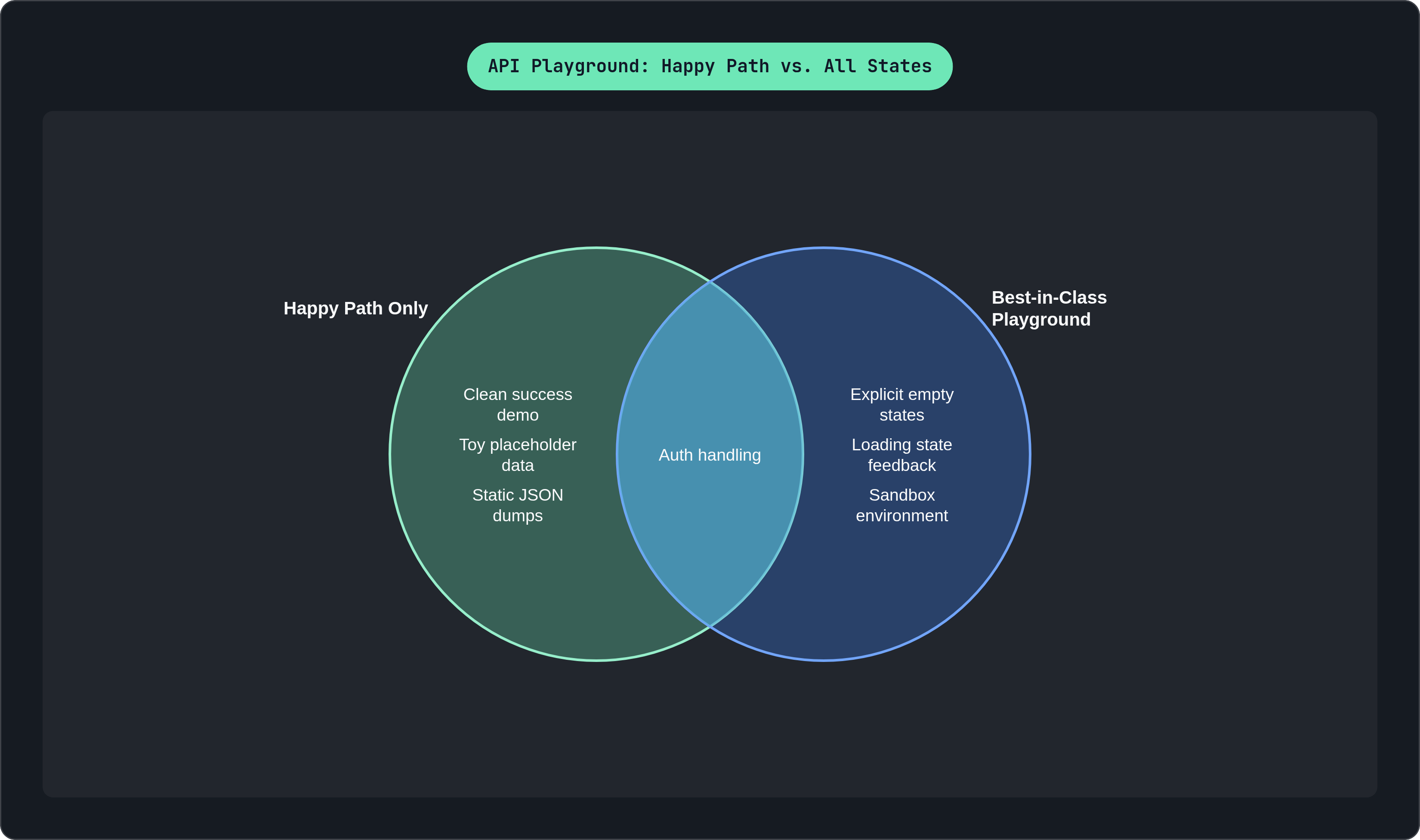
Most playground implementations receive careful design attention for exactly one state: the successful response. Every other state gets treated as an edge case. Developers, however, encounter the other states constantly during integration, and those encounters shape their lasting impression of the platform more than any clean success does.
Three states require explicit, intentional design. The empty state, what a developer sees before they have sent anything, should not be a blank form; it should offer sample requests and briefly surface the most common use cases, giving developers enough context to know where to start. The loading state, often entirely ignored, should communicate what is being processed and set a latency expectation, because silence reads as failure, particularly when network round-trips are involved. The error state is the most consequential of the three. It must explain the cause, the likely fix, and whether the issue originates with the request, with authentication, or with the system itself. A raw status code is not an explanation.
Undocumented error codes turn debugging into guesswork that experienced developers won't endure for long. Opaque authentication errors consume hours that those same developers correctly recognize as a platform's failure, rather than their own. Missing error documentation, unclear authentication flows, absent sandbox access, and outdated code examples are among the leading causes of integration abandonment. That raises an important question: what kind of trust does a playground build when things go wrong? A playground that handles failure gracefully and transparently teaches developers to trust the API precisely at that moment, and that particular kind of trust is more durable than anything a successful demo produces.
Authentication handling that removes friction instead of adding a new obstacle
Authentication is the gateway every developer must pass through before the submit-and-response loop can run. It is also, in many playgrounds, where the experience quietly breaks down. Credentials entered, then re-entered for the next session. OAuth flows that redirect developers away from the documentation and back into auth configuration screens they just left. Error messages that report authentication failure without specifying whether the token is malformed, expired, or missing a required scope.
A playground should support every authentication scheme the API uses, API keys, bearer tokens, OAuth, without requiring developers to re-enter credentials across sessions. Credential persistence is a small implementation detail with an outsized effect on willingness to return and continue exploring. The developer who must re-authenticate every session is being taxed repeatedly for a problem they already solved, and repeated friction on a solved problem is exactly the kind of thing that makes developers quietly choose a competitor.
Fern's approach is instructive. Its API explorer integrates directly with authentication flows, auto-populates keys where possible, and persists credentials so that authentication is solved once. For initial testing, the simplest available method, typically a temporary sandbox key, should lower the first barrier; complexity can be introduced as understanding deepens. Where SDKs exist, they should absorb authentication complexity entirely, so the developer is thinking about API behavior rather than credential management. Authentication errors deserve the same explicit treatment as every other error state: the message should tell the developer precisely what is wrong and how to fix it, not simply that something failed.
Layout and information architecture that keep cause and effect visible simultaneously
The governing principle of playground layout is simultaneous visibility: the request being built, the available parameters, and the response received should all be visible at once. When these elements are separated across tabs or nested within accordions, developers must hold their mental model in working memory rather than reading it off the screen. Cognitive load accumulates, comprehension slows, and quit rates rise in ways that are measurable and avoidable.
A layout that requires tab-switching teaches the interface rather than the API. Anything that draws a developer's attention to itself as a UI is failing at its actual job. The interface should recede.
Response explorers that allow developers to expand nested objects and traverse arrays interactively are more effective than static JSON dumps, because interaction is itself a form of questioning. The developer is not passively receiving a schema but actively discovering its shape. Real-time parameter validation, showing accepted value types and flagging invalid inputs before submission, eliminates a class of errors that would otherwise only surface after the request is sent, wasting a round-trip and interrupting the flow that produces comprehension.
The practical test for any layout decision: can a developer understand what went wrong and why without navigating away from where they are? If the answer requires any navigation at all, the information architecture has failed. Developers navigate away from the documentation entirely rather than within it, which means every unnecessary click is a potential exit.
Multi-language code generation that meets developers in their own stack
A successful request in the playground has no direct value to a developer's codebase until it becomes working code in their language. The translation layer between "it works in the docs" and "it works in my project" is where momentum dies, and it is a surprisingly consistent place for adoption to stall even when everything upstream has gone well.
The quality bar for generated snippets is higher than it might appear. Generic placeholders that illustrate the shape of a call are marginally better than nothing. Actual working SDK calls, parameterized with the values from the live request the developer just executed, are a different category of useful entirely. MicroStrategy's REST API Playground generates snippets across a substantial range of language and library variants, which is a useful model for breadth. Fern produces snippets that are real SDK calls rather than pseudocode approximations, because its documentation and SDKs share a single underlying definition. That tight coupling between playground and code generation is the meaningful differentiator: the difference between handing a developer a map and handing them working directions.
Copy-to-clipboard should be one action, consistently visible, without requiring a developer to manually highlight text. Trivial in isolation; compounding in practice.
There is also a collaborative function to code generation that is easy to overlook. A significant share of developers work in team contexts where colleagues cannot directly read raw API responses or evaluate JSON schemas. A working snippet bridges that gap, making the playground's output useful beyond the individual session and beyond the individual developer.
OpenAPI specifications as the structural foundation that makes everything else maintainable
Every interactive element in a well-designed playground, parameter forms, code snippets, response schemas, request validation, can be generated automatically from a machine-readable API definition. OpenAPI, the dominant standard for REST APIs, is the most important architectural decision a playground team can make, because it converts the spec into the single source of truth from which documentation, SDKs, tests, and the playground itself are all derived.
The practical consequence is straightforward: when the API changes, a spec-driven playground updates. A manually maintained playground drifts. Drifted playgrounds are worse than no playground at all, because they mislead developers who are already past the threshold of trust. A developer who follows documentation into a failure is not in a neutral position; they are worse off than if the documentation had simply been absent, because now they are debugging a problem the documentation created. I have seen this dynamic kill adoption for APIs that were, underneath the bad docs, well-designed.
Swagger UI is the most widely deployed transformation of an OpenAPI spec into an interactive interface, and it works reliably for moderate API surfaces. For large, complex APIs, it can become sluggish and limited in its testing workflows. Worth knowing before committing to it as the foundation of a developer experience at scale.
The spec-first approach also enables a category of consumers that is increasingly consequential: AI agents that query documentation programmatically require the same machine-readable structure that human-facing playgrounds use. The infrastructure investment in a well-maintained OpenAPI spec serves both audiences simultaneously, a return on investment that is now straightforward to defend in ways it wasn't a few years ago.
Where the leading playground tools actually differ in practice
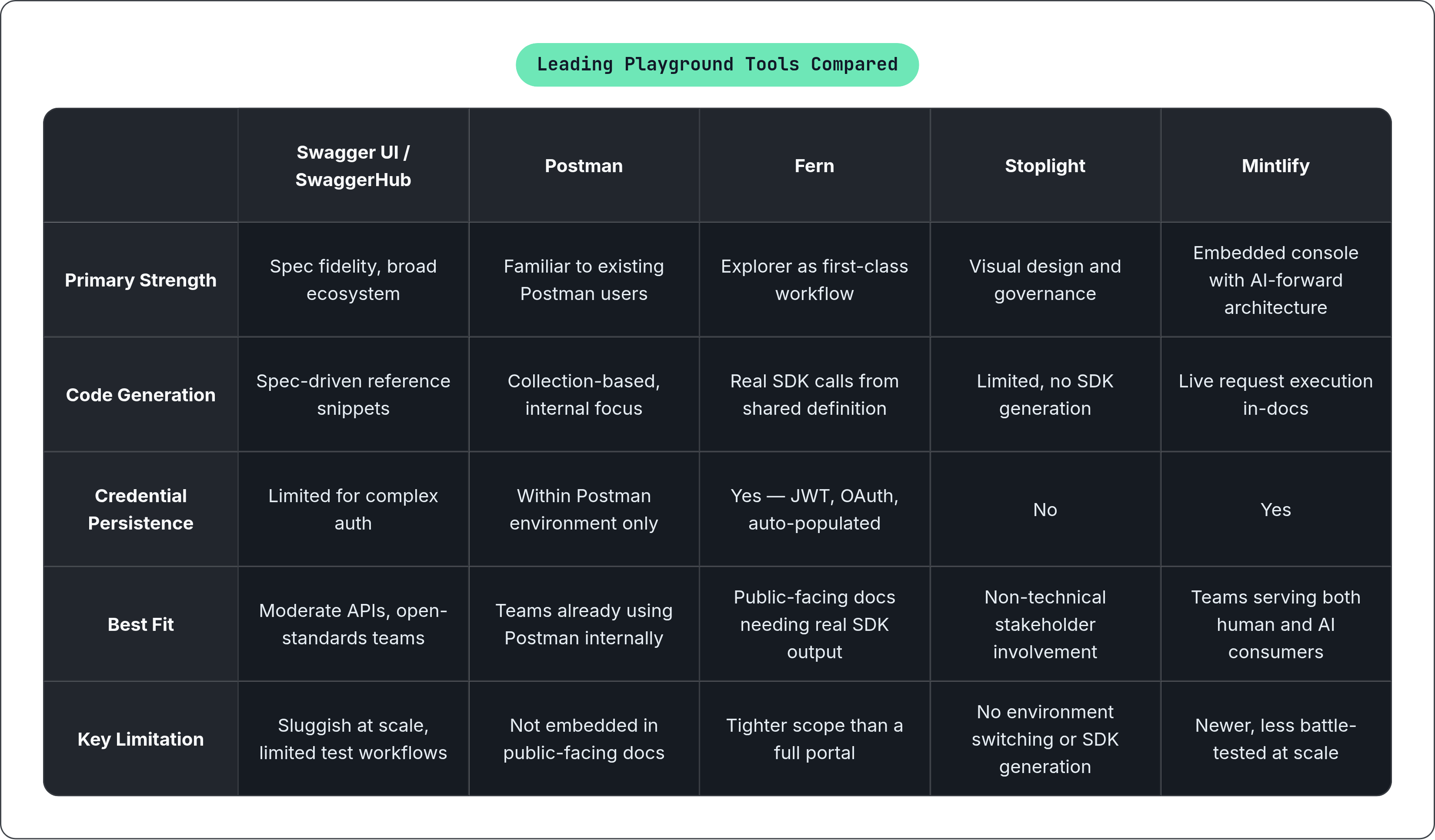
The tool category distinction matters before any feature comparison. API reference generators turn a spec into browsable, interactive documentation. Developer portals combine reference docs with guides, search, authentication, changelogs, and cohesive information architecture. Conflating the two leads to choosing a tool optimized for the wrong scope, and that is an expensive mistake to reverse once a team has built around it.
Swagger UI and its hosted counterpart SwaggerHub offer strong spec fidelity and broad ecosystem support. The open-standards foundation is an asset, and the interactive testing works well for moderate API surfaces. For large APIs with complex auth requirements and advanced testing workflows, the limitations become meaningful quickly.
Postman evolved from API client to full platform and auto-generates documentation from collections. Its playground experience is familiar to teams already using it for internal testing, but it lives within the Postman environment rather than embedded in public-facing documentation. That distinction matters when the audience includes developers who arrive cold, without prior context or tooling relationship.
Fern treats the explorer as a first-class part of the developer workflow rather than an appended feature. Authentication integration is comprehensive, covering JWT, OAuth, and credential persistence. Code examples are working SDK calls because the documentation and the SDKs share a single definition.
Stoplight is strongest for teams that need to involve non-technical stakeholders in API design through visual tooling and governance workflows. Its interactive testing surface is more limited: no credential persistence, no environment switching, no SDK generation. The tradeoffs are coherent, but they are real tradeoffs.
Mintlify positions its playground as the interaction layer within a broader knowledge infrastructure. The embedded try-it console allows developers to authenticate and execute live requests without leaving the documentation. Its portal is also designed to serve AI agents through MCP servers and llms.txt, making it one of the more forward-looking architectures for teams thinking beyond the human reader as the sole consumer.
The differentiating questions worth asking of any tool: Does the explorer persist credentials? Does it generate real SDK calls or illustrative placeholders? Does it update automatically when the spec changes? Can it serve both human readers and programmatic consumers?
Security and trust considerations that playground designers cannot defer
The central technical challenge of a browser-based playground is allowing cross-origin calls to a live API without routing developer credentials through the platform's own servers. The architecture that resolves this most cleanly keeps requests entirely within the developer's browser. When the platform does not touch credentials or response data, a category of inadvertent logging risk disappears, along with the liability that comes with it.
CORS handling and proxy architecture are not implementation details that can be revisited after launch. They are foundational design choices that determine what data the playground operator has access to, with implications for both security posture and developer trust. A platform should be able to answer two questions clearly: where are credentials stored, and does any request touch our servers? Inability to answer those questions is itself a signal, and experienced developers notice the evasion.
Not every endpoint needs to be executable in a live explorer. Destructive operations, deletions, payment initiations, administrative functions, can be excluded from the interactive surface without being removed from the reference documentation. Selectively disabling the try-it feature for high-consequence endpoints is a design affordance, rather than a limitation. But how does this affect our original promise? A playground that surprises a developer with an irreversible action destroys trust far more completely than one that is transparent about its boundaries upfront.
Documentation that is transparent about what the playground cannot or will not execute builds more durable trust than a playground that appears omnipotent and surprises developers later. The disclosure is the trust signal.
Keeping the playground accurate as the API evolves
A playground is only as useful as its accuracy, and accuracy is a maintenance problem, not a launch problem. The gap between a v1 playground and a v3 API is not theoretical; it is the most common form of documentation debt, accumulating faster than most teams expect. Teams that build a polished playground at launch, ship a major API revision six months later, and then neglect the docs create a quiet disaster: developers hitting endpoints that no longer work as documented, framing the failure as an API problem rather than a documentation problem. The trust cost lands on the wrong account.
The mitigation is architectural. A playground generated from a live OpenAPI spec drifts only when the spec drifts, and the spec can be updated as part of the same workflow that updates the API. When playground content is manually authored, it drifts on a different schedule than the API it describes, and the divergence is invisible until a developer hits it.
Changelog integration compounds the benefit. When developers can see what changed, when, and why, they can update their integrations proactively rather than reactively. A playground that surfaces version history alongside the interactive console converts what would otherwise be a source of confusion into a source of confidence.
The hardest part of keeping a playground accurate is organizational rather than technical. The team that owns the API and the team that owns the documentation are often different, operating on different release cycles, accountable to different managers, incentivized to solve different problems. A spec-first architecture reduces the coordination cost by collapsing those two workflows into one. When the spec is the documentation, updates propagate without negotiation. For teams shipping multiple API versions per quarter, that is not a convenience; it is the only path that doesn't eventually collapse under its own maintenance weight.