API Reference Versioning Without Documentation Chaos
Keeping documentation in sync with live APIs costs less than debugging the gap.
API reference versioning gets blamed for a lot of chaos it doesn't actually cause. The real damage happens after the version ships, when the documentation describing it quietly stops matching reality. Postman's 2025 State of the API Report puts the industry's API-first adoption at 82%, with a quarter of teams now fully committed to the approach, so there are more APIs in production and more versions of each one running at once than at any prior point. That growth multiplies the surface area for documentation lag with every release cycle, and this piece is about where that lag actually comes from, how it compounds, and what teams that avoid it are doing differently.
Start with the number that should worry anyone shipping a public API: 39% of developers cited inconsistent documentation as their single biggest roadblock in Postman's 2024 report, ahead of authentication and rate limits and SDK gaps. A separate 2025 finding puts 93% of teams up against blockers like duplicated work, poor discovery, and outdated context, and Apidog has cited research suggesting 75% of APIs don't conform to their own specifications. Drift, in other words, is closer to the default state of things than an occasional hazard, and teams that don't actively fight it should assume they already have it.
The cost of that drift is not abstract. Insufficient documentation shows up as a top cause of wasted developer time for 41% of respondents in the research behind this piece, and 69% report losing eight or more hours a week to these inefficiencies, which works out to something like $18.5 million in annual lost productivity per 1,000 developers. That is not a rounding error in an engineering budget. The dominant theme across documentation research from 2024 through 2026 has shifted, too: the hard problem used to be writing the docs, and now the harder problem is keeping them current once written. That maintenance gap is where trust erodes, one stale endpoint at a time.
The versioning strategies teams actually use, and what each one demands from documentation
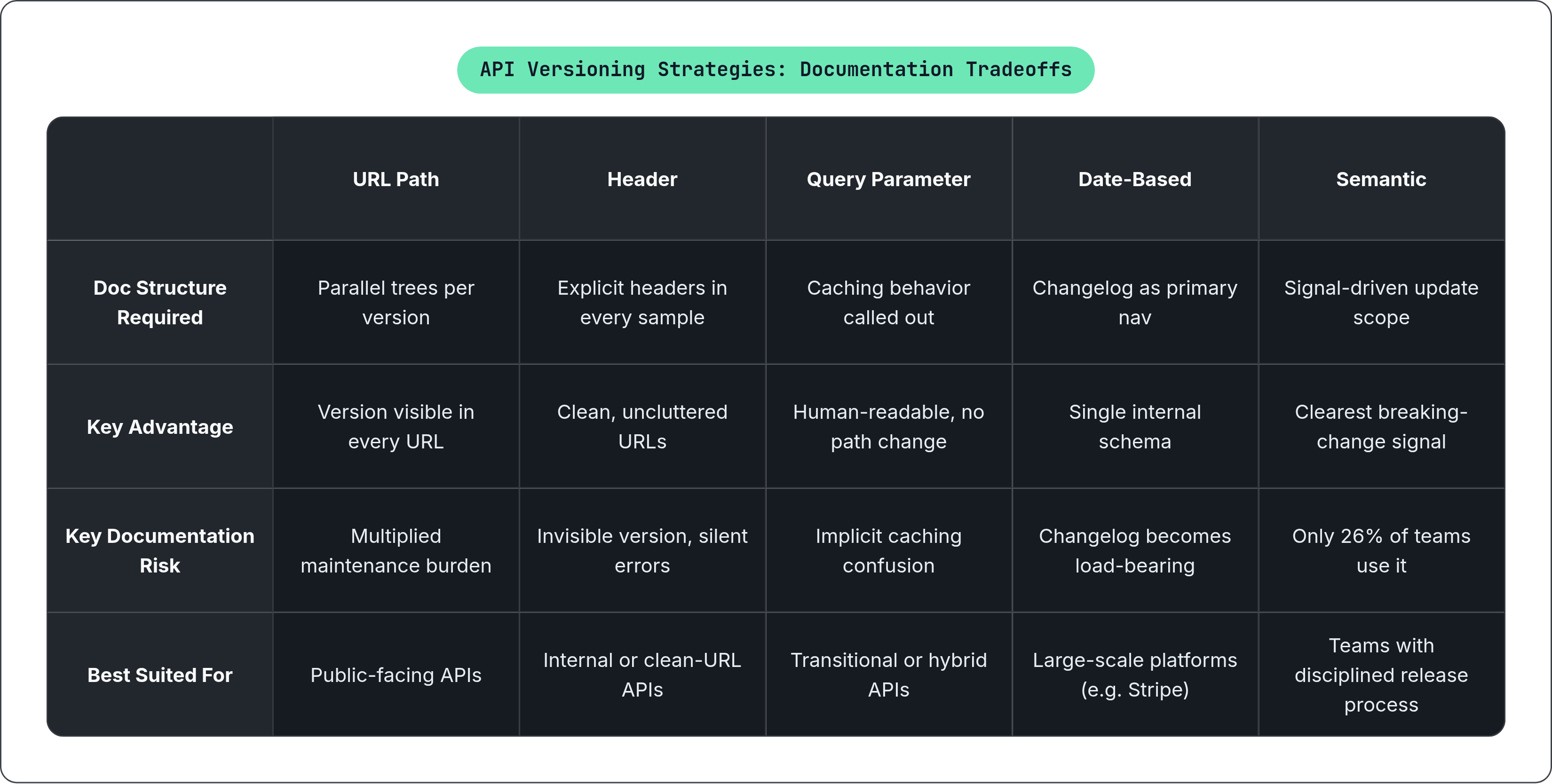
Most teams have settled on some form of version control: 60% version their APIs and 57% use Git repositories, according to Postman's 2025 data. But only 26% use semantic versioning. Sit with that gap for a second, because it's the whole problem in miniature: a majority of teams are tracking that something changed, while a small minority are actually signaling how much it changed or whether it breaks anything. Documentation authors are left guessing, which means consumers are too.
URL path versioning, the familiar /v1/resource pattern, remains the most widely adopted approach and the safest default for anything public-facing. Its documentation upside is real: the version sits right there in every URL, so scoping reference pages, testing links, and routing users to the correct docs becomes straightforward. The cost shows up on the other side of that convenience. Every structural page now needs to exist in parallel across however many versions are active, which means a team supporting v1 through v4 is maintaining four documentation trees that all need to stay internally consistent.
Header versioning, something like Accept-Version: v1, keeps URLs clean, but it makes the version invisible to anyone skimming a request. That invisibility has to be compensated for somewhere, and the compensation lands squarely on documentation: every code sample needs the header spelled out explicitly, because a reader who misses it will hit the wrong version without knowing it. Query parameter versioning splits the difference, staying human-readable without restructuring the base path, but it introduces its own wrinkle around caching behavior across versions that has to be called out in the docs rather than left implied.
Then there's date-based pinning, the model Stripe is known for, where a coercion layer transforms the canonical internal API shape into whatever a given pinned version expects. The database schema itself isn't versioned; only the response shape is. This is a genuinely different documentation problem, because the changelog stops being a supplementary artifact and becomes the primary navigation surface. Per-date reference pages replace the per-version tree structure entirely. It's an elegant model for API design, but it demands a documentation system built around dates as first-class objects, not an afterthought bolted onto a docs site built for /v1 and /v2.
Semantic versioning, major.minor.patch, remains the clearest signal available to both consumers and documentation authors about what actually needs attention: major means breaking, minor means additive, patch means fixed. And plenty of teams run a hybrid, mixing gateway-level routing with code-level version handling. That hybrid approach carries its own documentation consequence, though: the routing logic itself has to be documented, or consumers have no way to reason about which version they're actually hitting when a request goes through the gateway.
The synthesis here is simple to state and easy to ignore. The versioning mechanism a team picks determines the exact shape of the documentation problem it will spend the next several years managing. URL versioning creates parallel trees. Header versioning creates invisible complexity that only shows up in support tickets. Date pinning creates changelog dependency. Teams that don't think this through before choosing a strategy tend to retrofit their documentation systems after the chaos has already set in, which is a far more expensive way to learn the lesson.
How documentation drift actually happens — and why ownership diffusion is the accelerant
Documentation drift has a precise definition, and it's worth being precise about it: it's the state where a live API and its published reference have diverged, where endpoints return different shapes than what's documented, where deprecated fields still appear as valid in examples, where new required parameters show up in production with zero mention in the docs. This isn't vague staleness. It's a measurable gap between two artifacts that are supposed to describe the same thing.
Why exactly does this happen so consistently? Drift is silent in a way that broken code isn't. A failing build throws an error and blocks a merge. A stale doc page just sits there, looking exactly as authoritative as it did the day it was accurate. A developer copies a payload field from that page, sends the request, gets back a 400, and concludes the API itself is unreliable, when the actual failure sits one layer up, in a documentation page nobody flagged as wrong.
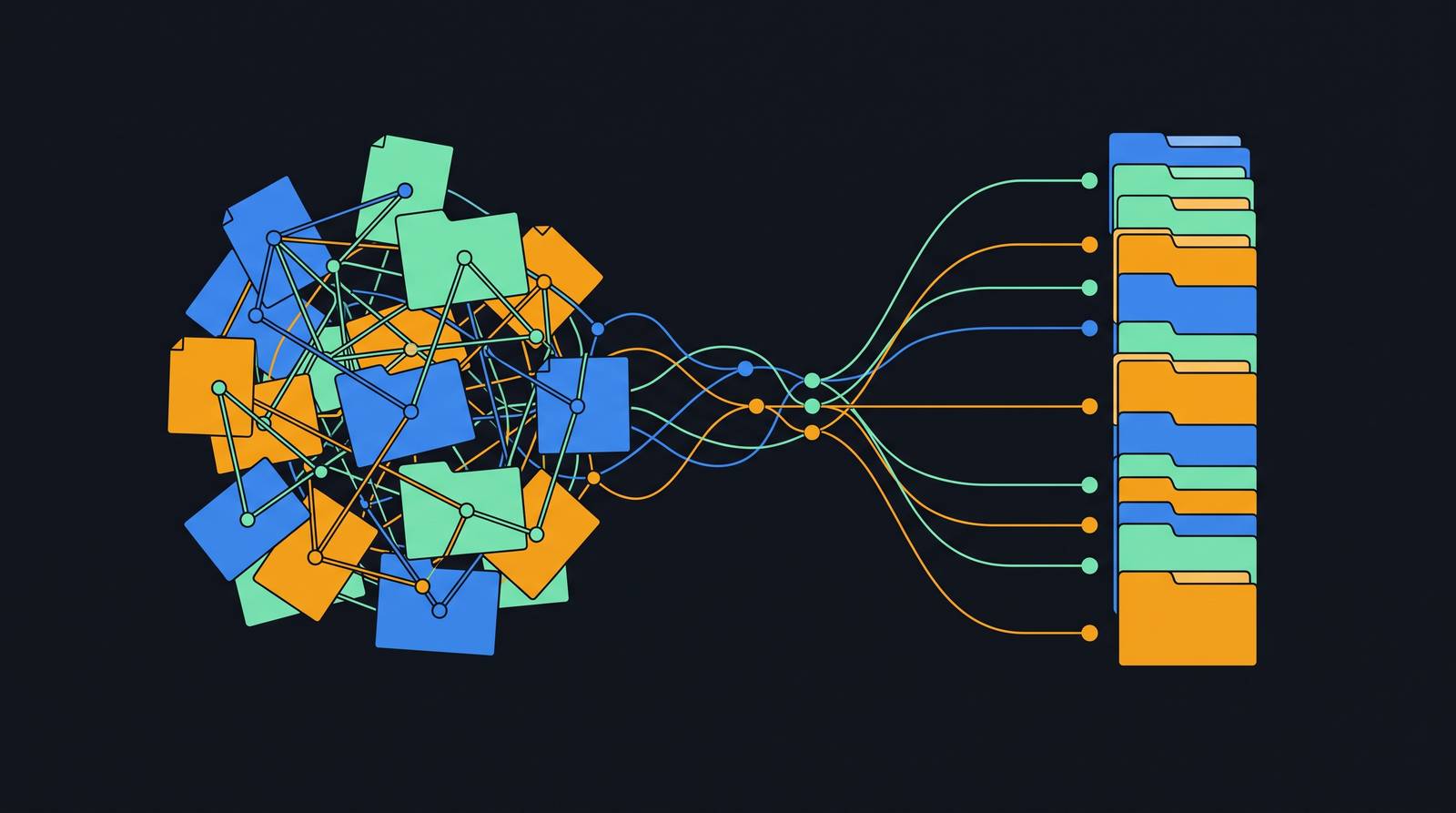
The root causes trace back to a few consistent patterns. Teams often ship changes without testing against the OpenAPI spec during development, so nothing catches the divergence before it reaches production. API information tends to scatter across too many systems: spec files here, a wiki page there, inline code comments, a Postman collection someone built for a demo eighteen months ago, a Confluence page that hasn't been touched since. None of these is treated as authoritative, so none of them can be trusted, and all of them slowly disagree with each other. Underneath both of these is a discipline problem: the OpenAPI spec too often gets treated as an output of development, something generated after the fact to describe what was built, when the healthier pattern treats it as a contract that drives the build in the first place.
Ownership diffusion accelerates all of it. Assigning documentation to "the backend team" or, worse, just "engineering," is functionally equivalent to assigning it to no one. Diffuse ownership means drift accumulates quietly, because no individual feels responsible enough to stop what they're doing and fix a stale page. One enterprise case documented in the research involved an organization running more than 50 microservices with inconsistent versioning across the fleet: some services used URL path versioning, others used headers, and client developers were left confused and frustrated trying to reason about the whole surface. The fix was an API gateway that standardized the public-facing surface first, since documentation can't rationalize a system that hasn't been rationalized underneath it.
One mistake shows up again and again in this research, and it's worth naming directly: only documenting the latest version. It feels efficient in the moment, since it's less work and the newest version is presumably where most new usage lives. But consumers running older, still-supported versions are left with nothing to reference, so they either guess at behavior or lose trust in the platform outright. And the maintenance burden this creates is real, not hypothetical: each active version needs its own testing, its own support path, its own documentation upkeep. That burden scales with the number of versions a team is actively supporting, not with how many new features shipped this quarter, which is exactly the kind of cost that's easy to underestimate until it's already too large to absorb.
Using the OpenAPI Specification as the single source of truth across versions
Here's where the fix actually starts to take shape. When the OpenAPI spec is treated as authoritative, documentation gets generated from the same artifact that defines the API's actual contract, and the gap that matters shrinks from "docs versus reality" down to "spec versus implementation," which is a gap that tooling can detect automatically. That's not a small distinction. It's the difference between a problem you find out about from an angry support ticket and one you catch in a pull request.
The specification itself keeps evolving to support this. OpenAPI 3.2.0, released in September 2025, added hierarchical tags along with more explicit support for streaming and sequential media types, both of which matter more every year as APIs move beyond simple request-response patterns.
Teams face a real structural choice here, and it's not obvious which side wins by default. A single OpenAPI document works fine when an API evolves incrementally, adding new endpoints without restructuring what already exists. But separate spec files per major version, something like api-v1.yaml alongside api-v2.yaml, give cleaner isolation when versions differ structurally, not just incrementally. Larger teams tend to land on a multi-file format regardless, because it's easier to contribute to, easier to review in a pull request, and it fits naturally into a docs-as-code workflow. It also forces reuse of shared objects instead of letting duplicated definitions drift apart from each other over time.
Folder structure ends up mattering just as much as the branching model, and this is a detail that's easy to underrate. A layout like docs/v1/, docs/v2/, docs/shared/ isolates the version-specific reference content while keeping onboarding material and shared concepts in one place that doesn't need to be duplicated. Skip that structure, and editors start copying files between versions instead of composing shared content, which is exactly the kind of shortcut that accelerates divergence rather than preventing it.
The strongest safeguard is generating documentation at build time, straight from the OpenAPI spec, as part of the same CI pipeline that ships the API release. When docs are rebuilt from the same trunk source that drives the release itself, drift becomes structurally harder to accumulate, not just procedurally discouraged. There's a secondary payoff worth mentioning too: a properly structured OpenAPI document enables automatic generation of client SDKs, validation code, and mock servers across every active version, which cuts down on manual maintenance work that would otherwise pile up right alongside the documentation.
Catching breaking changes before they reach consumers — CI as the enforcement layer
If the spec is genuinely the source of truth, then any divergence between the current version and the last released one is a signal, not noise. It means something needs to happen: a documentation update, a version bump, or a deliberate, communicated deprecation. The question is whether that signal gets caught automatically or discovered later by a confused developer.
This is where breaking-change detection tools like oasdiff earn their keep. They compare the current spec against the last released version inside CI and fail the build outright if an incompatible change slipped in. For any team running multiple services where consumers can't all upgrade in lockstep, this isn't optional infrastructure. It's close to a requirement. A failed build forces an actual decision at the moment it matters most: is this change intentional and breaking, in which case it needs a major version bump and a documentation update to go with it, or is it accidental, in which case it needs to be fixed before it ships at all.
Linting the spec itself matters too, and tools like Spectral handle this by enforcing style rules and catching structural mistakes in the OpenAPI document before it ever generates a single page of documentation. A malformed spec produces malformed docs; there's no way around that causal chain, so catching the malformation upstream saves everything downstream from inheriting it.
The deeper shift underneath all of this is what CI enforcement actually buys a team. It moves documentation correctness out of the category of cultural norm, which is fragile and depends entirely on individual discipline holding up under deadline pressure, and into the category of build property, which is enforced, visible, and actionable regardless of who's on the team that week. It's the same shift that automated testing brought to code correctness a couple of decades ago, and it's worth asking why documentation took this long to get the same treatment. When the spec drives both the API release and the documentation build inside the same pipeline, docs stop trailing behind releases as an afterthought and become a first-class output of the engineering process itself. The documentation is only ever as current as the last successful build, which is a genuinely different guarantee than "someone updated it last sprint."
Deprecation as a documentation event, not just an engineering decision
Deprecation is where all of this gets tested in public, because a deprecated endpoint that's still poorly documented doesn't just confuse people, it actively misleads them toward something that's about to stop working. Industry practice generally calls for somewhere between three and eight months of advance notice, with the exact window depending on how complex the API is and how large the dependent user base has grown; a niche internal endpoint with a handful of consumers needs less runway than a widely-used public one.
That notice period tends to follow a three-phase timeline. First comes the deprecation announcement itself, published in the docs, communicated through the API's own responses, and sent directly to registered consumers if that channel exists. Then comes a period of end of active support, where bugs and security issues still get addressed but no new development happens on the deprecated version. Finally, the sunset: the endpoint goes dark, and by that point consumers should have had ample warning through the Sunset header, which has been signaling the exact date since the announcement phase began.
That signaling now has actual standards backing it. RFC 9745, published in March 2025, formalized the Deprecation HTTP header as a standards-track IETF specification. The Deprecation header tells a client that an endpoint is deprecated and includes the timestamp when that status took effect; the Sunset header tells clients precisely when the endpoint will stop responding. Zalando's widely-referenced public REST API guidelines require both headers on every response coming from a deprecated endpoint, which is a reasonable model for any team drafting its own internal standard.
That technical signaling has to run alongside the documentation work rather than substitute for it. The deprecated endpoint's reference page needs updating the moment the deprecation is announced, not sometime after the sunset date has already passed and it's too late to matter. Migration guidance belongs right there next to the deprecated reference itself, not tucked away in a separate changelog that a consumer under deadline pressure may never think to check. Stale documentation on a deprecated endpoint is doubly dangerous for exactly this reason: it doesn't just fail to help, it actively points developers toward a path that's about to disappear beneath them.
This is also where the earlier point about only documenting the latest version becomes something closer to a liability than an inconvenience. Consumers stuck on older versions are precisely the ones who most need clear, version-specific guidance about what comes next, and they're the ones most likely to have nothing useful to read. Everything argued for earlier in this piece, treating documentation as a first-class engineering concern rather than an afterthought, gets tested most visibly right here. Teams that skip or delay deprecation documentation are the ones whose consumers find out about a sunset date from a 410 response landing in production, not from a docs page that warned them months in advance.
Tooling and workflow patterns that keep versioned docs current at scale
No single tool solves this problem end to end. The teams handling versioned documentation well tend to combine spec management, automated doc generation, and change detection into one pipeline rather than treating any of them as a standalone fix, and the tooling landscape has genuinely consolidated around a handful of recurring patterns worth naming.
On the change-detection side, oasdiff remains the open-source standard for diffing OpenAPI specs and flagging breaking changes directly inside a CI pipeline, and Spectral fills the linting role, enforcing structural and style rules before a malformed spec ever gets the chance to generate malformed docs. There's also a newer consideration worth raising here: as more teams ship products that lean on AI agents, static and siloed documentation stops being merely inconvenient and becomes a genuine bottleneck, because those workflows need documentation that's searchable and machine-actionable, not something a human has to manually consult and paste into context. A well-maintained, versioned OpenAPI spec is the natural foundation for that, precisely because it's already machine-readable by design.
The workflow patterns that actually hold up at scale share a few traits. Docs-as-code keeps documentation living in the same repository as the API itself, reviewed in the same pull requests and deployed through the same pipeline, which ties ownership directly to the team that owns the underlying code instead of leaving it floating. Named ownership matters more than it sounds like it should: assigning one specific person or role to be accountable for documentation correctness on a given API version beats generic team ownership every time, because generic ownership is, in practice, close to no ownership at all. A working version-switch interface lets consumers move between documented versions without hunting through outdated links, which is a baseline usability expectation at this point rather than a nice extra. And a changelog treated as a first-class page, sitting alongside the reference material for each version rather than buried in some separate release-notes archive, gives consumers a reliable place to check what actually changed.
Put those pieces together and a picture of "good" starts to emerge pretty clearly. Docs rebuild automatically whenever the spec changes. Breaking changes fail the build before they ever reach a consumer. Deprecation headers and documentation updates ship together, as one release artifact rather than two disconnected efforts on two different timelines. And a consumer on any currently supported version, not just the newest one, can find reference material that actually matches what the API does. That's the whole standard, really: documentation that's as reliable as the API it describes, which is a bar most teams still haven't quite cleared, but one the tools and standards covered here make genuinely reachable.