Generating API Reference Documentation from Code
Choosing between code-first and design-first documentation shapes everything downstream.
I've watched teams burn a month picking a documentation tool before anyone asks the more basic question: where does the truth actually live? That question is the entire piece. When people say "generate docs from code," they usually mean one of two very different things, and confusing them is how you end up with a doc pipeline nobody trusts.
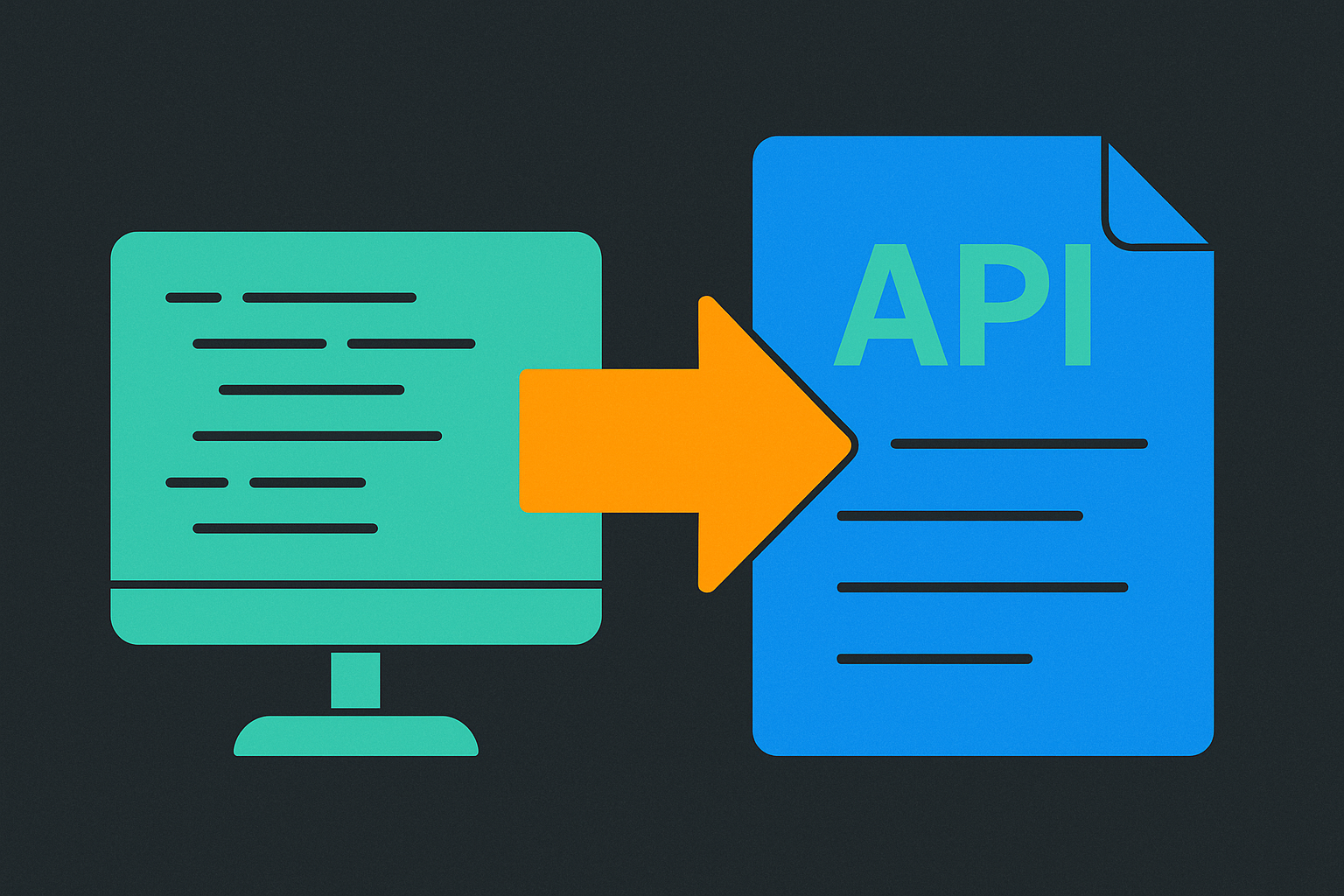
The first is annotation-driven generation. The code is the source of truth here. A developer writes a formatted comment or decorator above a function, a class, a parameter, and a parser reads that comment and turns it into structured output. The second is spec-driven generation, where a machine-readable API description, usually OpenAPI, occasionally RAML or API Blueprint, sits above the code as the source of truth instead. Code and docs both get generated from, or checked against, that one file.
These aren't just two toolchains competing for the same job. They're built on different beliefs about where an API's contract actually lives. Code-first teams build the thing, annotate as they go, and let a tool spit out the spec afterward as a byproduct. Design-first teams write the OpenAPI spec before anyone opens an IDE, and that spec becomes the thing every engineer argues with, points at, and eventually agrees to. I've sat in enough of those early design reviews to say this plainly: catching a mismatched field name or a missing error state in a YAML file costs you twenty minutes. Catching it after three teams have built against it costs you a sprint.
Worth naming a third approach, even though it's narrower than the other two. Traffic-analysis tools watch a running API and reverse-engineer its shape from real requests and responses. Genuinely handy for a legacy system nobody ever wrote a spec for, or a weekend prototype where formal annotations feel like putting a suit on a houseplant. This method is reconstructive, not authoritative, though; it tells you what the API happens to do, not what it's supposed to do, and most teams treat it as a stopgap rather than something to build on long-term.
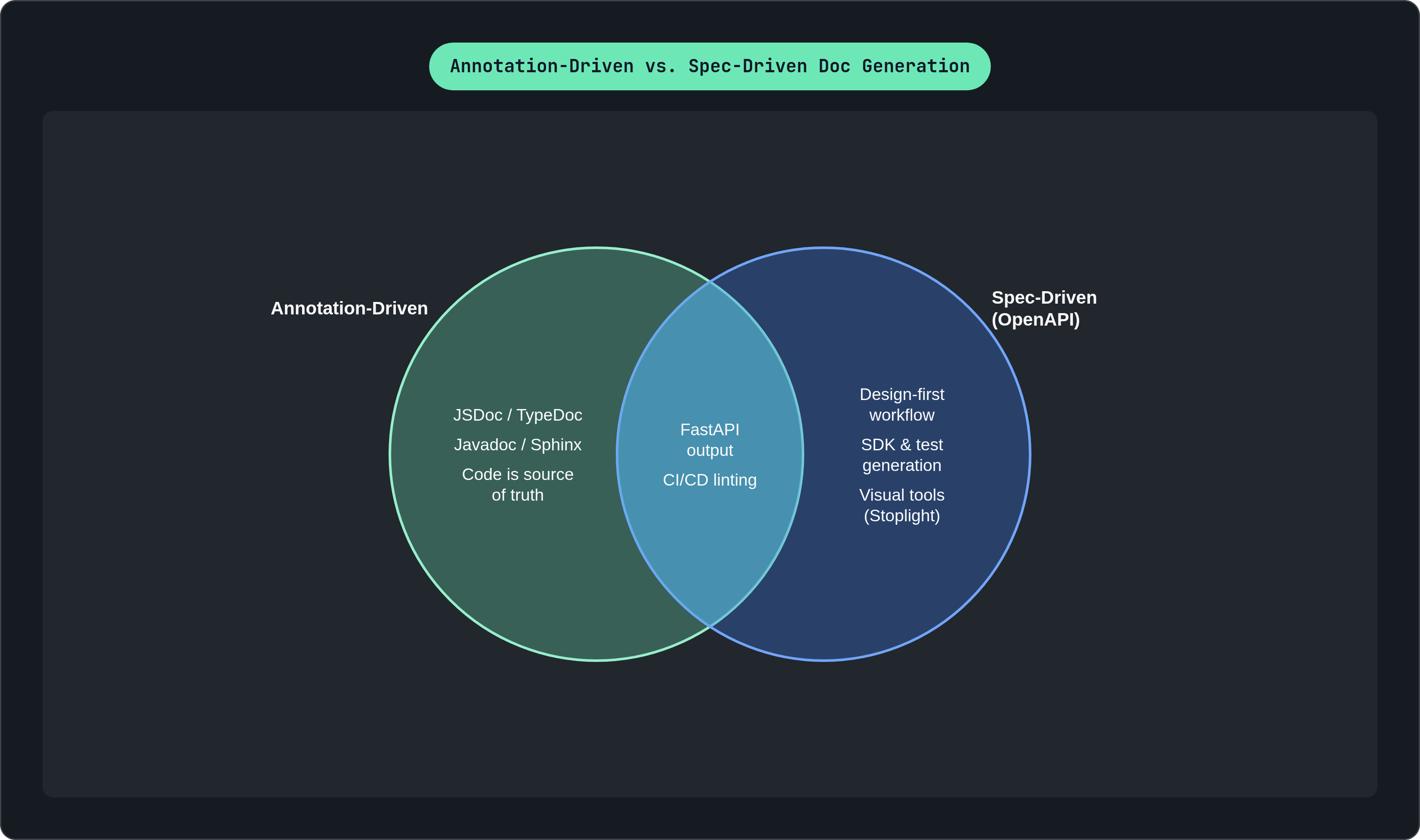
Most real pipelines don't pick cleanly between the first two models anyway. FastAPI blurs the line about as well as anything: it reads Python type hints, optionally your docstrings, and produces a full OpenAPI spec with no separate YAML file involved. So the "annotation-driven vs. spec-driven" divide gets fuzzy fast once tools like this exist. Still, the choice shapes everything downstream, even when it's made by accident: what tools are even on the table, how code review catches doc problems before they ship, how you fight drift, and how the final product gets in front of a developer.
How annotation-driven generators extract documentation from source code
The mechanic is almost embarrassingly simple: a developer writes a comment block above a function or class, a parser reads it, structured output comes out the other side. All the real complexity hides in which tool, for which language, and how much it can infer versus how much a human has to type by hand every single time.
JavaScript has JSDoc, and it's become the backbone of the "docs-as-code" approach that projects like Node.js and React lean on heavily. A commit that changes a function's signature updates the documented behavior in the same diff, which is about as close to zero drift as annotation tooling gets. TypeDoc, sitting at version 0.28.14 as I write this, pushes further for TypeScript: it reads type information straight from the compiler instead of guessing from comments, which closes off an entire category of bug where the comment claims one type and the code enforces a different one.
Java's had Javadoc since practically day one, it ships inside the JDK, and it's been the standard for decades, woven into nearly every Java build pipeline you'll ever touch. Python leans on Sphinx (version 8.2.3 currently), the tool behind Django's docs, NumPy's, Pandas's, plenty of others. It outputs to HTML, LaTeX, ePub, plain text, and its cross-referencing between modules is genuinely good, not just adequate. Doxygen covers a much wider spread at version 1.15.0: C, C++, Python, Java, PHP, C#, Objective-C. That breadth is exactly why it's the practical pick for polyglot codebases and embedded systems, where one team needs one tool to cover five languages instead of five tools nobody wants to maintain.
What comes out the other end is usually a browsable HTML site, organized by class or endpoint, with parameter tables and return types laid out clean. Here's the catch, and it's the same catch every single time: the output is only as good as what a developer actually typed. One engineer writes three careful sentences per function, another writes "does the thing" and moves on with their life, and the generator can't tell the difference between real documentation and a shrug dressed up in a comment block. Annotations go stale too, same as prose docs do, even if proximity to the code slows that down somewhat. The fix most mature teams land on, eventually, out of necessity: a linting rule in CI that fails the build if a public function ships without a required annotation. That's the difference between documentation as a personal habit and documentation as a standard that survives contact with a deadline.
How OpenAPI became the common language between code, specs, and docs
OpenAPI is a machine-readable format for describing REST APIs: every endpoint, every parameter, every response shape, written in YAML or JSON so both humans and tooling can read it without translation. It started as the Swagger Specification before getting spun out under the OpenAPI Initiative, hosted by the Linux Foundation, back in 2015. The current version, OAS 3.2.0, shipped in September 2025.
Why this format, specifically? Mostly because REST won, and decisively. Postman's 2025 report puts REST adoption at 93% across organizations, and once one style of API dominates that thoroughly, whatever description format serves it best just becomes the default by sheer gravity. An OpenAPI Description (an OAD, if you want the shorthand) lays out endpoints, HTTP methods, parameters, request bodies, response schemas, and auth schemes in a single document. Because it's machine-readable, other tools can chew on that one file and produce docs, client SDKs across more than 40 languages, server stubs, test suites, all from the same source of truth.
The numbers back this up better than I expected the first time I looked them up. Postman's 2025 report found 28% of organizations use Swagger specifically for documentation, design, and collaboration, second only to Postman itself at 40%. SQ Magazine separately reported in 2026 that Swagger tooling powers more than 40% of public API documentation across industries. That's not some niche corner of the ecosystem. Most of the public web's API docs run through one lineage of tooling, which is a strange kind of monoculture when you sit with it.
What makes OpenAPI more than just an input to a doc generator, though, is what it does between people. Design-first teams write the OAD before a controller exists and it becomes the contract that keeps backend, frontend, and mobile honest about what they actually agreed to build. Code-first teams flip the order, generating the OAD from annotations after the fact, the way FastAPI does automatically off Python type hints. Both directions work fine. What matters is that once a valid OAD exists, however it got made, the whole downstream ecosystem, renderers, SDK generators, test tools, can consume it without caring about its origin story.
What the spec-to-docs pipeline looks like in practice
Start with the input: a valid OpenAPI file, YAML or JSON, however it got produced, hand-written, generated off code annotations, or exported from a visual design tool. The origin doesn't matter here. From that one file, a rendering tool builds the actual browsable docs a developer will read at 11pm trying to fix a broken integration.
Swagger UI (version 5.30.2) is the most widely deployed renderer out there by a wide margin. It builds an interactive console right in the browser where someone can fire real requests at the API without leaving the page, and it comes wired up by default at the /docs route in frameworks like FastAPI. Redoc goes a different direction: a clean three-panel layout that a lot of teams find easier to scan for large APIs with hundreds of endpoints, and it slots naturally into a docs-as-code workflow where the same toolchain building the app also builds the docs site. There's also a growing crop of open-source, dark-mode-first renderers picking up teams who want that aesthetic without taking on a SaaS dependency for something as core as their reference.
Whichever renderer wins, the output tends to land on the same core pieces: endpoints listed with method and path, parameter tables split by path, query, header, body, response schemas with sample payloads attached, an authentication rundown, and, where the renderer supports it, a "try it" console for live testing right there on the page.
The spec isn't only feeding the docs page, though, and it's easy to forget that. It feeds SDK generation across 40-plus languages through tools like Swagger Codegen, contract testing suites, mock servers used in local dev. Docs are one output of a larger machine built around a single file, not the whole reason the file exists. Visual tools like Stoplight let teams build and check that spec through a GUI instead of hand-editing YAML at 2am, which lowers the bar for a product manager or technical writer to weigh in on API design directly, while still producing a standard, valid OAD at the end.
Where generated output falls short and what still requires human judgment
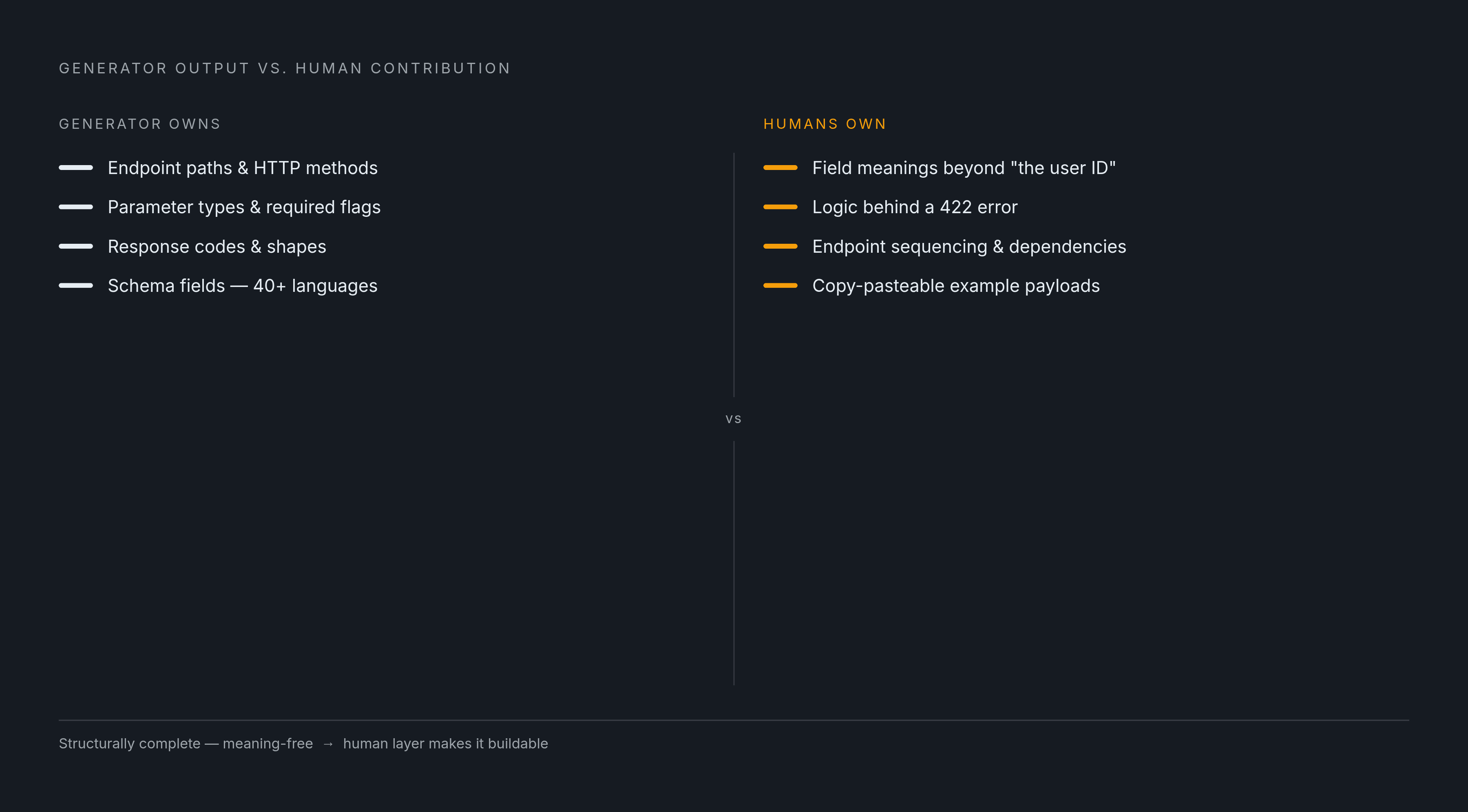
Generators are excellent at structural accuracy. Endpoint paths, parameter types, which fields are required, which response codes exist: that's the skeleton, and a generator builds a correct skeleton reliably, every time, no exceptions, no bad Friday deploy where it forgets a field.
What it doesn't produce is meaning. An autogenerated field description often reads something like "the user ID," which is technically accurate and helps nobody at all. A 422 error response gets its shape fully documented, every field, every type, but nothing in that spec explains the business logic that actually triggers the error in the first place. Sequencing is invisible to a spec, full stop: which endpoint has to fire before which other endpoint, what constraint exists between two parameters that only make sense together. None of that lives in an OpenAPI file no matter how carefully someone wrote it. Default example payloads tend to be placeholder junk, too, "string," "integer," instead of something realistic that actually shows a developer what a response looks like in the wild.
Is this a tooling gap that better generators eventually close? Maybe some of it. A chunk of it, though, is a people problem, not a technology problem, and Postman's 2025 data is blunt about it: 93% of API teams report collaboration blockers around documentation, and only 7% say they hit no such friction at all. Generated structure doesn't touch that number. It can't. I've never seen a better parser fix a broken review process, and I don't expect to start now.
There's a variable underneath all this that's worth saying out loud: annotation quality is the actual ceiling on annotation-driven pipelines. A generator can't invent meaning out of a blank docstring, and it can't correct a misleading comment; it just formats whatever it's handed, faithfully and fast, garbage or gold. Teams that skip enforcing annotation standards tend to discover, a year in, that their auto-generated docs have the exact same coverage holes their hand-written docs always had. They just got there faster and with better formatting.
So the practical split holds up: generation owns structural completeness and staying in sync as code changes underneath it. Humans own meaning, realistic examples, and the connective tissue that turns an accurate reference into one someone can actually build against.
What distinguishes a generated reference that developers actually use
Developers care about this more than most internal stakeholders realize. 80% say clear documentation heavily shapes whether they adopt an API at all, which tells you accuracy is the floor here, not anything close to the ceiling.
Structural completeness is table stakes at this point. Every public endpoint documented, every parameter listed with type and required-or-not, every response code covered, including the error states nobody enjoys writing about. A generator handles all of that competently without much help.
What separates a reference developers enjoy from one they merely tolerate comes down to a handful of specific choices. Descriptions written for what the reader is trying to do, not just what the field happens to be called internally: "the ISO 4217 currency code for the transaction" tells someone something useful, "the currency" tells them nothing. Realistic, copy-pasteable examples for the handful of operations people actually call most. Error descriptions explaining the condition that caused the error and what to do about it, not just the shape of the response body. Consistent naming across the whole surface, because if one endpoint uses user_id and another uses userId, a developer has to stop and wonder whether those are the same field or two different ones, and that half-second of doubt compounds across a hundred endpoints until it's a real cost.
Where the reference lives matters, too. A reference sitting next to guides, tutorials, and a changelog, all under one search bar, gets used far more than a spec renderer floating alone with nothing else around it for context. Increasingly, too, the reference needs to be readable by more than a person scrolling in a browser tab. Teams building on top of AI agents need docs structured so an agent can retrieve and act on them programmatically, which is a requirement that barely existed three years ago and now shapes how serious teams structure their content.
Underneath all of it sits the currency problem: a reference that was correct last quarter and isn't correct now does more damage than no reference at all, because it actively misleads someone who trusted it. That's exactly why the generation pipeline needs to run on every relevant code change or spec update, not on some quarterly documentation sprint everyone dreads and half-finishes before the next release eats the calendar.
Publishing and maintaining generated docs as a living system
Generating the docs is half the job. Without a destination that actually serves them to developers, kept in sync with the source automatically, you've built an elaborate file sitting on someone's laptop.
Self-hosted renderers like Swagger UI are cheap and give a team total control, but the team also owns the server, the update cycle, and every bit of infrastructure headache that comes bundled with that control. Managed documentation platforms take an OpenAPI spec plus whatever prose you've written and turn it into a full developer portal: search, version switching, a layout built for readers instead of for showing off a raw spec file. Some platforms tie documentation directly into AI workflows, so the reference stops being a static page a human occasionally browses and becomes something an agent can query as a live source of truth. Fern takes a related but distinct angle, generating both the reference docs and client SDKs across languages from the same spec, so one source file produces two deliverables instead of someone maintaining them by hand, separately, forever.
None of this holds together without CI/CD wired in correctly. A GitHub Action, or whatever your team's equivalent happens to be, that regenerates and redeploys docs on every merge to main, or on every change to the spec file specifically, shrinks the drift window down to almost nothing. Linting the spec inside that same pipeline, with a tool like Spectral, catches breaking changes and style violations before a developer ever sees them, which beats catching them in a support ticket three weeks later when someone's already frustrated.
Versioning matters, too, especially for a public API. Developers still building against v1 shouldn't get shoved into v2 docs with no warning; most serious platforms support a version selector that keeps the old documentation intact and reachable right alongside the new.
The trend across the industry is hard to miss at this point: technical teams report documentation mattering more over the past several years, not less, as more of the software world gets stitched together through APIs instead of built from scratch in-house. The infrastructure a team sets up now, the CI hooks, the linting, the choice of renderer and portal, decides whether their docs stay trustworthy as the API surface keeps growing, or whether they quietly rot the way most documentation eventually does the moment nobody's watching closely. The thing worth building toward is docs that update the moment the code does, structured so a person and a machine can both use them, living inside the same workflow as the product itself rather than off in a separate project that gets remembered twice a year, usually right before an audit.