OpenAPI Spec as the Single Source of Truth
Keeping specs in sync with APIs requires design-first discipline.
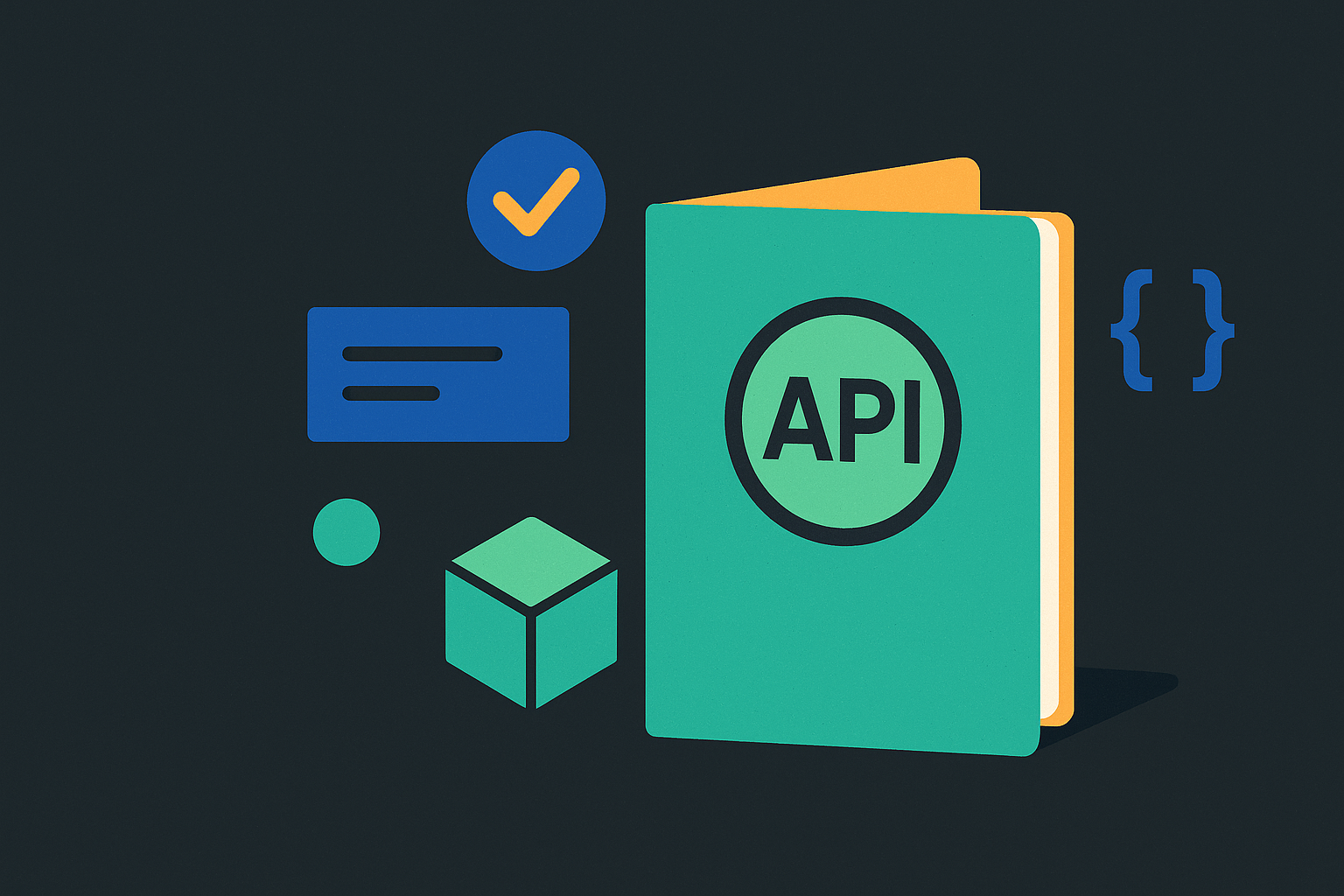
An OpenAPI document describes an HTTP API in YAML or JSON so both humans and machines can parse it: endpoints, request and response shapes, auth schemes, data models. That description only earns the label "source of truth" when it stays welded to the API it describes, and getting there takes tooling, governance, and the plain, unglamorous discipline of keeping a file honest about a system that changes every sprint. I've watched teams fail at exactly that more times than I can count.
The OpenAPI Initiative runs under the Linux Foundation, with Google, Microsoft, IBM, and SmartBear among the members; no single vendor owns the format. Version 3.2.0 shipped in September 2025, staying backward-compatible with 3.0 and 3.1 while adding hierarchical tags, first-class streaming, and custom HTTP methods. There's a 4.0 effort nicknamed "Moonwalk" floating around in early design as of early 2026, with no stable spec yet and no production tooling either, so I won't spend much time on it here.
Why API-first adoption makes the spec's role more consequential than it used to be
I went looking for proof this wasn't just a feeling I had from a few bad projects. Postman's 2025 State of the API Report backs it up: 82% of organizations, out of more than 5,700 surveyed, have adopted some level of API-first, and one in four call themselves fully API-first. Close enough to a default now that treating it as an edge case doesn't make sense anymore.
The money follows the same pattern. Sixty-five percent of organizations pull revenue directly from their APIs, and 74% of those pull at least 10% of total revenue that way. The fully API-first group does noticeably better here: 43% clear a quarter of total revenue from APIs, against 23% for "somewhat API-first" and 16% for the holdouts. The API management market is projected to run from about $9.70 billion in 2025 to $18.62 billion by 2028, which tells you where the money thinks this is going.
So what does that mean for the spec itself? When this much revenue sits this close to the API, the document describing it stops being a nice-to-have. A spec that drifted from reality used to be a minor annoyance, something you'd catch eventually during a slow week when someone finally read the changelog. Now the cost of drift scales right alongside those adoption numbers, and I don't think most teams have caught up to that yet.
How the design-first approach makes the spec the actual source, not a mirror of it
Design-first, sometimes called contract-first, flips the usual order: write the OpenAPI file first, build to it second. Sounds like a small sequencing tweak, but it carries real weight in practice.
If both the server and the client get generated from the same YAML file, there's exactly one place where either can be wrong, and the code is rarely it. Documentation written after the fact describes what got built instead of governing what gets built. A contract carries the authority to correct the thing it describes.
Design-first also changes the conversation before any code exists. Product managers, frontend engineers, backend developers, outside partners, they can all argue about behavior over the same YAML file before a line of implementation gets written. That's the cheapest point in the process to have that fight.
The payoff shows up once work starts running in parallel. Frontend teams spin up mock servers with something like Prism and start building UI before a real backend exists, while QA runs conformance tests with Dredd against the spec from day one. Documentation stops lagging the code, because it's generated from the same source the code is built from. In microservice setups I've seen this compress integration timelines from weeks to days, and it quietly deletes whole categories of contract-mismatch bugs before anyone gets the chance to write them.
The far end of this spectrum is what people call spec-as-source: the spec is the only file a human ever touches, and code is generated, never hand-edited. Change behavior, change the YAML, and everything downstream regenerates. Strict, not for every team, but worth naming as the edge, because everything else in this piece sits somewhere between here and the mess described further down in the drift section.
What a spec-as-source-of-truth actually generates downstream
Once the spec is the source rather than a mirror, it starts pulling real weight. Interactive documentation renders straight from it, current for exactly as long as the spec is current. Client SDKs and server stubs generate across a pile of languages from that one file, so the Python implementation and the Go implementation answer to the same document instead of to each other. Test cases follow the same logic: the response formats, status codes, and error codes written into the spec become the actual criteria automated tests check against.
Everything traces back to one file. Every artifact agrees with every other artifact by construction, not by luck, which is a distinction that matters more than it sounds like on paper.
A handful of tools make this real. OpenAPI Generator is open source and covers a wide language spread; Speakeasy generates SDKs across multiple languages with CI/CD baked in. Stainless hooks into GitHub and generates SDKs alongside docs. Fern generates client libraries and API references at the same time, so neither can quietly fall behind the other.
Here's the property that actually matters: what happens when behavior needs to change. In a spec-as-source setup, you edit the YAML, and that single edit regenerates the SDK, updates the docs, updates the test assertions. Most teams still do it the other way, making the same change by hand in three or four places and hoping nothing drifts. Discipline alone doesn't hold that line for long.
API drift: what happens when the spec and the implementation separate
Here's a number I keep coming back to: an APIContext white paper found 75% of production APIs don't match their OpenAPI specs, and a quarter of them matched their spec on zero endpoints. Zero endpoints agreeing with the document that's supposed to describe them, in a quarter of the APIs studied.
That gap has a name, API drift, the space between what the spec claims and what the running API actually does. Why does it happen so reliably? Structurally, most teams run two sources of truth at once, code and spec, held together by discipline, and discipline is a fragile mechanism. It works right up until a deadline tightens or the person who understood the system leaves, then it fails quietly, and nobody notices right away.
The security fallout isn't abstract. Auth schemes get misdescribed in the spec, deprecated endpoints stay listed as live, undocumented endpoints pile up in production without ever making it into the file that's supposed to describe the whole surface. Runtime behavior pulls away from the documented security model, and that gap is exactly where vulnerabilities slip past controls built on the assumption the spec was telling the truth.
Compliance audits fail for the same reason, which is a strange one to sit with. The API itself is often secure enough on its own; the documented version just stopped matching production. Paperwork failure, real consequences, and I've sat in the postmortem meeting where someone has to explain that distinction to an auditor who doesn't much care about the nuance.
The half-measure most teams reach for is keeping the spec in the same repo as the code and bolting a linter onto CI. That helps some, but it doesn't fix the problem, because there are still two artifacts, code and spec, each needing separate updates, and two things updated separately can always fail to be updated together. The real fix is the one from the design-first section: collapse it to one source, so there's nothing left for the spec to drift away from.
Linting and governance tooling that catches drift before it ships
Linting has the reputation of a chore, the thing a senior engineer grumbles about in review. In practice it enforces the contract at the moment a change is proposed, ahead of shipping, before someone three teams downstream finds the mismatch the hard way.
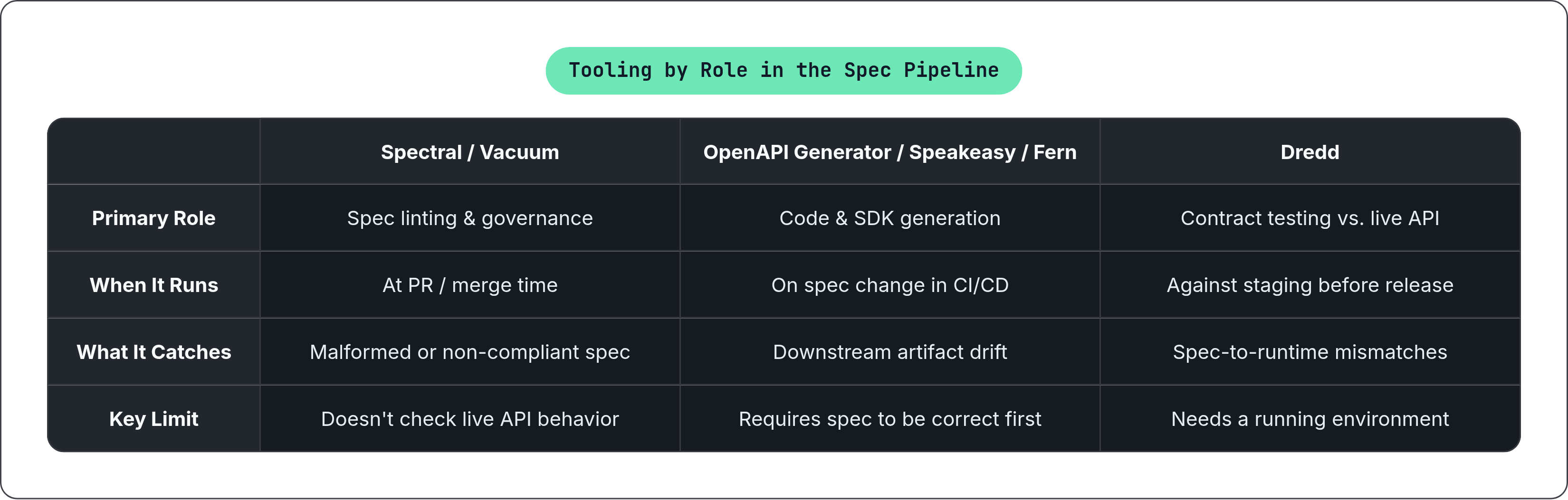
Spectral, built by Stoplight and open source, is a JSON and YAML linter with a built-in OpenAPI ruleset and room for custom rules on top. Teams lean on it to enforce checks aligned with the OWASP API Security Top 10, plus their own naming conventions and auth patterns. Because it sits inside CI/CD, a violation blocks the merge instead of quietly compounding into technical debt someone untangles six months later.
There's broader tooling too, built for teams juggling more than one format at once: OpenAPI 3.2, 3.1, 3.0, older Swagger 2.0, AsyncAPI, Arazzo workflows. That range matters for any organization with a mixed API estate built up across years by teams that didn't always talk to each other. Vacuum takes a stricter-by-default stance, which I like for teams that want a solid baseline without hand-tuning a rule set from scratch.
Still, linting has real limits, and it's worth being honest about where they sit. It validates the spec against rules about how a spec should look, and it has nothing to say about whether the live API agrees with it. Different problem entirely, needing different tooling.
The governance angle deserves its own mention too. Linting scales from a single repo up to portfolio-wide governance: an organization running dozens of services can enforce the same naming, the same versioning, the same security bar across all of them with one rule set. At that scale the spec is doing as much governance work as documentation work.
Drift detection at runtime and the gap left by Optic's shutdown
Linting checks spec quality. Drift detection checks whether the spec matches what the live API is actually doing right now. Two different problems, both needing solutions, and a team with only one of them has a real hole they probably don't know about yet.
Optic used to be the clean answer to the second problem. Run a diff command in CI, catch breaking changes, removed fields, changed types, new required parameters, before any of it ships to whoever's consuming the API. Open source, and for a while, the tool people just pointed at when this question came up.
Now Optic is gone. The GitHub repo was archived on January 12, 2026, following Atlassian's acquisition of the company back in April 2024 and a long stretch of inactivity after that. A few forks exist, but no real community picked them up, and the project is effectively dead, which is a loss I don't think the ecosystem has fully reckoned with yet.
So teams reassemble drift detection out of adjacent parts instead of reaching for one tool built for the job. Speakeasy's CI/CD hooks catch spec-to-SDK divergence as part of the normal generation flow. Dredd validates live endpoints against the spec directly. Fern generating docs and SDKs together narrows the window where the two could ever pull apart. Stitched together, these cover a good chunk of the same ground Optic once did, just less cleanly.
Drift detection at the spec-to-runtime layer is less mature than linting, full stop. Teams serious about this are building pipelines out of several tools rather than betting on one, which loops back to the design-first argument: push enforcement upstream, at design time, at code generation, at test generation, and runtime drift detection has less work left to do by the time anything ships. Prevention wins here, mostly because there's no mature tool left standing that specializes in catching the problem after the fact.
Version control, CI/CD integration, and the spec as a first-class code artifact
Treating the spec as code means exactly what it sounds like: version-controlled in the same repo as the implementation, reviewed through the same pull requests, subject to the same branching and release cadence as everything else, rather than living on a wiki page off to the side where nobody remembers to check it, which is still where I find specs living more often than I'd like.
A few concrete integration points make this real. Schema validation runs on every pull request, so a malformed spec fails the build before it gets anywhere. Linting through Spectral or Vacuum enforces design rules at merge time. Contract tests, run with Dredd or similar, check the live API against the spec in staging before anything reaches production. SDK regeneration through Speakeasy, Fern, or OpenAPI Generator can fire automatically the moment the spec changes, so downstream artifacts never get the chance to lag behind it.
Breaking changes need their own layer on top of all that: semantic versioning applied to the spec itself, deprecation notices that reach SDK consumers before a change actually ships, and CI checks that flag removed fields or changed types as breaking, requiring an explicit sign-off rather than sailing through on a green test suite.
What falls out of all this is more cultural than technical, honestly. When the spec gates the pipeline, teams start treating it as a design decision made before the real work starts, and there's less patience left for paperwork written up after the fact. That's the right instinct, in my experience, even when it's an uncomfortable one to enforce.
Most teams aren't starting from nothing, either. Postman's 2025 report has Postman itself as the most used tool at 40% of respondents, Swagger at 28%, OpenAPI Generator at 20%, API management platforms generally at 34%. The tooling's mostly already sitting in people's hands. The gap isn't adoption of the format; it's whether anyone's wired that tooling into the pipeline in a way that actually enforces something, rather than just running quietly in the background where it can be ignored.
How AI agents consume OpenAPI specs and why drift becomes a runtime failure, not just a documentation problem
Here's a gap worth worrying about: Postman's 2025 report makes clear that AI use among developers is rising sharply, while the share who design their APIs with AI agents in mind. Agent adoption is outrunning API design by a wide margin, and I haven't seen much evidence the gap is closing.
How does an agent actually read a spec? It's the function definition the agent works from to build a valid call: what endpoints exist, what parameters each one takes, what the response should look like. Platforms like Mintlify, a self-updating documentation tool built for AI agents and dev teams, are designed precisely around keeping that source current. The agent has nothing else to check against, and it trusts the file completely, because it has no reason not to. It can't smell that something's off the way a person can.
That's exactly why drift turns into a runtime failure for agentic systems instead of a documentation nuisance. A parameter removed from the live API but still sitting in the spec sends an agent off making a call that fails silently, or comes back with an error nobody planned for. The agent can't tell a bad spec from a bad endpoint. From where it's standing, both look identical, and there's no instinct telling it otherwise.
A human reading stale docs notices something's off and adapts, filling the gap with judgment the document itself never provided. An agent running against a stale spec has no judgment to fall back on. It retries, it escalates, it fails in ways that are much harder to trace to the actual root cause, because the failure surfaces several steps downstream from the moment the spec first went stale.
That raises the bar for what "complete" even means in a spec. Full examples, explicit error codes, exact response formats, these matter more to an agent than they ever did to a human skimming past the gaps with common sense. A spec a human reader can interpret charitably is often a spec an agent can't use at all.
OpenAPI 3.2's first-class streaming support lines up with this almost exactly. SSE feeds and MCP connectors, both common in agent setups, can now live in the same spec file as everything else, instead of getting split off into some separate, unofficial description that nobody's actually enforcing.
What it actually takes to keep the spec authoritative over time
A spec earns single-source-of-truth status through process, not through a line in a README announcing it. Written first, enforced continuously in CI, used to generate the downstream artifacts instead of checked against them after the fact, verified against the live API on an ongoing basis rather than once at launch and never again.
The failure mode, underneath it all, is organizational as much as technical. Any team maintaining the spec as something separate from the code is running two sources of truth whether they mean to or not, and that 75% drift figure from earlier is just what that structure produces at scale, given enough time and enough deadline pressure. I don't think most teams set out to build it that way; it's just what happens when nobody's watching closely enough for long enough.
The pieces that actually hold up combine rather than compete: design-first authorship, so the spec precedes the implementation instead of trailing it; automated linting through Spectral or Vacuum to catch correctness and style problems before merge; code and SDK generation through OpenAPI Generator, Speakeasy, Fern, or Stainless, so the downstream artifacts are structurally incapable of outrunning the source; contract testing against staging to confirm the live API still agrees with what the spec says; version control paired with real breaking-change governance, so consumers know what changed and when.
For teams building on AI agents, none of this is optional anymore, and I don't say that lightly. A spec that drifts sits as stale documentation quietly in a repo, sure, but it also functions as a broken interface for every automated system reading it, and those systems don't carry the judgment a human brings to a document that's fallen a little out of date.
A spec kept in sync with what's actually running is worth trusting, the way infrastructure is worth trusting, something developers, tools, and agents can lean on without double-checking it first. The alternative sits in the repo looking exactly the same as it always did while quietly drifting further from the truth, and nobody notices until something downstream breaks. By then the file's been wrong for months.