Documentation Review Processes in Engineering Teams
Effective documentation review requires cross-functional teams and explicit criteria.
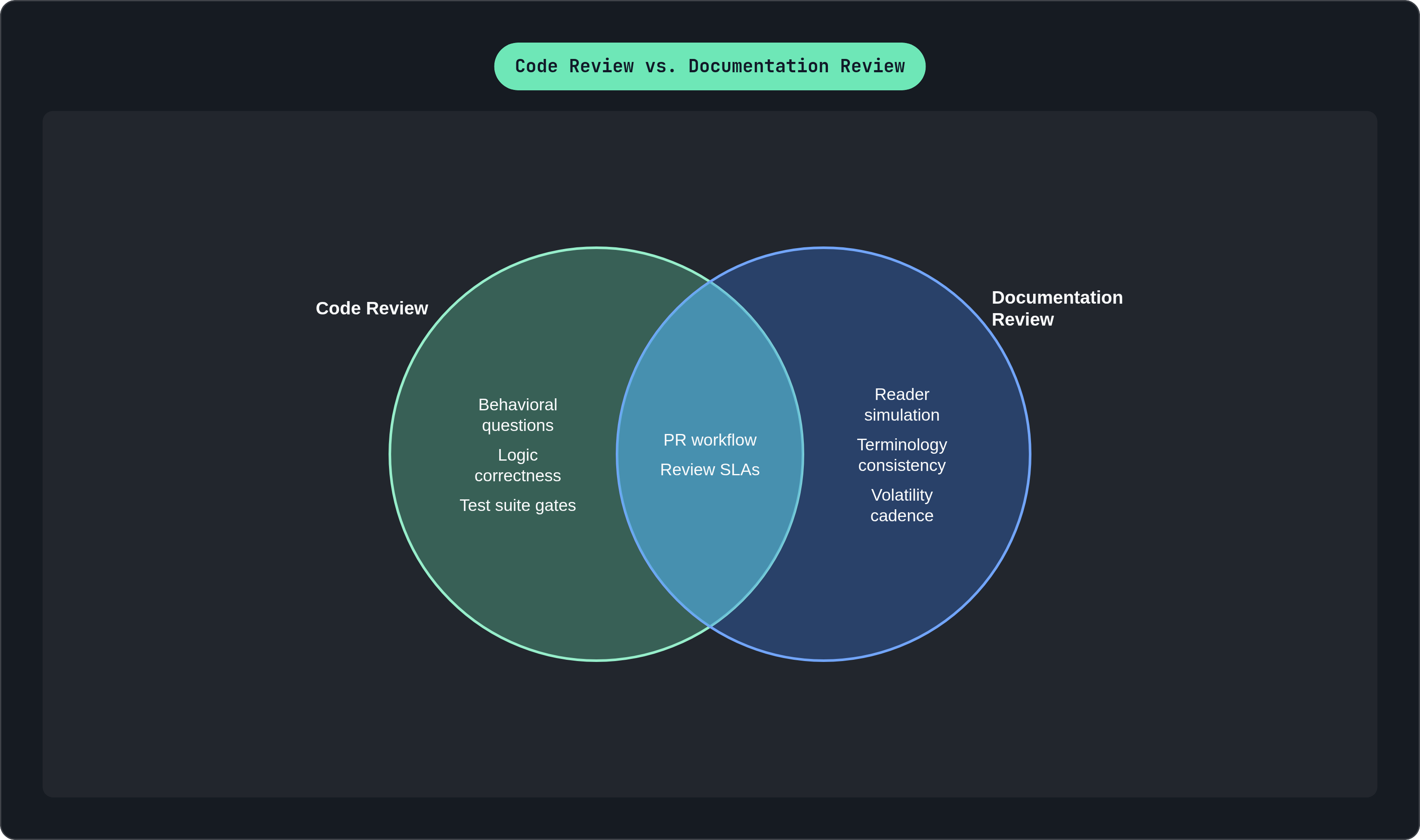
Code review has a well-understood purpose: catch defects before they reach production. The goal is shared, the tooling is mature, and the definition of success is largely unambiguous. Does the logic behave correctly? Documentation review operates under a less obvious but equally consequential standard: ensure the published page accurately describes what the system does, and that a reader can act on it without prior context.
The reviewer's job shifts accordingly. In a code review, the question is behavioral. In a documentation review, the question is experiential: can a reader who doesn't already know this system follow these instructions and arrive at a correct outcome? A pull request diff shows marked-up text. It does not show where a future reader will get stuck, or what they'll assume when a term goes undefined. Reviewing documentation well requires mentally simulating the reader's experience, and that is a distinctly different cognitive task than parsing logic.
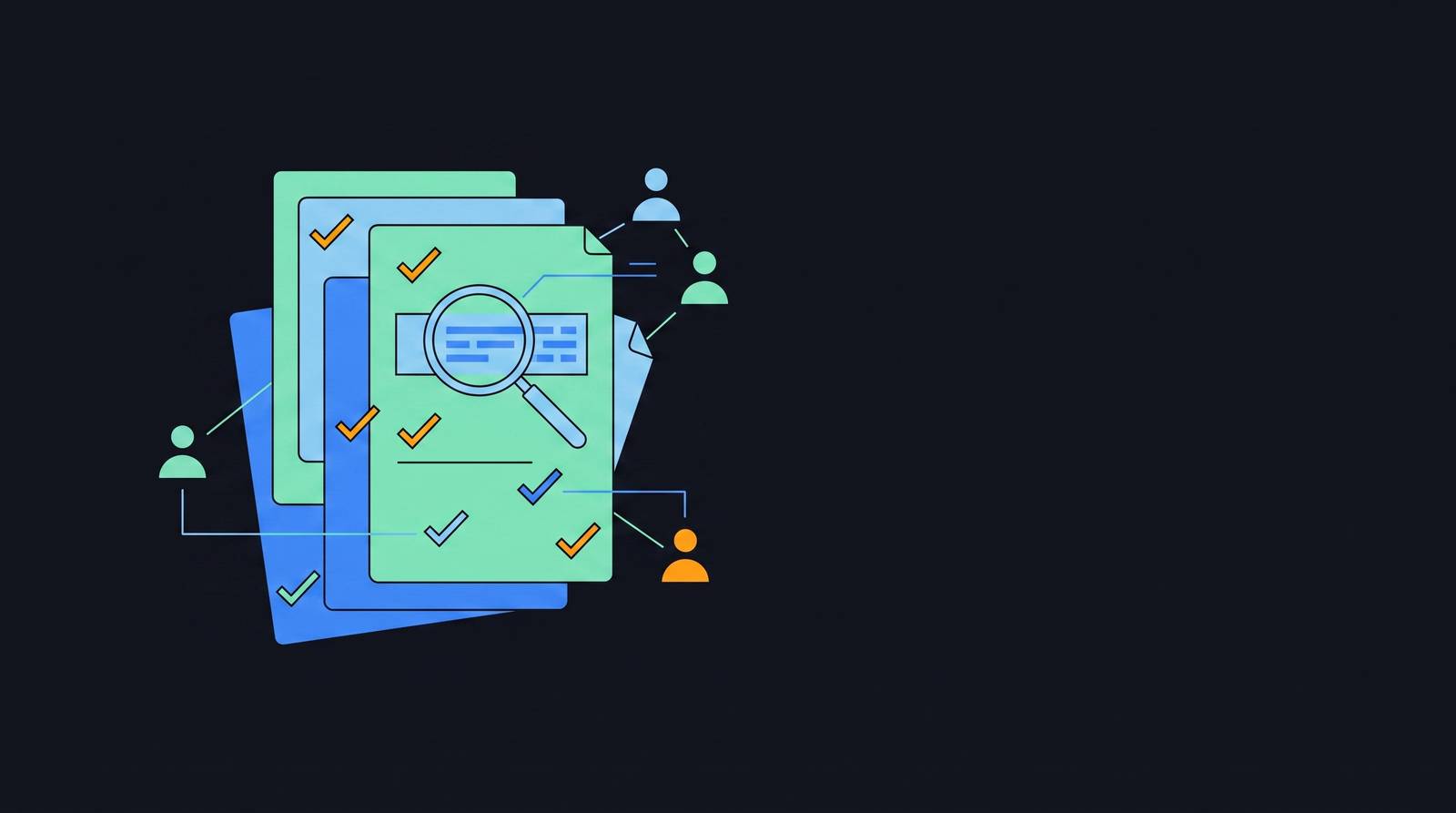
That simulation demands a different composition of reviewers. The engineer who built the feature is necessary for factual accuracy. A writer or editor is better positioned to evaluate structure, terminology consistency, and whether the page can be followed without tribal knowledge. Someone from product or support can answer the question no engineer naturally asks first: does this actually address what users are confused about? These three roles rarely converge in a code review. Documentation review needs them to.
Where this breaks down in practice is the absence of explicit criteria. When a team hasn't written down what a documentation review is supposed to check, reviewers default to intuition, and "looks good to me" is the natural result. Contrast that with a review checklist: factual accuracy, completeness of edge cases, task-oriented structure, consistent terminology with the rest of the docs, no broken links. The checklist is not bureaucracy; it is the difference between a review that catches real problems and one that merely certifies someone read it.
Docs-as-code gives review a concrete home in the engineering workflow
The docs-as-code model is conceptually straightforward. Documentation files, typically written in Markdown or MDX, live in Git. Changes are submitted as pull requests, reviewed by designated reviewers, and published after automated checks pass. Structurally, the workflow is identical to shipping code.
The practical payoff is that review is no longer optional or deferrable. Under a traditional documentation workflow, it is entirely possible, and common, to publish without review, to defer review until after release, or to skip it entirely when a deadline is close. When documentation lives in Git and publication requires a merged PR, the review gate is structural. It doesn't rely on discipline or good intentions on a given Tuesday afternoon.
A minimal CI configuration can enforce meaningful standards automatically: confirm the site builds, verify internal links resolve, run a style linter to flag terminology inconsistencies before a human reviewer ever opens the PR. That's not a comprehensive review; it's a floor below which nothing should ship.
The practice has real adoption at scale. Squarespace Engineering versions documentation alongside code, with documentation and code changes traveling together in the same PR. The Kubernetes project builds its documentation from Markdown files hosted on GitHub, rendered with Hugo, with more than 1,000 contributors submitting updates as pull requests. Google, GitLab, and Pinterest have all adopted this model; Pinterest specifically cited better developer participation and reduced documentation drift as the primary outcomes.
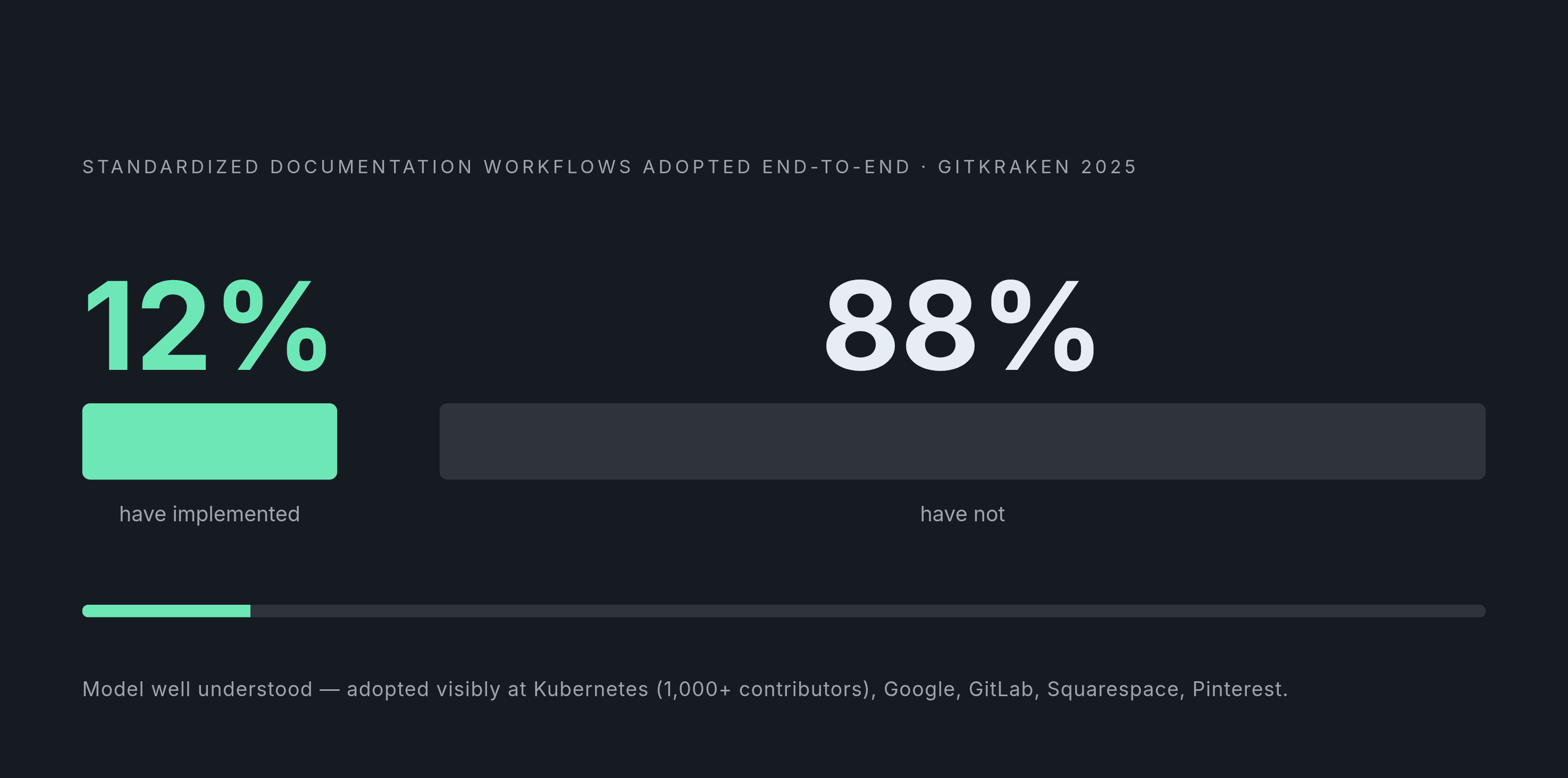
Despite this visibility, the GitKraken State of Developer Workflows 2025 found that only 12% of teams have successfully implemented standardized documentation workflows end-to-end. The practice is well understood but not widely implemented, and I think the gap is less mysterious than it appears.
Git is not a natural environment for writers who haven't used it before. Reviewing a PR in a raw diff interface makes it notably hard to experience content the way a reader will. The workflow requires real investment and ongoing maintenance before it generates value rather than just nominal compliance. Stripe has addressed part of the cultural dimension by including documentation contribution in its engineering career ladder, treating it as equivalent in standing to shipping code. Some platforms reduce the burden of standing up this workflow by building the review integration, automated checks, and publishing pipeline into the product itself. Both moves address the same underlying problem: the activation energy that keeps the adoption number stuck at 12% is ignorance of the model, it is the accumulated friction of implementing it without infrastructure that was built for it.
Ownership: the structural prerequisite that tooling cannot substitute for
Shared ownership of documentation is, in practice, abandoned ownership. When a document belongs to everyone, no one has a reason to act when it drifts. Updates get skipped because someone else will handle it. Gaps go unfilled because no one feels specifically responsible. This is not a character flaw; it is a predictable consequence of diffuse accountability, and I've watched it happen in organizations that cared deeply about documentation quality.
A working ownership model requires three things. First, every page needs a named owner, typically the engineer or team closest to the system the document describes. Second, each page needs a defined verification cadence that prompts the owner to confirm or update, not merely a passive expiry banner nobody reads. Third, group ownership needs to be treated with the same skepticism applied to group accountability in any other engineering context. Distributing responsibility across a team without a designated decision-maker is how documentation goes stale by committee.
Distributed expertise and centralized accountability are not mutually exclusive. Product managers, engineers, compliance specialists, and technical writers can all contribute to a document. The contribution model can be broadly collaborative. But every document needs one owner whose job it is to initiate reviews, evaluate incoming changes for accuracy, and escalate when the page no longer reflects reality. The contributor model and the ownership model are separate concerns, and conflating them is where most teams lose the thread.
Review SLAs apply here just as they do to code. A documentation PR that waits indefinitely because no reviewer feels personally obligated to act is functionally the same as a blocked code review: the work is done but it hasn't shipped. Establishing a maximum time-to-review for documentation PRs, assigning it to the page's named owner, and enforcing it with the same seriousness applied to code review SLAs converts ownership from a stated value to an operational one.
The Journal of Systems and Software has found that codebases with high-quality documentation show measurably lower defect rates and higher developer productivity, specifically a 21% reduction in defects and a 19% productivity increase. Those numbers are not an argument for editorial nicety; they are a structural input to code quality, and they make ownership a defensible engineering investment rather than a documentation team's internal concern.
When reviews should happen: matching cadence to documentation volatility
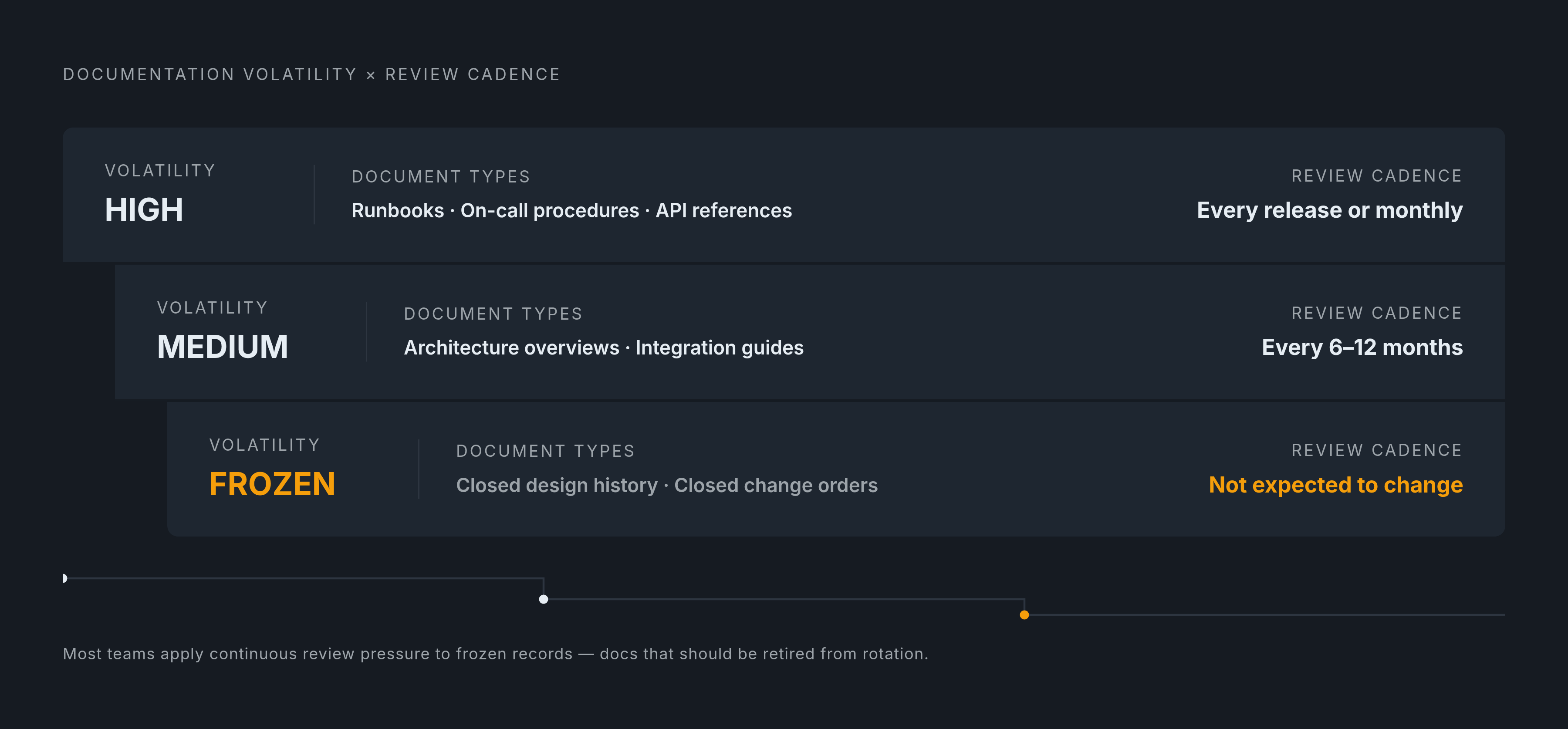
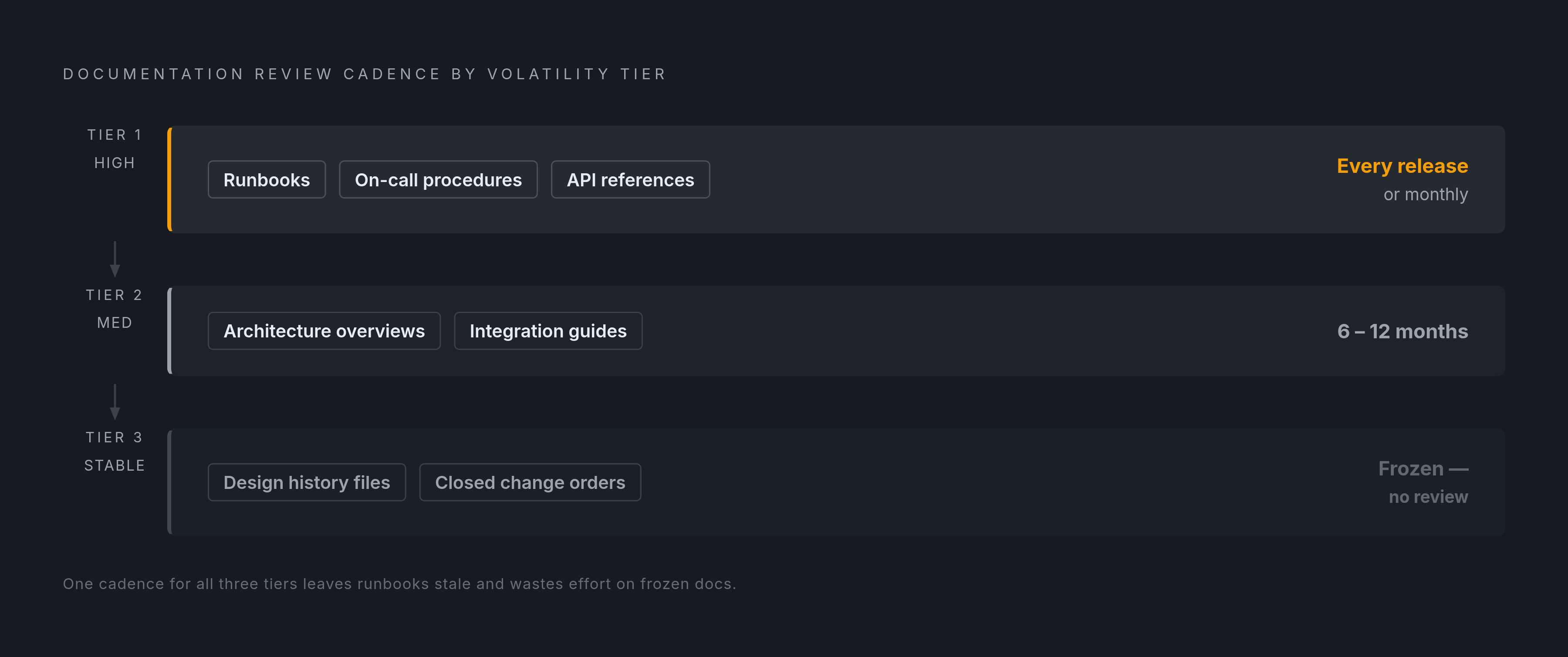
One of the more consistent mistakes I've seen teams make is applying a universal review cadence to all documentation. A quarterly review cycle is insufficient for a runbook that changes with every release; applied to a closed architecture decision record that will not be updated, that same cadence wastes time and erodes confidence in the process itself.
A volatility-based framework is more durable. High-volatility documentation, runbooks, on-call procedures, API references, should be reviewed after every release cycle or monthly at minimum. These documents are consulted under pressure, often by engineers who aren't the system's original authors, and inaccuracy carries immediate operational risk. Medium-volatility documentation, architecture overviews and integration guides, warrants review every six to twelve months. The systems they describe change, but not sprint to sprint. Stable records, shipped design history files and closed change orders, can be marked frozen. They don't need a review cycle; they need a clear designation that they are not expected to change.
Scheduled cadence is not sufficient on its own. Certain events should trigger an immediate review regardless of where a document sits in the rotation: software updates that rename features or change UI flows, incidents where the runbook was consulted and found wanting, regulatory changes, employee turnover in a role that held undocumented context, patterns of support tickets that suggest a gap, audit findings. These triggers belong on a release checklist and in post-mortem templates so they fire automatically.
The asymmetry of stale documentation deserves particular attention, because it's not obvious until you've been on the wrong end of it. A missing document signals its own absence; a reader who finds nothing knows to ask. A stale document projects false confidence. A reader assumes it reflects reality, acts accordingly, and discovers the error under the worst possible conditions.
That asymmetry is amplified in AI-assisted workflows in a way that changes the risk calculus considerably. A human engineer reading a stale runbook may notice that a step feels off and pause to verify. An AI assistant given the same document has no such hesitation; it acts on the information instantly and at scale. A survey of founders, operators, and engineers found that more than three in four had watched an AI tool at their company surface an outdated document and confidently produce an incorrect answer. Organizations moving toward AI-assisted development workflows are building a case for better documentation and making stale documentation a force multiplier for error.
Research from a 2024 developer experience survey found that engineers at companies with poor documentation take roughly twice as long to reach full productivity compared to engineers at companies with well-maintained docs. Nearly two additional months of salary and opportunity cost per hire concentrates the attention in a way that abstract documentation quality arguments rarely do.
What an engineering team's documentation review process actually looks like end-to-end
Step 1: Inventory and assign ownership
The prerequisite is an audit. Which documents exist, where do they live, and who, if anyone, currently owns them? That audit almost always surfaces the same three categories: documents with clear owners that are reasonably maintained, documents with nominal owners who haven't looked at them in months, and documents that exist in a kind of organizational vacuum. Every page needs a named owner and a volatility classification before anything else in this process functions correctly.
Step 2: Define review criteria
Before the first review happens under a new process, the team needs to agree on what a review is actually checking. Factual accuracy. Completeness, specifically whether edge cases and failure modes are addressed. Task-oriented structure, meaning the document leads a reader through an action rather than describing a system in abstract terms. Terminology consistency with the broader documentation set. Link validity. Writing this down converts review from a subjective impression into a repeatable practice. Without it, you're back to "looks good to me."
Step 3: Embed review in the PR workflow
Documentation changes travel in the same PR as the code changes they describe. CI runs automated checks before merge is allowed. The review gate is not optional. A documentation change that ships without review is the equivalent of a code change that bypasses the test suite: technically possible, but a signal that the process has broken down.
Step 4: Set review SLAs
Every documentation PR has a maximum time-to-review, assigned to the page owner, enforced the same way code review SLAs are enforced. The specific window matters less than its existence; a 48-hour standard prevents the pattern where a PR sits for two weeks because no reviewer feels a specific obligation to act.
Step 5: Build the trigger list
The team agrees on which events immediately initiate a documentation review outside the scheduled cadence. That list becomes a checklist item in release templates and incident post-mortem templates. When a review trigger fires automatically as part of an existing workflow, it doesn't depend on individual memory or judgment under pressure, which is precisely when memory and judgment are least reliable.
Step 6: Close the loop with tooling
The coordination burden of this process is real, and it shouldn't be managed manually. Tracking which pages are due for review, routing reviews to the right owners, surfacing stale documentation before it causes problems: these are coordination tasks that tooling handles better than humans do. Certain platforms are built to fit this workflow directly, with documentation living alongside code, updates synchronizing with product changes, and the platform architected to feed into AI workflows. The living source of truth that the process creates is also the knowledge infrastructure that AI agents can actually use accurately.
What I find particularly interesting about this, after watching teams attempt and abandon documentation processes for years, is the feedback structure it builds when it's executed consistently. Shipping a change and documenting it become the same action. Review catches gaps before they calcify into productivity drains. The documentation is oriented toward what the system actually does. Most engineering teams have not operated that way; most, in my experience, don't believe it's achievable until they've seen it run for a quarter.