End-to-End Documentation Platforms That Serve Both Human Readers and AI Systems
Documentation platforms must serve both human readers and AI agents to prevent integration failures.
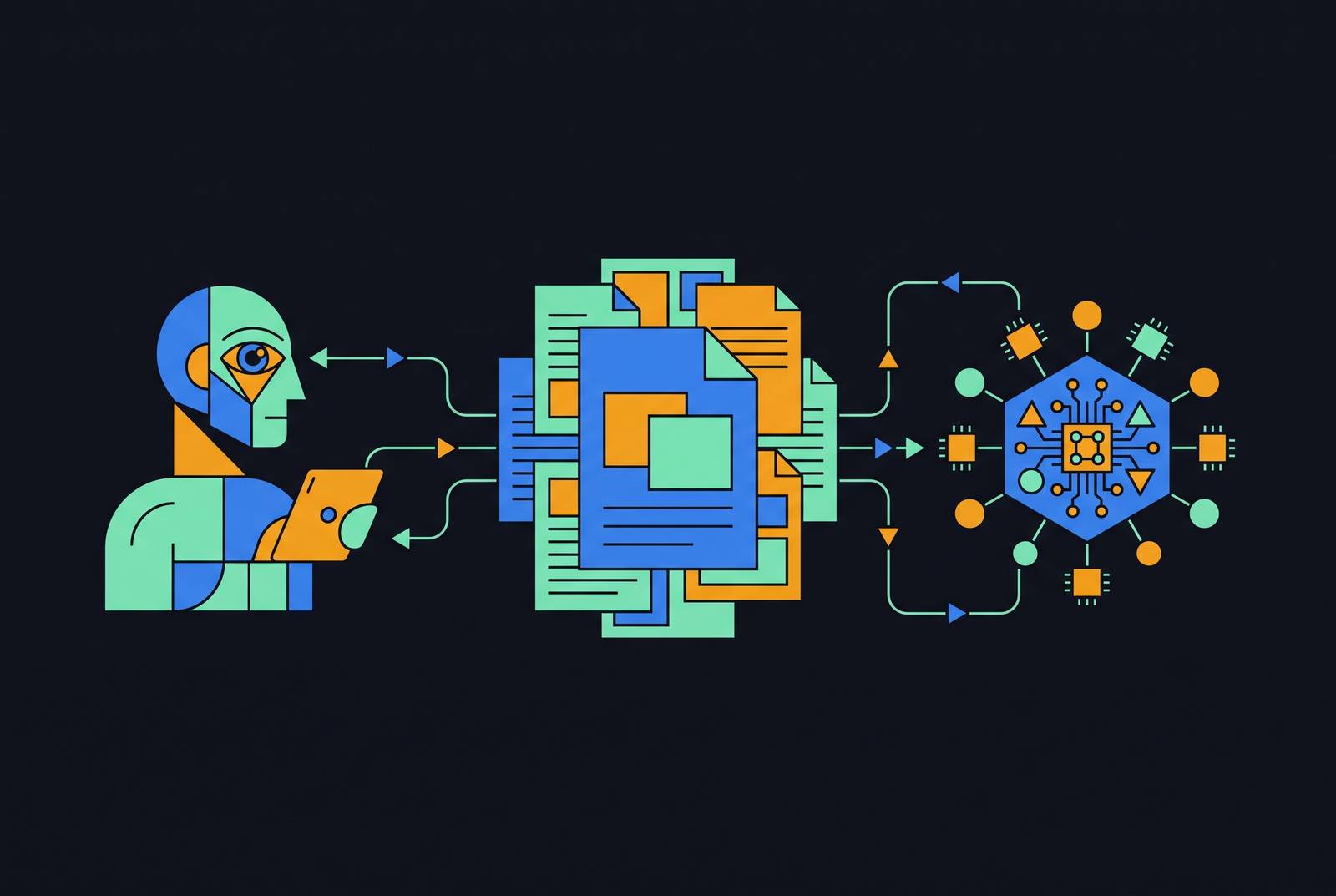
An agent recommends a product, tries to integrate it, hits a documentation page that doesn't exist, and quietly abandons the product for a competitor. Agents have been observed treating a missing page as evidence that the product never had the capability. The failure sits in how documentation is read rather than in what the documentation says. Human readers browse visually. They follow navigation menus, scan headings, click into interactive tabs, and tolerate a little friction because they can backtrack and reread. AI systems don't work that way. They retrieve pages into a context window, parse Markdown far more reliably than HTML, and have no way to click through a browser-based walkthrough or toggle an interactive code tab. An agent moving through a product's docs is executing a fixed sequence: discovery, then retrieval, then action, and each of those three stages demands a different format than the one before it.
The stakes are concrete rather than theoretical. When a developer asks an LLM for help integrating an API, the quality and format of that product's documentation shapes the answer the developer gets back, sentence for sentence. If the docs are structured only for a human skimming a sidebar, the model has nothing reliable to retrieve, and it fills the gap. That's how agents end up hallucinating parameters that don't exist or producing integration code that fails on the first run, because the documentation never gave the model anything stable to work from even though the underlying API is intact. The rest of this piece works through what changes when a platform treats both audiences as first-class: what formats the machine-reading side actually requires, why a split pipeline guarantees drift between the two, what a seven-point framework for judging a platform looks like, and how specific platforms handle the full stack today.
The three format requirements that separate machine-readable documentation from everything else
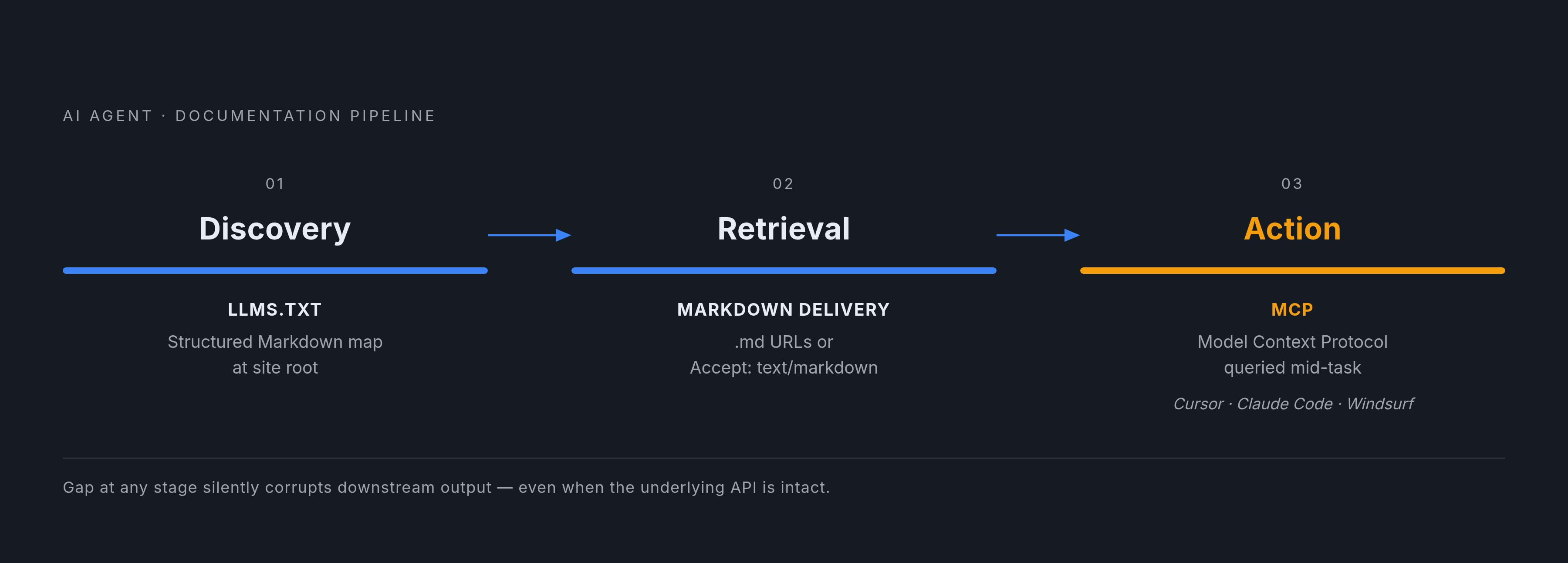
Three formats cover the three stages an agent moves through, and none of them substitutes for the other two. llms.txt handles discovery: it's a structured Markdown map of a site's available content, so an agent landing on a product URL has something to navigate instead of a string of guesses. Markdown delivery handles retrieval: once the agent knows which page it wants, it needs the actual content back in a form it can parse cleanly. MCP, the Model Context Protocol, handles action: it lets a coding tool query documentation directly while it's mid-task, rather than falling back on whatever the model already memorized during training.
Before llms.txt existed as a convention, if an agent had no index, it would guess at.md URLs and llms.txt paths that simply weren't there, and fail before the task even began. A well-maintained llms.txt file changes that outright: instead of guessing, the agent gets a map. A companion file, llms-full.txt, goes further and delivers the complete content, including resolved API specifications and working code examples, so an agent doesn't have to chase links across a dozen separate pages to assemble one answer. The objection to llms.txt deserves a direct answer rather than a dismissal: it's a community convention, not a standard. No body like the W3C or the IETF has blessed it, and the major search providers haven't confirmed that it functions as a ranking input. Adoption among AI providers is voluntary, and it shows: some crawlers respect it, some ignore it. That's a real limitation on how much weight any single platform should put on llms.txt alone. It is one format among three, not the whole solution.
Markdown delivery is where retrieval actually happens. Agents pull individual pages either through dedicated.md URLs or by requesting Markdown directly with an Accept: text/markdown header. Markdown costs fewer tokens than full HTML, and it keeps the commands, schemas, and code samples intact in a form a model can parse, without noise like navigation chrome or embedded scripts to strip out. Fidelity is the whole game here: a Markdown response has to keep the full API schema, the exact installation commands, every prerequisite, version numbers, and links that actually resolve. Dropping any one of those breaks the agent's output downstream, even if the page still reads fine to a human. Some platforms now detect LLM traffic by its request pattern and serve Markdown automatically instead of HTML, which cuts token consumption and speeds up processing without requiring the agent to know a special URL scheme in advance.
MCP sits above both of those as the highest-bandwidth layer, because it isn't passive delivery, it's active querying. A coding tool like Cursor, Claude Code, or Windsurf can ask a documentation server a direct question mid-task and get a current answer, instead of relying on whatever the underlying model learned at training time and may now be wrong about. What matters inside that exchange is what the MCP server actually hands back. If a server returns the full original page with commands and schema intact, the agent gets something it can act on directly. A server that returns a synthesized summary gives the agent someone else's interpretation of the page, and for an integration task those two responses are not interchangeable: one preserves the exact syntax the agent needs to reproduce, the other paraphrases it. The protocol itself is still moving. On July 28, 2026, MCP's maintainers finalized a major revision that removes protocol-level session tracking and makes MCP stateless at the protocol layer. Not every change in that revision is backward compatible, and a server built against the new spec may fail to interoperate with an older client unless it keeps the prior session-based path running alongside the new one. Discovery documents placed at.well-known paths round out the picture, so agents and MCP clients can locate a server or API catalog without a human configuring anything by hand.
A single source of truth is the architecture that keeps both audiences in sync
Running two documentation pipelines, one tuned for humans and one for agents, sounds workable, but then an API actually changes. The moment it does, every place that API is described has to update at once: the human-facing page, the Markdown version an agent retrieves, the llms.txt index pointing to both. Maintain those separately and consistency has no mechanism to hold, since manual duplication across three or four parallel copies of the same fact will eventually fall out of sync. The output that drifts out of date fails both audiences at once: the human reader sees stale instructions, and the agent retrieves a Markdown version built from that same stale page.
The fix is architectural rather than procedural: generate every delivery format from one specification instead of writing each one by hand. An OpenAPI spec that engineering already maintains can drive the human-readable reference docs, the Markdown version agents pull, and the SDK code examples shown in both, all from a single source. Nobody has to remember to update three places, because there's only one place to update. That matters more now than it did two years ago, because AI-assisted coding tools have pushed shipping velocity up to a point where documentation that depends on a human remembering to follow up after every release decays faster than any manual process can track. The test for whether a platform has actually solved this is specific: when a pull request merges in the code repository, does the documentation pipeline read that diff, draft the corresponding update, and route it for review on its own? Or does someone still have to remember to open a second ticket to get the docs updated? The machine-readable files need the same discipline. An llms.txt or llms-full.txt file that regenerates on a weekly cron job is stale the moment a deploy happens between cycles, and a stale machine-readable index does the same damage as a stale human page, just invisibly, because no one is reading it to notice.
That invisibility is the deeper problem with trying to manage this by instinct. Standard web analytics mix agent traffic in with human traffic in the same dashboard, so a team has no clean way to see which pages AI systems actually hit, which ones they skip entirely, or where the machine-readable content is quietly failing a retrieval attempt. Without that visibility, drift isn't just likely, it's undetectable until a developer reports that an LLM gave them broken integration code.
Seven Criteria for Evaluating Dual-Audience Documentation Platforms
The architecture above, one source generating multiple formats automatically, implies a specific set of things a platform has to get right, and those line up with what can go wrong at each stage of an agent's workflow rather than a generic feature list pulled from a sales page. Seven criteria cover that territory.
Discovery from a product URL asks whether a platform generates llms.txt at the site root automatically, updates it on every deployment instead of on a fixed schedule, and links to that index from individual Markdown pages, so an agent entering through a side door can still find the map. It also asks whether.well-known discovery documents advertise MCP servers without a human wiring that up by hand.
Retrieval through Markdown, an index, or MCP asks whether a platform offers more than one path in, because agents don't all arrive the same way. Some pull.md URLs directly, some negotiate content type through headers, some query an llms-full.txt file, and some go through MCP search. A platform that supports only one of these paths forces every agent into the same narrow gate.
Content fidelity for integration tasks is a separate question from retrieval and easy to confuse with it. Retrieval asks whether the agent can get a page. Fidelity asks whether the page it gets still has the complete API schema, the installation commands, the prerequisites, the version numbers, and links that resolve rather than fail. A platform can pass retrieval and still fail fidelity if its Markdown export quietly drops a parameter table. Version-aware search and working redirects matter here too, so an agent working against a current API version doesn't end up with instructions written for a version two releases back.
Agent-specific guidance alongside human-facing components asks whether authors can hand an agent a CLI command or a raw API example directly, separate from an interactive tab built for a human to click through. An interactive walkthrough is useless to a system that can't execute a browser, so if that walkthrough is the only place an instruction lives, the agent simply doesn't have it.
OpenAPI and AsyncAPI generation asks whether the API reference is generated from the spec the engineering team already keeps current, rather than written separately and left to drift. AsyncAPI support matters specifically for WebSocket and event-driven APIs, and many platforms still handle that category poorly.
AI-assisted maintenance asks whether the platform treats a documentation update as something that happens automatically downstream of a shipped code change, with a human reviewing a drafted update rather than authoring one from scratch.
AI traffic analytics asks whether a team can see agent visits broken out from human visits, see which pages agents reach, and see where they stop, so they find doc gaps before a developer reports a broken integration rather than after.
One distinction inside this framework is easy to collapse by accident: MCP server coverage and content fidelity sound similar but test different failures. MCP coverage asks what kind of response the server returns at all: a full original page, or a synthesized summary. Fidelity asks, once a full page is returned, whether that page still has every schema and command intact. A platform can clear one of these and fail the other, so judging a platform against this framework means checking both separately rather than treating "has an MCP server" as a single pass/fail box.
How AI-native documentation platforms handle the full dual-audience stack
Against that seven-point framework, the platforms built specifically for this dual-audience problem treat machine-readable delivery as a built-in mode of the product. The defining trait of this category is that llms.txt generation, skill.md output, MCP servers, Markdown delivery, and in-docs AI assistance ship as native features rather than something a team configures through a third-party add-on.
One such platform generates interactive API references automatically from OpenAPI and AsyncAPI specs, with a playground built into every docs site so a developer can test a call without leaving the page, and the same spec drives machine-readable output on the back end. It produces llms.txt, llms-full.txt, and skill.md automatically, and serves Markdown to AI agents instead of HTML, tuned to use fewer tokens per request. MCP server support lets Cursor, Claude Code, and Windsurf query the documentation directly mid-task instead of relying on stale training data. The in-docs AI assistant runs what the platform calls agentic retrieval, giving the model tool-calling access to search, fetch, and reason across documentation pages, OpenAPI specs, and other configured sources in multiple steps, a meaningfully different capability from a single-pass RAG lookup that returns one chunk and stops. On the maintenance side, an autonomous workflow reads a merged pull request, drafts the corresponding documentation update, and opens a PR for human review, closing the loop the single-source architecture depends on. An AI traffic dashboard separates visits by agent type, ChatGPT, Claude, Perplexity, shows which pages each one reads, and flags where they stop reading, giving a team the visibility that standard analytics can't provide. Bi-directional Git sync keeps the repository and the published site in lockstep, with preview deployments letting a team review a change before it goes live regardless of whether a human or an agent drafted it.
GitBook supports llms.txt output, MCP server support, and structured Markdown delivery as core output modes, and its proactive agents draft updates directly from pull requests and support tickets, giving a team a starting draft to review rather than a blank page every time code or a support ticket signals that something in the docs needs to change.
Fern treats machine-readable output as a build artifact rather than an afterthought, automatically generating token-optimized llms.txt and llms-full.txt files whenever the underlying documentation changes, and serving Markdown instead of HTML the moment it detects LLM traffic in a request. Its content tags, <llms-only> and <llms-ignore>, give an author direct control over what an AI system sees versus what a human reader sees on the same page, so a team can include dense technical context for a model to parse while keeping the human-facing version of that same page clean and readable.
What separates these platforms from a generic documentation tool with an llms.txt plugin bolted on is automation at every layer: the API reference, the Markdown export, the machine-readable index, and the maintenance workflow all trace back to one source, updating together rather than depending on a human to keep four separate copies in sync. That's the architecture the first three sections of this piece built toward, and it's the actual test a team should apply when a platform claims to serve both audiences at once.