How Continuous Documentation Keeps Docs From Going Stale
Embedding documentation updates in code workflows prevents the drift that makes manuals unreliable.
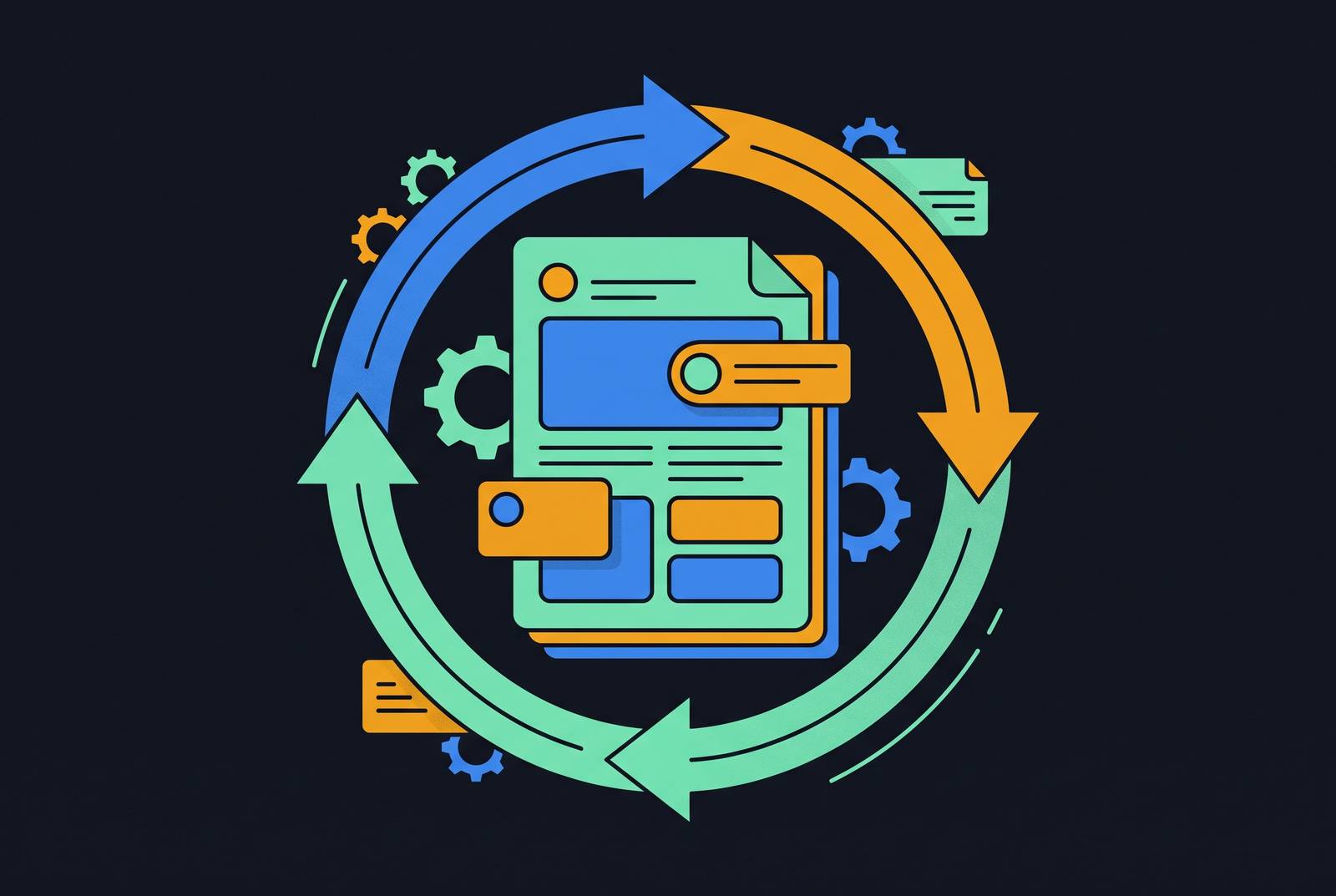
Documentation stays up to date when its workflow keeps pace with the product. Continuous documentation makes that connection structural, linking updates to code changes, automated checks, and named owners. The correction is not to ask teams to care more about their docs, but to stop treating documentation as a deliverable that is finished when it ships.
Why documentation goes stale even when teams care about it
Documentation and code often live in separate systems, with no mechanism that forces them back into alignment after the initial writing sprint. A product change can therefore be complete in one system while its explanation remains untouched in another. That separation makes drift a predictable outcome of the workflow. Even a conscientious developer must remember to cross the gap whenever behavior changes. The workflow depends on memory precisely where it needs a dependable connection.
The cost of that separation is also delayed. Documentation feels like extra work while a feature is being built, but months later someone needs it to keep that feature working. By then, the missing updates have compounded, and the original context is harder to recover.
What breaks when documentation drifts — and for whom
Engineers encounter that expense as wasted investigation. A documentation error can send them into hours of debugging even when the code is behaving correctly. After enough such encounters, they stop trusting the runbook and Slack a teammate instead, or repeat work whose documented result no longer seems believable. The knowledge has not necessarily disappeared. People no longer trust it, so they need to ask someone else for an answer again.
That dependence carries into support. Questions that correct documentation could answer become tickets, and when wrong instructions cause integration problems, engineers get pulled in to troubleshoot. Support becomes the first place people turn for help with the product, even for problems the documentation should answer. End users have to wait, while the time new developers need before they can get work done may stretch from days to weeks. They learn to rely on Stack Overflow threads, colleague advice, or trial and error rather than the official account of how the product works.
AI agents extend this chain beyond individual readers. They treat documentation as ground truth and can confidently suggest deprecated methods, wrong SDK calls, or outdated configuration steps. Experienced developers can sometimes recognize and work around those inaccuracies. Agents cannot rely on that human judgment, so an error in the knowledge base can spread through generated answers and code at scale.
Why the deliverable model is the actual structural problem
A deliverable is closed when it ships, while a living system remains subject to change. If documentation is complete at a milestone, the model has no built-in obligation to respond afterward. It supplies neither a feedback loop from changing code nor an automated signal that an explanation has drifted. Unless ongoing ownership is explicit, it also leaves responsibility for the next correction unresolved.
More careful writing improves the initial document but cannot make its claims remain true as the product changes. Manual updates have a related limit, because correcting an API specification does not also correct the quickstart or every tutorial that repeats an authentication requirement. Scheduled quarterly reviews help discover these discrepancies, but they remain point-in-time inspections. They cannot match continuous shipping merely by being taken seriously. The useful distinction is therefore not between teams that review documentation and teams that do not, but between workflows that periodically inspect drift and workflows that respond to the changes that cause it.
What continuous documentation actually means in practice
With continuous documentation, teams update the docs as part of changing the product. It is a workflow design. Its docs-as-code implementation uses the same tools and practices for documentation that software teams use for code, including Git for version control, Markdown for formatting, pull requests for review, and CI/CD pipelines for deployment. Documentation becomes a parallel artifact that moves through development with the software.
GitLab stores its documentation source files in the same repositories as the product code, while a separate project builds the documentation site by aggregating them. That distinction matters because shared source workflows do not require every publishing component to live in one repository. Kubernetes manages documentation on GitHub, where community contributions are reviewed and merged like code changes. These examples make the operational model concrete without making one repository layout the definition of continuous documentation. The essential connection is that product changes, documentation changes, and review belong to the same ongoing process.
Co-locating docs with code so updates happen where changes happen
Keeping documentation in the repository with the code it describes reduces the distance between a change and its explanation. A developer can include both in the same pull request, putting the documentation in the same diff and review context. Updating it no longer requires a move into a separate system after the implementation is complete. Skipping the update becomes a visible omission. Co-location is therefore a forcing function for attention, although it is not a guarantee that every necessary edit will happen.
Version control adds a second benefit. Documentation inherits branching, rollback, and history, so a team can recover what the docs said at an earlier release as well as see the latest explanation. Kubernetes provides a user-facing version dropdown so readers can find documentation matched to the cluster version they run. That link between the product version and what the docs say it does matters when more than one version is in use. Developers may still resist writing documentation, but co-location lowers the activation energy by keeping the context open, the tools familiar, and the review checkpoint shared.
Using CI/CD pipelines to catch drift before it reaches users
Proximity makes an update easier to notice, but a pipeline can make it a condition of shipping. With documentation checks in CI/CD, selected quality requirements become part of the build status. Pipelines can be configured to fail when code changes lack corresponding documentation updates. This changes the conditions under which a change can pass without its documentation being addressed.
When reference documentation is generated from the API specification, an added endpoint or changed parameter can appear without a separate manual reference edit. That keeps the reference in step with the specification, while other checks test whether code examples compile, links resolve, and API calls return the responses they should. Scans can also flag deprecated references or content that has not changed recently in a fast-moving feature area. Recency is a signal for investigation rather than proof of inaccuracy, but it gives reviewers a place to look.
Reusable content and review cadences as the third layer of protection
Pipeline checks do not remove the burden of repeating the same fact across many pages. If every rate limit warning or authentication prerequisite is copied independently, one product change creates many opportunities for omission. Reusable snippets address that multiplication at the content level. A repeated block lives in one source file, and each page references it. When the source changes, every page that uses it changes too, so it is easier to keep standardized warnings, compatibility notes, and other repeated explanations the same.
Human review adds the judgment that these checks and snippets cannot provide. The cadence should reflect how quickly the subject changes, with weekly review for release notes and fast-moving features, and monthly or quarterly review for core guides and architecture overviews. Breaking changes, deprecations, and security fixes require immediate attention, ahead of the next scheduled pass. Human review is the accountability layer that receives automated signals and checks meaning beyond what a build can establish. Every page or section still needs a named person responsible for its accuracy.
Where AI fits into a continuous documentation workflow — and where it creates new risk
AI is most useful here when it transforms trusted inputs. API specifications, tickets, subject-matter expert interviews, and OpenAPI definitions can supply the basis for structured drafts. AI-powered search can also show what is missing through unanswered query analytics, while recency signals can flag content that may need a review. These uses accelerate work already grounded in the documentation system. They help identify what to write or revisit without making the generated result its own evidence.
The risk changes when AI is asked to produce content without a trusted input source. A plausible explanation may describe an earlier product state or include behavior that has not been validated. Fluent wording does not resolve that uncertainty, and a faster drafting process can multiply it. AI can write a draft, but a person must be clearly responsible for checking it. When drafts are generated automatically, the review and validation that ordinary updates need matter even more. AI is an accelerant inside a continuous documentation workflow whose structure keeps its output accountable.
How living documentation becomes functional knowledge infrastructure for AI agents
Once documentation tracks the product continuously, its role extends beyond helping people look up answers. AI coding assistants, in-product help widgets, and autonomous agents consume it as input to their own work. Current knowledge needs to be available where those systems need it. Static, siloed documentation leaves that connection unresolved. An agent can still act on outdated instructions even if a better explanation has been written elsewhere.
Knowledge infrastructure designed for agent workflows completes that connection by making documentation searchable, actionable, and automatically integrated. Continuous maintenance keeps the knowledge aligned with the product, while the access layer makes it available to the systems generating code, answers, and decisions. Neither part replaces the other. Accessible but stale documentation spreads errors, while maintained documentation that remains outside the workflow cannot serve as its dependable knowledge layer. For teams shipping with agents, the strategic role of documentation is therefore changing from a reference artifact to infrastructure feeding the intelligence in the product.
Practical starting points for teams moving from deliverable to living system
Moving documentation into the repository with its code comes first because it changes the context of subsequent pull requests. Linking API reference documentation to the specification then prevents the drift that often comes from updating the reference by hand. Pipeline validation can come next, checking for broken links, stale code examples, and deprecated references on the pages people use most before the checks cover more pages.
Repeated facts are the next useful target. Extracting rate limits, authentication requirements, and version notes into single-source snippets reduces the number of edits needed when those facts change. Named ownership and explicit review cadences then give both automated warnings and unresolved questions a destination. Release notes need weekly attention, architecture overviews can receive quarterly review, and breaking changes need immediate updates.
For very small teams, the setup effort of a static site generator, CI/CD pipeline, and review workflow can outweigh the immediate benefit of adopting the full system. Starting with co-location and one automated check is a more proportionate move. The goal is not tooling completeness in one sprint, but a durable connection between product changes and the knowledge that describes them.