Documentation as a Living Knowledge Layer for Agents
Agents need documentation redesigned for machines, not just humans, or retrieval will fail.
Organizations are deploying AI agents faster than they're building the documentation infrastructure those agents depend on. Per McKinsey's 2025 State of AI report, 79% of organizations now use generative AI in at least one business function, and per Microsoft's 2025 Work Trend Index, 46% of business leaders say their companies already use agents to automate workflows. Task-specific agents are projected to inhabit 40% of enterprise applications by the end of 2026, up from less than 5% in 2025. The infrastructure around agents (models, APIs, orchestration layers) is maturing at a pace that borders on vertical, while the knowledge feeding those agents lags far behind.
What agents actually need from a knowledge source — and why documents written for humans fall short
Human readers do a lot of invisible work when they open a wiki page. They notice the "last updated 2022" tag and mentally discount what follows. They read a vague paragraph and infer the missing context from things they already know about how the company operates, and they skim past a broken link without breaking stride. Agents interact with documentation programmatically, and that difference changes everything.
Text gets converted into mathematical vectors, repositories get crawled, raw segments get extracted and ranked by similarity. There's no intuition sitting on top of that process, no gut check that says "this looks old." The agent retrieves literally and reasons structurally, which means it's entirely dependent on the structure it's given, and most documentation was never given any.
Legacy documentation was built as a library for humans, organized around narrative flow rather than programmatic access. Twenty-page onboarding guides, sprawling wikis with no clear section boundaries, policy documents that bury the actual rule three paragraphs into a narrative explanation. All of that works reasonably well for a person skimming with context already loaded. A retrieval system trying to pull the single right chunk of text out of a few hundred thousand candidates needs something else entirely.
What does an agent actually need? Clear, unambiguous unit boundaries, for one; something closer to a discrete, self-contained fact or policy rather than a sprawling document. Metadata that signals authority, recency, and scope, so the retrieval layer knows whether a chunk is current and whether it's even in the right domain. Structural signals that separate a current policy from one that's been superseded, because similarity scores alone can't tell the difference. And critically, the "why" behind a policy, alongside the "what." A retrieved fact that's technically correct but stripped of its rationale can be practically wrong the moment it's applied to a new situation.
Here's the part worth sitting with: this isn't a model capability problem. Bigger models and better prompts don't fix bad structure, because the failure happens before the model ever gets involved, and it happens at retrieval. That failure isn't unique to agents, either. Employees already lose something like 20 to 30% of their working time hunting for information scattered across Slack, Confluence, Google Drive, wikis, and old email threads. Agents inherit that same fragmented mess, just faster and with less capacity to notice when something's wrong.
How agents retrieve knowledge: RAG as the architecture connecting docs to reasoning
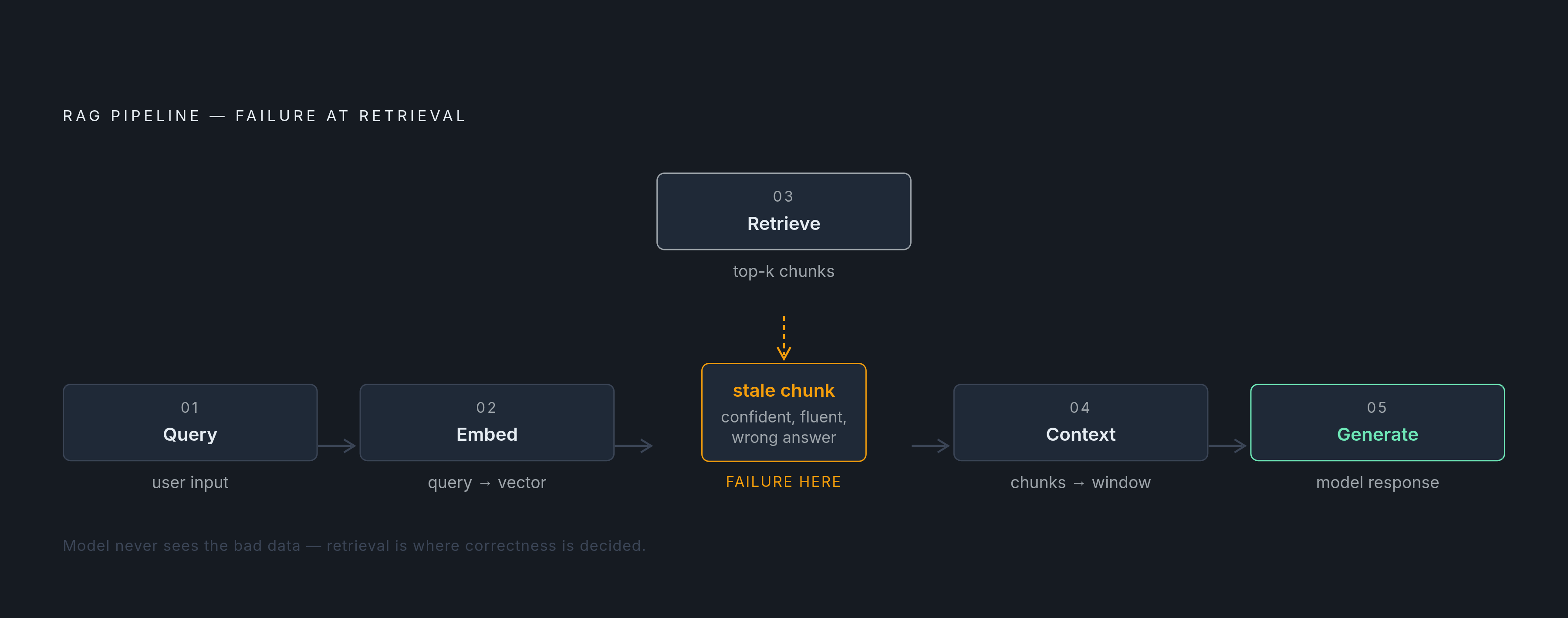
Retrieval-Augmented Generation, or RAG, is now the standard pattern for grounding agents in an organization's own knowledge without retraining the underlying model. Foundation models have a knowledge cutoff and no access to anything proprietary; RAG solves both problems at once by pulling in external documents at query time and grounding the model's output in something verifiable, which cuts down on hallucination.
The pipeline itself is fairly mechanical. A query comes in, gets converted into a vector, and a nearest-neighbor search pulls the top-k most similar chunks from an index. Those chunks get stuffed into the model's context window, and the model generates a response conditioned on whatever it was handed. That's the whole trick.
This raises an obvious question: what happens when the retrieval layer hands the model garbage? The model does exactly what it's supposed to do with bad input; it produces a confident, fluent, wrong answer. The output is only as good as what gets retrieved, and what gets retrieved is whatever matches best, not necessarily whatever is correct.
A few retrieval techniques have become common in enterprise deployments. Hybrid search combines keyword-based methods like BM25 with dense vector retrieval, and fusing the two through something like Reciprocal Rank Fusion improves accuracy by 15 to 30% over either method alone, according to Applied AI Research's 2025 Enterprise RAG Architecture briefing. That gain makes sense once you consider that enterprise queries often need exact term matches (a SKU, a regulation number, a specific field name) that pure similarity search tends to blur past.
GraphRAG takes a different approach: instead of indexing chunks of text, it builds a knowledge graph out of entities and relationships. That structure handles multi-hop questions and cross-document links that flat vector search can't represent well, including something as specific as "this 2025 policy replaces the 2023 version." Agentic RAG goes further still, folding the retrieval decision itself into the model's own reasoning loop, so the agent decides dynamically when to query and what to query for, rather than following one fixed retrieval step every time.
The interesting shift in enterprise practice right now is that the "how" (vector databases, embedding models, the retrieval mechanics) is becoming fairly standardized across vendors. What's still wildly different, and what actually separates a reliable deployment from an unreliable one, is the "what": the schemas, the validation rules, the quality of the underlying documents. Infrastructure is converging, even as the knowledge being fed into it remains a mess.
How stale documentation corrupts agent output — the mechanics of documentation rot
A common failure pattern looks something like this: an agent answering pricing questions cites a rate that has long since expired, because the page describing it was never updated. The model itself worked exactly as designed. The data it was fed was simply wrong, and it had no way of knowing that.
This is the retrieval-layer hallucination, and it's distinct from the kind of hallucination people usually mean when they talk about LLMs making things up. The agent retrieves a superseded page because its embedding similarity happens to be high; there's no structural flag anywhere telling it the page is dead. So the answer comes back fluent, specific, and confidently wrong, with nothing in the output itself that signals the problem.
Two failure modes tend to drive this. The first is stale embeddings: someone updates the source document, but the vector index never gets refreshed, so the agent is querying against a mathematical representation of a page that no longer exists in that form. The second is a ranking failure: the newer, correct document exists in the index, but the older one happens to score higher on similarity, so the agent defaults to whichever version matched first rather than whichever version is actually right.
Picture a compliance agent answering an anti-money-laundering question by pulling from both official regulatory guidance and an internal Confluence page. The regulation changed six months ago, and the Confluence page still describes the old rule. Retrieval returns both chunks, similarity scores are high on the outdated one, and no structural alert fires anywhere in the pipeline to say "this one's dead." A compliance officer glancing at a memo might pause and think "wait, didn't this change?" A model has no equivalent instinct, and stale content stays invisible to it unless something in the knowledge layer itself flags it.
The risk compounds sharply in multi-agent systems. One agent's stale output becomes another agent's input, and errors propagate silently across a workflow with no single point where a human would naturally catch it. That's a systemic risk, and it tracks with broader governance data: Gartner projected that 60% of AI projects lacking AI-ready data would be abandoned through 2026, and by mid-2025, 42% of U.S. companies had already abandoned most of their AI initiatives. Documentation readiness looks less like a symptom of those failures and more like a leading cause of them.
Why siloed documentation fails agents even when it is technically current
Staleness is one problem. Fragmentation is a separate one, and it persists even when every individual document is perfectly accurate. Knowledge scattered across Slack threads, ticketing systems, wikis, and half-forgotten file shares defeats retrieval regardless of how current any single source happens to be, because the retrieval layer can only pull from what it can actually reach and index.
Knowledge locked inside an email thread or a call recording or some tool that was never connected to the pipeline is invisible to the agent, simply absent, as though it never existed at all.
Silos also breed version conflicts. Two systems hold two different versions of the same policy, and neither one is marked as the canonical source. Retrieval returns both chunks with similar confidence scores, and the agent has no structural basis for choosing between them. It might pick correctly, or it might not; there's no way to know in advance which one it'll surface.
There's also a deeper layer of context that rarely survives the move from a live conversation into a written document at all. The reasoning behind a decision, the nuance embedded in why a team chose one workflow over another, the implications of some past ruling that everyone in the room understood but nobody wrote down explicitly: that context tends to die somewhere between the Slack thread and the Confluence page. An agent operating purely on the written documentation misses that layer entirely, even when the document it retrieves is, on its face, the correct one.
This leads to an uncomfortable practical consequence: an agent can retrieve exactly the right document and still generate a wrong or unhelpful answer, because the document alone doesn't carry the organizational context that gives it meaning. Scale doesn't fix this. Adding more agents on top of a fragmented, siloed knowledge base doesn't improve anything; it just multiplies the number of places where the same failure can happen.
What a living knowledge layer looks like structurally
A living knowledge layer is a set of structural properties built into how knowledge is stored, maintained, and served to a retrieval system, and it looks meaningfully different from how most documentation is organized today.
Freshness monitoring is one piece: tracking last-modified timestamps, setting staleness thresholds that vary by content type, and triggering re-indexing when something changes, rather than relying on a scheduled crawl that might run days or weeks after the fact. Knowledge objects matter too. Instead of long-form pages, the underlying unit becomes something small and metadata-tagged, carrying its own scope, its own authority signal, its own recency marker that the retrieval layer can actually act on rather than infer.
Provenance and versioning close the loop: structural markers that tell the system which policy is current and which one it replaced, so ranking can be based on correctness rather than pure similarity. Automated detection catches what humans miss. Failed searches, queries that come back with no confident result, pages nobody's touched in a year: these are all signals that something in the knowledge base needs review. Detection and even a first drafted fix can be automated, though the approval step stays human.
One pattern worth naming is what some teams call an agentic steward: a system that watches a live signal stream across a data catalog, notices when an entry references an asset that's been deprecated or changed, and routes that entry to its owner for a refresh. If a data model retires an old field, every knowledge base entry referencing that field gets flagged and queued automatically, without anyone running a manual audit months later and finding the mess.
RAG and agent memory work as complementary layers here. RAG handles the static, domain-level knowledge; memory handles the dynamic record of what happened in a specific interaction. Together they form something closer to a full data foundation, and treating them as one governed system rather than two disconnected ones matters. Some enterprises are building what amounts to a middle platform: an unstructured data processing layer, built on a RAG engine, that sits underneath whatever agents get deployed on top of it. Knowledge infrastructure comes first, and agents come after.
The human role in all this doesn't disappear; it moves. Automated systems handle discovery and drafting, while humans handle judgment, which is exactly where their attention belongs.
What teams building on agents need to do differently about documentation
Documentation used to be a deliverable, finished the day it got published. That framing doesn't hold anymore. It has to be treated as infrastructure, something that needs the same ongoing maintenance discipline as a production service, which is the problem Mintlify, a self-updating docs platform for dev teams and AI agents, was built to address. Because that's functionally what it's become.
A few practices follow from that shift pretty directly. Ownership should sit at the level of the knowledge object, not the document; someone specific is accountable for whether a given unit of information is still accurate, not just whether it technically exists somewhere. Staleness thresholds should differ by content type: pricing and compliance material ages fast and needs frequent re-indexing, while a high-level architectural overview might stay valid for a year or more without a refresh.
Retrieval itself needs instrumentation. Tracking which documents agents actually pull, which queries come back with no confident answer, and where a human ends up correcting an agent's output; these signals point to exactly where the knowledge layer is breaking down, often well before a user complains about it. Documentation update workflows should also connect directly to the events that make documentation stale in the first place: a feature ship, a policy revision, a deprecated API endpoint should automatically queue a review, rather than depending on someone remembering to update a page weeks later.
Fragmentation deserves treatment as a real structural debt, not a minor inconvenience. Knowledge that lives only in a Slack thread or someone's meeting notes stays outside the knowledge layer as far as an agent is concerned; either an ingestion pipeline captures it, or it stays invisible to every agent built on top of that system.
Get this right, and the payoff compounds. Agents running on current, well-structured, genuinely accessible knowledge don't just answer more questions correctly; they become reliable enough to hand more autonomous decisions to, which expands what a team can actually build on top of them with any confidence. The benefit isn't confined to agents, either, because the same structuring that makes retrieval work for a model also cuts into that 20 to 30% of human work time lost searching fragmented sources, since tagged, well-organized knowledge is easier for people to find too.
The teams shipping agentic products that actually hold up under real use share a common trait that has little to do with model selection. They treat the knowledge layer underneath as something alive: maintained continuously, monitored for decay, and never mistaken for a finished piece of work.