What MCP Servers Do and Why Docs Are the Right Data Layer
Reliable AI agents depend on current, well-governed documentation exposed through a shared protocol.
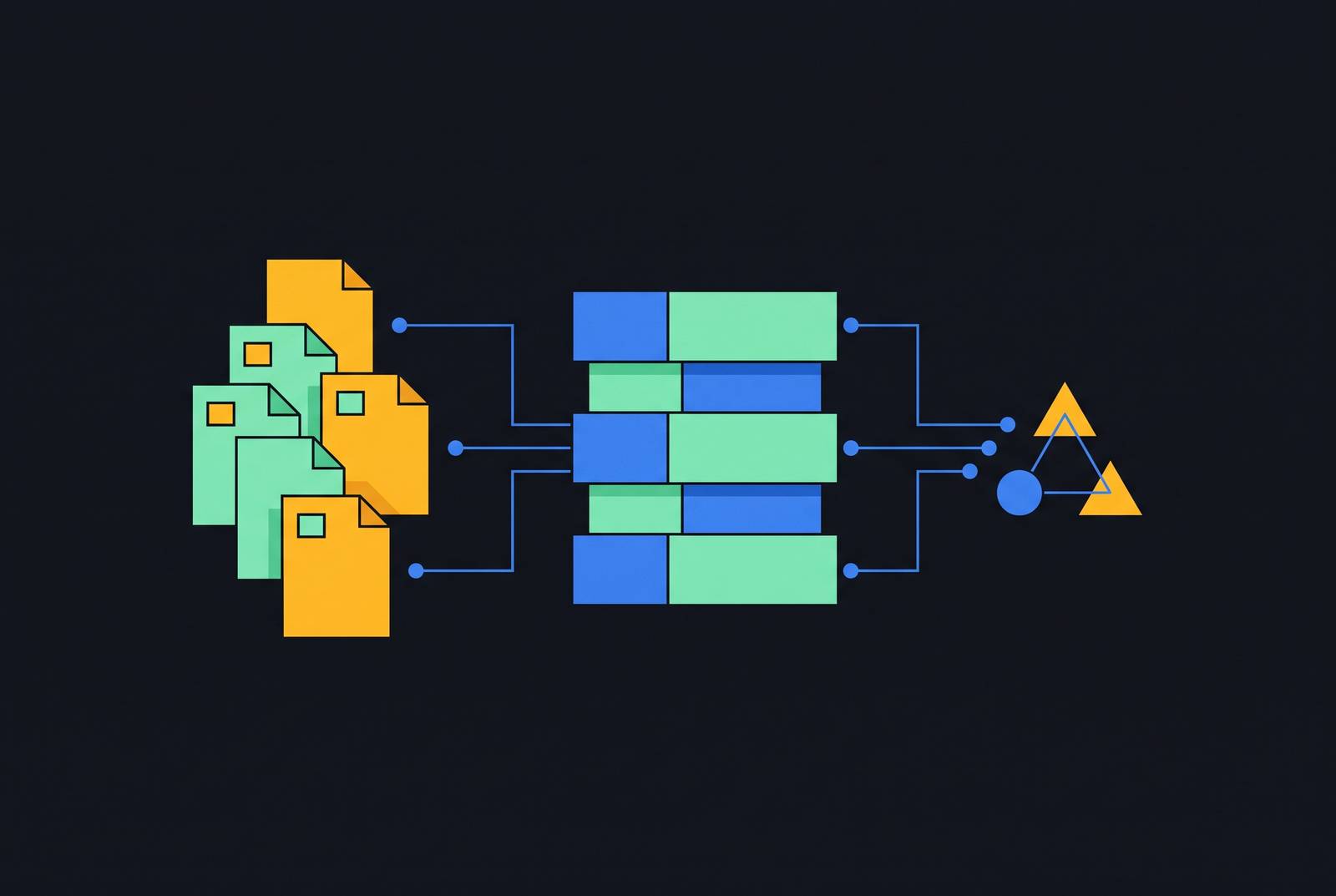
MCP servers give AI agents a standard way to reach external tools and data without building an integration for each pair. Documentation is the natural knowledge layer to expose through that connection because it describes how a system works. An agent’s reliability depends on whether the documentation it receives is accurate, current, and governed as carefully as the system it describes.
The integration problem MCP was built to solve
Before a shared protocol, connecting an AI application to an external system meant building a bespoke integration for that pairing. With N applications and M tools or data sources, teams had to build as many as N×M custom connectors. A new tool needed an integration for every application that wanted to use it. A new application needed integrations for every tool it needed. Growth on either side multiplied the maintenance burden on the other.
The developer’s problem was therefore not just getting one connection to work. It was keeping many versions of the same connection working as models and APIs changed or were deprecated. Teams repeated engineering work, yet their implementations could still behave differently. Users often had to move information by hand between systems that an assistant could not reach directly. A shared standard needed to go beyond making connectors easier to write and end the need to rebuild each pair.
What MCP is and how it collapses the integration graph
The Model Context Protocol is an open standard that gives AI applications a consistent interface to external tools and data sources. Each application implements the client side, and each external system exposes its capabilities through a compatible server. The integration graph changes from N×M to N+M because each participant implements the protocol once.
Anthropic’s MCP announcement describes the aim as “a universal, open standard for connecting AI systems with data sources, replacing fragmented integrations with a single protocol.” MCP builds on function-calling patterns. It standardizes how capabilities are described and invoked so that the same approach works across model vendors. A common interface gives different external systems a shared way to present what they can do while leaving their differences in place.
In December 2025, the Linux Foundation formed the Agentic AI Foundation with MCP as one of three founding projects, alongside Block’s goose and OpenAI’s AGENTS.md. That gave MCP neutral, open governance. Anthropic’s announcement also named Block and Apollo as early adopters and described how companies that build development tools were using MCP to get information for coding tasks.
How an MCP server actually works through hosts, clients, servers, and three primitives
An MCP connection has three roles, the host, client, and server. The host is the AI application, such as an agent runtime or IDE, that runs the model and owns the conversation. Inside it, a client maintains a connection with one server, so a host can run multiple clients. The server is an independent, focused process that exposes capabilities for a particular domain. It does not need a custom implementation for each host that calls it.
Those capabilities take three forms, namely tools, resources, and prompts. Tools are model-controlled functions that the model discovers through tools/list and can choose to invoke, such as creating a GitHub issue or running a SQL query. Each tool has a name, a description, and a JSON Schema for its inputs. The model relies most on the description to decide whether the tool fits the task. Resources, by contrast, are application-controlled content identified by URI, including files, database rows, and API payloads.
That difference in control is important. The host or user controls the attachment of resources as context. Prompts occupy a third role as user-controlled, named templates that accept arguments and are commonly surfaced as slash commands. Treating all three as interchangeable would obscure who decides what enters the interaction.
Runtime discovery is the meaningful distinction from a conventional REST API integration. The capability description travels with the server, allowing an agent to read what is available and decide how to use it without a pre-wired integration. The same agent code can then use the capabilities that a different server says it offers. Communication uses JSON-RPC 2.0 over stdio for local servers or Streamable HTTP for remote servers. These mechanics standardize access, but they leave the substance of the returned context to the source.
Why documentation is the natural data layer to expose through an MCP server
Documentation already covers the API surface, configuration options, error states, and usage patterns in one place. Its purpose is to explain how the system works. That makes it especially well suited to grounding answers about product behavior. Among the data sources an agent can reach, documentation supplies the structured account that connects individual details to their meaning.
Without that grounding, a model may confidently cite an endpoint that does not exist or recommend a configuration deprecated two versions ago. Its training data is frozen at a cutoff, so fluent recall cannot establish what is true of the current product. MCP gives the application a way to supply live context instead. Documentation is a particularly rich source of that product-specific knowledge, provided that it reflects the system as it now works. Live access and current information are related, but they are not the same property.
A reference page, an API spec, or a changelog entry can be a URI-identified resource that the application retrieves and supplies when needed. The agent can then reason from documentation chosen for the task as well as from what it remembers from training. This changes documentation’s role from a static file someone must remember to consult into knowledge infrastructure available within the workflow. Its value comes not simply from being accessible, but from making the system’s maintained account of itself available where answers and actions are formed.
What documentation quality directly controls in an agent's output
An outdated reference page can cause an agent to recommend a deprecated configuration even when retrieval works exactly as intended. In that case, the connection has succeeded while the data layer has failed. Better access does not distinguish an authoritative statement from an obsolete one if both appear in the same trusted source.
A tool description is the model’s main signal for deciding whether a capability matches the user’s task and explanatory text for a developer browsing an interface. If descriptions are vague or fail to distinguish similar tools, the model may choose the wrong one or skip a suitable one entirely.
More text does not automatically solve that problem. Every tool name, description, and parameter schema consumes context on every request. A bloated tool set crowds out conversation history, retrieved documentation, and space for reasoning. Precision must therefore carry useful distinctions without burying them in excess text. This cost grows with poor documentation discipline and with the number of servers.
Behind these failures is often an ownership gap. When nobody clearly owns the accuracy and authority of a page, its content can degrade while the agent continues to serve it confidently. The resulting answer may look like a model failure even though the underlying error entered through an unmanaged source. Accurate, well-scoped documentation is thus a prerequisite for reliability. That dependency also makes the trust placed in documentation a security concern.
The security risk that docs-as-data-layer introduces
The strongest objection to documentation as a data layer follows from the same property that makes it useful. Agents treat retrieved material as authoritative context, which gives malicious content an opportunity to influence their behavior. A returned page, note, or text field can contain both information about the product and instructions. If the model treats those instructions as higher priority than the user’s intent, grounding becomes a route for prompt injection. Prompt injection can produce an incorrect answer, an unintended action, or data exfiltration.
Because servers act with the user’s permissions, the effects of a poisoned document may extend beyond the source from which it was fetched. The relevant boundary is not just the page being read, but everything the agent can access or invoke. Incidents in 2025 showed several kinds of risk, including prompt injection attacks against the GitHub MCP server and supply chain compromises through malicious packages. Asana’s cross-tenant data exposure came from a tenant-isolation logic flaw, which points to a different failed control than prompt injection would.
In MCP host implementations that pass configuration fields such as command and args directly to OS subprocess execution without validation or sanitization, the stdio setup can expose execution risks. This is not the same failure as a model following hostile instructions in documentation. One concerns how a process is launched, while the other concerns how retrieved content influences reasoning and action. A common protocol does not erase these different trust boundaries.
Governance must include input validation, scoped permissions, and provenance controls over which sources can appear as resources. The MCP specification also recommends human-in-the-loop checkpoints on tool invocations. Together, these controls address what may enter the context and what the agent may do with it. Documentation can serve as trusted knowledge only if that trust has limits, especially when read access can lead to action.
Keeping the documentation data layer current as agents both consume and produce it
Those limits become more consequential when agents also write the documentation that other agents consume. GitHub described automations, as of August 3, 2026, that can be triggered from a pull-request comment to generate or update documentation from code changes. The relationship is no longer a one-way path from maintained content to an answer. Agent activity can now feed new content back into the same knowledge layer.
In the self-correcting version of that loop, agents surface gaps and inaccuracies during use, and those signals feed documentation update workflows. An agent can follow a style guide and draft an update, with human review before the text is published. The published correction then becomes available to later interactions. This is the practical meaning of living knowledge infrastructure.
Without human review and checks for accuracy, though, the same loop can make errors build on one another. Generated documentation can return a mistaken claim to the data layer, where another agent retrieves it with the confidence attached to maintained content. A clear owner remains necessary even when the work of drafting and updating is automated. Automation changes who produces the text, but not who is accountable for its accuracy.
Evaluation remains an important limit on confidence. No widely adopted, rigorously governed independent accuracy benchmarks exist specifically for documentation MCP servers, so vendor accuracy claims should be treated as unverified until such retrieval benchmarks exist. The practical requirement is knowledge infrastructure that is searchable, version-controlled, automatically synced with product changes, and integrated into agent workflows. MCP makes that knowledge reachable, but its dependability requires documentation ownership. As agents both consume and produce the source of truth, governing that source becomes a first-class engineering responsibility.