Documentation Platform AI Layers and Which Tools Cover All Four
Evaluating which layers your docs platform actually handles well.
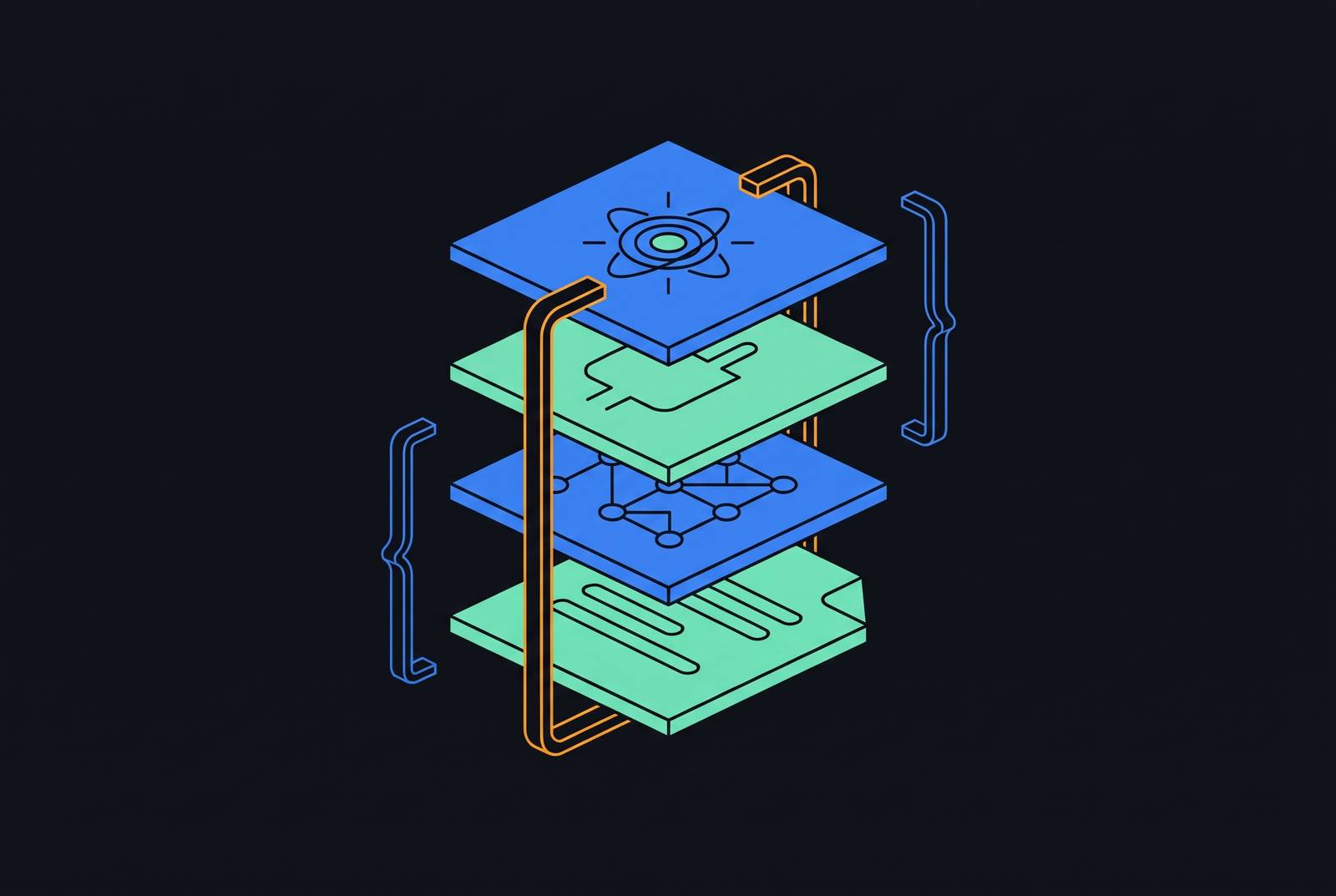
Documentation platforms in 2026 serve both developers and the AI agents that read on their behalf. Evaluating them requires four distinct lenses, namely publishing, generation and maintenance, retrieval, and embedded Q&A. Only a subset meaningfully spans all four. A useful buying decision therefore depends on which jobs a platform handles well and where another tool must take over.
Why documentation platforms now serve two distinct audiences simultaneously
Human developers read documentation to learn how a product works, while AI agents parse it to get tasks done. Those needs are not interchangeable. A developer may benefit from a long explanation that connects concepts, but an agent needs the smallest useful piece of authoritative content. AI coding assistants, answer engines, and support agents now use documentation as a primary input for answering questions about how a product works. Stale or poorly structured content can therefore produce wrong answers beyond the documentation site itself.
Features and price alone cannot show whether the same content works for both audiences. If Cursor or ChatGPT cannot read the authoritative source, they may skip it or return out-of-date details, so machine-readability affects how well the product can be trusted as well as how it is presented. The shift from static publishing to structured delivery has fractured the tooling market into distinct jobs. That fracture is what the four-layer framework maps.
The four layers that now define what a documentation platform actually does
Publishing docs that AI agents can parse gives machines content in a structured form they can use. Generating and maintaining doc content from code and specs produces drafts and keeps them in step with changes to the product. Retrieval infrastructure that makes existing docs queryable by AI systems exposes content across channels through retrieval-augmented generation, or RAG. Embedded reader Q&A that answers in context without hallucinating gives readers a conversational assistant grounded in the documentation they are viewing.
These are separate jobs requiring distinct AI capabilities. A publishing system can serve structured Markdown without helping anyone write it, while a writing assistant can write updates without hosting a single page. Retrieval can draw on content in several systems, but embedded Q&A must take the reader’s current page and version into account. The distinction is architectural. Doing one layer well does not show that a tool does another well, even when both share the same interface.
Layer 1 — Publishing docs that AI agents can actually parse
Can an agent find the relevant material and extract a useful answer without treating a whole page as an undifferentiated block? The core requirements include llms.txt output, MCP server exposure, and structured Markdown. Each addresses a different part of access, from discovering content to querying it and separating it into usable units.
An llms.txt file at the root of a documentation site gives AI coding assistants a structured content index, analogous to robots.txt for crawlers. An MCP server exposes documentation as a tool that clients such as Claude Desktop and Cursor can call directly. Structured Markdown makes it easier to split the content into the smallest useful pieces. A clear question followed by a clear answer, for example, gives a retrieval system a more explicit boundary than a sprawling page.
GitBook’s technical documentation guide describes native MCP support and structured metadata, and links to an external agent-readiness checker. Fern’s platform page describes automatic llms.txt generation and support for Server-Sent Events and WebSocket in its API playground. For AI and ML APIs, those streaming formats are especially relevant because model responses arrive as real-time chunks. These delivery concerns sit alongside the need for accurate writing. A weak publishing layer degrades retrieval, reader Q&A, and the generated updates that must ultimately pass through it.
Layer 2 — Generating and maintaining doc content from code and specs
Draft generation shifts the question from delivery to authoring. Producing prose from a repository, a pull request description, or a function description is now a widely implemented capability. In-editor rewrites and suggestions also help with pages that have already been written. But a first draft is a one-time event. The product continues changing after the page is published, which makes maintenance the harder and less well-served part of this layer.
The resulting failure is silent drift. A guide written six months ago against an earlier API version can still look authoritative even when its instructions no longer fit the product. Promptless addresses that gap through proactive authoring, drafting updates when a pull request opens, a Slack thread mentions documentation, or a ticket is created. GitBook’s guide describes Git sync, AI-assisted drafting, and workflows through Claude Code and Codex.
Does generating reference pages from OpenAPI keep the docs up to date? Only for part of the content. Spec synchronization can keep an API reference accurate without updating conceptual guides, tutorials, or onboarding flows, where drift can do the most damage to developer experience. Maintenance therefore requires connections to the SDLC platform, ticketing system, and source code as well as the spec file. Teams that emphasize generation while neglecting those connections invest in new text without addressing the reliability of what already exists. For that existing content, retrieval becomes the next source of leverage.
Layer 3 — Retrieval infrastructure that makes existing docs queryable by AI systems
Retrieval infrastructure works on top of hosting and leaves it in place. It ingests existing material, uses RAG to make that material queryable, and exposes it through channels beyond the documentation site. Those channels can include Slack, Discord, support forms, MCP clients, and a public API. This is more than a search box. Its role is to make a documentation corpus available to other systems, independently of the platform that publishes it.
kapa.ai’s February 2026 guide describes a technical RAG platform that ingests content from more than 50 source types. These include documentation sites, GitHub code and issues, support tickets, collaboration systems, OpenAPI specs, and PDFs. Its public search endpoint returns JSON arrays ordered by relevance, allowing other systems to query the content programmatically. The hosting platform remains in place. A team can therefore add retrieval without migrating the system used to write and publish its documentation.
Accuracy and feedback distinguish this infrastructure from access alone. kapa is designed to cite sources and acknowledge uncertainty rather than invent an answer, while its analytics include coverage-gap detection, source-level insights, conversation debugging, and uncertainty monitoring. Algolia takes another approach with keyword search that has an AI overlay and native version and language filtering, but puts less weight on coverage-gap analytics. In kapa’s model, unanswered questions become prioritized documentation backlog items, connecting the retrieval system to the reader experience that exposes those gaps.
Layer 4 — Embedded reader Q&A that answers in context without hallucinating
Embedded Q&A serves a narrower situation than cross-channel retrieval. A developer is already reading a particular page, often for a particular product version, and asks for help without leaving that context. A useful assistant must preserve those boundaries. Someone reading v2 documentation should not get an answer pieced together from v1 and v3, however convincing it sounds.
The assistant should prioritize the current page, cite the specific documentation behind an answer, and acknowledge when the available content does not cover the question. A generic conversational interface alone does not show that an assistant does these things. Nor does an answer that reads well prove that it is grounded. When an embedded assistant gives incorrect integration advice, the developer experiences it as a failure of the product.
GitBook’s guide describes a built-in conversational assistant, while Fern’s platform page describes Ask Fern as a RAG-grounded answer layer within the documentation site. Both help readers within the docs, though having an assistant alone does not show that all the safeguards for context are in place. Cross-channel retrieval can coexist with that experience because it serves other entry points and source collections. With all four jobs distinguished, the comparison can now become more exact. Which tools span the layers, and where does their coverage stop?
How current platforms map across all four layers — and where each one stops
GitBook covers much of the framework, with a focus on cross-functional teams that manage technical documentation for more than one product. Its publishing capabilities include native MCP support and structured metadata, while Git sync, drafting assistance, and coding-agent workflows address authoring. Its built-in assistant supplies reader Q&A. Its MCP analytics, launched in February 2026, track which AI tools crawl documentation and what they seek. That adds visibility into machine consumption, but it is not the same evidence of retrieval depth as multi-source ingestion and cross-channel deployment.
Fern’s profile is strongest around API delivery and spec-driven maintenance. Automatic llms.txt generation supports machine consumption, while SSE and WebSocket playground support address real-time APIs. Its platform also describes automated SDK generation in nine-plus languages and CI-driven documentation updates. Ask Fern adds in-site Q&A. For AI and ML companies exposing model APIs with complex response types, these capabilities connect documentation correctness to SDK quality, although cross-channel retrieval is a weaker part of its coverage.
kapa has a different boundary by design. It specializes in retrieval across sources and channels, with coverage-gap analytics and explicit uncertainty handling, leaving publishing and authoring to other tools. Its ability to deploy answers through several interfaces does not make it a full documentation platform or establish the complete page-and-version-aware experience defined in Layer 4. Its independence from the host is the advantage. Teams can add it to existing documentation without moving their publishing system.
Promptless is narrower still, covering proactive authoring rather than hosting, analytics, or reader Q&A. It hands drafts to a separate publishing system, making it a Layer 2 complement. Algolia, by contrast, complements an existing platform through Layer 3 search and retrieval, particularly where keyword precision and version or language filtering are priorities. Algolia’s official DocSearch program page states that the service is free for open-source and technical docs, and its expansion announcement includes technical blogs and projects. Its integrations with Docusaurus and popular documentation frameworks support that complementary role.
GitBook and Fern reach across the framework, but their capabilities do not establish equal depth in every layer, especially cross-channel retrieval. The specialists have clearer boundaries and depend on a publishing platform around them. No tool treats all four jobs as equally core. Knowing where a product stops is more useful than treating every mention of AI as equivalent coverage.
How teams should build a stack when no single tool covers all four layers
The practical response is to audit missing layers before choosing tools. Can Cursor, Claude Desktop, or ChatGPT accurately answer API questions by reading the published documentation? When a pull request merges a breaking change, does any automated signal show that the documentation needs an update? Can a support engineer or agent query the corpus programmatically across channels? Does the site offer a contextual assistant that cites sources and declines unsupported answers?
The gaps then determine the combination. If machine-readable publishing and embedded Q&A are both missing, moving to GitBook or Fern is likely to offer the most leverage. If publishing already works but cross-channel access does not, kapa or Algolia can add retrieval without a migration. If proactive maintenance is missing, Promptless or a CI/CD-integrated generation tool can complement the existing host. The aim is coverage without unnecessary duplication.
A single integrated platform can still be the simpler choice for a small team. Specialist tools add depth, but that benefit must justify the operational complexity of a composed stack. The decision turns on which responsibility needs deeper support and whether the team can operate the combination. Documentation then becomes living infrastructure, with machine-parseable content connected to agent workflows and updated with the product, rather than a static artifact waiting for someone to consult it.