AI-native documentation platforms compared: structured outputs for agents vs. human-readable developer docs
Agents now read half your docs; architecture must follow.

AI-native documentation is a rewrite of the assumptions underneath doc pages that most teams have not fully reckoned with, because the reader those pages were built for is no longer the only one showing up. Nearly half of documentation traffic now comes from AI agents, tools like Cursor, Claude Code, ChatGPT, and Perplexity querying pages the way a developer once would, and according to GitBook, that share has already tipped past 50%, past human visitors entirely. This piece walks through what that split means architecturally, which standards have emerged to serve the agent side, and how the current crop of documentation platforms has sorted itself in response. The position worth stating up front: most platforms are still solving this backwards, retrofitting machine-readable output onto systems built for human eyes. The platforms built schema-first from the start are the ones proving durable.
Gartner's projection that over 30% of API demand growth by 2026 will come from AI agents rather than human developers sounds abstract until you sit with what it implies: a growing share of the "developers" pulling up an API reference are not developers at all. A preprint from April 2026, titled "Beyond Human-Readable," makes the architectural case directly: the optimization function behind documentation has changed, and treating that as a minor formatting concern misses the scale of the shift. One reader skims, follows narrative structure, and benefits from screenshots and visual hierarchy. The other parses programmatically, burns tokens on markup it cannot use, and needs the smallest, most precise unit of context that will let it finish a task. Same page, two consumers, incompatible needs, and that tension is the spine of everything that follows.
Why the same doc page serves these two consumers so differently
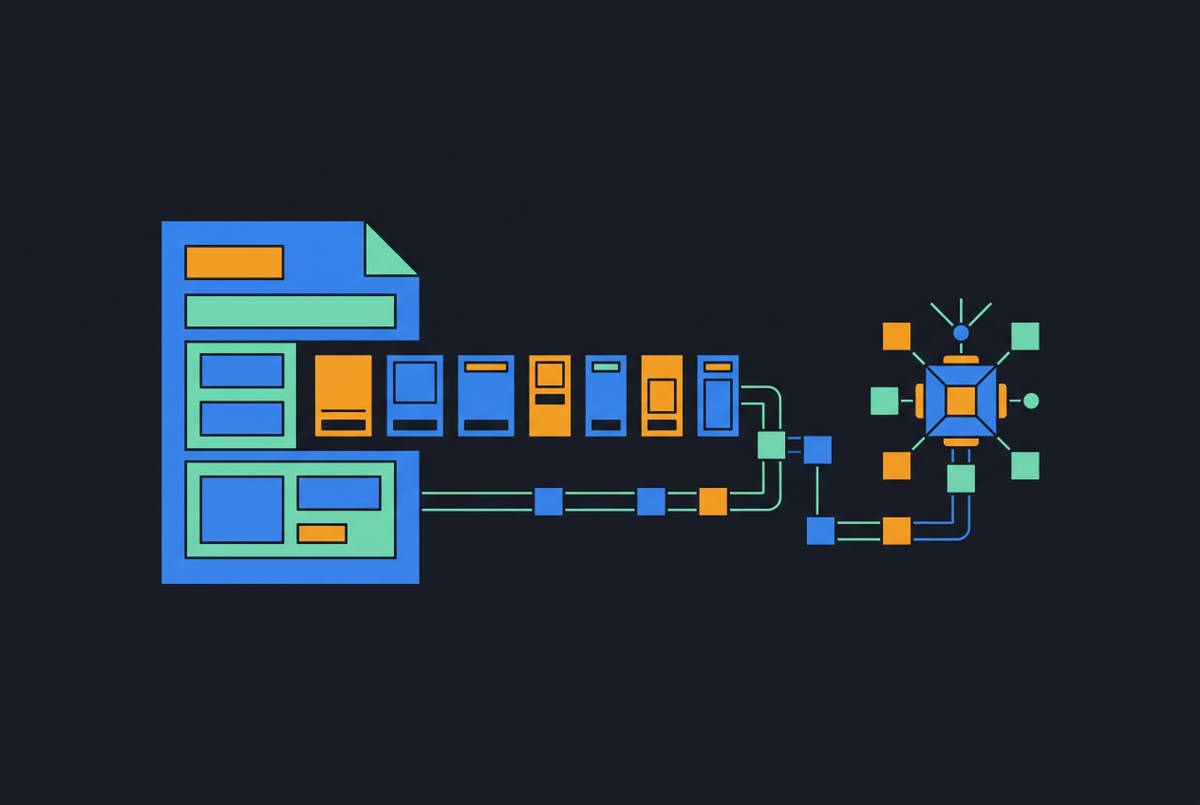
Start with token cost, since it is the most concrete version of the problem. A traditional HTML API reference page, the kind most teams have shipped for a decade, can run to several thousand tokens once an agent parses it: navigation menus, CSS classes, header and footer boilerplate, all of it structurally necessary for a human browser and functionally inert for a language model. The agent does not want the sidebar, it wants the endpoint schema and the authentication requirements, and it has to wade through everything else to extract them.
Markdown solves a meaningful chunk of this by construction. The same informational content, stripped of styling and navigation markup, runs at roughly a tenth of the token cost of the HTML equivalent, according to comparisons cited in the platform literature, and that is a resource constraint as much as a stylistic preference. Agent context windows now run from 200,000 tokens up to a million on the higher end, which sounds enormous until you factor in that performance in practice tends to degrade well before that ceiling, somewhere around 40% utilization according to research on agent-oriented documentation. Every token spent parsing markup the model cannot act on is a token unavailable for the reasoning it was actually invoked to do.
Dachary Carey of MongoDB put the asymmetry plainly: good documentation for humans does not automatically serve agents well, because tokens are expensive and context behaves like a shared, finite resource. Agents need the smallest possible unit of docs that gets the job done, valuing completeness and layout far less than a human reader would. Give an agent noise instead of signal and the failure mode escalates past a bad experience into a hallucinated parameter, a broken API call, generated code that fails on the first request because the model inferred a field name that does not exist. That failure traces back to building for eyes and handing the result to something that reads differently, and this stopped being a documentation-team problem and became an infrastructure one.
The standards that define what agent-readable documentation looks like in practice
Three layers of emerging standard have shown up to address this, each solving a different part of the problem. Lumping them together as "AI stuff" is the mistake to avoid here; they answer different questions and fail in different ways when skipped.
The first is content discovery. Jeremy Howard of Answer.AI proposed llms.txt in 2024, hosted at llmstxt.org: a plain Markdown file sitting at a site's root, functioning roughly like robots.txt does for search crawlers, telling AI systems what the site contains and where to find it. Its companion, llms-full.txt, goes further and carries the full documentation content itself, stripped of HTML, with resolved API specs and SDK examples in clean form an agent can ingest without a parsing step. Adoption is still early, somewhere in the 5 to 15% range across tech and documentation sites as of early 2026 by most estimates, but it has already become the de facto convention among AI-native companies including Anthropic, Cursor, and Vercel. The convention has seen uptake beyond AI-native companies, a signal that mainstream platforms see it as durable rather than passing. It's worth flagging that this remains a community-driven proposal, not a ratified standard from the IETF or W3C, which matters when a platform claims llms.txt "support" as a checkbox feature.
The second layer is capability description, through what is being called skill.md: a structured file describing what an agent can actually accomplish with a product, what inputs it needs, and what constraints apply. This sits a level above documenting individual endpoints; it is closer to a manifest of what the product does than a reference for how to call it.
The third is access governance, a proposed manifest called agent-permissions.json, declaring which automated interactions are allowed at all: rate limits, whether a human needs to be in the loop before an action executes, which endpoints an agent should prefer. Together, these three form something like a layered stack. llms.txt handles discovery, skill.md handles capability, and agent-permissions.json handles access.
Underneath all three sits Model Context Protocol, the transport layer that makes the whole thing interoperable rather than a pile of bespoke integrations. Anthropic created MCP and released it as an open standard in November 2024; by December 2025 it had been donated to the Linux Foundation's Agentic AI Foundation, making it vendor-neutral in a way that matters for long-term platform bets. MCP defines three first-class context types: Tool for executable actions, Resource for read-only data, Prompt for reusable templates, each with standardized methods for listing and calling. The adoption numbers are hard to wave off: over 97 million SDK downloads and more than 13,000 MCP servers live on GitHub, with OpenAI, Google DeepMind, Microsoft, AWS, and Cloudflare all building support in. Gartner expects 75% of API gateway vendors to support MCP by the end of 2026. A release candidate dated 2026-07-28, the largest revision since the protocol launched, adds a stateless protocol core, an Extensions framework, Tasks, MCP Apps, and hardened authorization, and this is still being actively built, not settled.
Practically, a platform that does not generate llms.txt and expose an MCP server has already lost the agent audience, no matter how polished its human-facing docs look.
How the 2026 platform landscape has sorted itself into distinct strategies
The market has not converged on a single model, and it should not; the strategies on offer answer different questions, and pretending otherwise is how teams end up buying the wrong tool.
Some products are full platforms, handling authoring, publishing, and AI-ready delivery under one roof, where a team's entire documentation workflow lives in a single system. Others are AI writing assistants, generating and updating content directly from code changes but handing off to a separate publishing layer; they solve the freshness problem without solving delivery. A third category is retrieval infrastructure that sits on top of existing docs, making them queryable by AI systems across whatever channel an agent happens to be using. That third category is additive, riding on top of the authoring layer rather than competing with it.
Among the full platforms, three philosophies keep recurring. One treats docs as a product in their own right, prioritizing polish, discoverability, and developer experience, with the human reader still the primary audience and AI-ready formats layered on afterward, and Mintlify, a knowledge infrastructure platform for dev teams and AI agents, sits closer to this end of the spectrum, though it extends toward serving autonomous agents as well. Another treats documentation as a live tool: an interactive API explorer, authenticated live calls, usage analytics, all optimized for the specific moment a developer is deciding whether to adopt an API at all. A third treats the OpenAPI spec, or an equivalent schema, as the single source of truth, where docs and SDKs are both generated outputs of the same underlying artifact, and agent-readable formats fall out of that machine-readable foundation almost for free. That third philosophy carries the strongest long-term case of the three: when the spec is the source of truth, agent-readiness stops being a separate project.
One dividing line worth naming specifically: streaming protocol support. AI model responses are frequently delivered through Server-Sent Events or WebSocket connections rather than simple request-response calls, and platforms that can document and test these natively serve the AI-API use case in a fundamentally different way than platforms that treat streaming as an edge case. For a team building or documenting an AI product, this decides whether the interactive playground actually reflects how the API behaves in production, and that is well beyond a cosmetic difference.
What GitBook, Fern, and similar platforms each optimize for
GitBook positions itself around a single managed pipeline: a proactive AI Agent, an embeddable AI Assistant, auto-generated MCP servers, and llms.txt output, all pulling from one source of truth rather than maintaining separate content pipelines for human and machine readers. Its Git sync is genuinely bi-directional across both GitHub and GitLab, which matters more than it might sound: engineers keep working from the repo, non-engineers edit visually, and the two stay reconciled without someone manually copying changes back and forth. Most competitors still assume a code-first contributor base; GitBook does not require that. It carries SOC2 and ISO27001 compliance, relevant for enterprise teams that need to clear a security review before adoption. The trade-off is the one that comes with any managed, opinionated system: teams with highly custom delivery requirements may find the guardrails constraining rather than freeing.
Fern takes the schema-driven route to its logical end, and of the platforms discussed here, it is the one where agent-readable output shows up as a side effect of the core architecture rather than a feature bolted on afterward. Write the OpenAPI spec once, and polished API references and type-safe client libraries get generated from it automatically, docs and SDKs sharing a single authoritative artifact rather than drifting apart over time. Its AI-native outputs include Ask Fern, a retrieval-augmented search layer, automatic llms.txt generation, and auto-generated code examples across multiple languages for every documented endpoint. It also supports streaming protocols, Server-Sent Events and WebSocket, natively in both its interactive playgrounds and its generated SDKs, which sets it apart for teams building on or documenting AI APIs specifically. The trade-off is architectural: this model is powerful when the OpenAPI spec really is the authoritative source, and less natural for teams whose documentation is mostly conceptual or narrative rather than endpoint-driven.
Some platforms sit closer to GitBook's philosophy of docs-as-product than to Fern's schema-first bet, leaning on interactive API explorers and usage analytics that show which endpoints developers actually call and where they get stuck. That telemetry is a genuine advantage for teams optimizing the human adoption funnel, the moment a developer decides whether an API is worth integrating at all. The agent-readable output layer in these platforms is less architecturally load-bearing than Fern's, closer to an added feature than a structural consequence of how the docs are generated. For teams that live and die by conversion metrics on their developer portal, that trade-off may be the right one, though teams whose main traffic is increasingly agentic should ask whether the analytics investment is solving the problem that is actually growing.
Document360 sits in a different lane from the API-focused platforms above, and teams should evaluate it against the specific audience and use case they are actually serving rather than the same criteria applied to the others.
Across all of these, one observation holds regardless of vendor: every serious platform has added AI-facing features somewhere between 2025 and 2026, but the depth of that work varies enormously. Generating an llms.txt file is close to table stakes at this point. Whether the underlying data model was actually designed to produce machine-readable output, versus retrofitted to export it, is the deeper and harder question, and no feature list answers it on its own.
The access-control and freshness problems that comparison tables don't capture
Freshness functions closer to a correctness requirement than a nice-to-have for agentic systems. A human reader who hits a stale doc page notices the mismatch and works around it, maybe checks the changelog, maybe pings a colleague. An agent acting on the same stale page just executes on it, and the result is a broken integration, not a merely suboptimal one. That is the sharper version of the hallucination problem raised earlier: the model was fed an artifact that no longer matched reality, rather than reasoning incorrectly on its own.
Platforms differ quite a bit on how tightly the authoring workflow is wired to the shipping workflow. A Git-sync architecture creates a natural update trigger; docs change when code changes, because they live in the same repository and the same pull request. Manual-upload platforms lack that trigger, and someone has to remember to update the docs, and that someone is a human with other priorities. The AI writing assistants mentioned earlier address part of this by generating content straight from code diffs, but that only closes the loop if publishing is just as fast as generation. A perfectly accurate draft sitting in a review queue for two weeks is still stale documentation from an agent's perspective.
There is a second problem that rarely shows up in vendor comparison tables at all: access control at a finer grain than the page. Human readers are mostly fine with page-level gating; either you can see the doc or you cannot. Agents acting on behalf of different customer tiers or different automation contexts often need something more granular: permission to read one section of a page but not another, or to call one endpoint documented on a page while being blocked from a second endpoint documented right next to it. Without that granularity, teams end up building workarounds, splitting pages that would otherwise belong together, just to get the access boundary they need. The proposed agent-permissions.json manifest described earlier is the emerging answer to this, but it only means anything once platforms actually implement support for it, and most have not yet.
Evaluate not just whether a platform supports llms.txt and MCP right now, but whether its content pipeline makes keeping those outputs current a natural side effect of normal work, or an extra maintenance task someone has to remember to do. The second kind of platform will look fine in a sales demo and fall apart six months into production use.
How to match a platform's architecture to what your team actually ships
Three variables decide this, and they interact rather than standing alone.
First, the consumer mix. If agent traffic is already approaching or has passed human traffic, which the figures in the first section suggest is increasingly common, then structured-output depth matters more than visual polish or narrative flow. If the audience is still overwhelmingly human developers, interactive experience and search quality remain the bigger lever, and agent-readiness is worth having but not worth optimizing around exclusively.
Second, the source of truth. Teams whose API is already governed by an OpenAPI spec get structured, agent-readable output almost automatically from a schema-driven platform like Fern, because the spec is doing the work. Teams whose documentation is primarily conceptual, walking through architecture decisions or onboarding flows rather than endpoint parameters, keep more of the workflow coherent under a full-platform approach like GitBook, where authoring and delivery are one system rather than two.
Third, the freshness requirement. Teams shipping code frequently need Git-sync or code-diff-triggered authoring, because manual update cycles will not keep pace. Teams with genuinely stable documentation, the kind that changes a handful of times a year, can tolerate a slower manual process without much consequence.
What is becoming the common case rather than the exception is a documentation surface that has to serve both audiences at once: a human developer deciding whether an API fits their use case, and an AI agent, minutes or seconds later, consuming the exact same content programmatically to actually build the integration. That reframes the evaluation question, shifting it from "which platform is best" in the abstract toward asking which platform's architecture makes serving both audiences the default behavior rather than a workaround. The minimum viable signal on the agent side is not complicated to check for: native llms.txt generation, an llms-full.txt output, and an auto-generated MCP server. Absent those three, agent-side consumption falls back to scraping HTML that was never built to be parsed that way, and the token cost and hallucination risk described at the start of this piece come right back into play.
As MCP adoption climbs toward the 75% gateway-vendor figure Gartner projects for 2026, and as llms.txt keeps moving from early-adopter convention toward broader implementation, the platforms built around these as core primitives from the start will have progressively less retrofitting to do. The ones treating agent-readiness as a feature to bolt on after the fact are building on a foundation that was never designed to carry the weight, and that gap tends to show up exactly when it is least convenient: in production, at the moment an agent tries to act on a doc page and gets it wrong.