OpenAPI and AsyncAPI spec renderers for developer-facing API references
The gap between a spec file and usable documentation is exactly where renderers matter most.
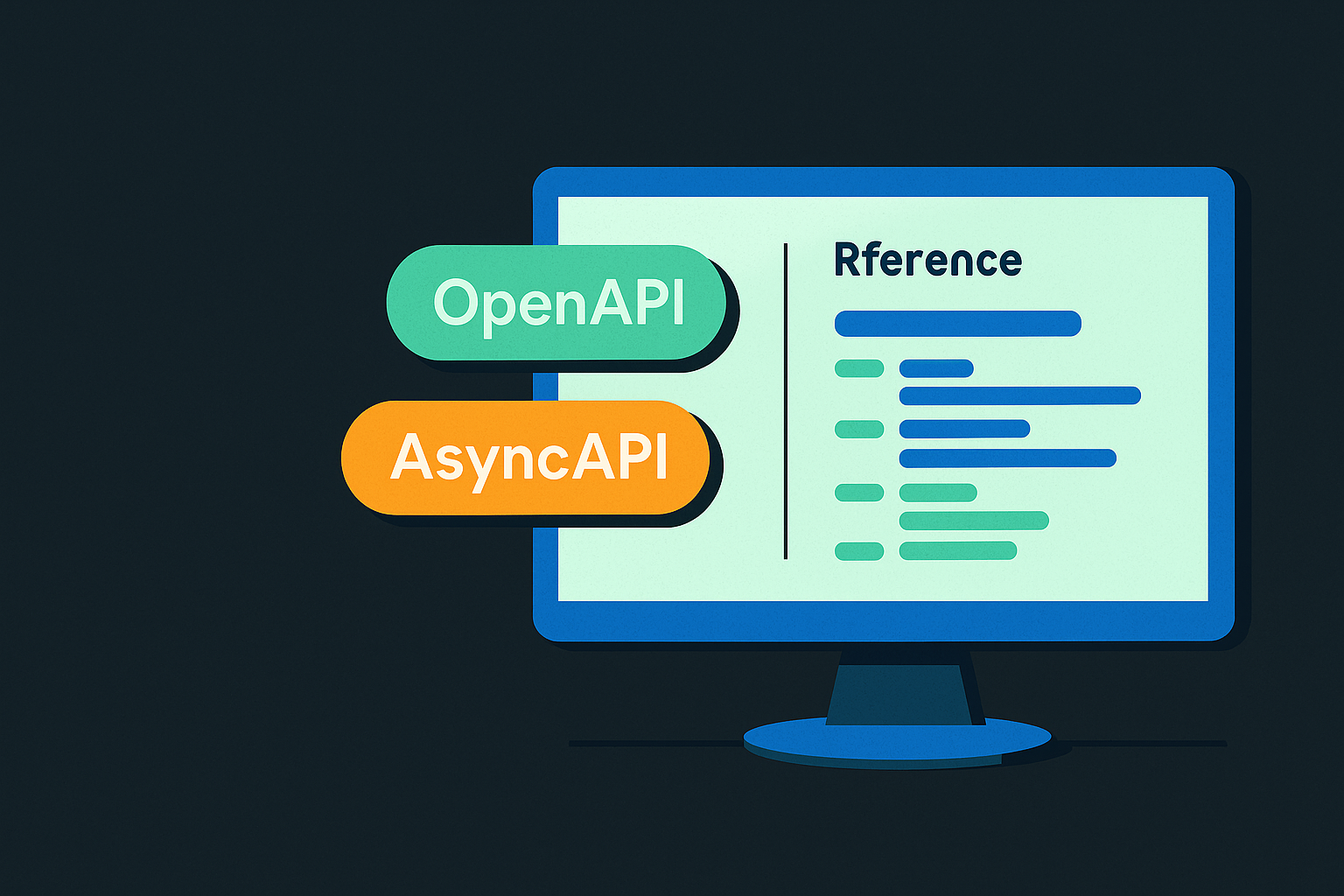
OpenAPI and AsyncAPI documents are contracts, not prose. Both specs describe an API in YAML or JSON, a format built for parsers, not for the person trying to figure out which field is required on a POST request at 11pm. This piece looks at the layer that sits between the raw spec and the developer reading it: the renderer. Understanding what separates a passable renderer from a genuinely good one turns out to matter a lot more than most teams assume when they pick one off the shelf.
OpenAPI, the interface definition language for REST and HTTP APIs, grew out of the original Swagger spec and now lives under the OpenAPI Initiative, part of the Linux Foundation. AsyncAPI does the same job for event-driven systems, covering WebSockets, webhooks, Kafka, MQTT, and AMQP, and sits under the same Linux Foundation umbrella. Per Postman's State of the API 2025 report, 93% of developers still ship REST APIs, which makes OpenAPI the default contract for nearly every public and internal HTTP API in production today. That statistic alone should tell you why the quality of OpenAPI rendering is not a niche concern. AsyncAPI covers the ground OpenAPI structurally cannot, and without a renderer built for it, event-driven APIs tend to ship without documentation anyone can actually use. The gap between "a spec file exists in the repo" and "a developer can read it, trust it, and call the API correctly" is exactly the gap a renderer is supposed to close.
The versioning context renderers have to keep up with
Spec versions move, and renderers don't always move with them. OpenAPI 3.1 aligned the spec with JSON Schema 2020-12, which sounds like a footnote until you realize it broke backward compatibility with 3.0 in ways that exposed real gaps in existing tooling; nullable handling changed, webhooks got formalized, and a lot of renderers built for 3.0 simply didn't know what to do with the new semantics. OpenAPI 3.2.0 landed in September 2025 with structured tag navigation, media types built for streaming, and new OAuth flows. Further out, OpenAPI 4.0, nicknamed "Moonwalk," is still in design as of early 2026. No production renderer supports it yet, and there's no point evaluating tools against a spec version that doesn't exist in the wild.
On the async side, AsyncAPI 3.0 is production-ready and already running at Salesforce, SAP, Adidas, and Deutsche Telekom, among others, according to published adoption reports. AsyncAPI Studio has caught up to support 3.1.0 documents. Why does any of this matter for someone picking a renderer? Because a renderer that hasn't caught up to 3.1's nullable handling or its webhook structure won't throw an error, it'll just render something wrong. The developer reading it has no way to know the documentation and the actual contract have quietly diverged. Checking spec version support isn't a nice-to-have step in evaluating a renderer; it's the first filter, before you even look at design or features.
What a renderer actually does: the core rendering job and where it gets hard
At the floor, a renderer parses the spec, resolves the $ref chains that let OpenAPI documents avoid repeating themselves, groups operations by tag, and displays request and response schemas in a way a human can scan. That part is table stakes. Most tools clear that bar without much trouble.
The harder part shows up in the corners. Deeply nested schemas with allOf, oneOf, and anyOf compositions need to be readable, not just technically present on the page; a renderer that dumps a five-level-deep composed schema as a wall of collapsed JSON has technically rendered the spec and failed the developer at the same time. Multiple authentication schemes need clear, separate treatment, not a single generic "auth required" badge. Webhooks and callbacks, introduced with OpenAPI 3.0 and refined in 3.1, still trip up renderers that were designed before those fields existed. And AsyncAPI brings its own vocabulary entirely: channels, operations, and message bindings that vary by broker. Kafka bindings look nothing like MQTT bindings. There's no OpenAPI equivalent to translate from, so a renderer has to be built specifically for this structure rather than adapted from REST logic.
Beyond parsing, the real differentiator is a set of UX choices that have nothing to do with spec compliance and everything to do with whether a developer finishes the page feeling confident or confused. Is navigation a flat list, grouped by tag, or a full hierarchical sidebar? How many languages does the code sample generator support, and do the samples actually reflect the correct auth headers, or do they show a placeholder that misleads more than it helps? Does a "try it" console exist, and does it work against a live endpoint or a mock? Is search full-text across both endpoints and schema fields, or nonexistent? None of these are wrong answers by default. A read-only reference and an interactive client solve different problems, and that's a real design decision, not a deficiency in either direction. Different teams need different defaults here, and that distinction runs through the rest of this piece.
Swagger UI: the incumbent every renderer is measured against
Swagger UI was built alongside the original spec and has been the default renderer for more than a decade. Every major backend framework ships an integration for it out of the box: FastAPI, SpringDoc for Java, Hono with zod-openapi, Fastify's Swagger plugin. As of mid-2026 it's pulling 160,641 weekly npm downloads and sits at 28,949 GitHub stars, numbers that reflect just how deep the installed base runs across the industry.
What it does well is almost boring to describe: zero-config setup, support across nearly every framework a backend team might reach for, and a UI pattern every backend developer already recognizes on sight. That familiarity is worth more than it sounds like on paper.
Where it shows its age is just as clear. The visual design hasn't moved much while documentation expectations elsewhere have. Support for OpenAPI 3.1 arrived later than it did for newer challengers. Theming and customization take real effort to get right, more than teams expect going in. And the built-in "try it" console works, technically, but feels dated next to what newer tools ship by default. None of this makes Swagger UI outdated as a standard; the spec itself is fine. Swagger UI as a renderer is just showing its age, and it remains the right default when getting something running fast matters more than how polished it looks.
Redoc: the three-panel layout that became the professional reference standard
Redoc is the most widely adopted open-source alternative to Swagger UI, sitting at 25,890 GitHub stars under an MIT license as of August 2026, and it moves 1,275,803 weekly npm downloads, a figure that places it among the most-downloaded alternative renderers in the ecosystem.
Its contribution to the field is really a layout: left-side navigation, documentation in the center, code samples on the right. That three-panel pattern has become something close to the benchmark for what a professional API reference is supposed to look like, and you'll see its influence in tools well beyond Redoc itself.
The trade-off is intentional. The open-source version is read-only by default, with no live request runner built in, which keeps the page light and fast but means a developer can't test a call from the documentation itself. Self-hosted Redoc also displays one API at a time, so a team running multiple APIs has to build its own hub around it rather than getting that for free. OpenAPI 3.1 support is partial: some edge cases around JSON Schema 2020-12 semantics still have gaps, an area where other renderers have pulled ahead. Redoc's best fit is a team that cares more about clean, readable reference documentation than interactivity, particularly when the audience is reading to understand rather than experimenting live against the API.
Scalar: where the renderer and the API client start to merge
Scalar launched in 2023 and has grown fast since, reporting over 20 million monthly npm installs and more than 15,500 GitHub stars by its own figures, making it one of the fastest-growing renderers in the current field.
Its pitch is combination: the clean three-panel presentation Redoc popularized, paired with the interactivity Swagger UI offers, plus client code generation across TypeScript, Python, Go, PHP, Java, and Ruby bundled into one package. OpenAPI 3.1 support has been complete since 2024, including the JSON Schema 2020-12 draft, webhooks, and the updated nullable semantics, giving it a real technical edge over Redoc for any team already on 3.1.
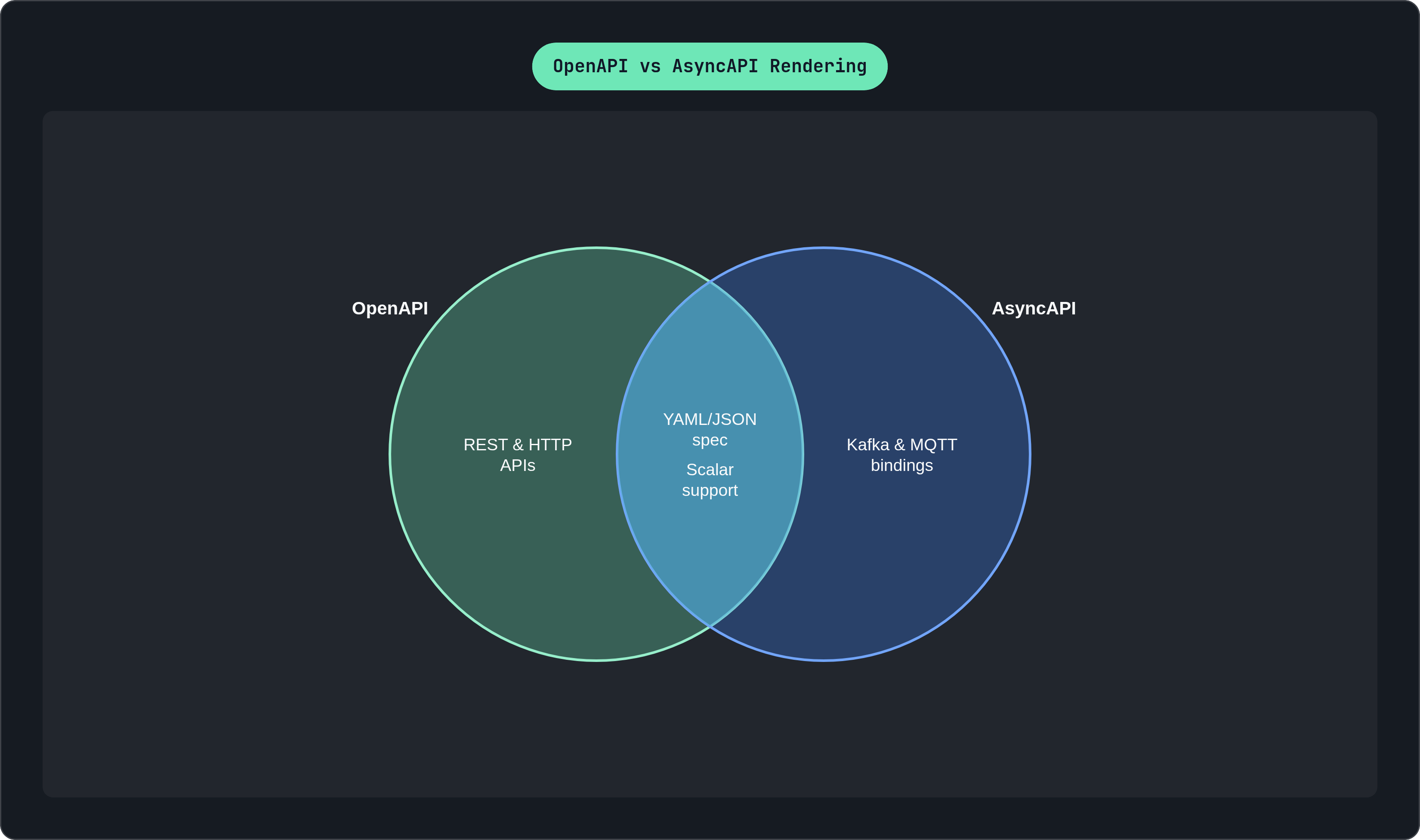
The "try it" experience goes further than most competitors. Scalar ships one of the most capable built-in API clients among renderers, and it also offers a standalone desktop client, an offline-first alternative to a tool like Postman, that reads and edits the OpenAPI document directly. It's also one of the few renderers that covers AsyncAPI alongside OpenAPI, which matters for teams running both spec types and trying to avoid maintaining two separate toolchains. On pricing, the free tier is MIT-licensed and unlimited, covering API references, the built-in client, and both 3.0 and 3.1 support; a Pro tier at $24 a month adds custom domains, Git sync, guides, and landing pages; Enterprise adds SSO, role-based access, and an AI assistant billed at $0.02 per message after the first 1,000. A partnership with Speakeasy for SDK generation extends Scalar's scope into the broader API lifecycle. That expansion is also the open question: blurring the line between renderer and client adds real capability, but it adds complexity too, and a team that wants a narrow, embeddable reference component might find Scalar's scope wider than what they actually need.
Stoplight Elements and RapiDoc: the embeddable component approach
Stoplight Elements takes a different shape entirely: it's a free, open-source Web Component and React component that drops into an existing documentation site or app, rendering the OpenAPI document inside whatever shell the team already runs. It includes a "try it" console, and the underlying pitch is straightforward: documentation quality on par with the best API references out there, embedded in an environment the team already controls and brands. Stoplight's broader commercial platform, separate from Elements itself, adds a visual editor and Spectral-based linting for style governance, aimed at organizations wrestling with inconsistent API design across many services.
RapiDoc follows a similar logic in a lighter package: an embeddable web component that works directly against existing OpenAPI specs, with no SaaS dependency, fully self-hosted, and a small footprint.
Both tools share an assumption worth naming directly: the team already has a documentation site and a brand, and what they need is the API reference layer slotted into it, not a full standalone documentation experience built around the spec. That makes them a strong fit for teams integrating a reference into a larger developer portal or product docs site, where dropping in a separately hosted renderer would create a jarring context switch for the reader.
AsyncAPI rendering: why the tooling lags further behind and what fills the gap
AsyncAPI's rendering problem is structurally different from OpenAPI's, and it's worth sitting with why. Instead of documenting operations on a URL, you're documenting channels, messages, and broker-specific bindings, concepts that an OpenAPI-native renderer simply has no framework for. One might argue this is just AsyncAPI catching up to where OpenAPI already is; the more accurate read is that async architectures need fundamentally different rendering logic, not a delayed version of the same logic.
The honest state of things: open-source coverage for basic AsyncAPI rendering is reasonable, but coverage for interactive testing is thin. Event-driven APIs ship without usable reference documentation far more often than REST APIs do, and that gap is exactly what this section is about.
The official AsyncAPI React Component (@asyncapi/react-component) renders documentation from a spec in real time in the browser, and also ships as a WebComponent with bundles for Angular and Vue. It is also used as a render engine by the AsyncAPI Generator, which matters if you're building custom output. The Generator itself is template-driven, producing Markdown, HTML, or Node.js code from an AsyncAPI definition; it's flexible, but anything outside the standard templates means writing your own. EventCatalog comes at the problem from a different angle entirely, focused on visualizing event flows and producer-consumer relationships across services rather than rendering endpoint-by-endpoint reference docs; it's an architecture tool wearing documentation clothes. Scalar, as noted earlier, is one of the few commercial renderers explicitly supporting AsyncAPI alongside OpenAPI, useful if a team wants one tool across both specs. Bump.sh also supports AsyncAPI alongside OpenAPI 3.1, 3.0, and 2.0, with automatic changelog generation and breaking-change detection built into pull requests, a strong option for teams that want async documentation wired into CI.
What nobody has solved cleanly yet is an interactive "try it" console for async APIs. Testing a Kafka topic or an MQTT subscription interactively is a fundamentally different problem than firing off an HTTP request and reading the response; there's no clean request-response cycle to hook a button to. That gap sits open across the entire ecosystem right now.
Hosted platforms: when a renderer alone isn't enough
Standalone renderers handle display. At some point, teams need more: search across a full catalog, versioning, usage analytics, navigation across multiple APIs, and integration into a broader documentation workflow. That's the point where a hosted platform starts to make sense instead of a renderer alone.
Bump.sh takes a CI-native approach, plugging into existing Git workflows, generating changelogs automatically, and flagging breaking changes directly in pull requests. Its Hubs feature lets a team publish multiple APIs from separate repos as one unified catalog, and it supports both OpenAPI and AsyncAPI, which is rarer than it should be. SwaggerHub centers on collaborative spec design: validation, mocking, and documentation generation from a single workflow, aimed at organizations where governance and spec-first design are the actual priority, with rendering as a downstream output rather than the main event.
There's a newer category worth naming too: platforms that treat the API spec as one input among several, alongside prose, guides, and changelogs, rather than the single source of truth. This distinction is becoming more relevant as teams build for AI agents that need to consume documentation programmatically, not just render it for a human eye. Mintlify falls into this category, treating documentation as knowledge infrastructure that stays synchronized with the underlying spec and stays usable by both people and AI workflows, which is a different requirement than a renderer that just displays a static file well. As teams move toward agent-first architectures where documentation needs to stay current without someone manually re-triggering a build, that synchronization matters as much as how the reference page looks. The trade-off across all of this is straightforward, even if the right answer isn't: standalone renderers give more control and cost less; hosted platforms trade some of that control for less infrastructure work and more built-in features. Which side makes sense depends on team size, how many APIs are in play, and whether the audience sits inside the company or outside it.
How to match a renderer to what your team actually needs
The right first question isn't "which renderer is best." It's "what is this reference for, and who's actually going to read it." That reframing does most of the decision-making work on its own.
An internal API used by a handful of teams rarely needs more than a lightweight, self-hosted option like Swagger UI or RapiDoc; anything heavier is overhead nobody asked for. A public-facing reference where first impressions shape how a developer judges the whole API benefits from the three-panel pattern that Redoc and Scalar both build on; polish here isn't vanity, it changes how trustworthy the API itself feels. Developers who need to experiment before they commit to integrating move faster with a built-in "try it" console, which is where Scalar and Stoplight Elements have an edge. Teams running multiple APIs across multiple groups, with inconsistent spec quality between them, need governance features to actually be load-bearing, not decorative, which points toward Stoplight or SwaggerHub. And any team running event-driven architecture alongside REST has to choose between a dual-spec renderer like Scalar or Bump.sh, or running a dedicated AsyncAPI tool next to a separate OpenAPI renderer.
One check comes before all of this, though, and it's non-negotiable: confirm the renderer actually handles your OpenAPI or AsyncAPI version correctly before evaluating anything else about it. A renderer that misrepresents 3.1 semantics isn't a minor inconvenience; it produces documentation that contradicts the contract it's supposed to describe, and a developer has no way to know which one to trust.