What AI-Native Documentation Actually Means
Documentation must be structured data, not opaque text, to guide AI agents reliably.
What traditional documentation looks like to an AI agent
Legacy platforms store documents as binary blobs. A PDF or DOCX file is, from an agent's perspective, opaque the moment it is published. AI can help generate that content, but once the document exists in that form, a downstream agent cannot meaningfully query it. It has to work around the structure rather than through it.
What that workaround looks like in practice: the agent scrapes unstructured text carrying no semantic hierarchy, infers relationships between concepts the human author assumed were self-evident, and guesses at parameters, edge cases, and constraints that were never explicitly documented. The author knew what they meant. The agent has access only to what the author wrote, and the gap between those two things is where reliability problems originate.
This is where I've watched developers lose entire afternoons. An engineer integrates against an API, the docs look complete, the call fails in a way that makes no sense until someone finds a Slack thread from eight months ago explaining that the parameter behavior changed in a minor release. No hallucination involved. Just stale authoritative content, which fails silently in a way that a hallucination sometimes won't. A hallucination can trip an obvious error. Official documentation that's a version behind? You trust it right up until you can't figure out why nothing works.
The hallucination connection is real but often misframed. When docs have gaps, whether missing parameters, undocumented error codes, or absent edge cases, models fill those gaps with plausible-sounding inventions. This is not a model failure in isolation; it is a model failure conditioned on a documentation failure. Even retrieval-augmented generation, which reduces hallucinations substantially on average, does not close the gap entirely. Legal AI tools hallucinate in a meaningful proportion of queries even with retrieval grounding, and domain-specific rates remain high across fields, per an arXiv 2025 study.
Model capability is one variable. Documentation structure and freshness are others, and they are variables that engineering and documentation teams actually control.
The two audiences documentation now has to serve simultaneously
Per Mintlify's internal analytics, nearly half of traffic to documentation sites now comes from AI agents, including Cursor, Claude Code, ChatGPT, and Perplexity, as of 2026. These agents use documentation for product research, implementation, debugging, and customer support. They are not a secondary use case.
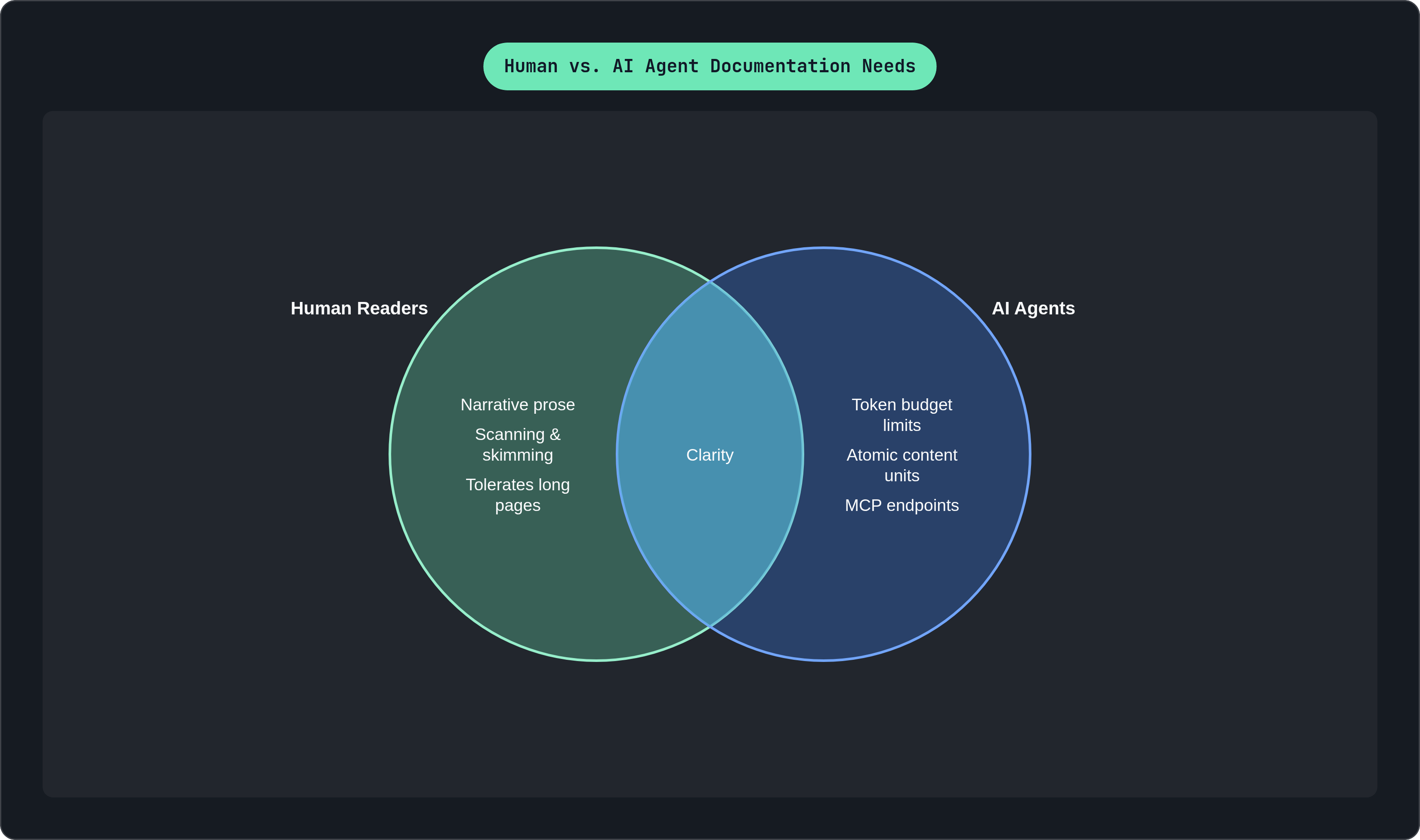
The two audiences have meaningfully different consumption patterns, which is where the architectural tension gets uncomfortable. Human readers scan, jump around, tolerate narrative prose, and benefit from examples woven through a page. AI agents operate under hard token limits, may silently truncate long pages without signaling that truncation has occurred, and need self-contained atomic units. The Chroma 2025 Context Rot report found that reasoning quality begins degrading at 30,000 or more tokens. An agent hitting that ceiling on a sprawling documentation page doesn't tell you it ran out of runway. It just stops reasoning as well.
Empirical testing by Dachary Carey at MongoDB, reported in the State of Docs 2026, found that writing well for humans does not automatically mean writing well for agents. That finding cuts against the intuition most experienced writers carry, and it took me longer to accept it than it should have. Good documentation has long meant clarity, completeness, and usability. Those qualities remain necessary. They are no longer sufficient.
The specific divergences that matter in practice: the llms.txt convention does not reliably guide agents to structured content. Agents don't consume full pages; they chunk and truncate. And the specific agent-model combination matters, because some agents delegate to smaller models behind the scenes, compounding existing context or reasoning limitations in ways that are hard to predict or test for.
A single documentation artifact, authored for one audience, cannot serve both well without deliberate choices at the architectural level.
What the structure of an AI-native document actually looks like
The AI-native document is a structured data object. An agent can query it, manipulate it, and reason over it, rather than parsing opaque text and inferring what the author intended. That is the difference between documentation as content and documentation as callable infrastructure, and it took me longer than I'd like to admit to fully sit with what that distinction demands in practice.
Several structural properties distinguish an AI-native document from a well-written traditional one. Pages are self-contained, carrying enough context to be understood without requiring the agent to fetch adjacent pages to resolve ambiguity. Content is explicit rather than implied: rate limits, error codes, edge cases, and constraints appear as defined fields, not embedded in prose that assumes a reader will draw the right inference. Complex workflows are broken into atomic content units sized to fit within the token budgets where reasoning reliably holds, per a 2025 study on recursive language models.
One counterintuitive implication of the token budget framing: a REST endpoint reference can be written at length without significantly increasing hallucination risk, because the agent's reasoning task is relatively contained. A step-by-step guide through branching workflow logic demands tighter chunking, because multi-step instruction execution is where token budget pressure has the most adverse effect. Content unit size is determined by the nature of the reasoning task, not by what looks complete to a human reader. That inversion still catches experienced writers off guard, because it asks them to write for a kind of reader whose failure mode is invisible.
Intelligence, in an AI-native system, should be persistent and contextual. Decisions are not isolated lookups; they are part of an ongoing feedback loop between the agent and the documentation system. Static documents break this by design, because they were never intended to participate in a reasoning loop.
The two technical standards that make agent-readable documentation possible
Two standards are shaping the technical architecture of agent-readable documentation, and they operate at different levels of the stack.
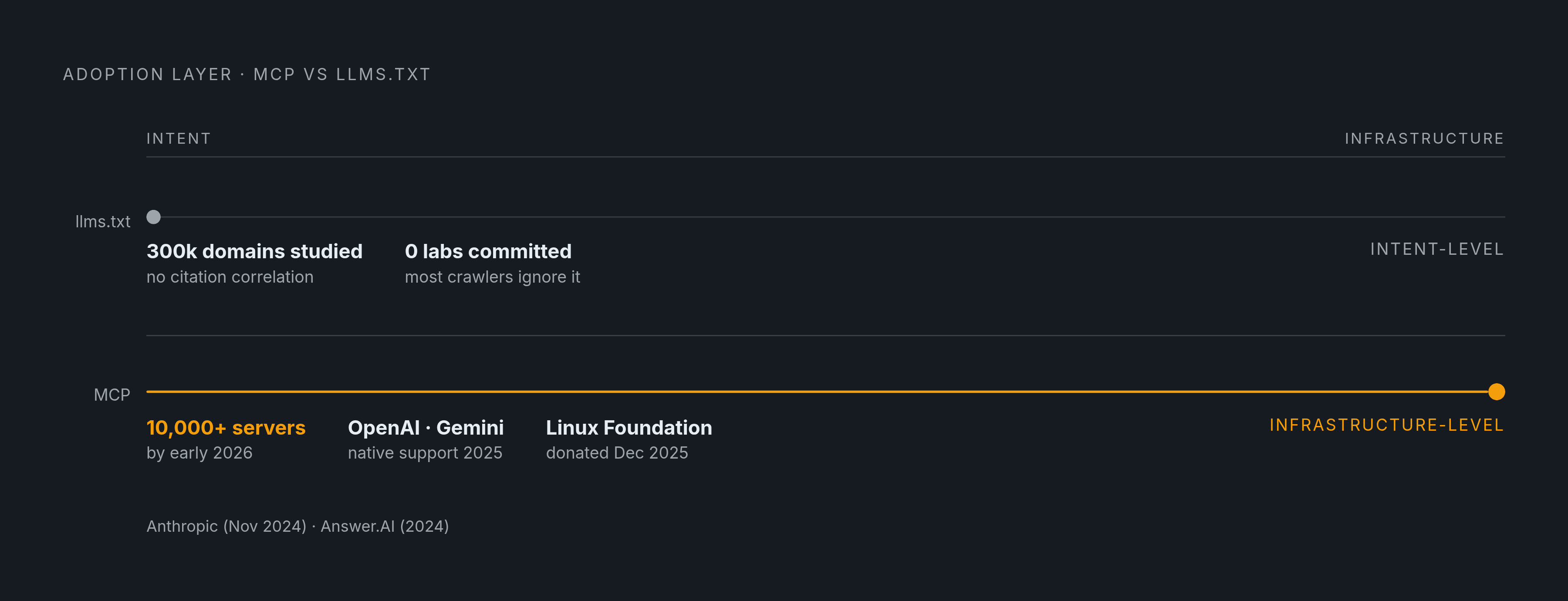
The Model Context Protocol, or MCP, is an open standard introduced by Anthropic in November 2024 for connecting AI assistants to the systems where data lives, including content repositories, APIs, and development environments. The adoption trajectory has been rapid: OpenAI added native MCP support to its Agents SDK in March 2025, Google integrated it into the Gemini agent stack later that year, and Anthropic donated MCP to the Linux Foundation's Agentic AI Foundation in December 2025. Over 10,000 published MCP servers existed as of early 2026.
For documentation specifically, MCP matters because it exposes executable context that agents can call directly. If API documentation is not MCP-ready, agents must guess at endpoints or infer them from prose. MCP eliminates that inference requirement by surfacing structured, callable context directly into the agent's reasoning loop, reducing both token waste and the gap where hallucination lives.
The llms.txt convention is a different kind of proposal, and its current standing warrants candid scrutiny rather than enthusiasm. Introduced by Jeremy Howard of Answer.AI in 2024, it is a curated, prioritized list of a site's most important content, structured for LLM consumption rather than for search crawlers. A study of 300,000 domains found no statistical correlation between having an llms.txt file and being cited by LLMs. No major AI lab has officially committed to honoring it as of early 2026; log analysis shows most AI crawlers do not request it. The strongest real-world use case is the one where it is actually being exercised: AI coding assistants. Cursor, GitHub Copilot, and Claude retrieve documentation in real time, and llms.txt helps them identify and fetch the right pages with less token waste. Visible adopters include Stripe, Cloudflare, Vercel, Supabase, and Anthropic. That list signals intent even where crawler behavior has not yet caught up.
MCP has infrastructure-level adoption. llms.txt has intent-level adoption. They are solving different parts of the problem: MCP exposes documentation as callable infrastructure; llms.txt attempts to guide how agents navigate to the right content in the first place.
Why retrofitting traditional documentation platforms falls short
The first wave of AI documentation tools, roughly 2022 through 2024, wrapped a chat interface around an existing wiki and called the result AI-native. The document underneath remained a binary blob. The second wave, spanning 2024 through 2025, added retrieval grounding so that answers cited source articles. That was a genuine improvement, but it still treated documentation as passive content rather than active infrastructure.
Retrofitting, architecturally, means copying data out of the documentation platform, processing it elsewhere, and sending results back. The interface may appear integrated. Underneath, the approach introduces compounding risks: more systems to secure, more places where policy can break, more junctions where information can drift out of sync. Per Forbes Tech Council reporting from July 2026, this architecture distributes control and governance across a more complex surface area than a native approach.
The native versus retrofitted distinction is not primarily about which features appear on a pricing page. It is about where control and governance actually live. A native system governs the document as a first-class object. A retrofitted system governs a copy of a copy, processed through an intermediary, which means the failure modes are both harder to anticipate and harder to trace when they surface in production.
There are things legacy platforms cannot do regardless of what AI features are layered on top. They cannot treat the document as a queryable data object. They cannot detect when content has drifted out of sync with the product without manual review. They cannot expose MCP server endpoints that agents can call directly. They cannot distinguish agent traffic from human traffic in analytics, which means teams are optimizing blind on exactly the audience that is growing fastest.
Creation speed is the easier half of this problem. Going from four hours per article to thirty minutes is real productivity. Maintenance is the hard half: keeping articles trustworthy after launch, as the product changes beneath them, is where retrofitted architectures have no structural answer.
What AI-native documentation platforms are doing that earlier tools didn't
The current generation of documentation platforms, as observed in 2026, treats two capabilities as foundational that earlier tools handled as optional: code synchronization and multi-agent compatibility. Leading platforms expose llms.txt feeds, MCP server endpoints, and pull-request workflows so that AI coding assistants can read documentation directly, per reporting from HappySupport in 2026. The document participates in the development workflow rather than existing downstream of it.
Auto-sync with code is a system-level capability, not a feature toggle. Generated documentation and SDKs update and version automatically alongside code changes, which addresses the drift problem structurally rather than by relying on a writer to notice that the product has changed beneath them. That distinction matters more than it sounds. A writer can be diligent, thorough, and still lose the race against a fast-moving engineering team. Structural sync changes the odds.
Agentic retrieval is a meaningful advance over basic RAG. Basic retrieval-augmented generation fetches context once before generating an answer. Agentic retrieval gives the model tool-calling access to search, fetch, and reason across documentation pages, OpenAPI specs, and external sources in sequence. For multi-step technical questions, where a single retrieval pass may miss necessary context that only becomes relevant partway through the reasoning chain, this is a practical difference, not a theoretical one.
AI traffic analytics, treated as a distinct capability rather than a byproduct of web analytics, gives teams visibility that was previously unavailable. Standard web analytics conflate agent and human traffic. AI-native platforms show which agents visit, which pages they access, what queries they run, and where they encounter failures. Without that visibility, teams are guessing at where their documentation is letting agents down.
The platform category that combines authoring, publishing, API references, AI readability, retrieval, conversational interfaces, and analytics in a single coherent system is what the research distinguishes as an AI-native full platform. GitBook serves more than 150,000 organizations as of 2026; Mintlify is used in production by Perplexity, Replit, Harvey, and X. That scale reflects architectural adoption, not experimentation.
How the technical writer's role shifts when documentation becomes infrastructure
The clearest finding in the State of Docs 2026 report, which surveyed 1,131 respondents and was published by GitBook, is that writers are spending less time drafting and more time fact-checking, validating, and building the context systems that make AI output worth refining. The shift is not toward replacement. It is toward a different distribution of labor within the same function, though that framing can make the change sound tidier than it feels from inside it.
AI handles first drafts at speed. The writer's job moves upstream into judgment calls the model cannot make reliably. User empathy, understanding what a reader actually needs to accomplish rather than what they literally asked, remains distinctly human work. So does product judgment: deciding what deserves to be documented, at what depth, for which audience. The editorial work that turns technically accurate information into useful understanding requires contextual reasoning that models approximate but do not consistently perform.
The role also expands into work that simply did not exist before: designing context systems, maintaining agent-readable structure, monitoring AI traffic analytics to identify where documentation is failing agents in production. A writer governing that system is not a content producer in the traditional sense. Whether that is an expansion or a replacement depends partly on organizational willingness to redefine the job rather than just the tooling.
I've watched a structurally similar shift happen before, in infrastructure. When teams moved from physical servers to cloud environments, the engineers who adapted were not necessarily the ones who learned the new deployment tool fastest. They were the ones who were willing to question what the job was actually for. Some of the best infrastructure engineers I knew during that period spent months being excellent at the wrong thing, optimizing around a mental model that the environment had already moved past. No one told them directly. The work just quietly contracted around them.
Documentation is in that same moment now. The writers navigating it most effectively are not asking "how do I use AI to write faster?" They are asking what the artifact itself has become, and what it means to be responsible for it when an agent is depending on it in production.
Documentation that updates in sync with product changes is no longer a quality aspiration; it is the precondition for reliable agentic systems. The agent running on top of the docs is only as reliable as the docs themselves, which means the writer governing those docs is, by extension, governing a dependency in the systems her organization is building. Most organizations have not yet adjusted their expectations, their tooling, or their headcount decisions to reflect that. The gap between what documentation now is and how organizations still treat it is where the most consequential work is happening, quietly, and largely without the recognition the function has historically received.