Docs-as-Code Platforms With Built-In AI Drift Detection and Automated PR Workflows
AI agents now read documentation at machine speed, making drift detection essential.
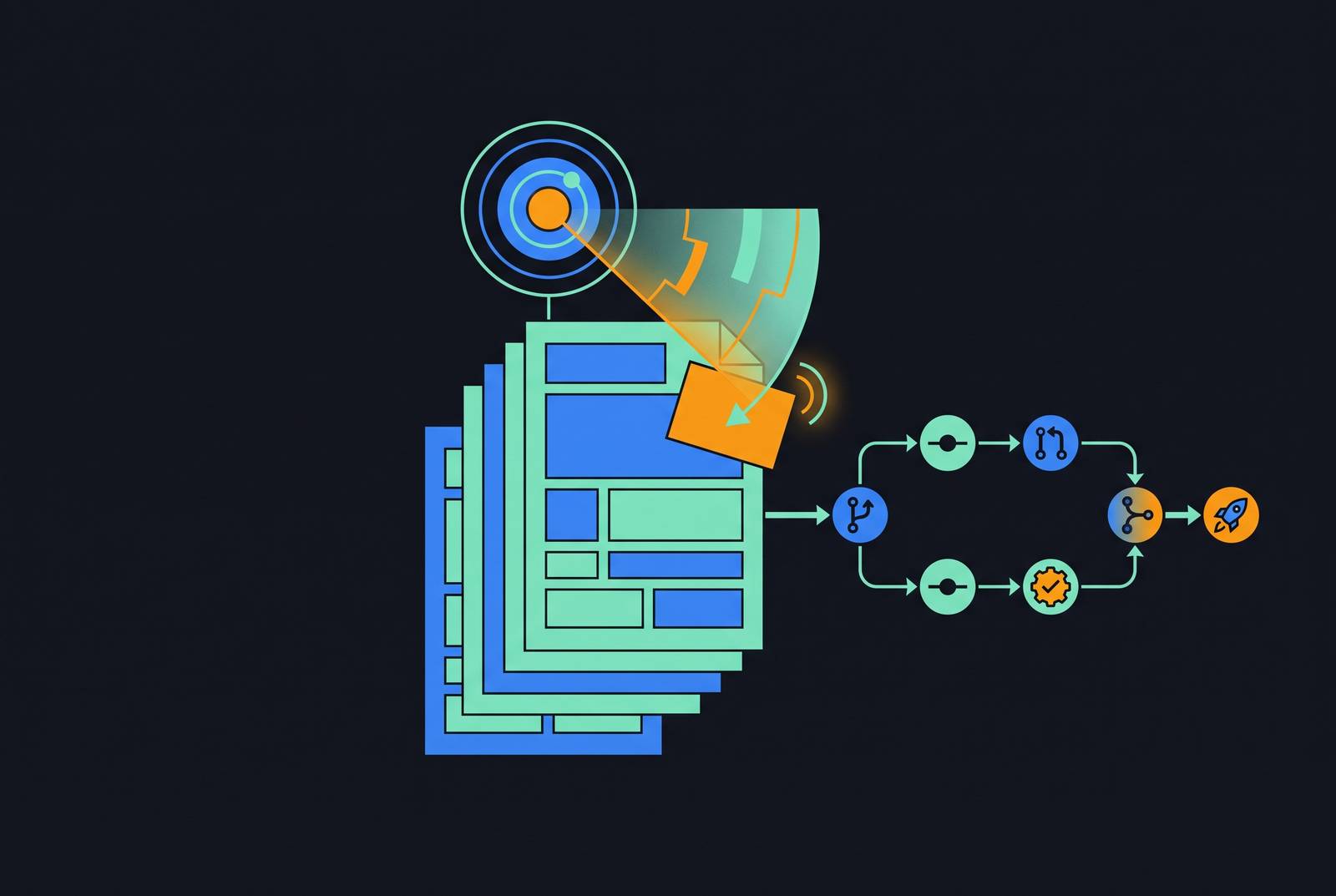
Docs-as-code solves a real problem: it puts documentation into the same repositories, branches, and pull request workflows that engineers already use for source code. But version control tracking a documentation file's history is a different task from knowing when that file has become wrong, and docs-as-code was never built to do the second thing.
The workflow docs-as-code assumes looks reasonable on paper. In practice, that assumption collapses under the way engineers actually work. Git records that a file changed and when, with complete precision. It cannot tell anyone that an onboarding guide, a runbook, or an API reference now describes a system that no longer exists.
The Falconer docs-as-code guide describes the result in plain terms: a backend service gets renamed, and the onboarding guide keeps pointing new hires to the old name for months. When an authentication flow changes, three runbooks can quietly stop matching the system they document, and nobody notices until an incident forces someone to open them. Stale documentation does more damage than missing documentation, because a blank page signals uncertainty and prompts a developer to go ask someone, while a stale page carries the implicit authority of being in the repo, reviewed and merged, and gets trusted exactly when it shouldn't be. That gap between tracked history and semantic accuracy is what every later section in this piece works to close.
What undocumented drift costs engineering teams
Drift compounds for the same reason the detection gap exists in the first place: nothing in the docs-as-code workflow catches the moment prose and code diverge, so the gap simply widens with every subsequent merge. Falconer estimates that developers lose three to ten hours a week just searching for information that should already be documented and isn't, or isn't accurate. A separate survey ranks insufficient documentation second only to technical debt as a drag on developer productivity. Those numbers describe a tax levied every week, on every engineer, regardless of how good the original documentation was when it was written.
Trust drives the cost up, not volume. Once that habit sets in across a team, the wiki becomes what practitioners sometimes call a write-only archive: content keeps getting added to it, but nobody reads it before acting. The investment in writing it in the first place stops paying any return.
The cost becomes visible during audits, when controls documented on paper no longer match controls in practice. Teams operating under SOC 2 or ISO 27001 carry policy pages that are supposed to describe the controls actually in place, so if a new integration isn't reflected there, someone has to explain the delta, usually under time pressure, during evidence collection. Auditors are checking whether documented controls match practiced ones, and a gap between the two is precisely the finding nobody wants on record.
Regulation is adding a sharper edge to that exposure. Existing documentation frameworks were built to describe deterministic software, not systems whose behavior depends on probability and training data, so when that mismatch opens up, documentation gaps carry direct regulatory weight, not just internal inefficiency. That regulatory pressure lands on human-facing documentation. A newer, faster-moving pressure comes from documentation consumers that are not human.
AI agents as documentation consumers raise the stakes for drift
Documentation used to have one audience: people, reading at their own pace, usually able to tell when something looked outdated or didn't quite match what they were seeing on screen. That audience has split. AI coding agents now read documentation too, at machine speed, without the skepticism a human engineer might bring to a page that feels slightly off.
Mintlify looked at traffic across its documentation network and found that AI agents make 45.3% of documentation requests, nearly matching the share that comes from human browsers. Claude Code alone generates more documentation requests than Chrome running on Windows. That is a structural shift in who reads docs, not a verdict on any particular coding assistant: tools like Cursor, Claude Code, and Windsurf query live documentation mid-task, pulling in whatever the page currently says about a parameter, an endpoint, or a configuration flag. The hallucination is a correct read of an incorrect source, not a model failure.
The Model Context Protocol adds a second layer of consumers on top of ordinary page traffic. An MCP server lets a documentation platform expose its content directly to AI coding agents, so the agent queries the docs as a live data source rather than depending on a developer to paste the right page into a prompt. That turns documentation accuracy into a live-query reliability problem instead of an onboarding problem that only mattered in a new hire's first two weeks. The llms.txt standard, which some platforms now auto-generate alongside llms-full.txt from verified source content, is meant to keep the AI-facing representation of a doc set matched to the human-facing one. But that guarantee only holds if the underlying docs are current, which returns the whole question to the detection gap described at the start of this piece.
The pace of change is also accelerating the window in which any of this matters. GitHub recorded hundreds of millions of commits across its platform in 2025, and a shipping velocity like that means more opportunities for docs and code to diverge, arriving faster, with less time between a merge and the moment an agent or a developer acts on documentation that's already wrong. Given how high the stakes have climbed, and how fast the window for stale docs to do damage is compressing, the obvious next question is what a platform actually has to do to close that loop before drift turns into either a bad agent suggestion or a bad audit finding.
What a drift detection layer needs to do
Closing the gap takes more than a cron job that checks whether a repo received new commits. Effective drift detection needs semantic anchoring between code and prose, PR authorship that cites its own evidence, a human approval gate that never gets skipped, and it has to cover the other places documentation goes stale, not just the code repo. Current platforms agree that these five things matter. They do not agree on how to weigh them against each other, and that disagreement is where the real design decisions live.
The first requirement is repo-to-docs linkage: a system has to know which section of the documentation corresponds to which part of the code, not merely that some file somewhere changed. If that linkage is missing, every commit triggers a search instead of a targeted check. A lint check catches a broken link or a malformed code block. It cannot catch the page that still parses perfectly and still describes, in grammatically correct prose, a function that no longer exists under that name, which is the exact failure mode that does the most damage because nothing about the page looks broken.
The third requirement is evidence-backed PR authorship. The fourth is mandatory human review before anything merges. Every current leading approach preserves this gate, and for good reason: automated merging would remove the audit trail that both compliance programs and ordinary team trust depend on. The fifth requirement extends past code diffs entirely, because most documentation staleness has nothing to do with a commit. Product decisions, UX redesigns, pricing updates, and policy changes all make documentation wrong without touching a single line of source code, and a system that watches only the code repo will miss that entire category of drift, systematically and by design.
Those five requirements point to three genuine disagreements among the platforms that try to meet them. The second disagreement is over whether drift checks should anchor to the specific code a given doc references, or rescan the whole repository on a schedule. Anchoring contains that cost but demands upfront instrumentation that takes real engineering time to set up correctly.
The third disagreement is really an open problem rather than a design choice, and it's the strongest objection anyone can raise against automated drift detection as a category. A 2026 arXiv study applying a framework called DOCER to analyze AI configuration artifacts across 356 repositories found that manual inspection classified roughly a quarter of all flagged elements as false positives. A one-in-four false-positive rate is not a trivial noise floor. It erodes confidence in the detection signal itself and piles review burden back onto the same engineers the tool was supposed to relieve, which is precisely the trust spiral described earlier in this piece, just relocated from stale docs to unreliable alerts about stale docs.
What every current approach holds in common, despite disagreeing on scope and method, is the human-review gate: AI suggests, the team decides, and nothing merges without a person approving it. That consensus matters because it's the one design decision none of the platforms examined next are willing to compromise on, whatever else separates them.
Six platforms' approaches to drift detection and automated PR workflows
Each platform below answers the design questions above with a different bet about where drift actually comes from and how much human oversight a team is willing to build its process around.
Mintlify's Workflows and Autopilot features turn drift detection into a repository-triggered review process. The system connects to a watched source repo, reads code changes as they land, drafts the corresponding doc updates, and opens a pull request for human review, running on Claude Opus 4.6 inside sandboxed environments built on OpenCode and Daytona. The autonomous drift detection agent requires a Pro or Enterprise plan, and the beta caps each organization at 10 active workflows, each running up to 20 times a day. The strongest fit is a team that treats documentation as infrastructure serving both human developers and AI agents, and that wants MCP-ready hosted docs with automated PR authorship built in rather than bolted on.
Moxie Docs generates documentation from a GitHub repo, re-checks it on every merge, and opens what it calls a Cleanup PR whenever it finds drift, and it also exposes MCP context for AI agents and hosts public help centers. It adds a weekly batch option too: every Friday, Moxie recaps the week's merges and opens a single docs-only pull request covering anything documentation missed, which suits teams that would rather review drift once a week than get a notification on every merge. Its PR checks are advisory by default: they warn without failing the build or blocking a merge on their own, so a team that wants drift detection to function as a hard gate has to explicitly require those check names in branch protection rules. Markdown is the current scope; inline comments and JSDoc support are still forthcoming.
DeepDocs is built for a narrower job: it scans a repo on every commit, finds drift, and opens targeted pull requests, updating existing documentation rather than regenerating it wholesale, which preserves the original author's voice instead of overwriting it. It focuses on GitHub PR workflows without targeting agent-facing outputs or MCP context, and it watches code diffs only. It shares the non-code blind spot that affects any tool anchored purely to the repository.
Ferndesk takes the opposite bet on scope. Built as an AI-native documentation platform for SaaS teams, it combines a help center, an OpenAPI-powered API reference with a Try It playground, and an AI agent that monitors the codebase alongside changelogs and support tickets. Ferndesk drafts updates before the docs fall out of sync rather than reacting only after a merge has already landed.
Red Hat's Code-to-Docs is an open-source GitHub Action, triggered by a comment on a pull request, and it needs no separate platform subscription. It offers three commands: review-docs identifies affected documentation files and posts a review with checkboxes for a human to work through; update-docs creates a pull request in the docs repository containing whichever updates the reviewer accepted; and review-feature fetches a specified Jira ticket along with its linked Confluence or Google Docs specifications, compares those requirements against the code diff, and posts a Spec vs Code Analysis identifying what's covered, what's missing, and what changed outside the original plan, while also running the review-docs analysis. The two-step design means a reviewer chooses which files to accept before update-docs ever runs, so nothing merges without a person in the loop, and reviewers can add global or file-specific instructions directly in the update-docs comment if they need granular control over what the AI touches. It fits open-source projects or teams that want drift detection without taking on a SaaS dependency, particularly ones that already run Jira and Confluence.
A self-rolled GitHub Agentic Workflow, built around Docker's Autoheal project, runs on a weekly schedule plus a manual trigger, with read-only repository permissions except for draft pull request creation through safe outputs. When implementation and tests disagree, the workflow flags the conflict for a person to resolve instead of guessing which one is correct. It suits open-source maintainers who want scheduled AI audits with tight cost control and no external platform to depend on, and it demonstrates that the same principles commercial platforms charge for, evidence, human review, and surgical scope, can be assembled from open tooling by anyone willing to configure the workflow themselves.
Lessons from Infrastructure-as-Code reconciliation for docs drift detection
Infrastructure-as-code faced its own version of this problem years before documentation tooling caught up to it, and the way that field solved reconciliation offers a useful preview of where docs drift detection is heading. Terraform and similar tools maintain a state file recording what infrastructure should exist, then reconcile that declared state against what's actually running in the cloud, flagging any divergence as drift that needs resolving before the next deploy proceeds. That reconciliation loop runs continuously, treating a mismatch between declared and actual state as a first-class signal rather than something a human has to notice by accident.
Documentation drift detection is reaching for the same kind of reconciliation loop, just applied to prose instead of infrastructure state. The parallel suggests that the next step for docs tooling isn't a smarter one-time scan but a continuous reconciliation process: a declared state (what the docs claim) checked constantly against actual state (what the code, the product, and the support queue show to be true), with every divergence surfaced as a discrete, evidence-backed item for a human to resolve. Getting that reconciliation loop right for documentation is worth the same patience and rigor the infrastructure world eventually brought to its own version of the problem.