Content Reuse and Single-Sourcing in Large Doc Sets
How to stop duplicating content across hundreds of documents.
A writer who has just changed a single warning label discovers, twenty minutes later, that the warning appears in six different installation guides, worded six slightly different ways, and only three of the six have been updated. The fix is not a bigger team or stricter style guide. The fix is a different way of storing the content in the first place, single-sourcing, where components get written once and reused everywhere instead of documents that each carry their own copy of the same material, and this piece walks through why document-centric authoring collapses under its own weight, how single-sourcing works at the component level, and where the payoff is most visible, including in the newer world of AI agents that now read documentation too.
Why document-centric authoring breaks down as doc sets grow
Picture the writer again, twelve files open, searching for every place an installation procedure appears so a product change can be reflected consistently. Paligo's content reuse guide has a name for this: documentation whack-a-mole, the experience of fixing the same problem over and over in different places because the same content was typed out independently each time it was needed. The underlying cause is that a document, by its nature, is a container, and once content gets placed inside that container, it tends to stay there, cut off from every other document that could use it. When one sentence in a shared procedure changes, the document format provides no mechanism to notify anyone that five other copies of that sentence now need the same edit.
The math only gets worse with scale. Adding more documents to a library grows duplication along with it. More duplication means more update cycles, and more update cycles mean more chances for one copy to drift from another. None of this is a question of individual writers being careless. No single person, however organized, can hold hundreds of documents in their head well enough to catch every place a change needs to land. An architecture that keeps things in sync automatically solves this, not a writer with a better memory. GitBook's 2026 technical documentation guide points to exactly this pressure as the reason structured content and content reuse are back on the agenda for teams managing large and growing documentation libraries: once a doc set passes a certain size, the old filing-cabinet approach to writing simply stops holding together.
Single-sourcing at the component level
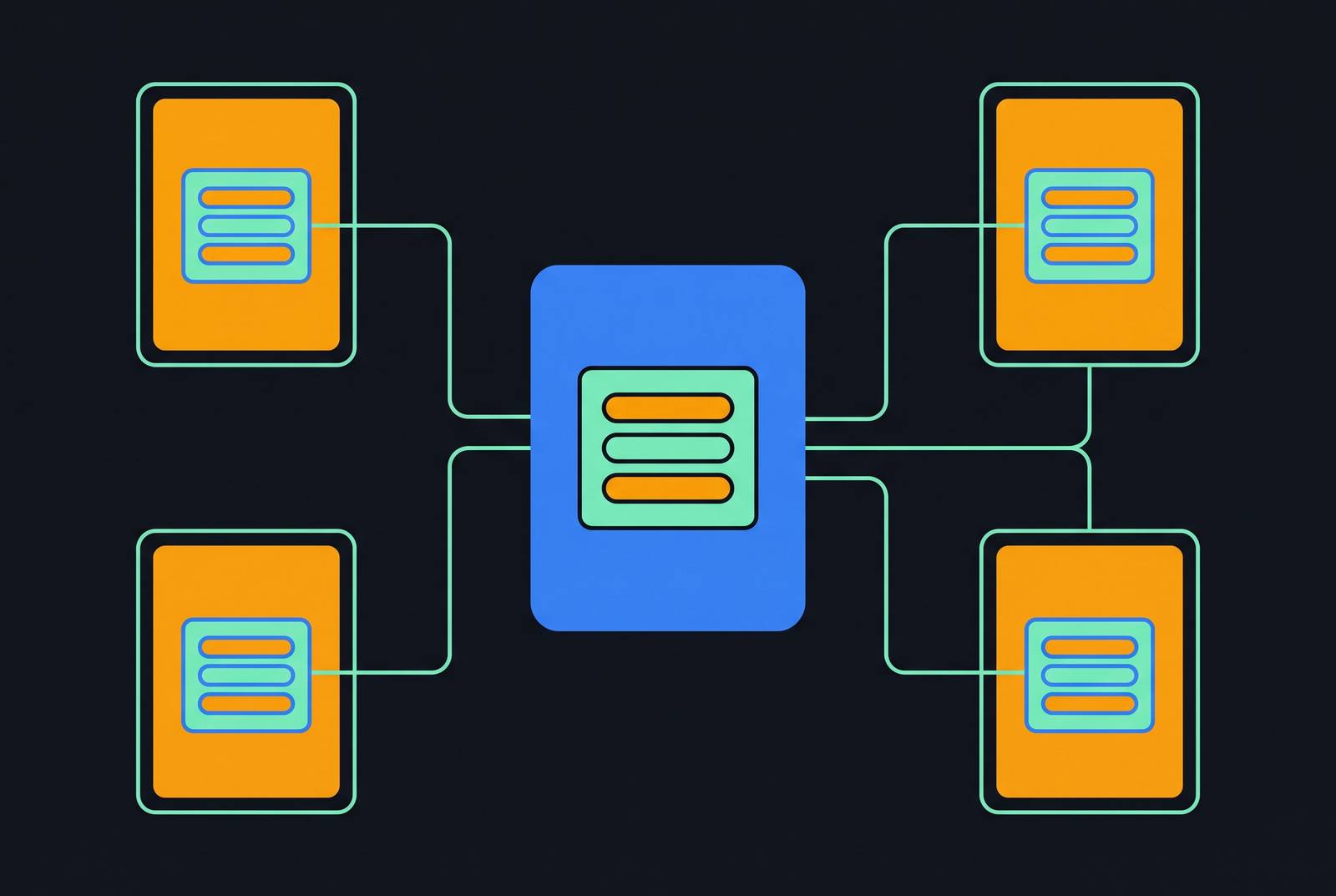
Single-sourcing answers that structural problem by changing the unit being managed. Instead of managing documents, teams manage components, meaning small, independently stored pieces of content that get pulled into whatever publication needs them. Paligo's guide frames the shift with a useful comparison: rather than photocopying the same document for five different binders, keep the original in one place and let every binder pull from it. Edit the original once, and every place it gets used updates along with it.
Components come in a range of sizes. A complete topic might be a full procedure, like a specific installation step. A content section might be a single paragraph explaining a concept. A content fragment can be as small as one sentence or a definition. Media elements cover images, diagrams, code snippets, and tables. Variable content covers text that changes depending on who is reading it or what product they are using. Paligo's content reuse guide lays out all five of these as distinct kinds of reusable units, and the distinction matters because not every problem calls for reusing a whole topic when a single sentence would do.
The infrastructure that makes this practical is called a Component Content Management System, or CCMS. A CCMS manages content at the level of these components rather than at the level of whole documents, creating a single source of truth and removing the copy-paste habits that cause drift. The mental shift this asks of a writing team: instead of thinking in terms of a finite stack of documents, writers start thinking in terms of a much larger pool of topics, often numbering in the thousands, that can be assembled into any number of combinations. Paligo's CCMS overview sums up the resulting value proposition in a single phrase: create content once, publish everywhere. One source feeds every output.
The three mechanisms that make reuse work in practice
That phrase, create once and publish everywhere, depends on three mechanisms working together: structured authoring, standard reuse through references, and conditional content. Each handles a different part of the problem, and a mature single-sourcing practice tends to need all three.
Structured authoring means separating content from how it looks on the page. Because a component carries no formatting instructions of its own, the same piece of content can come out as a PDF, a web page, a mobile screen, or in-product help text without anyone touching the underlying text. Fluid Topics' 2026 guide to documentation tools points to oXygen XML Editor's single-source publishing feature as an example of this in action: a team can produce several different output formats from one file or one set of files, because format is applied at publishing time rather than baked into the content itself.
Standard reuse is the mechanism most people picture when they hear single-sourcing. Take a "Safety Procedures" topic. It gets written once and stored once, and every publication that needs it references that one stored copy rather than containing its own version. Edit it, and every publication referencing it reflects the change right away, with no separate update step required for each one. Paligo's single-sourcing page also points to the audit trail this creates: the CCMS tracks when and where each piece of content gets used, so there is a complete record of every change and every place it took effect. None of this works, though, if topics are written to depend on their surroundings. A topic that reuses well has to stand on its own, without assuming the reader just came from a particular paragraph in a particular guide. Writing a topic that links tightly into its neighbors solves a short-term writing problem and creates a long-term reuse problem.
Conditional content solves a different need: the same base material, adapted for different audiences, product tiers, operating systems, or formats. Paligo's variable content example shows this in action: a sentence like "Configure {PRODUCT_NAME} using the administration panel" resolves to the correct product name automatically depending on who is reading it, at the moment of publishing. Paligo's CCMS page lists multi-dimensional variables and conditional filtering among its core features for exactly this reason. Standard reuse and conditional content solve different problems. Standard reuse means two publications show the exact same content. Conditional content means two publications share a common base that renders a little differently depending on context. A documentation team that only has one of these two tools will eventually hit a wall the other one was built to clear.
Where single-sourcing pays off most: translation and version management
If the mechanisms above sound like architecture for its own sake, translation is where the savings turn concrete fast. In a traditional document-centric workflow, changing one sentence in a large manual can mean sending the entire document back out for translation, not just the sentence that changed. Multiplied across a dozen languages and several update cycles a year, the cost adds up quickly, in time and in translation vendor invoices. Under single-sourcing, a component gets translated once. When that component is reused across several publications, every one of those publications inherits the translated version automatically, with no repeat translation cost and no repeat review cycle.
That said, the first year of adopting this approach usually costs more, not less, because restructuring an existing library into components, tagging it, and building the reference structure takes real time before any savings start showing up. The honest case for making that investment anyway rests on what happens after year one. Each subsequent update cycle costs less than the one before it, and for a global company with ongoing localization needs across many markets, the investment tends to pay itself back within a reasonably short window.
Version management follows a similar logic, on a smaller scale. Paligo's single-sourcing page frames this as a structural benefit of the platform itself: it tracks changes and revisions as they happen, which makes it straightforward to revert to an earlier version or confirm that the right documentation version shipped alongside a specific product release. This matters in a particular way for regulated industries, where auditors expect an accurate, accessible record of what changed and when, and Paligo notes this directly as one of the clearer use cases for the feature. The structural difference between the two approaches is one of scale: in a document-centric system, version management means tracking multiple whole-document copies, while in a CCMS it means tracking versions of much smaller components, a far smaller surface to manage and a far smaller space for something to go unnoticed.
Why structured source content still matters alongside an LLM
If a language model can rewrite, summarize, or restate content on demand, that still does not explain why teams should keep investing in component architecture and metadata discipline. The question deserves a real answer rather than a dismissal, because the premise, that AI makes content more flexible, is true as far as it goes.
An AI system reading documentation is only as good as what it can actually access; Adobe's content management digital trends report states the limit: agents can only surface and reuse assets that have been properly tagged, structured, and catalogued. An agent cannot invent organization that was never put into the source material.
Currency is where this becomes an acute problem in technical documentation specifically. A configuration parameter that got renamed recently will still show up under its old name in a model's training data. A deprecated API endpoint will still surface in a general model's output, because the model has no way of knowing it was deprecated after its training cutoff. An agent needs access to current internal knowledge, not a frozen snapshot of how things used to work. GitBook's 2026 guide makes the stakes of this explicit: when documentation is poorly structured or out of date, AI tools either skip it entirely or return the wrong answer, and GitBook treats this as serious enough that AI readiness has become its own buying criterion for choosing a documentation platform. Robotics and Automation News' 2026 analysis adds a related point about what structured content makes possible: it can be assembled dynamically, reused across different channels, and accessed programmatically by other systems, forming the foundation of a dedicated content layer inside a broader automation stack.
Put together, these two threads point to the same conclusion. The structural discipline that keeps documentation maintainable for a human writing team, consistent components, clear metadata, content kept current, is the same discipline that makes that documentation usable by an AI agent. Single-sourcing and AI readiness are the same investment, read from two different angles.
Agentic AI extends the single-sourcing model beyond traditional publishing
The practical effect of that overlap is that the single-sourcing model is widening in scope. Structured source content used to serve one audience: the humans reading the published output, in whatever format they received it. It now needs to serve a second audience at the same time, the AI systems retrieving and reasoning over that content, which makes getting the "single source" right more consequential than it was when only people were reading the result.
One might argue generative AI already solved this by making content easier to produce on demand. But generative AI mostly sped up individual tasks, drafting a paragraph, summarizing a document, rewording a sentence. Agentic AI asks for something different in kind: real-time, orchestrated retrieval where an AI agent routes a request, checks it for approval, and reuses content across an automated workflow, without a human in the loop reading it first. Adobe's content management report describes this as agentic AI closing a gap that generative AI left open. Where generative AI speeds up a single task, agentic AI introduces brand-compliant intelligence that handles routing, approvals, scheduling, and asset reuse in real time, turning what used to be a linear content pipeline into something closer to a dynamic, end-to-end operation. That same report finds that most organizations still describe their content supply chain as largely linear and resource-intensive, so the shift toward this agentic model is still ahead of most teams rather than behind them.
GitBook's 2026 guide reflects this shift directly in how it tells teams to evaluate documentation platforms. AI readiness, covering support for standardized machine-to-model connectivity, structured metadata, and built-in AI tooling, sits as one of six equal criteria, alongside structured authoring, versioning, API reference quality, docs-as-code workflow, and collaboration model. None of those six outweighs the others in the framework; a platform strong on versioning but weak on AI readiness is, by this measure, only half-built for where documentation is heading.
Knowledge infrastructure and single-sourcing are the same project viewed from two directions. Infrastructure that an AI agent can actually use requires the same discipline single-sourcing has always demanded: components properly tagged, kept current, and built into real workflows rather than left static on a shelf. Documentation that sits in silos, disconnected and un-updated, blocks both outcomes at once. It is hard for a human writer to maintain, and it is unusable by an agent trying to retrieve accurate information from it.
Choosing tooling that matches the scale and maturity of your doc set
None of this points to one correct platform for every team. The right choice depends on where a given documentation library actually sits, somewhere on a spectrum that runs from lightweight, topic-based authoring tools on one end to a full XML-based CCMS on the other. A small doc set with a handful of writers and a modest translation need does not require the same infrastructure as a global enterprise managing thousands of topics across a dozen languages and several regulated markets. Buying more platform than the current doc set needs just adds overhead without adding much benefit; buying less than it needs guarantees a painful migration later, once the library has already grown past what the lighter tool can handle.
Is the authoring layer getting evaluated in isolation, when it should be paired with how content actually gets delivered? A CCMS earns its keep by managing components, reuse, and versioning on the authoring side. But the delivery layer, the system that gets that structured content in front of readers and, increasingly, in front of AI agents retrieving it on a reader's behalf, deserves just as much scrutiny. A documentation stack that handles authoring well but delivers content through a channel ill-suited to agentic retrieval has only solved half the problem this piece has been describing. The two layers work as a pair: structured authoring upstream, matched to a delivery system downstream built for both the human reader and the automated systems now reading alongside them.