documentation platforms with built-in AI assistants compared
Four AI jobs hide behind "AI-powered" documentation platforms.
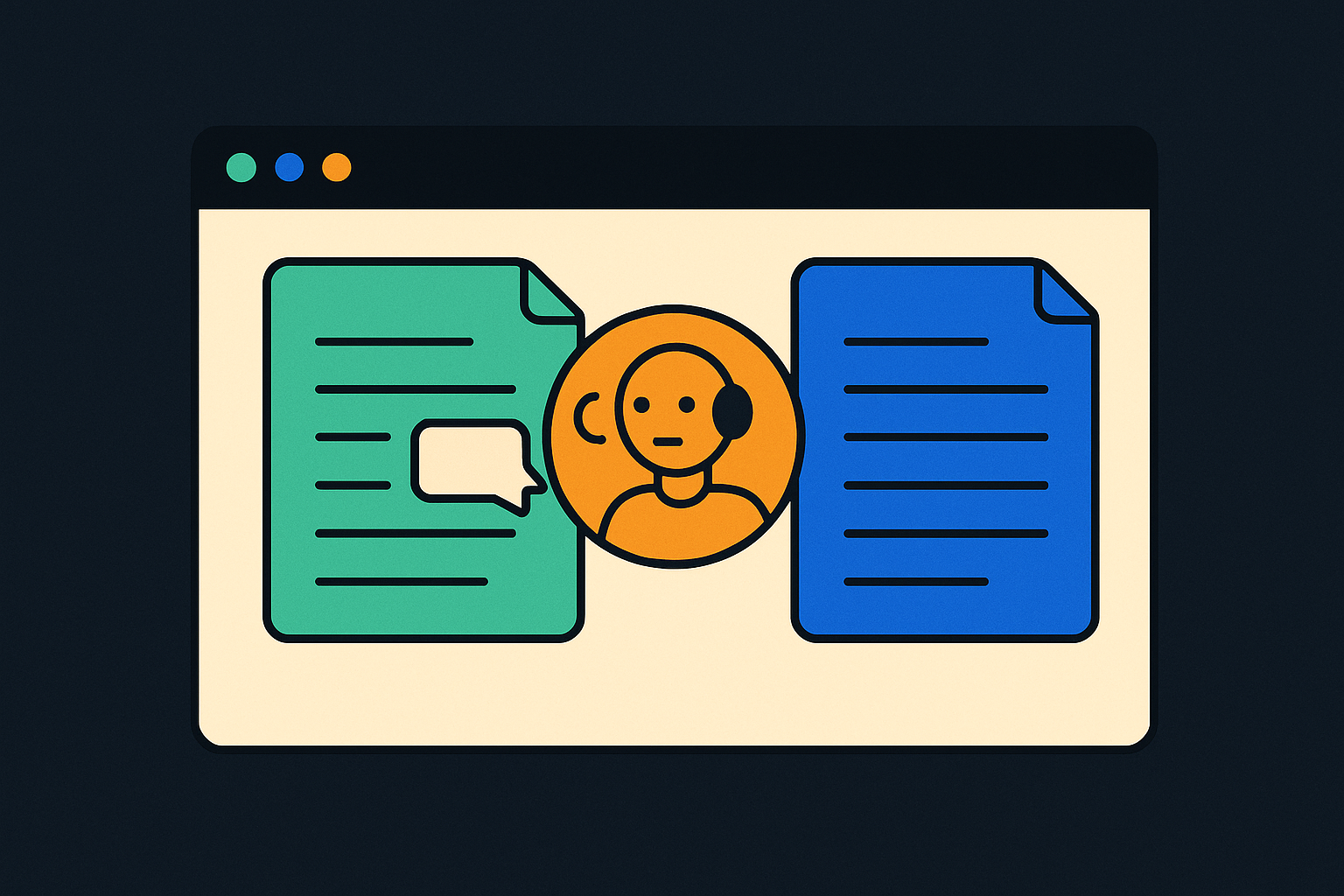
Documentation platforms all market themselves as AI-powered now, but the term hides four separate jobs: drafting, search, maintenance, and making content readable by machines instead of people. Split the lifecycle into those four layers and the marketing noise mostly falls away. Layer one is the AI-native platform itself, the product that handles authoring, publishing, and delivery in one place. Layer two is the writing assistant, a tool that turns a pull request or a code diff into a draft and then hands it off to something else to publish. Layer three is retrieval infrastructure, software that sits on top of docs a team already has and makes that content queryable by Slack bots, Discord bots, or an API, without anyone migrating a single page. Layer four is in-docs chat: the widget that answers a reader's question right there on the page, using retrieval-augmented generation against the site's own content.
A platform can be sharp at one of these and simply absent from another. That's the part the "AI-powered" label glosses over. A tool with a strong in-docs assistant might have nothing resembling proactive maintenance. A tool that auto-drafts from GitHub issues might not support the machine-readable outputs that let a coding agent parse the site at all.
Two of those outputs matter more than they used to: llms.txt, a structured file that tells an AI agent what a documentation site covers and how to use it, plus support for a standardized protocol connecting AI tools to external data sources, letting tools like Cursor and Claude Code query live docs instead of falling back on stale training data. Add AI traffic analytics, the ability to tell agent visits apart from human ones and see where each stalls out, and a rough checklist starts to form. Standard web analytics wasn't built to answer that question, and most of it still can't.
Dachary Carey of MongoDB put the underlying tension well in the 2026 State of Docs Report: "Good for humans is not good for agents. Tokens are expensive and context is a public good. Agents need the smallest possible unit of docs that will help them complete their task." That's the frame the rest of this piece applies, platform by platform, layer by layer.
What practitioners actually worry about when AI writes the docs
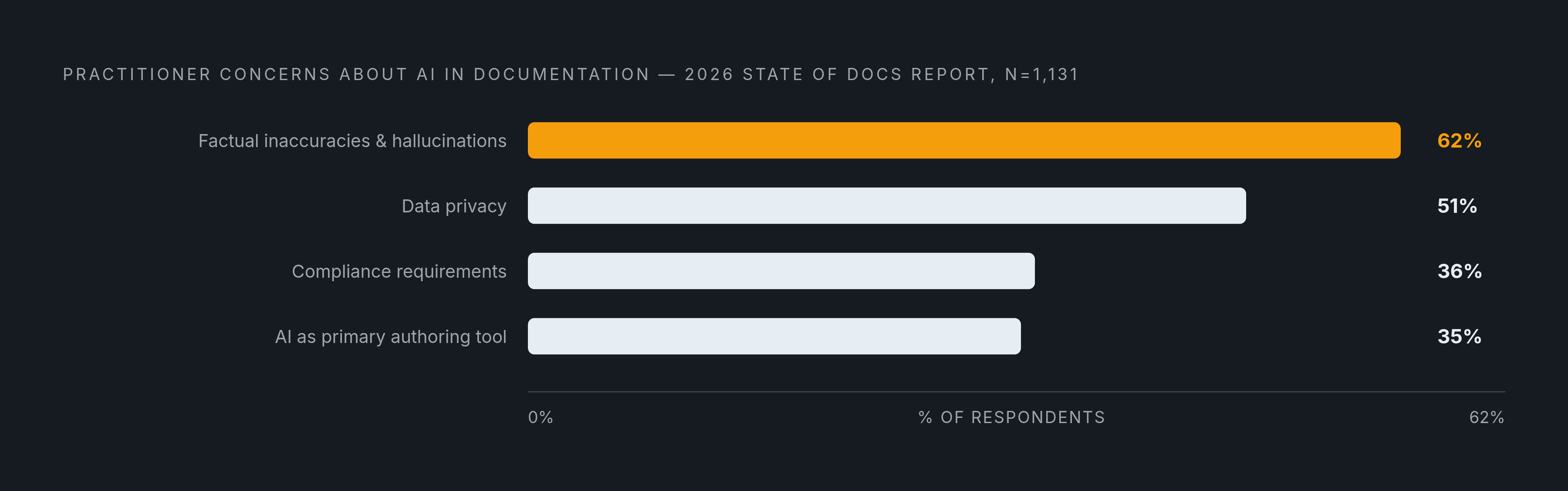
Ask documentation teams what scares them about AI-generated content and the answer isn't job loss. It's accuracy. In the 2026 State of Docs Report, 62% of the 1,131 practitioners surveyed named factual inaccuracies and hallucinations as their top concern, well ahead of anything else on the list.
That number should recalibrate how a team weighs features, and it points to something the rest of this piece keeps circling back to: a platform that drafts fast but doesn't ground its output in current, verified content is optimizing for the wrong variable. Security concerns trail close behind, 51% cite data privacy, 36% cite compliance requirements, and 35% flagged concerns about AI becoming the primary tool for creating and maintaining docs. None of that is abstract anxiety. It's the difference between a tool a compliance team signs off on and one it kills in review.
Half of respondents, 50%, now say AI and prompt engineering is the top new skill documentation professionals need going into 2026. Read that next to the accuracy worry and a pattern shows up: AI isn't replacing the writer, it's changing what the writer spends time on. But what does that actually look like day to day? Teams getting real value out of these tools aren't handing over the whole pipeline. They're using AI to clear one specific bottleneck (drafting, search, gap-detection) while keeping a human in the loop before anything publishes. Carry that lens into every platform section below, because the vendors that skip the human-in-the-loop step are the ones worth the most scrutiny.
GitBook: proactive agent plus embeddable assistant, at a tiered price
GitBook is the one platform here shipping a proactive AI Agent, an embeddable AI Assistant, auto-generated MCP servers, and llms.txt output all inside a single managed product. That combination matters because most competitors cover two or three of those, not all four.
The Agent, in beta as of this writing, connects to GitHub issues, Slack, and Linear, pulling signals from conversations and code changes. Translation is also supported within the platform. This is the maintenance layer doing actual work: catching the moment a product changes and the docs haven't caught up yet, rather than waiting for someone to file a complaint.
The Assistant is a separate thing from the Agent, worth keeping distinct. Unlike some tools whose chat is confined to the documentation page, the Assistant is designed for broader deployment. GitBook added AI traffic analytics in February 2026, breaking out agent visits and queries from ordinary human pageviews.
Pricing is where things get complicated, and this is the part worth reading slowly before signing anything. The free plan skips advanced AI (no AI writing, no AI search, no Assistant) but does include llms.txt and MCP server access. Premium runs $65 per site per month plus $12 per user, and adds AI Answers search, but not the Agent. Ultimate, at $249 per site per month plus $12 per user, includes the Assistant (capped at 200 successful answers monthly) and Agent access, currently in beta. Want more Assistant capacity or external embedding? That's a $149-per-month add-on on top of Ultimate, unlocking 1,000 answers. Translation bills separately too: $25 for the first 50,000 words, then $0.20 per 1,000 words beyond that.
Some users report the editor getting sluggish on larger content sets, and a pattern of being pushed to upgrade to keep editing content that was previously accessible on a lower tier. Weigh that against the feature depth before committing. GitBook fits best for cross-functional teams, engineers, writers, and product managers all touching the same repository, at a scale where the Ultimate tier's cost is easy to justify against the Agent's breadth. Below that scale, the tier structure starts to feel like a tax on teams too small to need it yet.
ReadMe: API-native analytics and agent infrastructure, lighter on maintenance AI
ReadMe is worth naming here for the shape of its problem, even though its specific product name sits outside the scope of direct comparison in this piece. What's instructive is the pattern: a hosted CMS built around a visual editor and an API explorer, with AI split cleanly into a writing assistant on one side and a reader-facing chat tool on the other.
The writing assistant helps draft and edit content, and separate linting and audit tools flag content gaps and documentation issues. That's quality assurance, catching what's wrong with existing docs, not proactive maintenance that watches for product changes and drafts updates unprompted. The reader-facing chat answers questions with analytics attached, showing exactly what was asked and how the system responded.
The standout feature in platforms of this kind is analytics depth: not just page views, but which API endpoints developers are actually calling, where they get stuck, and how usage shifts over time. That's usage intelligence, a genuinely different signal than traffic counts. The tradeoff shows up on the maintenance side: reader-facing chat in this category tends to be boxed into the docs site itself, and there's typically no proactive agent comparable to GitBook's, nothing that auto-drafts from code signals or support ticket volume.
Document360 with Eddy AI: customer-facing knowledge base depth, with maintenance as the gap
Document360 built its AI layer, called Eddy AI, around GPT-based models, and it shows up everywhere in the product: assistive search, an AI writer suite for drafting, a customer-facing chatbot, sentiment analysis, and auto-translation across multiple languages. The platform counts over 2,000 companies as customers, including Microsoft and Riot Games, which says something about its footing in enterprise knowledge management.
Pricing here takes real attention to parse. Document360 charges per project, not per seat, so a second product line, a partner portal, or a separate developer docs site means paying for a second project at full rate. As of 2026, quoted ranges run Professional at $199 to $249, Business at $399 to $499, and Enterprise at $799 and up, per project, per month, billed annually. The company moved to quote-based pricing in November 2024, so actual quotes can shift from these ranges and are worth confirming directly with sales. The AI Suite itself isn't bundled in: AI Suggest runs $99 to $149 per project monthly, and the Eddy AI conversational search bills per resolution.
Here's the gap that matters most for teams evaluating this against GitBook or Fern. Document360 handles authoring, version history, workflow, and multilingual content well, and its AI writer drafts competently. But it doesn't detect when an article has gone stale because the underlying product changed underneath it. There's no equivalent to a PR-triggered update workflow, and that absence is the whole ballgame if a team's real problem is docs drifting out of sync with a codebase. Agent-readability features are an area the platform continues to develop, even where maintenance automation hasn't fully caught up. This fits enterprise teams running customer-facing or internal knowledge bases where multilingual reach, sentiment tracking, and structured authoring outrank the need for docs that a coding agent can parse cleanly.
Fern: when the spec is the source of truth for both the docs and the SDK
Fern takes a different starting point entirely. The API reference generates directly from the API spec, and the SDK generates from that same spec, so the two can't drift apart the way hand-maintained docs and hand-maintained SDKs tend to. That's an architectural choice, not a feature bullet, and it eliminates an entire category of staleness before it starts. Compare that to Document360's gap above: one platform bolts AI onto a maintenance problem it can't structurally solve, the other designs the problem away.
Ask Fern, the sidebar assistant, indexes the documentation, and answers show up in-product and through the API, with a Slack bot also available. Fern also supports llms.txt, and its dashboard tracks LLM bot traffic broken down by provider, alongside a bot-versus-human split at the page level, confirmed among the platforms compared here for that kind of granularity.
What Fern doesn't have is a proactive authoring agent pulling from product signals the way GitBook's Agent aims to, and its in-docs chat, like most of the field, stays docs-site-only. Pricing is straightforward by comparison: a free Hobby tier, a Team plan at $150 a month, and custom Enterprise pricing above that. For an API company where SDK and doc consistency matters as much as prose quality, spec-first generation removes a maintenance headache other platforms have to solve with bolted-on AI. For a team that needs content types beyond API reference (marketing pages, tutorials, conceptual guides), Fern is narrower by design, and that narrowness is a real cost, not just a footnote.
Kapa and Promptless: the retrieval and maintenance layers that sit above any platform
Neither of these is a publishing platform, and that's the point. Both solve one layer of the problem independent of where the underlying docs actually live.
Kapa sits on top of documentation a team already has, indexes it, and exposes MCP servers so the content becomes queryable across a website widget, Slack, Discord, and a direct API, all from one index. That's a meaningfully different shape than a platform-native assistant that only answers questions on the docs page itself. Kapa also tracks question and gap analytics, surfacing what users asked, where the AI's answer failed, and which topics have no coverage at all. Pricing is quote-based, contact sales. The clearest use case: a team with years of content built up in Confluence, Notion, or some legacy CMS, that wants a retrieval layer without a migration project hanging over it.
Promptless works the drafting side. It watches pull requests and support tickets and turns them into documentation drafts, which then wait for human review before anything publishes, so it never touches delivery or hosting directly. There's no in-docs chat here and no publishing surface; it generates llms.txt output, though MCP support isn't confirmed. It runs $500 a month. The use case is narrow and specific: a team whose real bottleneck is getting a first draft written fast after a code change ships, not a retrieval problem and not a hosting problem.
Put those two next to each other and a bigger point comes into view. AI documentation tooling is modular now. A team can run a publishing platform that's weak on maintenance and pair it with something like Promptless to cover the drafting gap, or bolt Kapa's retrieval layer onto docs that were never built with MCP in mind. Which combination makes sense depends entirely on where the actual bottleneck sits, and that's a question each team has to answer honestly before comparing price sheets, not after.
How the platforms compare when mapped against the four functional layers
Line the platforms up against proactive maintenance, the layer that catches stale docs before a reader does, and the spread is stark. GitBook's Agent, still in beta, pulls from GitHub issues, Slack, and Linear, the broadest signal set of the group. Document360's AI writer drafts well but has no confirmed mechanism for detecting that a product change has made an article obsolete. Fern sidesteps the problem structurally: docs and SDK share a spec, so an entire failure mode simply doesn't exist there the way it does elsewhere. Kapa and Promptless don't compete on this axis at all, since neither one is a maintenance layer to begin with; they're retrieval and drafting, respectively.
On agent-readiness, llms.txt and MCP support have become close to table stakes across the field. GitBook, Document360, and Fern all ship both. The differentiator has moved to depth: whether MCP access changes by pricing tier, whether traffic analytics separate agent visits from human ones, whether embeddable chat can live outside the docs site itself. That last point splits the field cleanly. GitBook's Assistant embeds anywhere; Fern's and Document360's stay tied to the docs page.
None of this adds up to a single winner, and that really is the argument of the whole piece: "AI-powered" was never a spec, just a label. But the platforms do split by what a team actually needs solved. If the bottleneck is stale docs after code ships, GitBook's Agent or Fern's spec-first generation solve that directly, and Document360's AI Suite does not, no matter how good its writer suite looks in a demo. Platforms like Mintlify have leaned into the idea that documentation now serves two audiences at once, human readers and AI agents parsing content through MCP, and keeping docs synced with a fast-moving codebase has stopped being a nice-to-have and become the baseline a team should expect. Whatever platform a team lands on, the useful exercise is the one this piece has walked through: map the tool against the four layers (drafting, search, maintenance, and agent-readiness) and check which ones it actually covers before a sales deck convinces anyone it covers all four.