documentation platforms with native AI search and assistant features
AI-powered search and chat are becoming table stakes in developer documentation.
Documentation platforms keep getting sold on how clean they read in a browser. That test no longer holds. A platform can look excellent to a developer scrolling through tidy sidebar navigation and still fail the moment an AI agent tries to pull a fact out of it mid-task. Dachary Carey of MongoDB stated in the State of Docs Report 2026: "Good for humans is not good for agents." Static docs sitting behind a search bar can't feed agents reliably, and the real question facing teams in 2026 is whether their content was built for agentic retrieval from the start, or just made to look good for a person reading it top to bottom.
The three functional layers that separate AI documentation capabilities
Start with the plumbing. The marketing language around "AI-native docs" hides a lot of variation, and most of it collapses into three layers once you look closely.
Layer one is semantic or assistive search. This moves past keyword matching and pulls content by meaning, returning a cited passage instead of ten blue links ranked by guesswork. Most vendors calling themselves AI-native have built at least this much. At this point, it's table stakes, not a differentiator.
Layer two is retrieval-augmented generation, or RAG-powered chat. A language model's answer gets grounded in the actual documentation corpus instead of whatever it memorized during training. The stronger builds don't retrieve once and generate once. They take a multi-part question, split it into sub-queries, run those at the same time, and stitch the results into one answer. That's a harder engineering problem than layer one, and fewer platforms pull it off.
Layer three is agent-ready knowledge delivery, and this is where the whole category runs thin. It means putting content in formats an AI system can parse and act on without a human walking it through: llms.txt files, skill.md declarations, MCP server endpoints, plain Markdown instead of tangled HTML, and workflows that let a coding assistant query docs directly mid-task instead of working off a stale snapshot.
A fourth thing cuts across all three: agentic retrieval. That's the gap between one retrieval pass before generation, and giving the model tool-calling access so it can search, fetch, and cross-check multiple pages or API specs inside one conversation. Basic RAG chat answers one question and stops. Agentic retrieval chases a multi-step answer the way a decent support engineer would, checking three sources before committing to a response. Everything below gets measured against these four things.
How the category evolved in three distinct waves before reaching its current form
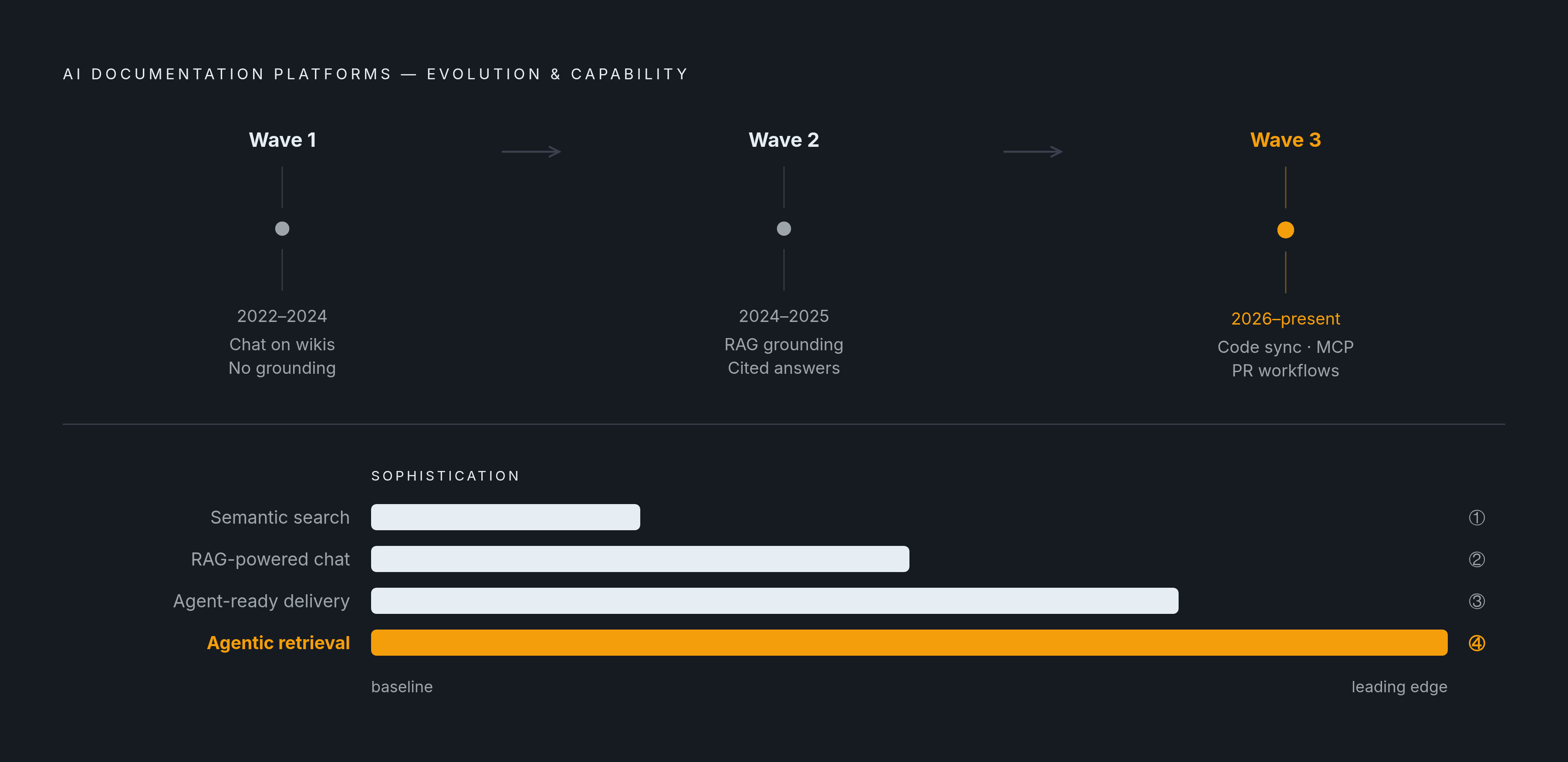
The category didn't show up fully built. It moved through three fairly clean waves, and knowing where a platform sits in that sequence tells you what to actually expect from it.
Wave one, roughly 2022 to 2024, was chat interfaces bolted onto a wiki. No retrieval grounding, no citation, just a language model doing its best impression of confidence. Answers hallucinated often enough that "AI-native" became a term you had to squint at before trusting. Wave two, 2024 into 2025, fixed the grounding problem: retrieval got wired in properly, answers started citing the article they pulled from, and basic RAG became the baseline rather than the pitch.
Wave three is where things sit now, in 2026, and the leading edge has moved to code sync and multi-agent compatibility. Platforms are shipping llms.txt feeds, standing up MCP server endpoints, and building pull-request workflows so a coding assistant like Cursor or Claude Code can read documentation directly instead of guessing off outdated training data.
The market underneath this is not small. The Document AI market was valued at USD 14.66 billion in 2025 and is projected to reach USD 27.62 billion by 2030, a 13.5% compound annual growth rate, with AI integration accounting for 42% of growth in the document generation software segment specifically. That's a structural repricing of what documentation infrastructure is worth.
Worth flagging directly: not everything marketed as an "AI documentation tool" is a full platform, and most buying mistakes in this category start with that confusion. The space splits into pure authoring assistants, pure retrieval layers that bolt onto any site, and full platforms handling authoring, hosting, and AI delivery together. Mix those up during a buying decision and a team ends up paying platform prices for a retrieval layer, or the reverse, neither of which anyone notices until the renewal conversation.
GitBook: block-based authoring with an AI assistant that extends beyond the docs site
GitBook has been around since 2014, built on a block-based visual editor with two-way Git sync, OpenAPI rendering, and interactive API playgrounds. It's one of the more widely used platforms for developer-facing product docs, and its AI layer, launched in July 2025, is a wave-two build with real wave-three pieces mixed in, not a first-generation chat bolt-on.
The AI Assistant runs on agentic retrieval rather than one retrieval pass, and it plugs into GitBook's adaptive content system to personalize responses based on who's asking and what context surrounds them. It also connects to external sources through MCP servers. The sharper move came in November 2025: an embeddable version of the assistant, letting a team put the same AI inside its own product instead of trapping it on the docs site. That's a genuine layer-three move, since the knowledge layer isn't stuck to one surface anymore.
GitBook Agent, still in beta, connects to GitHub, Linear, and Slack (Intercom works as a source connector too) to turn scattered conversations into structured documentation. The platform handles AI-powered translation across 36 languages, refreshing when the source content changes. The honest limit: the Agent is reactive. It answers what's asked. It doesn't go hunting for what's stale or missing on its own, and proactive gap detection sits on the roadmap, not in the product.
Pricing runs annual, per site per month. There's a free tier, but AI features are unavailable on the Basic tier. Premium is $65 per site per month plus $12 per user per month. Ultimate, at $249 per site per month plus $12 per user per month, is where the AI Assistant, cross-site search, unlimited adaptive content, and the beta Agent live. Ultimate ships with 200 AI Assistant answers monthly; going past that means the Advanced AI Assistant add-on at $149 a month, which raises the ceiling to 1,000 answers and unlocks embedded assistants, customization, and external knowledge sources. A single site with ten users lands around $369 a month. Add the AI add-on and that's roughly $518. Scale to three sites with ten users and the add-on, and the number climbs to about $1,016 a month. Real money, worth budgeting before falling for the feature list.
Document360 and Eddy AI: RAG-powered search with compliance controls and an embeddable API
Document360 is a cloud-based knowledge management platform used by more than 2,000 companies, including Microsoft and Riot Games, and its AI runs under the Eddy AI brand.
Ask Eddy AI handles assistive search by pulling relevant passages and synthesizing one cited answer, no link list needed. The sharper trick shows up on complex, multi-part questions: Eddy breaks them into sub-queries automatically, runs them at the same time, and folds the results into a single response that covers every part of what was asked. That's the sub-query decomposition pattern from layer two, made concrete. It's available across the knowledge base and through integration points for third parties.
The API layer deserves its own mention, offering programmatic access to Eddy's capabilities so teams can integrate the retrieval quality into their own workflows and interfaces.
A standalone AI Chatbot module shipped in January 2026 (version 12.1.1), pulling from the knowledge base and additional configured sources. In August 2026, Document360 added a Restrict Access option, letting teams exclude specific reader groups from selected Eddy AI features, including assistive search, the article summarizer, related-article recommendations, the MCP server, and a text-to-voice feature called Listen. Restricted readers just don't see those features anywhere on the site.
On compliance: Eddy runs on OpenAI's APIs, and OpenAI's API policy does not use customer data to train models by default, though customers can opt in if they want that. Document360 itself is SOC 2 compliant. Eddy AI features live on the Professional, Business, and Enterprise plans. Given the sub-query handling, the embeddable API, and the granular access controls, this sits comfortably in wave two with real wave-three touches for anyone with compliance on their mind.
ReadMe: interactive API docs with in-docs chat and an AI linting layer
Interactive API documentation platforms build their whole identity around one thing: letting a developer fire off an API call right on the page and watch the response come back live. That's the foundation here, and the AI layer sits on top as an in-docs chat called Ask AI, paired with analytics on assistant usage, useful for surfacing where the docs themselves may have gaps.
Worth naming directly: this Ask AI feature is documented as a docs-site capability, and programmatic access to Ask AI sits behind the top tier. That's a meaningful contrast against GitBook's embeddable assistant, and if the plan is to put AI search anywhere besides the documentation portal, ReadMe's top-tier requirement is worth factoring in.
The more interesting piece is an AI-assisted linting layer, something like an "Agent Owlbert," that audits documentation, flags gaps, and checks new updates against a style guide. That's a wave-three capability in spirit, though it's aimed at quality control rather than autonomous publishing, closer to a diligent copy editor than an agent writing and shipping changes on its own. External tool connectivity is part of the broader platform offering as well.
Pricing scales with customization and access: lower tiers cover custom domains and basic AI linting, mid tiers drop platform branding and add deeper customization, and enterprise tiers, priced individually, unlock audit logs, SSO, and API access to the AI search layer. Programmatic access to Ask AI sits behind the top tier, so a team wanting to push the assistant past the docs site should expect to pay for the highest plan to get there.
Kapa.ai: a retrieval infrastructure layer that works across any documentation platform
Kapa.ai makes a different bet than every platform above: rather than being a place to write and host docs, it's a retrieval layer that sits on top of whatever platform a team already uses. More than 200 companies run on it, including OpenAI, Monday.com, Nokia, and Sentry, and it handles more than two million questions a month.
The platform-agnostic design is the whole pitch. It works on top of GitBook, on top of the other platforms in this piece, on top of nearly anything, so there's zero lock-in to one publishing system. Source coverage backs that up: Kapa ingests documentation, GitHub, Slack, Discord, Confluence, Zendesk, Salesforce, YouTube, and more, with over 30 source connectors, and public and private sources can sit combined inside a single project.
On answer quality, this approach takes a model-agnostic stance with a dedicated research team tuning retrieval and generation on an ongoing basis, and it's built with an explicit "I don't know" capability. That matters more than it sounds like it should. A system built to surface its own uncertainty instead of confidently inventing an answer runs on a different design philosophy than one optimized purely for sounding fluent, and in technical documentation, a wrong answer costs real engineering time to untangle. That single design choice, admitting the gap instead of papering over it, is arguably the most underrated feature in this entire category.
Deployment isn't limited to a widget bolted onto a docs page either. It reaches MCP, Slack, Discord, an API, support forms, and custom frontends. Analytics cover coverage gap detection with AI-generated recommendations, source-level insights, CSAT tracking, conversation debugging, and uncertainty monitoring: basically a dashboard for finding where the documentation itself runs thin.
The trade-off is this: Kapa is not a documentation hosting platform. Teams bring their own docs and layer Kapa's product on top of them. That's the cost of the flexibility, and it raises a fair question for anyone shopping this category. If retrieval quality is the whole priority, does a dedicated retrieval layer beat the native AI search built into one publishing platform? For a team already committed to a docs host with weak native AI, the answer leans toward yes. There's no clean universal answer beyond that, but it's a question worth sitting with before signing anything.
Algolia DocSearch with Ask AI: established search infrastructure with a generative layer added
Algolia DocSearch brings more than a decade of search infrastructure into this comparison, and in October 2025 it added a generative layer called Ask AI on top of its existing keyword and semantic search engine. A free tier exists for qualifying open-source projects.
The defining trait here is ownership. A team using DocSearch's Ask AI brings its own LLM API key, whether OpenAI or Anthropic, and configures the model, sets token limits, and manages prompting directly. No vendor lock-in on the model layer, which stands out in this comparison, since every other platform here makes that choice for the customer instead.
The strengths line up with what a decade of search infrastructure buys: market-leading keyword search with a semantic layer on top of it, native support for filtering across multiple versions and languages of documentation, tight integration with Docusaurus and similar docs frameworks, and accessibility built to WAI-ARIA standards.
The trade-off mirrors the strength directly. Owning the AI stack means owning model selection, configuration, prompt engineering, and ongoing cost management, overhead the native-AI platforms in this piece absorb for the customer instead. Wave one and wave two are extremely mature here. How far into wave three a team gets depends entirely on what they build on top of that owned stack themselves. The natural fit is a team with real in-house AI capacity that wants search quality and model flexibility without handing the AI layer over to a platform's built-in opinions about how it should work.
What agent-ready knowledge delivery actually requires, and which capabilities deliver it
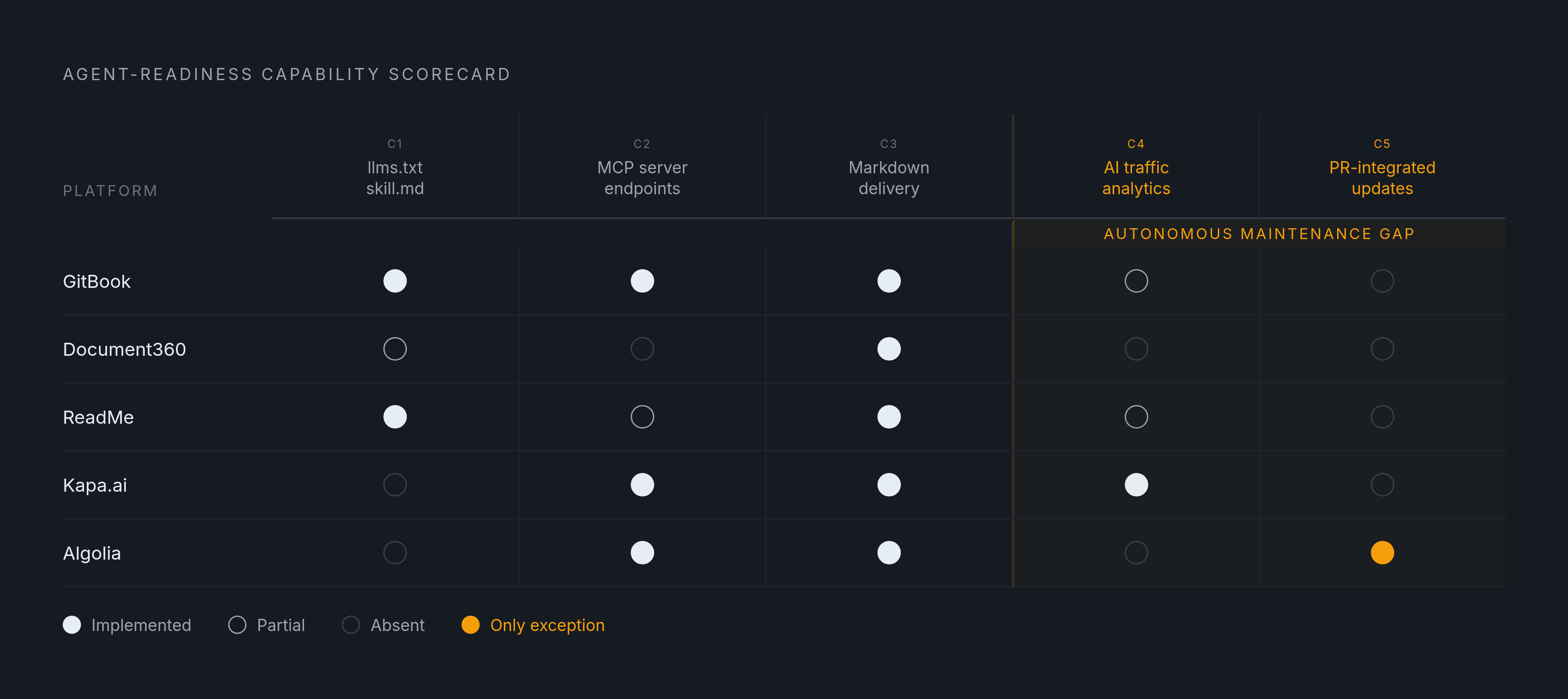
Five capabilities separate genuine agent-readiness from a well-marketed chat widget, and most platforms in this piece are still missing at least two of them.
llms.txt and skill.md files give AI systems a machine-readable map of site structure and stated capabilities, so an agent can figure out what a set of docs helps it accomplish without parsing raw HTML to guess. MCP server endpoints let coding tools like Cursor, Claude Code, or Windsurf query documentation live, mid-task, instead of relying on whatever got baked into the model's training data months or years back. Clean Markdown delivery matters more than it sounds like it should: agents parse Markdown far more reliably than full HTML, so content negotiation, serving a human an HTML page and an agent a Markdown version of the same content, is a concrete engineering requirement, not a nice extra.
AI traffic analytics is the quieter gap, and arguably the more important one. Standard web analytics mix agent traffic in with human traffic, so a platform that can't tell the two apart can't tell a team which AI agents are hitting which pages, which queries fail, or where the real content gaps sit. PR-integrated update workflows close the loop on the other end: when a code change drafts a documentation update automatically and routes it for human review before publishing, the docs stay synced with the product they describe instead of drifting the way static documentation always eventually drifts.
Here's the position: no platform surveyed here implements all five uniformly, and the gap isn't evenly distributed. Most have solved retrieval by now, and that part of the market has genuinely matured. Almost none have solved autonomous maintenance, keeping the underlying content current without a human pushing every update by hand. GitBook Agent is reactive. ReadMe's linting catches problems after the fact. Kapa flags gaps but doesn't fix them. That gap is exactly what Dachary Carey's line was pointing at: documentation built to read well doesn't automatically translate into documentation an agent can trust, and closing that distance is what separates a living knowledge system from a site that just happens to have a chatbot bolted on. Mintlify is one platform built around that distinction directly, treating documentation as infrastructure that both a developer and an autonomous agent can query, rather than a site tuned for one audience and hoped to work for the other.
No platform here wins outright, and pretending otherwise would flatten a real trade-off into a marketing claim. Teams chasing "AI-native" as a checkbox are asking the wrong question; the right one is which of the four capabilities, semantic search, grounded chat, agentic retrieval, agent-ready delivery, their actual traffic depends on. A platform that nails layer one and layer two but ships no MCP endpoint and no llms.txt file works fine for a support team fielding human questions. It's a weaker pick for an engineering org whose coding assistants already generate the largest share of documentation queries, a shift the State of Docs Report 2026 suggests is well underway. Knowing which layer matters most for a given team's actual traffic is the whole evaluation. Everything else is detail.