vector-based semantic search implementations in developer documentation tools
Semantic search solves the vocabulary mismatch between how developers ask and how docs answer.
Vector-based semantic search exists to solve one specific, recurring problem: the words a developer types into a search bar almost never match the words a documentation author chose to write. That mismatch, multiplied across a growing doc set and an increasing volume of AI agents querying documentation programmatically instead of humans, is why embedding-based retrieval and the hybrid systems built around it have become the practical default for technical documentation in 2026.
Consider the classic case. A developer hits a broken login flow and types "fix login issue" into a search bar. The documentation page that actually solves the problem is titled "Resolving Authentication Token Expiry Issues." Zero keyword overlap. Identical intent. A lexical search engine, the kind that runs on BM25 scoring or plain grep-style matching, looks for literal term overlap and comes up empty, or worse, returns a page that happens to contain the word "login" in an unrelated context. The developer's mental model of the problem (login is broken) and the author's mental model of the solution (tokens expire, here's how you resolve that) never touch.
This isn't a one-off annoyance. Documentation vocabulary is written by authors describing a system from the inside; it's queried by readers describing a symptom from the outside. Those two vocabularies drift apart constantly, and the drift compounds as a codebase grows, modules split, and naming conventions evolve unevenly across a doc set that might span thousands of pages. For API-first products, the stakes climb even higher. An AI agent hitting a bad retrieval result can't shrug and try three more phrasings the way a human does. It either gets the right chunk on the first pass or it doesn't, which means retrieval precision matters more for machine consumers of docs, not less.
How vector embeddings turn text into searchable geometry
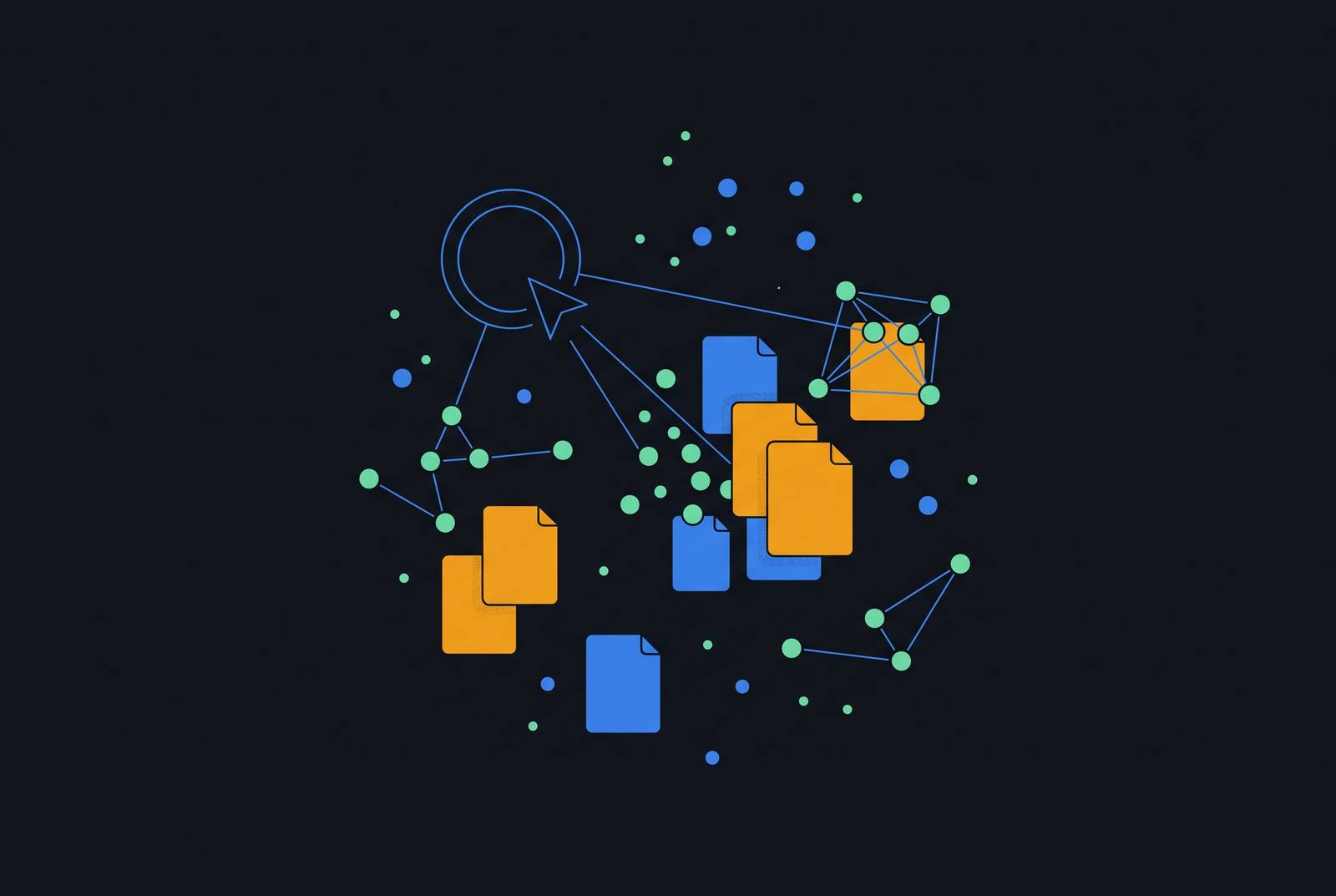
An embedding model reads a passage of text and produces a high-dimensional numerical vector, essentially a long list of numbers that encodes the passage's meaning as a point in space. Passages that mean similar things end up geometrically close to each other in that space, even if they don't share a single word. At query time, the search query gets embedded using the same model, and the system runs a nearest-neighbor search, typically using cosine similarity or Euclidean distance, to find which stored vectors sit closest to the query vector.
The whole mechanism behind why "fix login issue" retrieves "Resolving Authentication Token Expiry Issues" lies in this connection." The two phrases land near each other in vector space because they're about the same underlying concept, authentication failure, not because they share vocabulary. Proximity, not overlap, does the work.
A handful of embedding models show up repeatedly in documentation search pipelines: Sentence-BERT, OpenAI's text embeddings models, and older approaches like word2vec. Google's gemini-embedding-2, described as the first multimodal embedding model in the Gemini API, extends the same idea past plain text to additional modalities, which matters for doc sets that mix code samples, screenshots, and video walkthroughs.
Worth separating two terms that get used interchangeably but shouldn't be: vector search is the retrieval infrastructure, the mechanical process of storing vectors and finding nearest neighbors. Semantic search is the intelligence layer built on top of it, the broader system that interprets a query and decides what "relevant" means. Vector search is a component; semantic search is the outcome that component is built to support.
And here's the caveat that sets up everything that follows in this piece: embedding models are approximation engines. They're strong at capturing conceptual similarity and consistently weak at exact entities, things like version numbers, error codes, or specific API endpoint names. Ask an embedding model to distinguish between "v2.3.1" and "v2.3.2" and it may not, because those two strings look almost identical in vector space even though they mean very different things to a developer debugging a version-specific bug.
Chunking: the variable that determines whether retrieval actually works
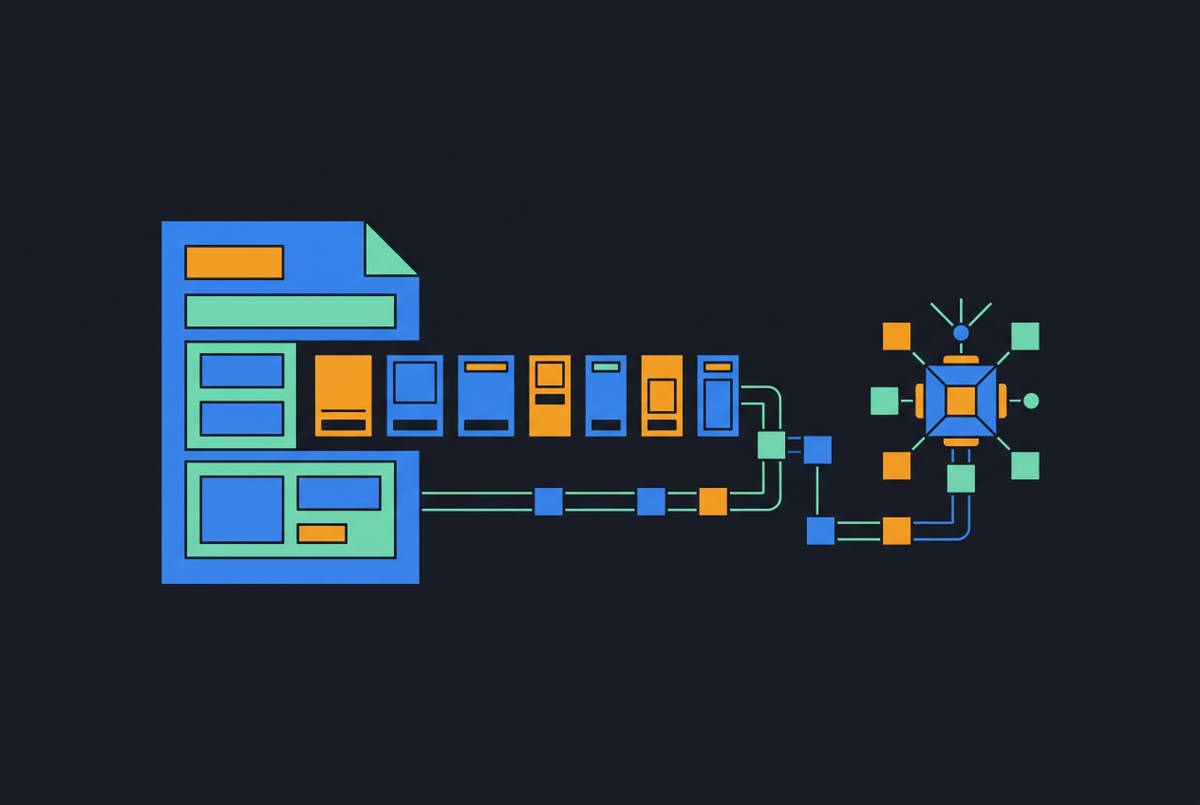
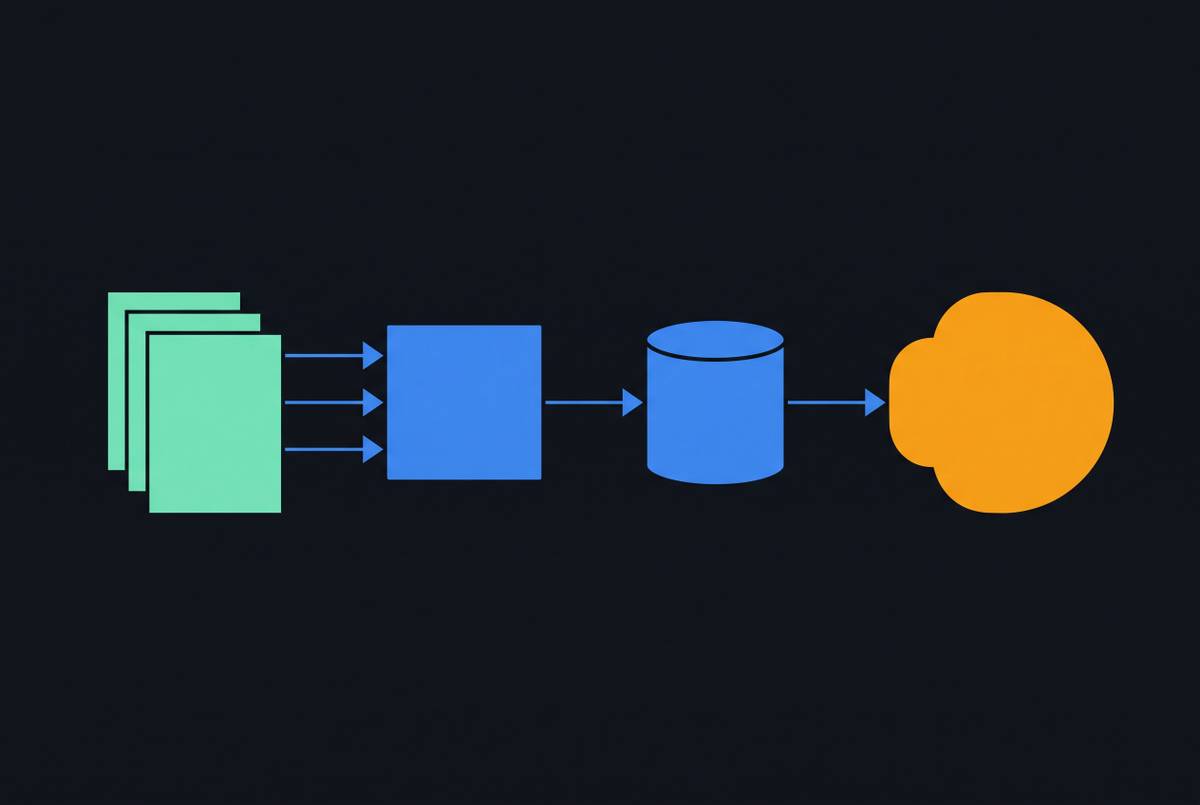
Before any of the geometry above can happen, a document has to get split into smaller pieces, embedded individually, and stored in an index. That's the standard pipeline: split the corpus into passages, embed each passage, store the resulting vectors, then embed the incoming query and pull back its nearest neighbors. It sounds mechanical, and it is, but the splitting step, called chunking, turns out to be the single highest-leverage and most-overlooked variable in retrieval quality. A strong embedding model fed badly chunked documents will still retrieve garbage.
Why does chunking matter this much? Because an embedding represents whatever text sits inside the chunk boundary, nothing more and nothing less. Cut a chunk mid-explanation and the vector you get back represents half a thought. Cut it too wide and the vector has to compress five different ideas into one point in space, which degrades how precisely that point can represent any single one of them.
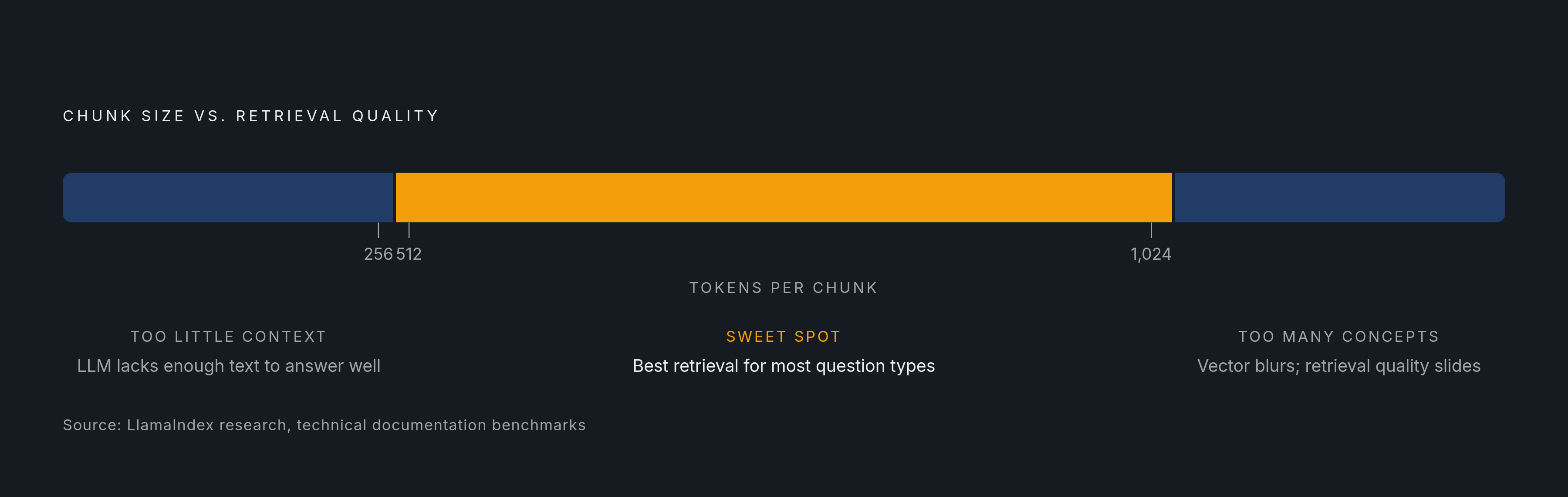
A practical starting point, per the AI Engineering Guide on GitHub: 512-token chunks, split along sentence boundaries rather than mid-sentence, with roughly 10% overlap between adjacent chunks so context doesn't get orphaned at the edges. Research from LlamaIndex on a technical documentation corpus backs this up with more granularity: 512 to 1,024 tokens is the sweet spot for most question types. Drop below 256 tokens and chunks frequently lack enough surrounding context for an LLM to actually answer the question well, even after successful retrieval. Push past 1,024 tokens and the embedding has to represent too many concepts at once, and retrieval quality starts to slide.
How much does this actually move the needle? The difference between good and bad chunking strategy can swing retrieval accuracy by 20 to 40 percentage points. That's a bigger lever than switching embedding models or migrating vector databases, which is exactly why chunking deserves scrutiny before either of those more disruptive changes gets considered.
Two approaches dominate in practice. Fixed-size chunking splits text at consistent token counts, which is fast to run at ingest time and produces predictable chunk sizes, but it cuts across topical boundaries without any awareness of where one idea ends and another begins. Semantic chunking, instead, detects shifts in topic and keeps coherent sections intact, which improves recall by up to 9% over fixed-size approaches as of December 2025, according to data from Introl. The tradeoff: semantic chunking requires an extra embedding pass at ingest time, which runs 5 to 15 times slower per document than fixed-size splitting.
So which one should a documentation team actually use? Semantic chunking earns its cost on corpora with strong topical shifts, FAQs, knowledge bases, reference docs where a short, self-contained section needs to stay whole. Fixed-size chunking is a reasonable fit for long-form, uniform narrative prose where topic boundaries are less pronounced. kapa.ai's own documentation states the underlying stakes: if the important terms or concepts a query is looking for aren't present inside a given chunk, that chunk won't get retrieved, even if the surrounding document contains exactly the answer the user needs. The information can be right there in the source file and still be functionally invisible to the system.
Why pure vector search fails on technical queries, and what hybrid search fixes
Embeddings are built to find conceptual similarity, which is exactly what makes them weak at the opposite kind of query: a user pasting in an exact product SKU, a specific error code, or a named API endpoint. There's nothing semantically "close" to an exact identifier like 429 or rate_limit_exceeded. Either the text is there or it isn't, and vector search, built on approximate proximity, doesn't reliably reward exact matches the way a keyword index does.
But most real-world documentation queries aren't purely one or the other. They're hybrid by nature, carrying both a conceptual intent and a precise technical term in the same sentence. "How do I handle 429 errors in the rate-limiting middleware" needs a system that understands the conceptual idea of rate limiting and also matches the literal string "429" and "middleware" against the text. Ask only a vector search engine and it might drift toward generic rate-limiting content. Ask only a keyword engine and it might miss a page that discusses the same error under a different label entirely.
The field's answer to this is hybrid search: run dense vector search and sparse keyword search (typically BM25) side by side, then merge the results. BM25 catches the exact terms. Dense vectors catch the paraphrases and the conceptual overlap. Neither one alone gets the full picture, but together they cover each other's blind spots.
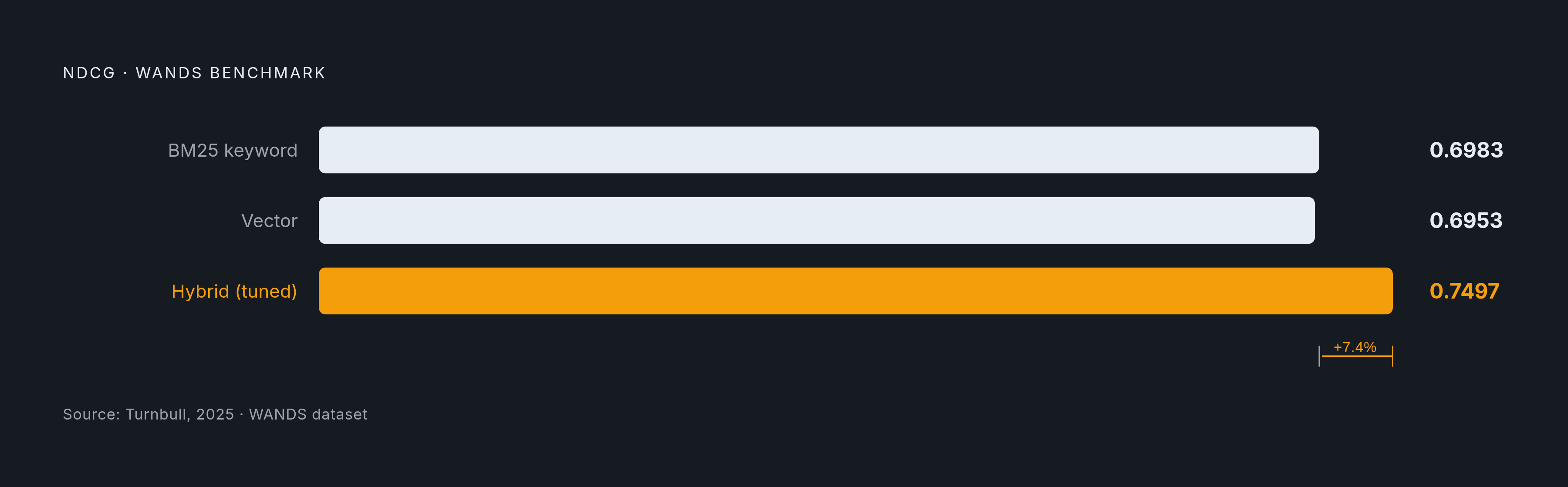
The evidence for this isn't just intuition. Benchmark testing on the WANDS dataset (Turnbull, 2025) found a tuned hybrid setup reaching 0.7497 NDCG, a relevance metric, compared to 0.6983 for BM25 alone and 0.6953 for pure vector search alone, a roughly 7.4% lift over either method run in isolation. The broader pattern across retrieval research points in the same direction: hybrid retrieval that fuses dense semantic embeddings with lexical search consistently outperforms either single method in isolation.
The mechanics of merging two ranked lists matter here too. Reciprocal Rank Fusion, or RRF, combines the ranked results from BM25 and vector search without needing to normalize scores across two different scoring systems, which is otherwise a genuinely annoying math problem. Weaviate implements a related idea called Relative Score Fusion, controlled by an alpha parameter: set it to 0 and the system runs pure BM25, set it to 1 and it runs pure vector search, and anything in between blends the two. The practical upshot across the industry's best-performing RAG systems is straightforward: they don't pick a side. They run both and merge the output.
How documentation platforms implement semantic and hybrid search today
The choice facing a documentation team in 2026 breaks down broadly into two paths: adopt a managed platform with semantic search built in, or assemble a self-hosted stack piece by piece.
Algolia's NeuralSearch, launched May 2, 2023, is one of the more established entries in the managed category. It combines vector and keyword search behind a single API, with end-to-end AI query processing baked in. A technique Algolia calls Neural Hashing compresses search vectors, which start as roughly 2,000-decimal-long numbers, down into fixed-length expressions, which is what lets the system run at high scale with lower latency. The system also learns from user interactions over time to adjust result relevance. Algolia reports powering searches at large scale, and was named a Leader in the 2026 Gartner Magic Quadrant for Search and Product Discovery. Frasers Group, testing NeuralSearch, reported roughly a 65% drop in zero-result searches and up to a 17% lift in conversion. Algolia also launched Ask AI in October 2025, a generative layer sitting on top of its search product, though currently available only as a website widget: no Slack or Discord bot integrations, with an API layer for teams building custom integrations.
kapa.ai takes a different angle, aimed specifically at developer-facing content. It ingests technical documentation, GitHub repositories, community forums, and support ticket history, then turns all of it into a retrieval-augmented chat experience. It connects to more than 50 technical data sources, spanning source code and GitHub content (repos, READMEs, code comments, issues and discussions), community channels like Discord, Slack, and forums, and support platforms like Zendesk. Its Query API performs semantic retrieval on its own, returning the most relevant chunks from ingested sources without generating an LLM response, meant to supply context to external LLMs and agents rather than to serve end users directly. More than 200 technical and enterprise companies use the platform. Prisma reportedly gets over 10,000 developer questions answered through kapa each month, and Mapbox saw roughly a 20% drop in monthly support tickets, according to kapa.ai's own case studies. The company raised a seed round of around $3.2 million in October 2024, led by Initialized Capital with Y Combinator participating.
Managed documentation platforms as a category now go a step further than search alone: many generate AI-optimized output formats like llms.txt and llms-full.txt files, feeding directly into agent workflows. Semantic search and agent-readable content are converging into the same product layer, rather than sitting as separate concerns. A newer differentiator worth watching in this tier is AI traffic analytics, meaning visibility into which AI agents are visiting a doc set, what they're querying, and where they hit dead ends. Traditional web analytics tools weren't built to see any of this. Mintlify, a documentation platform built with AI agents and developer teams as the primary audience, implements hybrid search across its indexing layer, combining vector embeddings with lexical retrieval so that both conceptual queries and exact API terms surface the right pages, a design choice that lines up with the broader industry finding that vector search alone isn't enough for technical documentation at real scale.
Teams that go the self-hosted route are, in effect, rebuilding what the managed platforms already ship, including a static site generator such as Docusaurus, MkDocs, or Starlight, a separate search layer like Algolia or Typesense, a custom-built AI retrieval integration, a hand-rolled MCP server, and whatever additional tooling connects the pieces. Typesense supports nearest-neighbor search on machine-learning-generated embeddings natively and has a reputation for fast setup relative to Elasticsearch. One developer summed it up as "10 minutes to set up instead of 10 days." Self-hosting buys control and flexibility, but the cost shows up later, in the integration work and the ongoing maintenance that a managed platform would otherwise absorb.
Choosing a vector database to back documentation search at scale
The vector database market has consolidated, as of late 2025, around a small set of established names: Pinecone, Weaviate, Milvus, Qdrant, and Chroma, alongside traditional search engines like Elasticsearch, OpenSearch, and Solr that have bolted on vector support to their existing lexical search cores. As a pricing reference point, Azure AI Search offers the first 1,000 semantic ranker requests each month free, then charges $1 per 1,000 additional requests.
Pinecone runs as a zero-ops managed vector search product, with built-in inference covering both embeddings and reranking, full-text hybrid search, and bring-your-own-cloud deployment options. Pricing starts at $50 a month. It carries SOC 2 Type II, ISO 27001, and GDPR certifications, and HIPAA attestation is included on the Enterprise plan or available as a $190/month add-on on the Standard plan. It suits teams that want managed scale without running their own infrastructure and that need compliance credentials already checked off.
Weaviate combines vector search, BM25F (a field-weighted version of BM25), and metadata filters in what's arguably the most mature native hybrid search implementation among the dedicated vector databases. Qdrant's architecture is designed to make the keyword side of hybrid retrieval performant at scale. Its architecture also accommodates documents that benefit from multi-vector representations. Weaviate fits teams that want strong hybrid search out of the box, modular embedding model choices, and an open-source community with some maturity behind it.
Qdrant is written in Rust and built for throughput and low latency. It offers the strongest free tier among this group of four, native support for sparse vectors (via SPLADE++ and miniCOIL), and support for a multi-vector retrieval approach similar to late-interaction models. A single Qdrant collection can hold both a dense HNSW index and a sparse index at the same time, which means native hybrid search without splitting data across two systems. It's a reasonable fit for budget-conscious teams and anyone actively experimenting with different sparse-dense hybrid configurations.
Milvus is open-source and built to scale, supporting multiple vector field types and distance algorithms across a distributed architecture suited to large deployments. Research published on arXiv (2409.17383) notes that reindexing overhead and query latency can become visible pain points in high-dimensional, dynamic datasets. Milvus tends to suit specialized domains that need high scalability paired with flexible distance-metric choices.
For teams already running Elasticsearch, OpenSearch, or Solr, adding vector capability incrementally to that existing infrastructure is a legitimate path too, rather than migrating wholesale to a dedicated vector store.
Measuring whether semantic retrieval is actually working
Standard recall, the metric most retrieval systems get graded on, measures whether the vectors a system retrieves match the mathematically nearest neighbors in ground-truth data. That sounds reasonable until you notice what it's actually rewarding: mathematical proximity, not semantic relevance. A vector can sit close to the query in high-dimensional space purely by coincidence of how the embedding model happened to encode it, without being conceptually useful to the person who typed the query.
That's the flaw traditional recall can't see past. It penalizes a system for failing to retrieve a neighbor that's mathematically close but semantically beside the point, what amounts to noise that happens to live near the query vector. Semantic Recall, a metric introduced at SIGIR '26 (Kuffo et al., 2026), tries to correct this by only counting neighbors that are both semantically relevant and theoretically retrievable in the first place. It doesn't ding a system for missing an irrelevant near-neighbor, which traditional recall does.
What does that mean in practice? A system scoring lower on traditional recall might genuinely be delivering better retrieval quality than its benchmark number suggests, while a team optimizing hard for traditional recall risks tuning its whole pipeline toward the wrong signal. That's a real risk, worth sitting with for a moment: teams often chase the metric that's easiest to compute rather than the one that reflects what users actually experience.
For documentation teams specifically, a few more grounded signals tend to be more actionable than a recall score in isolation: chunking quality, tracked over time; query coverage, meaning which searches return zero results and how often; and task completion, whether the person or agent asking actually found what they needed. AI traffic analytics adds a dimension none of the older metrics were built to catch at all, surfacing queries that fail specifically for AI agents, gaps that would never show up in a human-facing search log because no human ever typed that exact query in that exact way.
None of this happens without tooling built for the job. Frameworks like LangChain, LlamaIndex, and Haystack are widely used in retrieval pipeline construction, which gives documentation and platform teams a real path from ad-hoc "does this look right" testing toward something closer to systematic measurement. Given how much chunking strategy, fusion method, and embedding model choice all interact to determine what a query actually returns, that kind of measurement is a core requirement. It's the only way to know, with any confidence, whether the retrieval system is doing the job it was built for.