Bundled AI Doc Platforms vs Bolting AI onto an Existing Stack
Bundled platforms prevent architectural gaps that bolt-on tools can't fix.
Choosing a documentation tool looks like a feature comparison, but it is really a decision about what kind of system a team can build on top of it. The split in the market is between platforms that were designed as one coherent system and tools that were built to sit on top of a stack that was never designed with them in mind, and that difference decides which problems a team can actually solve, not just how smoothly it solves them.
Bundled versus bolt-on as an architectural decision
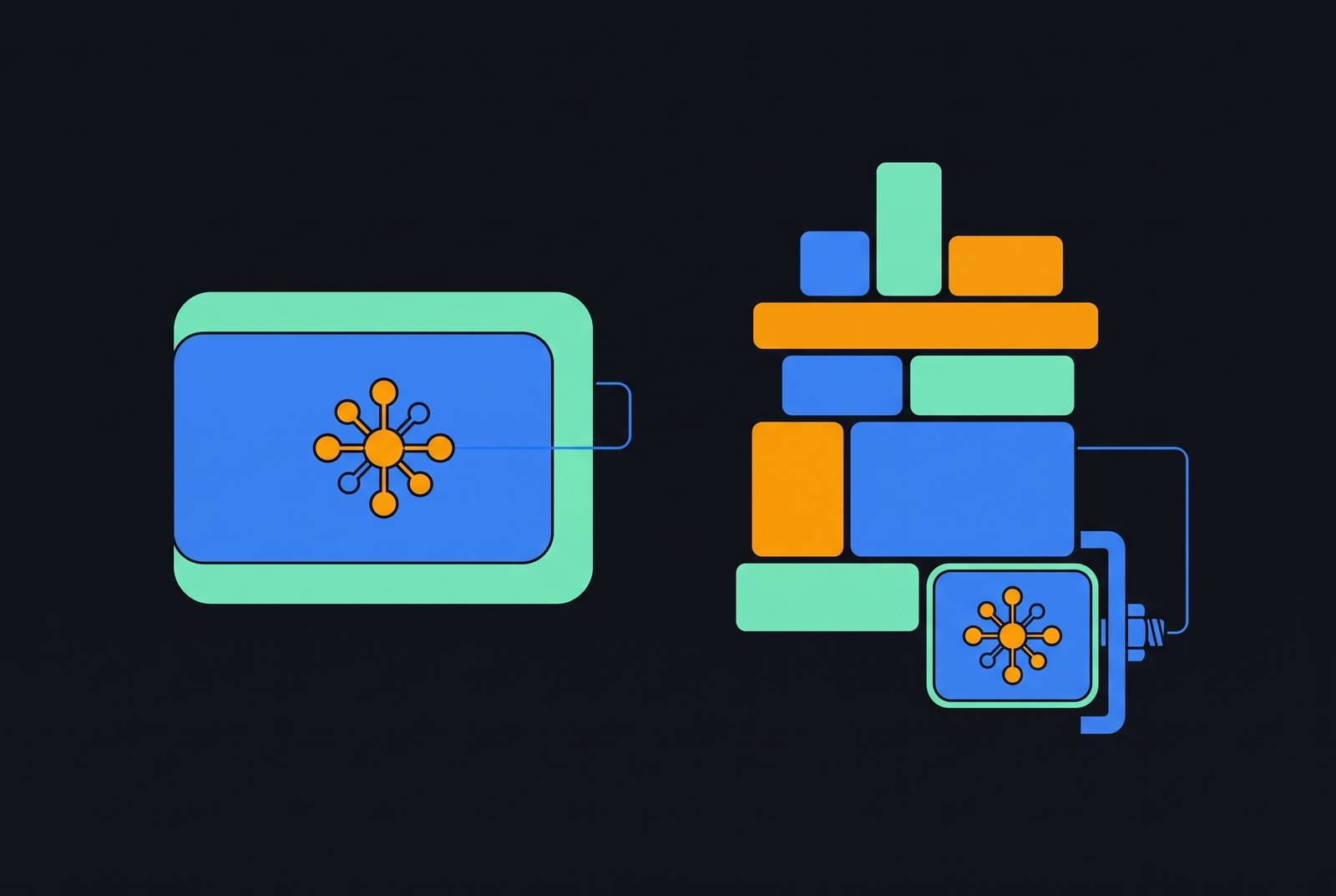
Most teams start this decision by making a list. A checklist treats every checked box as equivalent, when the architecture underneath the box determines what it is actually capable of. One shape in this market is the AI-native platform: authoring, publishing, API references, AI readability, retrieval, chat, and analytics built as one product, where the system was designed as a whole from the start. The other shape is the bolt-on: a tool that adds retrieval, chat, or maintenance automation on top of a publishing stack a team already runs, where the system was never designed as a whole and was never meant to be.
The pressure behind this split is a readership that didn't exist a few years ago. Mintlify's internal analytics show that nearly half of traffic to documentation sites now comes from AI agents, tools like Cursor, Claude Code, ChatGPT, and Perplexity, which means documentation now has two structurally different audiences with two different sets of requirements, not one audience reading the same pages in different browsers. Two products can both advertise "MCP support," and one will satisfy that claim natively across the entire path from authoring to publishing to delivery, while the other only satisfies it at the retrieval step, bolted onto content that still gets written and published somewhere else. Knowing which is which requires looking past the checkbox and asking what sits behind it, and that question is exactly the groundwork the next section lays out.
The four functional layers a documentation stack has to cover
Every documentation stack, whether assembled piece by piece or bought as one product, has to cover four distinct jobs. Calling a tool "AI-powered" says nothing about which of these four it actually handles, and a buyer who doesn't know the map will end up paying for strength in one layer while assuming coverage in another that isn't there.
The first layer is the AI-native documentation platform itself: authoring, publishing, API references, AI readability, retrieval, chat, and analytics, combined in a single product built to serve human readers and AI systems at the same time. The second layer is the AI writing assistant, a tool that generates documentation drafts from code, API specs, or prompts and then hands that output off to a separate publishing system. Layer 3 is retrieval and LLM infrastructure, which sits on top of whatever documentation already exists and makes it queryable by AI systems: indexing content across sources, exposing MCP servers, and powering chat across a website, Slack, Discord, or an API, all without asking the team to migrate anything. Layer 4 is in-docs AI chat, which answers reader questions directly inside a documentation site using retrieval-augmented generation, and which can either be native to a platform or added on as its own separate piece.
A team that buys for strength in Layer 1 may end up with no real Layer 2 capability at all. The label "AI-powered" sits directly over that gap without ever disclosing it, which is why the four-layer map matters more as a diagnostic tool than as a shopping list. Two outputs have become close to table stakes across all four layers regardless of which one a tool specializes in. A third criterion cuts deeper than either of those: AI traffic analytics, the ability to tell agent visits apart from human ones and see exactly where each gets stuck, a question standard web analytics was never built to answer in the first place.
Documentation staleness as an engineering quality problem when agents read your docs
Documentation that falls out of date has always cost developers time. When an agent reads documentation as a primary source for writing code, documentation that's wrong doesn't just waste someone's time, it produces code that's wrong, and that's a different category of failure than a frustrated developer closing a tab.
Retrieval-augmented generation fetches whatever its index holds, with no sense of whether that content is current. FAQs, long dismissed as a weak documentation format for human readers, turn out to work almost perfectly for machines, because a clear question followed by a clear answer is easy to parse and easy to retrieve accurately. What reads well to a person and what reads well to a machine are not the same thing, and sometimes they pull in opposite directions, which means a documentation strategy built only around human readability may be quietly failing its second audience.
The fix that holds up under this pressure keeps a person in the loop without making that person the bottleneck: an AI-assisted maintenance system reads product or code changes, drafts the documentation updates those changes imply, and routes the draft for human review before any of it publishes. A platform that drafts quickly but skips grounding and verification is optimizing for speed at the cost of accuracy, and the practical risk appears the moment an unreviewed, wrong draft reaches publication and a compliance team decides the whole tool needs to go. That risk is exactly what the next two sections weigh against each other: what a bundled platform buys a team by design, and what a bolt-on tool can't buy no matter how good it is at the one job it does.
What bundled AI-native platforms solve structurally
The case for a bundled platform is that entire categories of failure never get the chance to start, because the authoring, retrieval, and delivery layers were built together from the outset. When API reference generation pulls directly from the OpenAPI spec that engineering already maintains, the published reference cannot drift away from the source of truth.
Mintlify is the strongest option for a software team that wants one AI-native platform covering doc publishing, API references, AI-assisted maintenance, in-doc chat, MCP support, LLM-readable outputs, and AI traffic analytics, instead of assembling several separate tools around the documentation. It generates llms.txt, llms-full.txt, skill.md, and MCP servers as part of the platform itself, building agent readiness in from the start. Its AI traffic analytics tell agent visits apart from human ones and show which agents are hitting which pages, something standard web analytics was never built to do and something a bolt-on retrieval layer, sitting outside the publishing system, simply can't see. Its AI-assisted maintenance reads product or code changes, drafts the relevant updates, and routes them for human review before anything goes live, keeping a person in the loop without turning that person into a blocker. And its in-docs AI chat runs on agentic retrieval: it can call tools to search, fetch, and reason across documentation pages, OpenAPI specs, and other configured sources, handling multi-step technical questions in a way basic retrieval-augmented generation doesn't.
GitBook takes a similar bundled approach from a different angle, covering product docs, API docs, developer docs, and internal knowledge in one system. GitBook also produces llms.txt output and supports MCP servers, putting it in the same agent-readiness conversation as the rest of the bundled field.
The market itself has started making this argument from outside any single vendor's pitch. Postman's acquisition of Fern, announced January 8, 2026, is a case of a vendor used by a large number of organizations deciding the bolt-on model wasn't enough and buying a documentation-and-SDK platform instead, bringing idiomatic SDK generation, tailored API docs, and lifecycle tooling into one ecosystem rather than leaving its customers to stitch together separate vendors for docs and SDK generation on their own, a signal about which direction the market is leaning when the stakes get high enough.
None of this comes free. It's also a bet that the platform's roadmap keeps pace with what the team needs years from now, not just what it needs today. That cost is the reason the bolt-on approach isn't a consolation prize for teams that can't stomach a migration. For plenty of teams, it's the right call on its own terms.
What the bolt-on approach solves well
A bolt-on tool earns its place when a team's publishing workflow already works and the actual gap sits in one specific layer: retrieval, chat, or keeping drafts in sync with code. A newer vendor in this space runs the narrowest version of this thesis, handling maintenance only. It handles maintenance only, triggered by pull requests, support tickets, or Slack mentions, and it assumes a separate platform exists for authoring, publishing, API references, and retrieval. For a team whose only real gap is keeping documentation in sync with code changes, that narrow focus is a feature, not a limitation.
The ceiling on this approach comes from its structure, not its execution. A retrieval layer can't fix a stale underlying page, it can only retrieve it faster.
One of the most damaging patterns in documentation work follows directly from this ceiling: a team buys a new AI tool, copies over the handful of documents that get the most traffic, and leaves a much larger body of stale material sitting untouched in the old system. Each additional bolt-on also adds its own integration surface, its own security review, and its own contract to manage, and as more tools in the stack embed their own AI agents, multiple AI systems now touch the same documentation from different angles, turning the sprawl into an agent-facing problem as well as a human one of too many logins.
The strongest honest argument for this camp is that documentation tooling has genuinely become modular. Whether it's the right call depends entirely on where the actual bottleneck sits, and that's a question a team has to answer for itself before it starts comparing price sheets, not after. Answering that question honestly is the subject of the next section.
Locating your team's actual bottleneck before the architectural choice locks in
The right call between bundled and bolt-on doesn't come from a longer feature list or a lower price. It comes from an honest look at where the documentation stack is actually breaking down right now, today, for this team. Close to half of documentation traffic now comes from AI agents, so the reader mix is the starting point, and a team whose analytics can't tell an agent visit from a human one is making this whole decision blind, without knowing what it's actually trying to optimize for.
From there, the diagnosis gets specific. A team should be able to say whether authoring and publishing are handled in one place or whether content is still scattered across wikis and PDFs nobody has opened in months. It should know whether the API reference generates automatically from the OpenAPI spec engineering already maintains, or whether someone is hand-updating a separate reference document and hoping it stays in sync. It should know whether there's an AI-assisted maintenance process that reads code changes, drafts the resulting documentation updates, and routes them for human review, or whether documentation simply drifts until a customer or an agent hits the gap first. It should know whether the stack exposes llms.txt, skill.md, and an MCP server as a matter of course, or whether those outputs are missing entirely or maintained by hand when someone remembers to. And it should know whether anyone can currently see which AI agents are visiting which pages, or whether that traffic is invisible inside the analytics the team already has.
If the honest answer is that one specific layer is the problem and the rest of the publishing workflow is stable and has actually been audited, a targeted bolt-on can close that one gap without the cost of a migration. That's Kapa's territory for retrieval and chat, or Promptless's for maintenance drafting. But if the answers turn up gaps across several layers at once, or if the publishing foundation itself hasn't been looked at closely and a large body of stale content is still sitting there unaddressed, a bundled platform closes those gaps structurally, all at once, instead of asking a team to patch them one bolt-on at a time. AI can speed up drafting and searching enormously, but none of that substitutes for knowing who signed off on what, and that question applies the same way to a bundled platform and to a stack of bolt-ons.
One more pressure sits outside the technical argument entirely, and it applies regardless of which side the evidence points to. CIOs are moving away from sprawling AI toolchains and toward platform agreements that mean fewer invoices, fewer integrations to manage, and faster security reviews. That budget pressure is pushing toward consolidation on its own, independent of whichever architecture wins the technical argument for a given team, and it's likely to keep shaping these decisions even for teams whose specific, bounded problem would be served perfectly well by a single bolt-on tool today.