Documentation Freshness Signals for AI Retrieval Systems
Embedding similarity cannot detect when documentation becomes outdated.

Retrieval-augmented generation has a blind spot most engineers don't notice until a customer complains about a wrong API version. Cosine similarity, the math that decides which document chunk gets pulled into a prompt, cannot tell the difference between a fact that used to be true and a fact that's true now. This piece walks through why that gap exists, how fast it costs you in practice, and the specific engineering patterns that treat freshness as something you measure and score, not something you hope for.
Why embedding similarity cannot detect a superseded fact
Ask a RAG system a question and it does one thing: it finds text whose vector representation sits close to the query's vector representation. That is the whole of what it does, finding text whose vector representation sits close to the query's vector representation. There's no clock built into that math, no sense of "this was true in March and stopped being true in July." The embedding model just sees two chunks of text that talk about the same topic in similar ways, and it scores them as similar. Whether one of them got overwritten by a changelog six months ago is invisible to the geometry.
This becomes a real problem the moment documentation changes shape rather than just adding to itself. A function gets renamed, an API gets restructured, a pricing page gets an update: none of that guarantees the old version disappears from the index. If the ingestion pipeline hasn't deleted or flagged the superseded chunk, both versions sit in the vector store side by side, and their embeddings often look nearly identical because the surrounding language barely changed.
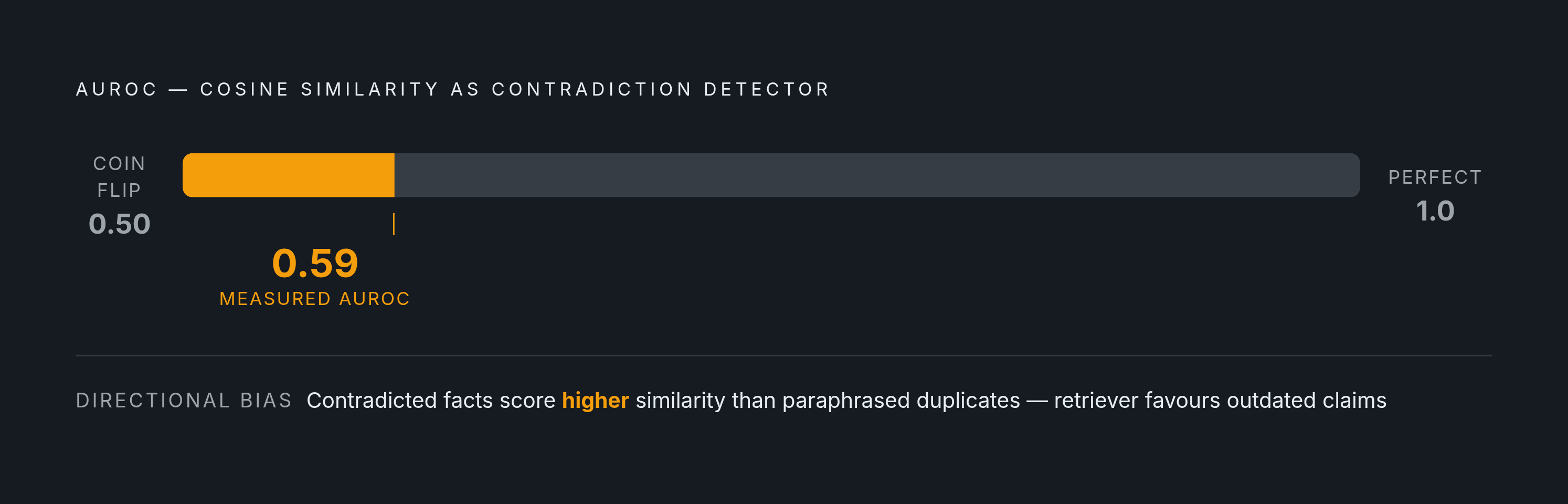
A study on this exact failure mode (arXiv:2606.26511) puts a number on it. Researchers measured how well cosine similarity distinguishes a contradicted fact from a duplicated one, and got an AUROC of 0.59. For context, a coin flip sits at the low end of the scale and 1.0 is perfect separation. An AUROC of 0.59 means the retriever is barely better than guessing when asked to tell "this fact was replaced" apart from "this fact was just restated."
Contradictions were, on average, more similar in embedding space to the original claim than paraphrased duplicates were. The system is actively biased toward surfacing outdated information, because the geometry rewards textual closeness, and a contradicted fact often shares more surface vocabulary with the original than a freshl... It's actively biased toward surfacing outdated information, because the geometry rewards textual closeness, and a contradicted fact often shares more surface vocabulary with the original than a freshly worded restatement does. The retriever isn't failing at freshness. It was never built to detect it.
What "freshness" means as a retrieval property
Freshness gets used as a single word, but it's really a bundle of separate signals that don't always move together. Pulling them apart matters, because each one needs a different fix.
Start with recency of the document itself: when was this page published or last modified? That's the easiest signal to get and the easiest to misread. Then there's factual currency, which asks a narrower question: do the specific claims inside this document, the pricing, the API names, the version numbers, the regulatory thresholds, match what's currently true? A third dimension is corroboration recency: do other recent, authoritative sources back up this page's claims, or contradict them? AI systems increasingly treat multi-source agreement among recent sources as a proxy for "this is still accurate," on the logic that stale claims tend to fall out of consensus first. Last, there are structural freshness markers: visible "Last updated" dates, changelog entries, version tags, the kind of metadata a parser can read without doing any semantic work at all.
Here's where it gets counterintuitive. A page published today that cites only 2023 figures reads as stale the moment a system checks its facts against reality, regardless of the publish date sitting at the top. Meanwhile a page from 18 months ago, if its claims have been kept live-validated against current sources, can read as fresher than something posted this morning. Timestamp and content currency are not the same axis, and treating them as interchangeable is how systems end up trusting the wrong document.
The structural markers deserve a closer look because they're the cheapest signal to act on. A "Last updated: March 2026" line near the top of a page, a DateModified field in schema markup, an "As of [date]" qualifier sitting next to a number that's known to expire, a validity window on a pricing table: none of these require touching the embedding model. A parser can read them directly.
Why does this taxonomy matter beyond definitions? Because each signal type wants to be injected at a different point in the pipeline. Recency and structural markers are best captured at ingestion time, when the document first enters the system. Corroboration recency is more of a query-time or scoring-time signal, since it depends on what else is in the corpus right now. Factual currency often needs post-retrieval validation, a separate check after the document's already been pulled. Collapsing all of that into one "freshness score" tends to produce a number that's technically real but practically useless.
How quickly freshness decays in practice, and why the rate surprised researchers
The decay rate on AI citation freshness is steeper than most content teams plan for. Data compiled by authoritytech.io suggests that roughly half of all content cited by AI systems is less than 13 weeks old, and content under 30 days old earns several times more AI citations than older pages. That's a cliff, not a gentle slope. That's a cliff.
Gander's analysis, also cited by authoritytech.io, models the decay as something close to a one-year half-life: a page loses about half its AI citation potential within 12 months of publication, holding everything else constant. Twelve months sounds long until you compare it to how fast a technical field moves. A library that ships minor version bumps every few weeks will have drifted meaningfully out from under a piece of documentation that's only lost half its visibility.
That decay rate isn't constant across platforms, either, and the variation matters for anyone building against these systems. Perplexity behaves like a real-time retrieval engine; according to stackmatix.com, visibility begins dropping just 2–3 days after publication without strategic refreshes. ChatGPT with browsing enabled sits somewhere in the middle: a moderate preference for fresh content, where regular updates help maintain visibility. Google AI Overviews takes a more structural approach, parsing "last updated" timestamps explicitly and applying a version of the "Query Deserves Freshness" logic that's existed in traditional search ranking for years.
What should a documentation team take from this? Mainly that "freshness" is a moving requirement, not a single target to hit once. It's a moving requirement that behaves differently depending on which system is doing the retrieving, and the platforms with the shortest decay windows are the ones that punish batch-updated content the hardest.
Why technical documentation is the hardest freshness problem in the corpus
General web content decays. Technical documentation decays and also relocates, which is a meaner problem. APIs get deprecated. Functions migrate to new modules. Whole repositories get reorganized, split, or merged. An embedding model has no way to know any of that happened unless the index gets rebuilt against the new structure, and if it doesn't, the model will keep confidently retrieving a chunk that describes a function that no longer exists at that path.
A study called "Still Fresh?" measured this directly, taking two snapshots of ten GitHub repositories covering RAG frameworks and developer tools, one in October 2024 and one in October 2025. LangChain's documentation shrank by 67% over that period, through a mix of reorganization and outright deprecation. Chroma's documentation went the other direction, growing several times over as content migrated in from elsewhere. Neither of those numbers describes a corpus that sat still.
The more interesting finding is what happened to the underlying facts, not just the file structure. Almost every query posed against the 2024 snapshot still had a fully supported answer in the 2025 snapshot. But, and this is the part that matters, the documents that supported those answers had often moved. Content that lived in LangChain's docs in 2024 had, in some cases, migrated to other repositories entirely by 2025. The facts didn't vanish. They changed addresses.
That distinction has a sharp implication for anyone scoping a retrieval system to a single repository or a single doc site. A system locked to LangChain's docs alone would miss the migrated content and either serve a stale answer or serve nothing at all, even though the true answer exists somewhere in the broader ecosystem the whole time. This is a scope problem you fix by finding the right place to look, not a timestamp problem you fix by adding a "last updated" field. It's a scope problem: the system is looking in the wrong place, and no amount of freshness metadata on the wrong document fixes that.
The benchmark landscape that now measures freshness failure
Two benchmarks, taken together, sketch out how bad data staleness gets once you try to measure it directly rather than infer it.
CRAG (the Comprehensive RAG Benchmark) built 4,409 question-answer pairs spanning a range of domains and question types, including facts that change over years down to facts that change second-to-second. Crucially, the questions span a range from popular, well-documented entities to long-tail obscure ones, and from facts that change over years down to facts that change second-to-second. The results are humbling. The most advanced language models tested answer no better than 34% of questions correctly on their own. Bolting on a straightforward RAG pipeline lifts that to 44%. Even the best industry RAG systems tested only manage to answer 63% of questions without hallucinating. And the accuracy drops specifically and sharply on the high-dynamism questions, the ones where facts change fast. Temporal volatility is, by CRAG's own results, one of the sharpest drivers of accuracy drops in the benchmark.
FreshStack takes a narrower, more surgical approach. It's a framework for automatically building retrieval benchmarks directly from code repositories and technical documentation, and it deliberately picked datasets built around fast-growing, recent, niche topics, specifically so the tasks would remain challenging. The headline finding: retrieval models used out of the box significantly underperform an oracle baseline across all five topics, and rerankers, the layer that's supposed to clean up first-stage retrieval mistakes, fail to improve results at all on two of the five. FreshStack has since been folded into RTEB (the Retrieval Embedding Benchmark, a newer version of MTEB) as of September 2025, and Databricks has incorporated it into KARLBench as well.
Put the two together and neither benchmark closes the gap between them on its own. There still isn't a benchmark that's universal, resistant to training-data contamination, and continuously updated on its own. Nor does any current benchmark's ground truth encode temporal-validity intervals, the idea that a fact carries an explicit "true from this date to that date" window (arXiv:2607.21962 raises this gap specifically). Benchmarks haven't caught up to grading temporal-validity intervals yet.
The specific freshness signals retrieval systems can inject
Once freshness gets treated as a first-class scoring input rather than an afterthought, the engineering task becomes concrete: what specific signal, injected at what specific point, actually moves the needle? A useful starting frame, borrowed from how Azure AI Search's freshness-aware retrieval preview describes its own approach, is that freshness should work as a ranking bias, not a hard filter. An old document that's still strongly relevant should still be able to surface. The goal is to nudge scoring toward recency, not to amputate anything older than a cutoff.
A handful of signal types do the actual work. Timestamp-based recency boosting takes a document's creation or last-modified date and folds it directly into the ranking score, with a decay horizon set by a parameter like boostingDuration (Azure's implementation uses ISO 8601 windows, so P90D means a 90-day boosting window). Structural content markers, the "Last updated" text, DateModified schema fields, lastReviewed tags, sitemap timestamps, give ranking layers something to parse without touching the embedding at all. IndexNow-style push signals go further upstream: instead of waiting for a crawler to notice a page changed, the system gets notified the instant it happens, which removes crawl lag from the freshness equation entirely.
Two more mechanisms handle the "did this actually change" question. Cryptographic change detection hashes a document's content and compares hashes over time, triggering re-embedding only when something's genuinely different. Cryptographic hashing approaches aim to ensure that only genuinely changed documents trigger re-embedding. A step further, semantic change detection tries to separate meaningful edits from cosmetic ones: OwlerLite uses a semantic change detector to distinguish substantive content changes from cosmetic ones, so only meaningful edits trigger a re-ingest. And corroboration signals, whether recent authoritative sources back up or contradict a given chunk's claims, function as a freshness proxy in their own right, separate from any timestamp.
In Azure's implementation, freshness policy gets set at ingestion time, but the scoring profile can be updated in place afterward. Changing the boostingDuration doesn't require reingesting the whole corpus, which is a meaningful operational difference between a system that's cheap to tune and one that isn't. That's a meaningful operational difference between a system that's cheap to tune and one that isn't.
None of this fixes the scope limitation raised earlier, though. A system that timestamps every document perfectly but is still only looking inside a stale repository will still miss a fact that migrated elsewhere, the same failure exposed when one open-source library's users migrated to a rival framework. Freshness signals tell you how current what you found is. They don't tell you whether you're looking in the right place.
Architectural patterns for keeping embeddings current as documents change
Most RAG systems in production still re-index on a nightly batch job. By 2026 standards, that's a design flaw, not a reasonable compromise: the vector store sits hours or days behind reality while the model and the retrieval logic themselves are working fine. The staleness is a pipeline problem, not a modeling problem, which is exactly why it's fixable without touching the model at all.
Streaming RAG is the architectural answer that's gaining traction. Instead of a scheduled batch loop, a continuous pipeline reacts to document change events as they happen. Change Data Capture (CDC) is the mechanism that makes this work: it watches a database's write-ahead log and routes creation or update events into a stream processor within milliseconds of the change occurring. Only the document that actually changed gets re-embedded, which means cost scales with how often things change, not with how big the corpus is. The nightly scheduling layer disappears entirely, because there's nothing left for it to schedule. One concrete implementation: RisingWave can connect straight to a PostgreSQL write-ahead log with a single CREATE SOURCE statement, no Kafka cluster or Debezium connector sitting in between.
LiveVectorLake (arXiv:2601.05270) reports results from testing this kind of architecture against a corpus of 100 documents spanning five versions over a simulated six-month window. Only 10 to 15% of the content needed reprocessing at each step, against 100% for a full re-index. Query latency on current-version queries came in at a median of 65 milliseconds. Change detection, using the cryptographic hashing method described earlier, hit 100% accuracy in this test.
The same architecture's version-aware retrieval component is worth noting for what it does and doesn't solve. On version-sensitive questions, questions where the correct answer depends on knowing which version of a tool or API is being asked about, it lifted accuracy to 90%, against a 58% baseline for a version-naive system. That's a substantial gap. But it comes with a real limitation: it requires manual version tagging on ingestion, and it has no automatic change detection layer of its own. It's a strong result with a specific dependency, not a fully automated fix.
Decay functions and scoring patterns that operationalize freshness as a retrieval dimension
Once you've decided freshness is a score, not a flag, you need a function that actually decays it over time. Three patterns occur repeatedly in practice, and they're not interchangeable.
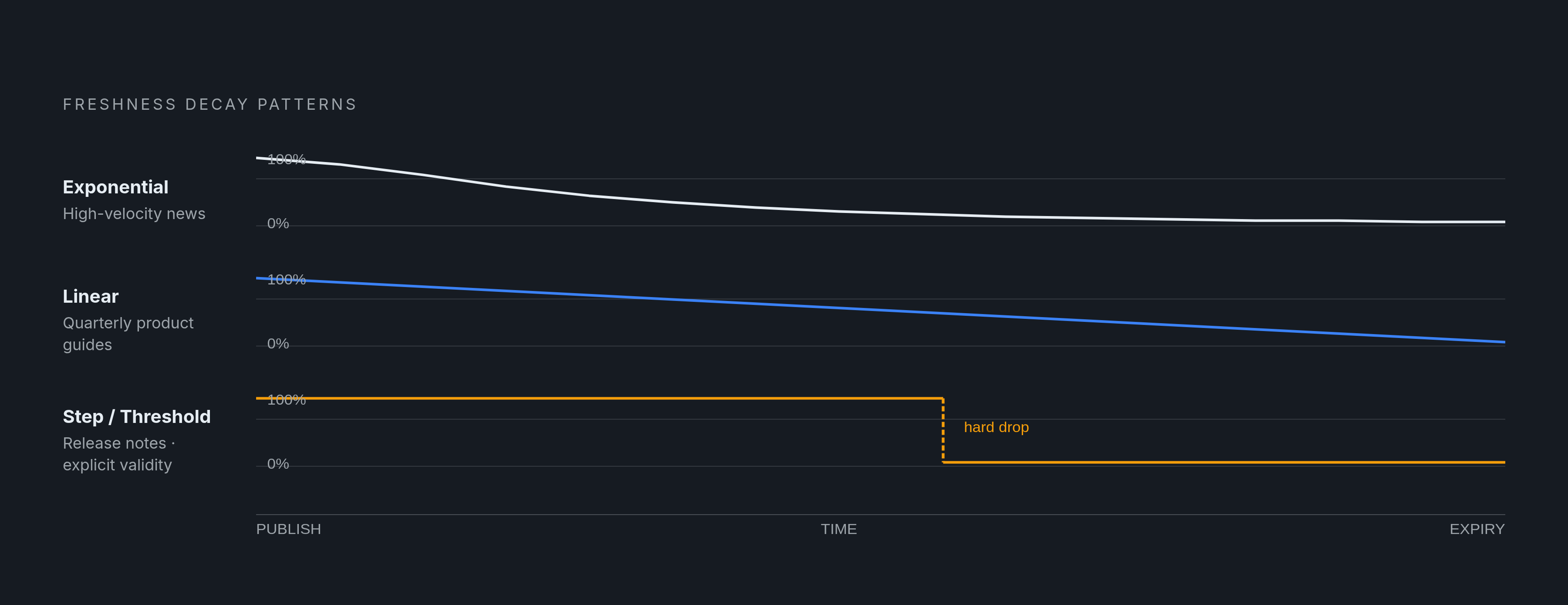
Exponential decay halves the freshness score every N days. It's the right shape for news and any high-velocity content where even a short lag is expensive: the penalty for staleness compounds fast, which matches how fast the underlying facts actually go bad. Linear decay, by contrast, degrades the score at a constant rate across a fixed boosting window. It's less aggressive and easier to reason about, which makes it a better fit for content with a moderate, predictable update cycle, something like a quarterly product guide rather than breaking news. Step or threshold decay is blunter still: full freshness credit inside a defined window, then a hard drop once that window closes. That shape suits content with an explicit validity period, a quarterly release note that's fully authoritative until the next one supersedes it, and not particularly meaningful in between.
Azure AI Search's boostingDuration parameter, the same ISO 8601 window format mentioned earlier (P90D for 90 days), is how that decay horizon actually gets configured in a scoring profile. The window itself can follow any of the three shapes above; the parameter just sets how wide it is.
Freshness biases the ranking, it doesn't override it. Query relevance and semantic reranking still apply on top of whatever the decay function produces. The goal is to surface the freshest document among the ones that are already strongly relevant, which is a narrower and more defensible target, never to surface the newest document regardless of fit. It's to surface the freshest document among the ones that are already strongly relevant, which is a narrower and more defensible target.
Temporal-validity intervals point toward where this is heading next: instead of a single timestamp, a fact carries an explicit window during which it's known to be true, which is a more direct way of handling supersession than any decay curve can manage on its own. That pattern is becoming visible in emerging systems, though the benchmarking work needed to grade it consistently, a gap identified in the CRAG and FreshStack discussion, hasn't caught up yet. Freshness as a retrieval property has moved from an afterthought to an engineering problem with its own vocabulary, its own benchmarks, and its own set of hard tradeoffs. What it hasn't become yet is solved.
Sources
- Configure Freshness-Aware Retrieval - Azure AI Search
- Content Freshness Signals for Answer Engines (2026)
- Still Fresh? Evaluating Temporal Drift in Retrieval Benchmarks
- OwlerLite: Scope- and Freshness-Aware Web Retrieval for LLM Assistants
- Content Freshness SEO in 2026
- arxiv.org
- VersionRAG: Version-Aware Retrieval-Augmented Generation for Evolving Documents
- takeagander.ai