Software Requirements Specification in Jira and Confluence Workflows
Connect Confluence specs to Jira execution with deliberate structure.
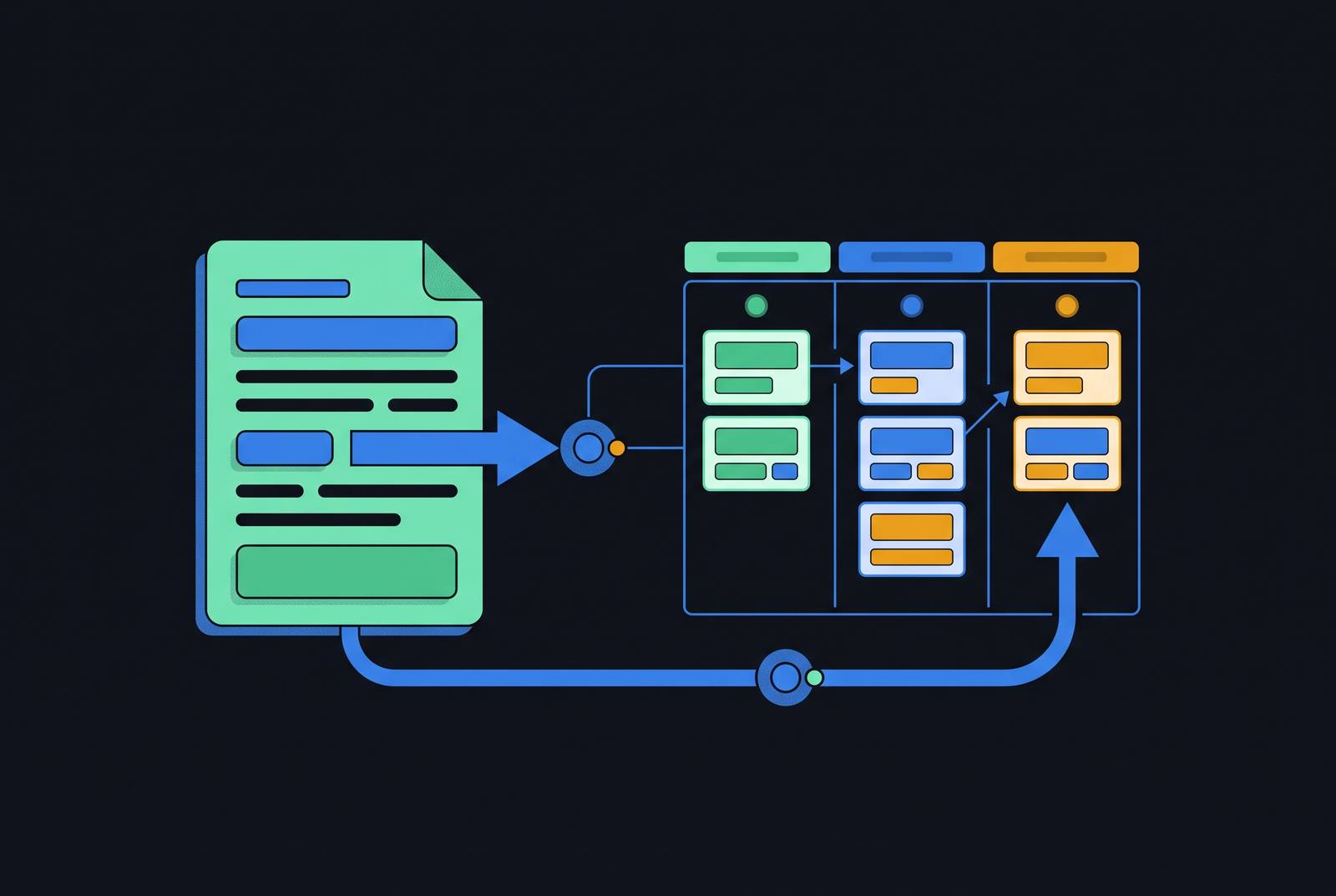
Jira's design logic is oriented around discrete work items: statuses, assignments, sprint membership, velocity through a defined workflow. It answers "What is the team working on, and is it done?" with real precision. What it answers poorly, sometimes not at all, is "Why does this work exist, what constraint is it satisfying, and how does it relate to the twelve other things we're building this quarter?"
The structural problem with a Jira-only approach is that story text is editable and deletable by anyone with appropriate permissions. Requirement rationale erodes in issue descriptions over time, as developers update tickets to reflect implementation reality rather than original intent. Hundreds of stories also resist the kind of coherent, cross-sectional reading that a requirements review demands. You can query Jira; you cannot easily read it.
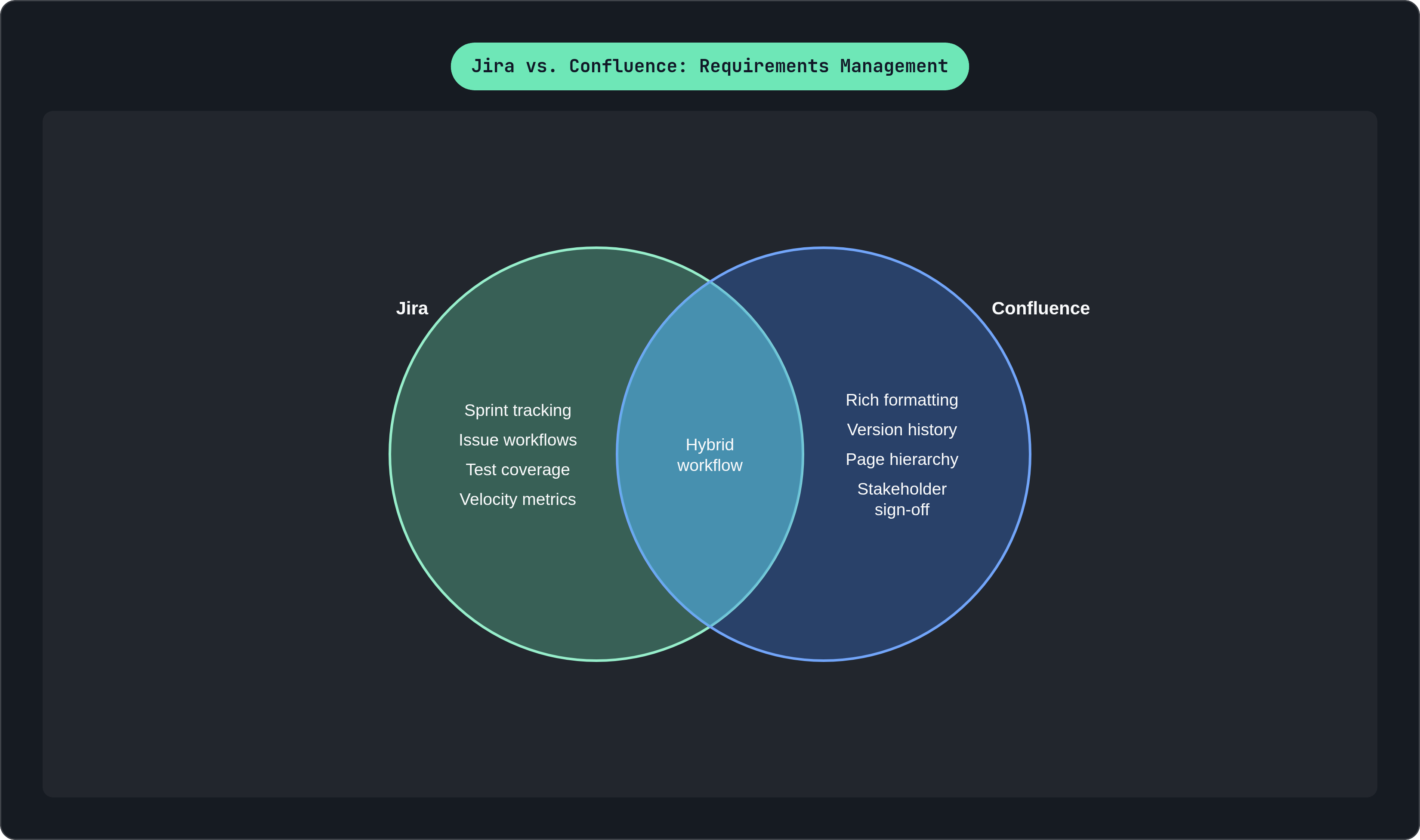
Confluence inverts the problem. Rich formatting, embedded diagrams, persistent version history, a page hierarchy that reflects product logic rather than sprint chronology: the tool is built for long-form, structured documentation. But Confluence cannot natively track implementation status, sprint assignment, or test coverage. A requirements page written there does not know whether the work it describes has started, finished, or been descoped. Left unconnected to Jira, it becomes a historical artifact faster than most teams realize, usually around the second sprint when nobody has time to update it.
Both tools are good at what they were designed to do. The failure is almost always the same: teams don't maintain a deliberate connection between the two surfaces. Requirements authored in Confluence drift from the Jira work they spawned; requirements managed only in Jira lose their narrative context and the rationale that makes them defensible later. Atlassian's own framing of the combined toolchain gestures at this, that complementary strengths appear only when a strict division of labor is maintained, one surface for authoring and context, the other for execution and tracking. Articulating that division is the job most teams skip.
Three patterns teams use to split authoring from execution across the two tools
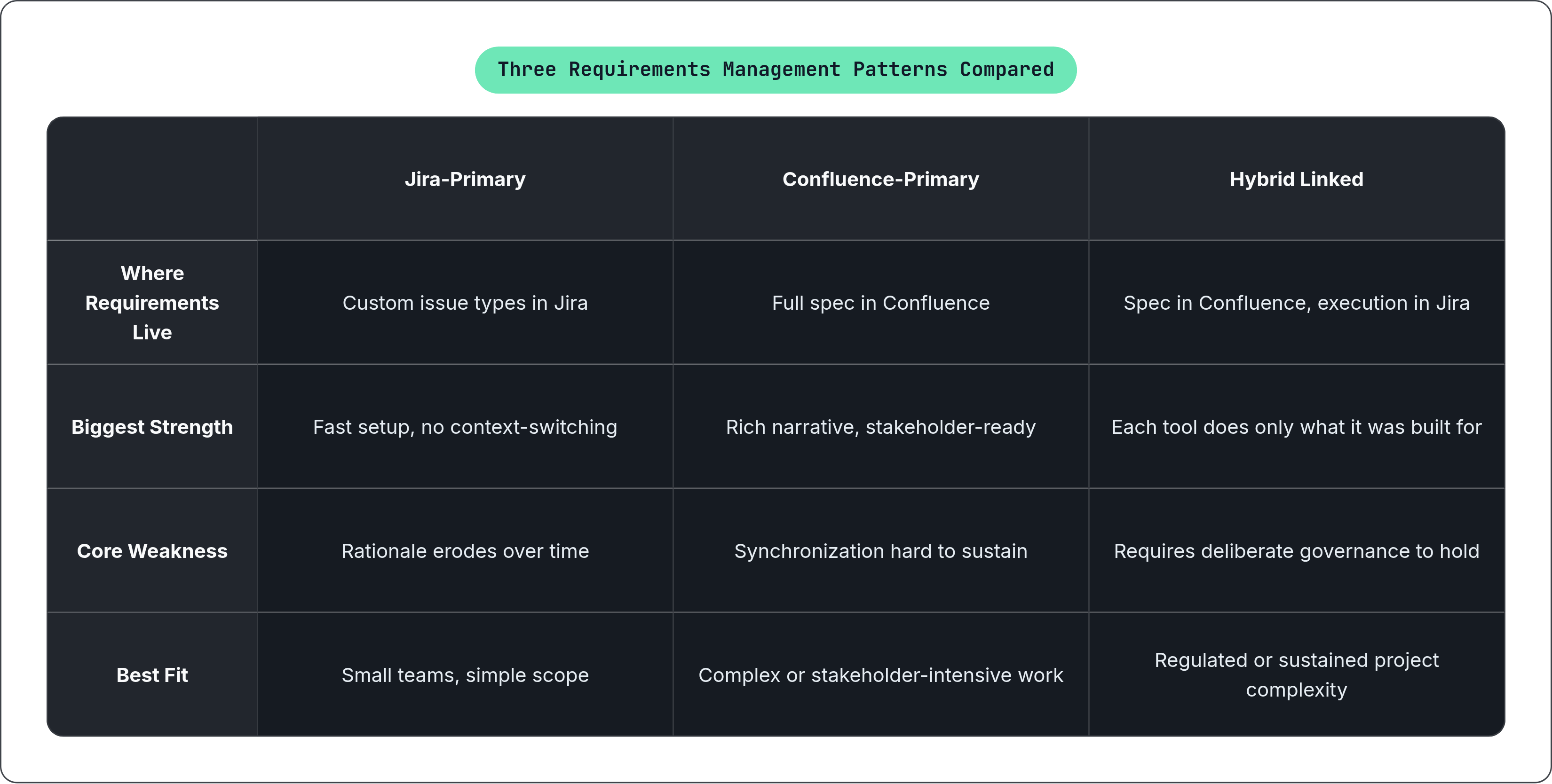
Teams tend to settle into one of three structural patterns, and the choice is rarely made deliberately. It usually reflects whoever set up the project first, which is itself a kind of diagnostic.
The first is Jira-primary: requirements live as custom issue types, epics, stories, or dedicated requirement issue types directly inside Jira. Setup is fast, the workflow is familiar, and there is no context-switching between tools. The cost is that this approach inherits all of Jira's limitations around narrative permanence. Teams that start here often find themselves, some months in, wishing they had preserved more of the "why" somewhere more durable. By then, the rationale is gone.
The second is Confluence-primary: the full specification lives in Confluence, Jira issues are derived from it, and the spec is the acknowledged source of truth. This handles complex or stakeholder-intensive requirements work better than Jira-primary does, but it creates a synchronization obligation. Jira must be kept consistent with the spec, which requires the kind of discipline that is easy to declare and hard to sustain past the first major scope change. I have watched this pattern hold up and fall apart on adjacent projects, sometimes in the same organization, and the variable that mattered most was never tooling configuration. It was whether the product manager treated spec maintenance as a real job function or as something that happened between the actual work. That is not a tooling problem.
The third pattern is the hybrid linked workflow. Specification detail and rationale live in Confluence; execution and status live in Jira; explicit links connect the two surfaces. A reasonable structural example: Initiative-level pages in Confluence correspond to Initiative issues in Jira, child pages map to Epics, stories are created from page content and linked back to the pages that specified them. The hierarchy becomes navigable in both directions, from spec to ticket and from ticket back to spec. This pattern tends to hold up under sustained project complexity because it assigns each surface only the job it was built to do.
Which pattern fits which context depends on team size, domain complexity, and regulatory obligation. Smaller teams often start Jira-primary because maintaining two surfaces feels disproportionate; that instinct is reasonable. Teams with complex requirements or compliance obligations generally need the hybrid approach. What matters most, regardless of pattern, is that the division gets established before the project starts. Retrofitting structure onto a populated Jira project is possible. Reconstructing rationale from old story descriptions is a different matter entirely, and the effort rarely produces anything you'd want to defend in a review.
How Confluence's Product Requirements Blueprint structures the authoring side
Confluence includes a built-in Product Requirements Blueprint that is easy to overlook precisely because it ships as a native feature rather than a paid extension.
On first use, the Blueprint creates an index page for the space and adds a sidebar shortcut; all Product Requirements pages are then listed with their status and owner visible at a glance. This alone addresses a common failure mode: requirements scattered across a space with no index, no ownership, and no consistent structure. Obvious in retrospect, rarely implemented without the scaffold.
The Page Properties macro is the structural backbone. It creates metadata fields, including owner, designer, tech lead, technical writers, objectives, success metrics, assumptions, milestones, and requirement priority, that surface in the index. The result is a collection of pages that behaves like a queryable requirements register rather than a static document library. Teams can filter by owner or priority without additional tooling, which matters when you are trying to answer "what are all the open requirements that still need a tech lead assigned" at ten in the morning before a stakeholder call.
The instructional text within the template is useful, particularly for teams new to formal requirements work. Prompts guide authors through each section and disappear once content is entered. This sounds minor. It is not. The blank-page friction that causes teams to write thin, unstructured requirements is a real problem, and scaffolding addresses it more reliably than style guides do.
The @mention feature makes review and sign-off traceable within the page itself. Mentioning a stakeholder notifies them directly; the audit trail for requirement approval lives in the tool without requiring a separate system.
The bridge to Jira is mechanical but significant. User stories written in a Confluence page can be highlighted and converted to Jira issues directly; a full table of stories can be batch-converted. This conversion is the on-ramp to the hybrid workflow: it structures the Confluence side in a way that makes the Jira connection natural rather than retroactively grafted on.
Embedding Jira workflow status back into Confluence so requirements stay current
The default failure mode of the Confluence-Jira combination is familiar to anyone who has managed a project of even moderate complexity. The spec is written, Jira issues are created, and the two surfaces evolve independently. Months later, the specification says one thing and the implementation is doing another, with no clear record of when the divergence happened or who made the call.
Application links between the two tools allow Jira artifacts, individual issues, epics, sprint boards, to be embedded in Confluence pages via Jira macros. The documentation then reflects current workflow status without manual updates. For a reader of the spec, this changes the experience considerably: a requirements page shows not only what a feature must do but where its implementation currently stands. The spec stops being a historical document and becomes something you can actually use during a sprint review.
Jira workflow design matters here more than teams typically appreciate at setup. A workflow that includes a formal requirement-approval step before development begins makes that approval status visible in the embedded macro. The difference between a requirement that has been validated and one that has merely been created is invisible in native Jira views. Surfacing it in the Confluence spec enforces the distinction and surfaces gaps during reviews before they become delivery problems.
One intake pattern worth considering: stakeholders capture initial requirements in a standardized Confluence template, a business analyst or product manager refines and disaggregates those into Jira stories, and the link between them stays traceable. The original stakeholder framing is preserved in Confluence. The refined work lives in Jira. Anyone reading the spec can follow a requirement from its original business framing through to its current development status without manually switching contexts and reconstructing the thread from memory.
Traceability across the two tools and where native functionality runs out
Traceability, in the requirements context, means something precise: every requirement can be traced forward to the work item implementing it and the test case verifying it, and backward from any ticket or test to the requirement that originated it and the business rationale behind it.
The compliance use case is obvious, but traceability matters in unregulated contexts too. When requirements change, a traceability map surfaces exactly which downstream work is affected. Without it, a requirement change becomes a manual exercise in asking everyone what they remember.
Both directions matter. Forward traceability runs from high-level requirement through epic, story, and test case. Backward traceability runs from a completed story or failed test back to the originating requirement and the reasoning behind it. Forward traceability without backward traceability answers "did we build it?" but not "did we build the right thing, and do we still know why we built it that way?" The second question is the one that surfaces during post-mortems and audits, often at the worst possible moment.
For small projects, a Confluence table with requirements in one column and linked Jira issues in another is functional. It requires no additional tooling and can be maintained by one person. The limitation is scaling: as requirements multiply, as many-to-many relationships between requirements and tickets become common, and as multiple product versions introduce branching histories, the table model consumes more time than it saves and starts hiding the gaps it was supposed to expose.
Jira's native issue link functionality does not produce a two-dimensional coverage view across requirement levels. Links exist between issues; a matrix showing requirement coverage, with gaps visible at a glance, does not. This is the native toolchain's most significant structural gap for teams managing requirements at any meaningful scale, and it is not a gap that gets smaller as the project grows.
Marketplace apps that extend the native toolchain for serious requirements work
The Atlassian Marketplace has a substantial category of requirements management apps, and their variety reflects how differently teams have organized requirements work across industries. Most address a common set of gaps: a traceability matrix with visual coverage reporting, formal review workflows, and version-controlled requirement histories, the things native Jira issue links do not provide.
Several approaches have emerged across the available options. Jira-native apps, including Requirements & Test Management for Jira, easeRequirements (R4J), and NSYS, keep everything inside Jira's data model while adding hierarchy, matrix views, and audit trails. These suit teams who want the mental model of a requirements document without leaving Jira. NSYS makes a point that is easy to miss: most requirements tools treat requirements as a tree of linked tickets, but requirements engineers think in documents. Giving back a document view is a design choice with real adoption consequences, not merely a feature, and on teams where engineers do the authoring that distinction can determine whether the tool gets used at all.
Confluence-bridge apps, such as Requirement Yogi, automatically transform requirements written on Confluence pages into a customizable traceability matrix. These suit teams who want to author in Confluence and report from it directly without maintaining a parallel data structure in Jira.
Test management integrations, including Zephyr Scale and Xray, extend traceability into the testing layer, connecting requirements through to test cases and continuous integration pipeline results. Both were among the fastest-growing paid Marketplace apps as of mid-2024, which says something about where teams are experiencing the most friction: not in linking requirements to stories, but in linking stories all the way through to verified test outcomes.
On selection: the right app depends on which gap is most painful, whether that is coverage reporting, formal review workflow, or test-to-requirement traceability. Evaluating by feature count leads to over-purchasing tools that are never fully configured. That is its own kind of compliance liability, quieter than the gaps it was supposed to close.
How compliance-driven teams use the same toolchain under stricter constraints
Standards like IEC 62304 for medical device software require traceability as a formal deliverable. It is not a development convenience; it is a compliance artifact that a regulatory body will inspect. Similar structural obligations apply in automotive development under ASPICE and in aviation software under DO-178C. The specifics differ, but the structural demand is consistent: show me the chain from requirement to implementation to verified test, with named approvers and timestamps at each transition.
The workaround that compliance teams default to is familiar and painful: manually copying Jira data into spreadsheets to produce a requirements traceability matrix for audit. The approach is error-prone, version-control-fragile, and increasingly untenable as product complexity grows. The spreadsheet captures a snapshot; the Jira project keeps moving; the gap between them widens until someone realizes, usually during audit preparation, that the two records no longer agree. I have never seen a team that enjoyed this process. I have seen several teams that kept doing it anyway, because the alternative required a conversation nobody wanted to initiate.
What regulated teams need that the standard toolchain does not deliver natively: immutable audit trails, formal requirement approval records with named approvers and timestamps, and a traceable link from system-level requirement down to unit test result. These cannot be improvised from Jira's permission model and Confluence's version history alone, however carefully configured.
Overlay tools, Ketryx being one example relevant to medical device contexts, sit on top of existing Jira and Git workflows rather than replacing them. The appeal is preserving development velocity and tooling familiarity while meeting compliance obligations. The alternative, migrating to a dedicated requirements management platform, carries significant organizational cost and learning overhead that is consistently underestimated by the people who propose it and immediately apparent to the teams who have to execute it.
The underlying architecture, Confluence for spec authoring and Jira for execution tracking, is compatible with regulated workflows. What changes under compliance constraints is the rigor of the links, the immutability of the record, and the formality of the approval steps. The pattern is the same; the tolerance for informality is not.
Practical decisions that determine whether the system holds together over time
The decisions that determine whether a Confluence-Jira requirements system holds together are less about tooling configuration and more about governance. That distinction matters because governance decisions are harder to revisit than configuration choices, which is why getting them wrong early tends to compound quietly until a project is already in trouble.
The division of labor between the two surfaces must be decided before the project starts and documented explicitly: which surface owns requirements authoring, who may edit requirement text in Jira directly versus only through Confluence, and who owns synchronization when requirements change. Norms that go undocumented erode under deadline pressure. They erode fastest at exactly the moment when the documentation matters most, which tends to be after the first major scope change, when everyone is already moving too fast to reconstruct what was agreed.
Scope containment matters for reporting fidelity. One Jira project and one Confluence space per product is a reasonable working principle. Mixing multiple products or versions into a shared project or space degrades the clarity of the links and makes any reporting across requirements layers unreliable. The overhead of maintaining separate spaces is real; the cost of debugging a reporting model built on a commingled space is typically greater, and less visible until you are in the middle of it.
Jira issues can be deleted by anyone with the Delete Issues permission. Confluence pages with version history provide the more durable record of what was required and why. This is the most concrete operational reason to keep the authoritative specification in Confluence: not because Confluence is philosophically superior, but because it is structurally more resistant to accidental or undocumented change.
Keeping the Confluence spec current as requirements evolve requires assigning a named owner to each requirements page and using the Blueprint's status field actively. Requirements pages treated as write-once artifacts create the appearance of documentation without its substance.
On the question of when to bring in Marketplace tooling: small projects can manage with native links and a Confluence table. Once the number of requirements, product versions, or reviewers grows past what one person can track manually, native tooling creates more risk than it saves in setup cost. The risk is not merely a confusing requirements register. It is the risk of building the wrong thing because a coverage gap was invisible, and that is a project risk, not a tooling budget question. Teams that treat it as the latter tend to have the wrong conversation until it is too late to have the right one.