Git-connected documentation platforms for API teams
Git-connected platforms keep API documentation in sync with code changes automatically.
A pull request merges, an endpoint's response shape changes, and the docs sitting in a separate CMS have no idea it happened. That gap, code moving one way and documentation staying put, is the reliability problem facing API teams right now, and it's why Git-connected documentation platforms have gone from nice-to-have to default setup. I've spent enough time untangling stale docs at 2am to have opinions about this, so this piece walks through what Git integration actually does under the hood, how different platforms handle it, and what's worth checking before you pick one.
Here's the mechanism, stripped down: developers rename a parameter, deprecate a field, ship a new required header. None of that has any way to reach a documentation system living on its own database with its own login and its own release schedule, because nobody wired a connection between the two. Postman's 2025 State of the API Report, drawing on more than 5,700 respondents, found that 93% of API teams report collaboration problems. 55% cite documentation gaps specifically, 35% point to duplicate effort, 34% struggle just to find APIs that already exist inside their own company. Three symptoms, same root cause: nothing forces the docs to know when the code underneath them moved.
You don't fix this by asking engineers to try harder, or by bolting a docs review step onto the sprint checklist. Teams shipping multiple deploys a day can't manually reconcile a wiki page every time a merge lands, so treating this as a willpower problem just lets the gap widen quietly until a support ticket forces the issue. And the cost doesn't stay contained to the docs site. A developer who hits a stale example or a parameter that no longer exists doesn't just distrust that page; they start to distrust the API itself. There's a newer wrinkle too: AI agents now fetch documentation directly to answer developer questions, so outdated content isn't misleading one person reading a page anymore. It's feeding bad information into automated workflows at whatever scale those agents happen to run.
What Git integration actually does inside a documentation platform
Docs-as-code, stripped to its basics, means the documentation source files (Markdown, MDX, OpenAPI spec files) live in the same repository as the code they describe. Once that's true, everything version control already does for code applies to docs for free: commits, branches, pull requests, review before merge. No separate system, no separate login, no separate mental model to carry around in your head.
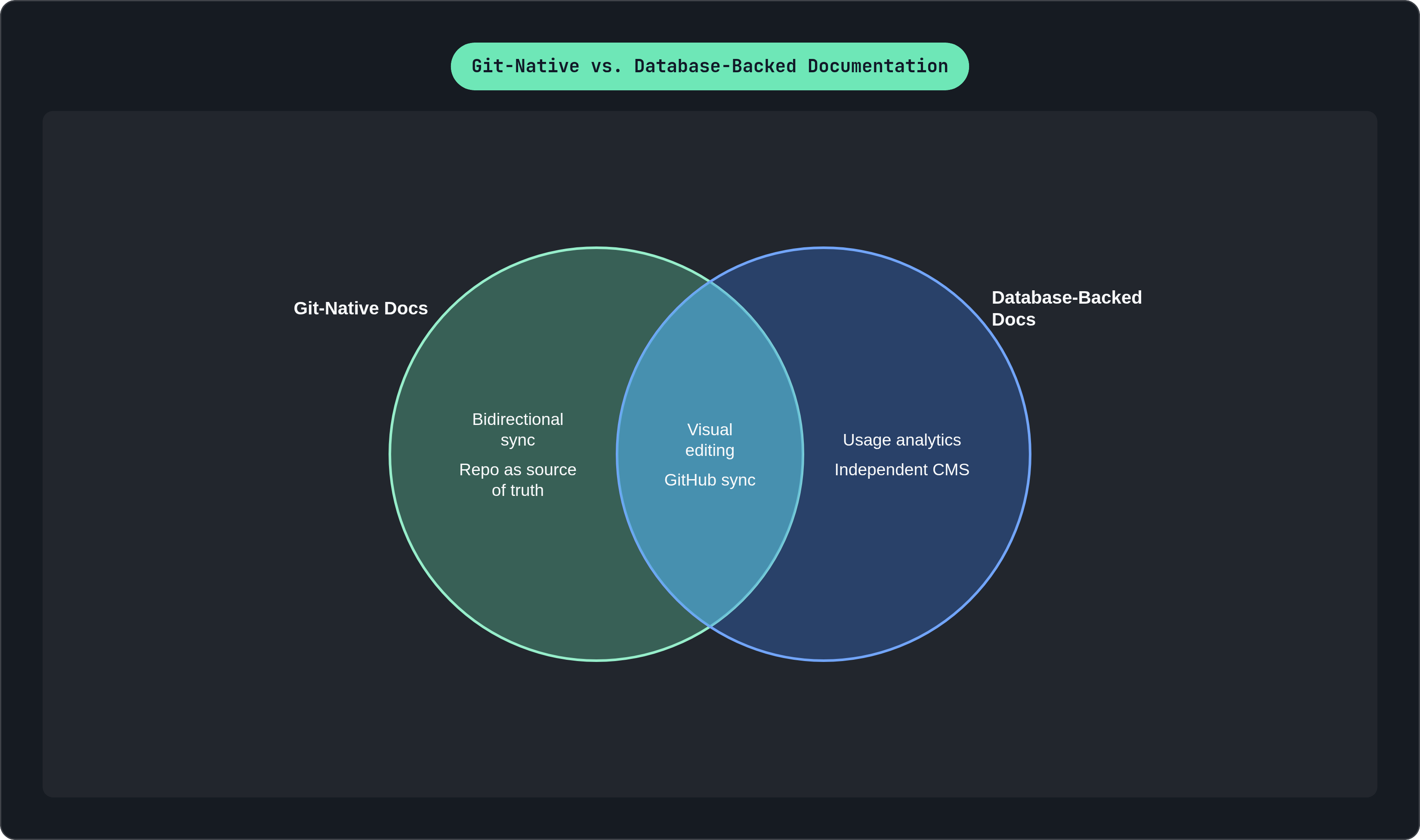
What actually matters, though, is whether the sync runs both directions. A push to the repo triggering a rebuild of the published site is the easy half; plenty of tools manage that much without breaking a sweat. The harder half is getting edits made in a visual web editor to commit back to the repo, so a non-developer fixing a typo in the browser produces the same commit history as a developer fixing it in VS Code. One-way sync still lets drift creep in, because sooner or later someone edits the published version directly and the repo never finds out. Bidirectional sync closes that loop. One source of truth, and it's the repo, full stop.
The OpenAPI spec is the backbone that makes any of this practical. A platform that treats the spec file as a first-class input renders reference docs straight from it: change the spec, the docs change, no separate content-writing step wedged in between. Something like three-quarters of companies offering APIs already use the OpenAPI standard, so spec-driven rendering has stopped being a differentiator and become table stakes. Branch-to-version mapping extends the same logic to releases: a feature branch carries its own pre-release docs, and when the code merges, the docs merge with it. CI/CD hooks let doc builds, linting, and spec validation run in the same pipeline that ships the code, which catches a broken reference before it reaches production rather than after a user emails support about it.
What Git integration is not: a visual editor with an optional "push to GitHub" button that acts as a backup copy instead of the actual source of truth. Sounds like a small distinction on paper. It isn't, and the next section runs straight into why.
The three platform clusters and what separates them
Zoom out far enough and most tools in this space sort into three groups. The sorting has less to do with feature checklists than with one structural question: what owns the content, actually?
Group one is managed SaaS platforms built around bidirectional Git sync, hosted for you, with the lowest setup cost of the three and a visual editing layer sitting on top of real Git fidelity underneath. These suit teams that want developer-authored pull requests and non-technical people typing into a browser, both, without running two separate toolchains to get there.
Group two is spec-first, governance-heavy platforms built around OpenAPI as the organizing principle, where linting, validation, and CI/CD pipeline integration are how people touch the tool day to day. Larger API programs, the ones with compliance requirements and a dozen teams publishing specs that all need to look and behave the same, tend to land here.
Group three is open-source, self-hosted frameworks. No seat cost, full control over the architecture, and a real engineering investment required just to keep the thing running and extend it over time. That trade works fine for a team with dedicated docs-engineering headcount and a specific reason to want deep customization. It's a rough fit for a five-person startup trying to ship an API reference by Friday.
What actually cuts across all three groups isn't the cluster label. It's whether Git is the primary source of truth or a sync layer sitting on top of a database-backed CMS somewhere underneath. Second thing worth checking: does the platform give non-technical contributors a real path in, or does every edit require someone comfortable with a CLI and a code editor? And there's a third, newer signal worth paying attention to: AI readiness. Does the platform generate an llms.txt file, support MCP servers, and serve clean Markdown to AI agents instead of rendered HTML they have to scrape and parse?
Mintlify: Git-native docs with an agent-automation layer
Mintlify stores source files as MDX inside the repository, and its web editor commits changes straight back to Git. No separate CMS database sitting underneath that can quietly drift out of sync with what's actually in the repo. The repo is the whole story here.
Bidirectionality isn't a feature you flip on; it's structural. What sets this platform apart on top of that baseline is a Workflows agent that watches for code changes and opens pull requests to update the docs on its own, which is about as close as this category currently gets to documentation that maintains itself instead of waiting for someone to remember. Coinbase reported cutting doc update time from around 20 minutes down to roughly 60 seconds after adopting this workflow. HubSpot cut the engineering time it spends on documentation roughly in half.
On the AI side, the platform auto-generates llms.txt files, exposes MCP servers, and serves Markdown to AI agents through content negotiation instead of making them scrape rendered HTML, while tracking agent traffic separately in its analytics. Anthropic, AT&T, and Perplexity all use it for developer-facing docs, and the enterprise tier covers SSO, SOC 2 compliance, and a high-uptime SLA with dedicated support.
Where it runs into limits: styling and page architecture are mostly handled by the platform's own conventions, so a team wanting something genuinely bespoke, a custom payment sandbox embedded in the reference, say, might hit a wall faster than building from scratch would have. It's also built for API reference and product guides specifically. An organization needing documentation that sprawls into broader cross-functional governance territory may find this isn't quite the tool for that job.
GitBook: WYSIWYG editing backed by real Git sync
GitBook flips the emphasis around. Its Notion-style visual editor is the primary place people write, and Git sync sits behind that as the persistence and collaboration layer rather than the visible surface. Edits made in GitBook push to GitHub or GitLab; pushes to the repo show up back in the editor; branches map to documentation versions the same way they would in a purely code-first setup.
That combination lowers the bar for non-developer contributors quite a bit without actually giving up Git as the underlying source of truth, which is a real balancing act to pull off. GitBook Agent, in open beta as of late 2025, writes and updates pages from a prompt, opens change requests on its own, and checks docs against a style guide. The roadmap points toward connecting it to GitHub issues and support conversations, so it can flag documentation gaps before a customer complains about one. On the AI-readiness front, GitBook offers an MCP server for published docs and generates an llms.txt index, so AI coding assistants can pull current documentation on demand rather than working off a stale training snapshot. Zoom, FedEx, and Nvidia are among its customers.
The gaps, stated plainly: no CLI for local doc preview, so teams either work in the browser or push changes and wait for sync to catch up. CI/CD integration is limited to Git Sync and webhooks, with no CLI-driven pipeline hooks for a spec-validation-heavy workflow that wants them. And OpenAPI integration renders the spec as content within the docs rather than treating it as the structural backbone the reference actually gets generated from, which means it functions more as docs with a Git backup than docs-as-code in the strict sense of the term.
Fern (now part of Postman): CLI-first, spec-as-foundation
Fern goes the other direction entirely. The whole architecture is CLI commands and YAML config files living in the repo. No database-backed CMS layer anywhere in the picture, so Git is authoritative without exception here, not authoritative with an asterisk tucked somewhere in the fine print.
The OpenAPI spec isn't imported as content; it's the foundation the reference docs get generated from directly, so there's no path for the docs to diverge from the spec short of someone actually editing the spec file itself. Fern's real differentiator is native SDK generation straight from that same spec, across several major programming languages. Very few documentation platforms offer this, and it closes the gap that usually sits between "here's the API reference" and "here's a client library you can actually install and call."
Postman acquired Fern in January 2026, with the stated goal of bringing its documentation and SDK generation tooling to Postman's much larger customer base; Fern keeps operating as an independent product for now. Before the acquisition, its customer list included Square, Auth0, Adobe, Twilio, and ElevenLabs.
The trade-off is steep for some teams. No visual editor at all, so anyone contributing has to work in YAML and Markdown through Git, which is a genuine wall for support, product, or marketing people who'd otherwise want to add a line to a guide. AI features run on a credit model that can gate functionality at lower pricing tiers. And the Postman acquisition adds real uncertainty about where Fern's own tooling ends and Postman's broader platform picks up over the next year or two. Worth watching, not a reason to rule it out today.
ReadMe: developer hub model with Git as a sync option
ReadMe takes a different approach worth understanding on its own terms: a visual, dashboard-driven hub combining interactive API references, guides, changelogs, and often a discussion forum in one place, with Git sync available through GitHub apps and CLI tooling that pushes OpenAPI spec updates on merges to main. That sync genuinely cuts down on manual busywork, and it's not nothing.
But here's the structural catch, and it's the one that matters most: in this model, Git works as a sync and collaboration layer sitting on top of a database-backed CMS. The repo isn't authoritative the way it is for a Git-native tool like Fern or the MDX-based platform discussed earlier. That's the main thing separating ReadMe's approach from true docs-as-code, and it means state drift and merge conflicts show up somewhat more often, since the database and the repo can end up telling slightly different stories about what's current.
The real upside is per-developer API usage analytics: seeing which endpoints an individual account actually calls surfaces the gap between what's written in the docs and what developers are really using, a genuinely useful signal that pure docs-as-code tools typically don't offer out of the box. This model fits teams that want a polished, interactive developer portal with real usage data, and who are fine with Git as a sync mechanism rather than insisting it be the primary source of truth.
Redocly: governance and multi-spec control for larger API programs
For organizations managing many APIs at once rather than one, Redocly centers on OpenAPI as the organizing principle, with added support for GraphQL, AsyncAPI, and SOAP specs living side by side. Git-backed editing with branch-based previews and team review workflows means spec changes go through an actual review step before anything publishes. That starts to look less like a docs tool and more like a governance layer for an entire API portfolio.
Linting and validation are the real headline feature here: enforcing OpenAPI style rules, catching breaking changes before they ship, running custom governance rules across dozens of specs inside CI/CD, all at once. That's the natural fit for larger programs where consistency across teams matters as much as any single published page does. Nobody adopts Redocly because they want a pretty editor; they adopt it because they've got 40 specs and no shared standard for what "done" looks like.
The honest limitation is that this governance depth comes with real configuration overhead attached. It's not the low-friction starting point a single-team startup wants on day one, and trying to force it into that role probably does more harm than good. This category, as a whole, also tends to lag the platforms discussed above on AI-agent readiness, a gap worth keeping an eye on as agent-driven traffic to documentation keeps climbing.
What to actually evaluate when choosing a platform
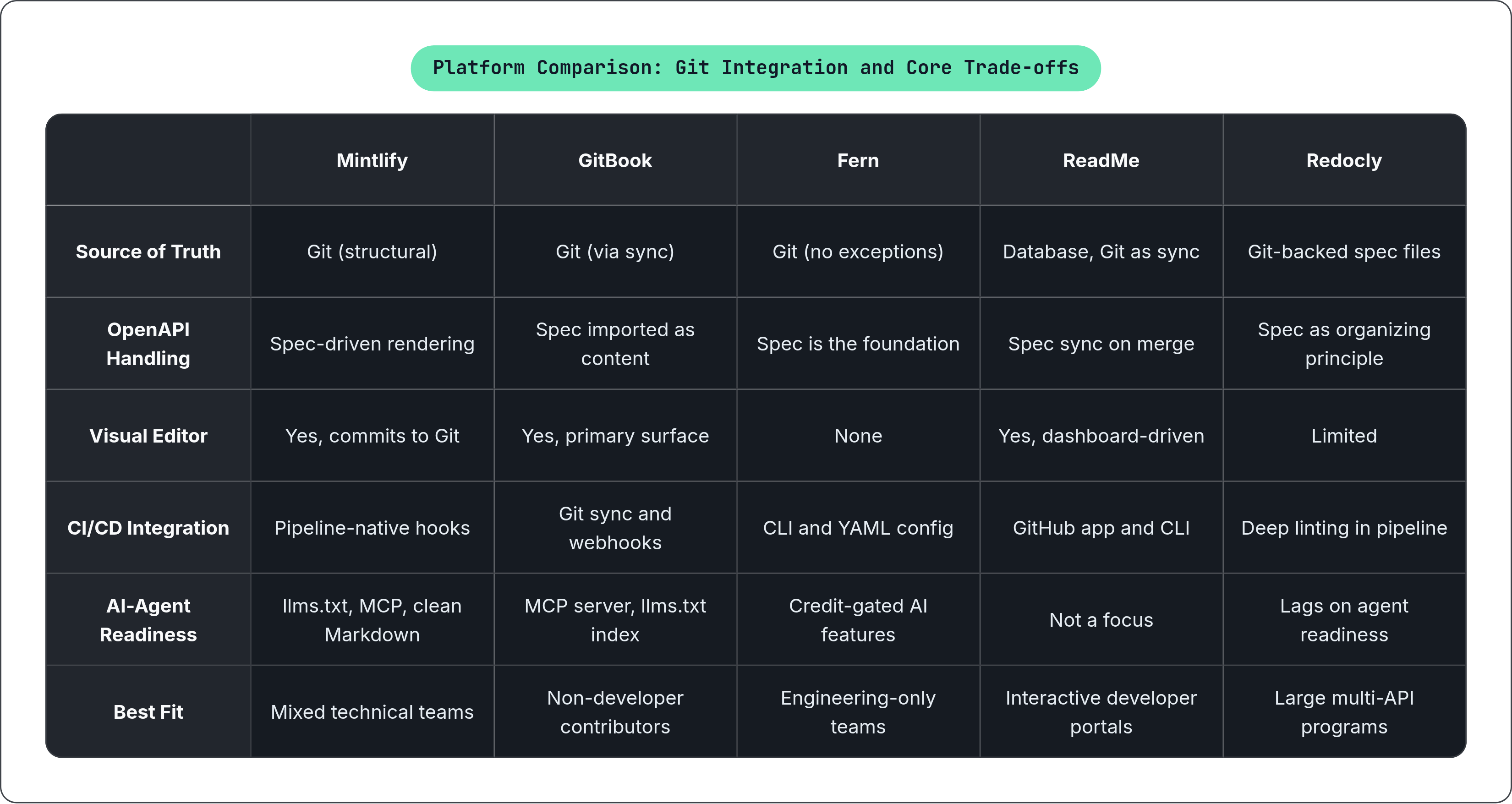
Start with the source-of-truth question, because it decides how drift gets reintroduced months down the line even after a team thinks they've solved it for good. Does Git own the content, or does a database own it with Git sitting alongside as a mirror? Everything else follows from that one answer, more or less.
Contributor access model comes next. If the whole team writing documentation is genuinely comfortable in a CLI with Markdown and YAML, a Fern-style tool or a self-hosted framework covers it fine. If product managers, support staff, or non-technical writers need to contribute regularly, a visual editor with real Git backing, which certain managed SaaS platforms including GitBook provide, keeps a two-track system from forming, the kind where developers write in the repo and everyone else edits some disconnected copy nobody ever reconciles.
Check OpenAPI integration depth specifically. Does the platform render docs from the spec structurally, so a spec change propagates on its own, or does it import the spec as formatted content that still needs a manual publishing step afterward? Those two look almost identical on a sales page. They behave very differently at 11pm when a breaking change ships and nobody notices for three days.
CI/CD fit matters too. Can doc linting, spec validation, and preview builds run inside the same pipeline that ships the code, or does the platform demand a separate, out-of-band process someone has to remember to run by hand? AI-agent readiness is worth weighing as a forward-looking criterion rather than an afterthought. Traffic from AI agents fetching documentation is growing fast, and platforms generating llms.txt files and serving clean Markdown extend the value of accurate docs to a whole class of readers that isn't human. MCP server support specifically is still early; awareness among developers is high, per Postman's 2025 data, but actual regular use is still catching up. It'll probably become a baseline expectation faster than most teams currently assume.
Scale changes the calculus more than any single feature does. A single-team startup and a company running hundreds of APIs across a dozen teams have genuinely different needs, and picking the right cluster matters more than any feature-by-feature shootout within a cluster ever will. What I keep coming back to, after however many of these evaluations: documentation updates should show up in the same pull request as the code change, get reviewed by the same people, and merge at the same moment. If a platform can't get you there, the rest is just decoration.