Metadata and Frontmatter Strategies for AI Retrieval
Proper frontmatter fields help AI systems retrieve the right document version every time.

A retrieval system that only looks at document content will confuse a 2023 refund policy with a 2025 one if the language overlaps closely enough. That's the core problem this piece works through: metadata, and specifically the frontmatter fields sitting at the top of a Markdown file, act as a retrieval signal in their own right, separate from whatever the body text says. Get the fields right, and an AI agent finds the correct chunk at the correct moment. Get them wrong, or skip them, and no amount of semantic similarity scoring will save the result.
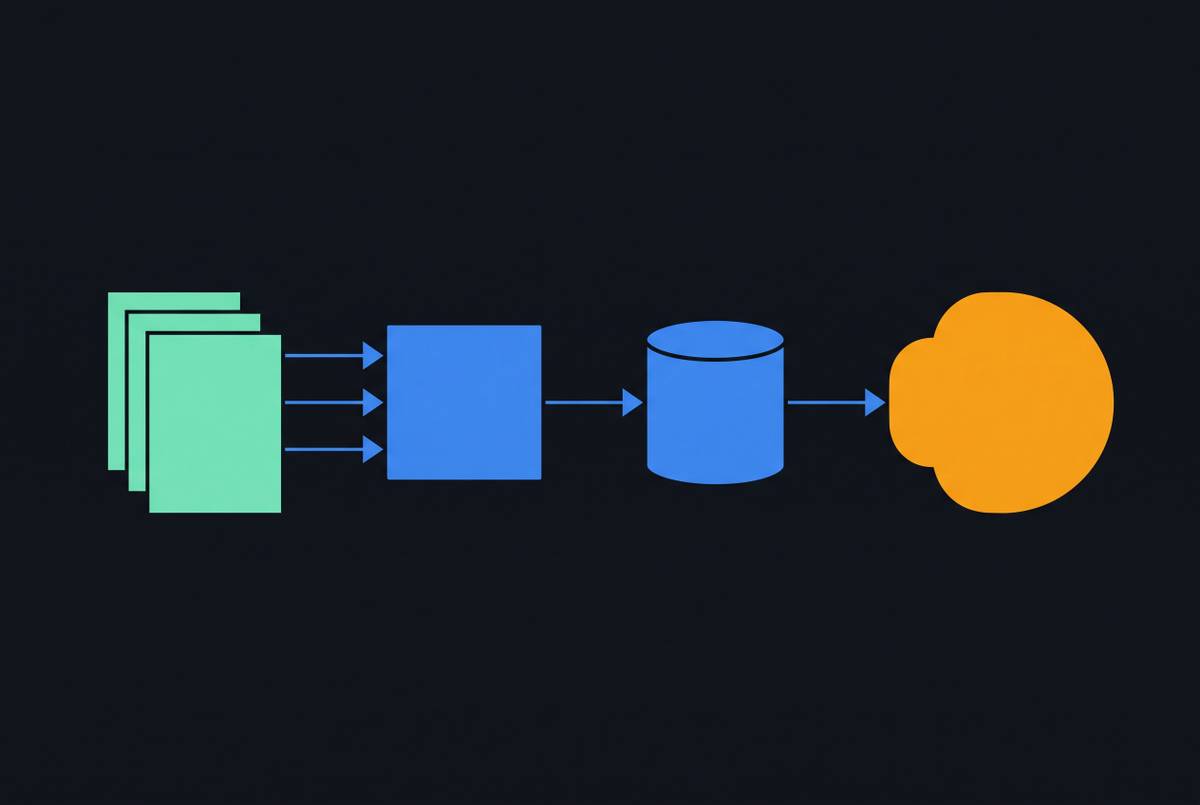
Picture the standard retrieval-augmented generation (RAG) pipeline. Every document gets chopped into chunks, each chunk gets embedded into a shared vector space, and a query gets compared against all of them using cosine similarity. The top-k closest matches come back. That's the whole mechanism, more or less, and it works reasonably well until two documents say almost the same thing.
Here's where it breaks. Someone asks for "the Q4 refund policy." An outdated 2023 policy document scores 0.91 on cosine similarity. The correct, current 2025 version scores 0.87. Content alone can't tell the difference, because both documents use nearly identical phrasing to describe a refund process. The system returns the wrong one with total confidence, and nothing in the pipeline flags it as wrong.
This kind of failure gets worse in corpora built on repetition: regulatory filings, policy manuals, API references. These documents reuse boilerplate language on purpose, for consistency and legal precision, which means chunk-level similarity turns into a weak signal exactly where accuracy matters most. Yousuf et al. (January 2026) note that practitioners have responded to this by flattening metadata into the input text as a rough fix, but the actual impact and trade-offs of doing so have stayed poorly understood. That gap is what the rest of this piece works through: not whether metadata helps, but specifically how, through what mechanisms, and with what measurable effect.
What metadata actually is in a document retrieval context
Metadata, in plain terms, is structured information that sits alongside the main content and describes it: titles, tags, dates, variable lists, database keys, relational properties. It doesn't replace the content. It tells a system what kind of thing the content is, and how it relates to everything else in the corpus.
NISO's framework, cited in Frontify's 2026 DAM guide, breaks metadata into three categories. Descriptive metadata helps someone find or understand a resource, things like title, author, and subject. Administrative metadata organizes files within a system, and splits further into technical metadata (file format, resolution), preservation metadata (how the file should be maintained over time), and rights metadata (who can use it and how). Structural metadata describes the relationships between parts of a resource, like how chapters relate to a book or how API endpoints relate to a broader spec.
In retrieval and dataset discovery work, the useful move is treating these signals as orthogonal to raw content. They don't compete with semantic similarity, they sit next to it, offering priors for clustering documents, disambiguating between near-identical chunks, and expanding a vague query into something more specific.
For Markdown-based documentation, the dominant form this takes is YAML frontmatter: a fenced block at the top of the file, delimited by triple dashes, that encodes structured fields before the body text starts. YAML won out for a few practical reasons. It's already everywhere in Markdown tooling. It's a superset of JSON so conversion is trivial, and it reads and edits cleanly by hand, unlike deeply nested JSON. TOML and plain JSON both work as alternatives depending on the platform, but YAML remains the default.
There's a concrete efficiency argument for AI agents specifically. When an agent opens a file, it can scan the YAML block first and decide whether the document is even relevant before spending context-window tokens on the full body. That's a token-budget benefit, not a theoretical one: skipping irrelevant documents at the frontmatter stage means more of the context window goes toward documents that actually matter.
Raw YAML frontmatter isn't indexed by search engines unless it gets rendered into HTML or converted into meta tags. A search crawler hitting a rendered doc site sees whatever the templating engine outputs, not the raw YAML. But AI crawlers pulling from raw repositories (GitHub, for instance) or hitting content APIs directly do read the YAML as-is. So the same frontmatter field can be a powerful signal or a dead letter, depending entirely on how the content gets accessed. That distinction determines whether the whole strategy works at all for a given system.
The core frontmatter fields that carry retrieval weight
Certain fields recur across production documentation systems, from GitHub Docs' schema to various Markdown tooling platforms. They're not arbitrary. Each one does specific retrieval work.
Title is the first signal a retriever or an agent reads, so it needs to be concise, descriptive, and carry the actual keywords a query might use. Description gives a brief summary that lets an AI system parse the document's purpose before touching the body, and it often appears in LLM-generated previews of search results.
Date fields (date, created, updated) matter more than they look. A standardized date format avoids the cross-platform parsing errors that crop up when systems disagree on whether "03/04/2025" means March 4th or April 3rd. Date-gating, where superseded documents get excluded from the candidate set once a newer version exists, is one of the more effective ways to cut down on an agent hallucinating from outdated content. It directly addresses the Q4 refund policy problem from the opening: if the 2023 document is date-gated out once the 2025 version exists, the similarity score never gets the chance to mislead anyone.
Author provides a provenance signal, useful when a query cares about who said something, not just what was said. Tags and categories are categorical signals that support metadata-based pre-filtering and clustering, discussed in more detail further down. Status (draft, ready, published) lets automation act on a document's lifecycle stage, keeping unfinished drafts out of the retrieval pool that agents actually query against.
Versions matter enormously for any documentation corpus where multiple releases of the same concept coexist, and GitHub Docs uses exactly this field in its production schema for that reason. Further along the sophistication curve, fields like priority, actions, and publish_target_date support pipeline automation: a scanner running maybe 30 lines of code can auto-index dozens of articles, newsletters, and product files just by reading their YAML frontmatter, no manual tagging required.
How many fields should a schema actually have? The Frontify/AVP 2026 guide suggests starting by mapping core fields and capping the total around 20. Dublin Core's baseline standard runs 15 fields, and in practice that often expands into a 16 to 20 field range once a team accounts for their specific needs. The discipline matters because an unbounded schema becomes unmanageable, but a rigid one misses fields a corpus actually needs. The practical resolution: make the schema extensible. Tags that keep proving useful over time get promoted to their own explicit field.
None of this holds up without ownership. A schema with 18 well-designed fields still degrades if no one enforces who fills them in, or how consistently. That governance question gets its own treatment later in this piece, but the fields above are only as good as the discipline behind them.
How metadata enters the embedding: prefix, suffix, and unified approaches
Deciding which fields to include only solves half the problem. The architectural problem remains: how does that metadata actually get folded into the embedding process itself?
Yousuf et al. (January 2026) ran a systematic study across four approaches. Metadata-as-Text prefix serializes structured fields into a readable string and concatenates it before the document chunk, prior to encoding. This increases intra-document cohesion, meaning chunks from the same document cluster more tightly together in embedding space, and improves separability between documents that would otherwise look similar. Metadata-as-Text suffix does the same serialization but appends it after the chunk instead of before. Across the study's evaluations, prefix placement outperformed suffix placement in key evaluations, which is a small but telling detail: where the metadata sits in the string can change how much weight the embedding model assigns to it.
Dual-encoder unified embedding takes a different approach entirely. Content and metadata each get mapped by parallel encoders into separate vectors, which then get fused through a weighted sum and normalized. In the study, this sometimes exceeded prefixing in performance while being noticeably easier to maintain at scale, since there's no ongoing need to hand-manage a concatenation string. Late-fusion retrieval combines content and metadata cosine similarities additively, or through a softmax-weighted interpolation, after the fact. That approach is useful specifically when content and metadata encoders were trained independently of each other and can't easily be merged into one pipeline.
The headline finding from Yousuf et al.: both prefixing and unified embeddings beat plain-text baselines consistently, not occasionally. Field-level ablation tests (removing one field at a time to see what breaks) showed that structural cues carry real disambiguating power, with company name and year turning out to be the strongest individual signals. Section titles, by contrast, offered only modest gains, which suggests not every metadata field is worth the same engineering effort.
Numbers from a separate study back this up. Mishra et al. (December 2025, University of Illinois Chicago) found that recursive chunking combined with TF-IDF weighted embeddings hit 82.5% precision, against 73.3% for a semantic, content-only approach. Naive chunking paired with prefix-fusion metadata reached a Hit Rate@10 of 0.925. And in regulatory or legal document corpora specifically, Yousuf et al. found that prefixing or unifying with metadata cut error rates by more than 20 percentage points compared to plain-text baselines, with measurable gains in both intra-document cohesion and inter-document separation.
So which architecture should a team actually pick? The unified dual-encoder approach offers performance close to prefixing without the ongoing maintenance burden of managing concatenation strings by hand, for teams evaluating architectures. The trade-off runs the other direction at setup time: unified embeddings take more engineering complexity upfront, where prefixing is comparatively simple to stand up but gets fiddlier to maintain as field counts grow.
When LLMs generate the metadata rather than humans writing it
Manual metadata curation works fine at small scale. It falls apart once a repository grows past a size where any one person, or even a small team, can keep every field accurate and current. And the failure mode isn't gradual. Retrieval failures described in the "Lost in the Middle" literature tend to increase specifically when metadata is missing or inconsistent across a large corpus, and the correct document exists somewhere in the middle of a long context window but never gets surfaced because nothing flagged it as relevant.
Mishra et al. (December 2025) describe a systematic LLM-based enrichment pipeline that generates metadata for document segments dynamically, rather than relying on a human to write it by hand. The pipeline improved semantic representations and retrieval accuracy substantially, achieving precision gains that outpaced content-only baselines by a meaningful margin.
For teams sitting on an existing archive with little or no metadata, the workflow looks fairly mechanical: run an LLM or NLP tool across the Markdown body content, pull out key entities, generate summaries, assess sentiment where relevant, then programmatically rewrite the file so that data lands in the YAML header. It's the kind of one-time batch job that turns a metadata-poor corpus into a metadata-rich one without months of manual tagging.
There's a chunk-level variant of this too. Some chunk-level enrichment approaches attach vetted, domain-specific terms directly to each chunk's indexed representation. That matters for queries using rare or specialized terminology, the kind of query where a standard embedding model might miss the connection between a jargon term and the document that actually answers it.
How much of this should run on autopilot versus get checked by a person? In practice, a significant share of enrichment work can run automated, with human validation reserved for the remainder. That balance shifts further toward human review in regulatory environments, where a confidently wrong LLM-generated field isn't a minor inconvenience, it's a compliance risk. Automation handles descriptive and repetitive work well: summarization, entity extraction, date normalization, category assignment. It handles context, nuance, rights management, and strategic classification poorly, because those are exactly the areas where a wrong answer delivered with total confidence does more damage than no answer at all.
Static enrichment decays. An LLM enrichment pass run once at ingest time captures the document as it existed on that day. If the pipeline doesn't re-run when the document gets updated, the metadata quietly drifts out of sync with the content it's supposed to describe, and nothing in the system flags that drift as it happens.
Pre-filtering versus post-filtering: the architectural decision that determines whether metadata works at all
Every metadata-aware retrieval system has to answer one question: does the metadata filter get applied before the vector search runs, or after? This sounds like a small implementation detail. It isn't. Get it wrong and metadata stops functioning as a retrieval signal altogether, no matter how well-designed the schema is.
Pre-filtering works by having the database identify every vector whose metadata matches the specified conditions first, and only then running the approximate nearest neighbor (ANN) search within that narrowed subset. When the filter is selective, it rules out a large chunk of the corpus, which is faster, because the expensive similarity search only has to work across a smaller pool. It also guarantees k results if k matching documents actually exist somewhere in the corpus. There's a security dimension here too: a pre-filter tied to a tenant identifier in a multi-tenant application can narrow the candidate pool before vector search runs. Access control gets enforced at the metadata layer, before similarity math ever runs.
Post-filtering is the more common default in RAG pipelines, mostly because it's simpler to bolt on after the fact. Vector search returns some number of results ranked by cosine similarity, and only afterward does the metadata filter get applied to that returned set. The problem: there's no guarantee about how many results survive the filter. When the target subset is sparse relative to the whole corpus, accuracy falls off sharply. post-filtering pipelines exhibit this accuracy loss when the qualifying data ratio is low.
Here's what that failure looks like in practice, drawn from a documented case (arxiv.org/pdf/2603.22587). An agent searched for "file identity tracking," restricted to a message type making up roughly 1% of the corpus, 3,961 chunks out of 240,000 total. The post-filter query returned exactly one result. The vector search picked its top 200 candidates by cosine similarity first, without any awareness of the metadata filter, and this caused the post-filter to check only afterward which of those 200 actually matched the target message type. Just one did.
This failure is quiet because the system didn't error out or return zero results. The system didn't error out or return zero results, either of which would have been a visible signal that something went wrong. It returned one result and presented it as though the retrieval had succeeded normally. Nothing about the response looked broken. This is what pool starvation looks like: the target subset is too sparse relative to the candidate pool, so filtering after the fact leaves almost nothing to work with, and the condition is common in exactly the corpora this piece keeps returning to, multi-version, multi-tenant, or topic-specialized documentation.
So what's the fix? Pre-filter when the filter condition is known ahead of time and selective. Use a hybrid approach, combining both strategies, when selectivity varies query to query and can't be predicted in advance. And avoid leaning on post-filtering alone whenever the metadata subset in question is sparse, because that's precisely the condition under which it silently fails.
Self-querying retrieval: letting agents translate natural language into metadata filters automatically
Users don't type structured predicates. They ask for "the refund policy from last year," not category: refund AND year: 2024. Someone, or something, has to bridge that gap between plain language and the structured filter syntax metadata actually requires.
Self-querying retrieval hands that translation job to an LLM. The model processes the incoming natural language query, identifies which metadata filters the query implies, constructs a structured vector search query using those filters, and then runs the retrieval. LangChain's SelfQueryRetriever is the leading open-source implementation of this pattern, letting an LLM translate plain queries into structured filters without a developer having to hand-write filter logic for every possible query shape. As of April 2026, the API is stable across LangChain and langchain-core 0.3.x.
What this unlocks in practice: a documentation agent that receives "show me the refund policy from last year" can generate a filter on year and category automatically, without the person asking the question ever needing to know those fields exist in the schema.
There's a real limitation, though. Filter interpretation isn't deterministic. Ask for "recent years" and the LLM might generate year > 2023 in one run and year > 2024 in another, depending on context window state and how the model reasons through the ambiguity at that specific moment. That's not a bug to be patched away entirely; it's a structural property of asking a language model to resolve a fuzzy temporal phrase into an exact numeric boundary.
The practical recommendation follows directly from that limitation: test self-querying against explicit date ranges in staging before trusting it in production. Don't assume the LLM will resolve temporal ambiguity the same way every time, because a wrong year filter reproduces exactly the pool starvation scenario described above, just with the metadata layer generated on the fly instead of hand-written.
And this only works at all if the underlying schema is solid. Self-querying depends on metadata fields being named clearly and populated consistently across the corpus, which loops directly back to the schema design decisions covered earlier in this piece. An LLM can't infer a filter on a field that doesn't exist, and it can't apply a filter reliably against a field that's populated inconsistently. The automation is only as good as the schema design decisions and field consistency that produce it.
Why metadata quality erodes and how to prevent it
Metadata doesn't stay accurate on its own. Without clear ownership and consistency rules, quality erodes as different contributors add files their own way, at their own pace, with their own sense of what belongs in each field. The Frontify/AVP 2026 guide is blunt about the consequence: this makes it progressively harder for users to find files within a digital asset management system, which defeats the entire purpose of building the schema in the first place.
The market response reveals the scale of the problem. The data-catalog market reached $1.68 billion in 2025 and is forecast to grow to $13.4 billion by 2035, a trajectory that reflects automation becoming the only realistic way to manage what one source (Skyvia, citing market research) calls the "data maze," where an estimated 80% of enterprise data sits unstructured or undiscovered. Gartner projects that 30% of organizations will adopt active metadata practices by 2026. The corollary is that a substantial share of metadata decisions still depends on human judgment calls, and those calls need documented rules behind them, or the whole system drifts.
What does governance actually look like in practice? A few decisions have to get made explicitly, not left to whoever happens to be creating a file that day. Who owns each field, an individual author, a team lead, an automated pipeline, or some combination of the three? Which fields are mandatory at the moment of file creation, and which can wait for a later enrichment pass? How do status, version, and updated fields get maintained as content changes, through manual commit discipline or CI/CD pipeline enforcement that catches missed updates automatically? And what's the expiration and archiving policy, the date-gating rule that pulls a superseded document out of the active retrieval pool before it has the chance to mislead an agent the way the 2023 refund policy did at the start of this piece?
Schema extensibility functions as a governance principle as much as a technical one. Start constrained, somewhere in that 16 to 20 field range discussed earlier, and resist the urge to add a field for every edge case that comes up. Let a tag prove itself useful across enough documents before promoting it to an explicit field. That discipline is what keeps a metadata schema from becoming exactly the kind of unmanageable sprawl that governance is supposed to prevent in the first place, and it's the same discipline that makes every strategy covered in this piece, prefixing, unified embeddings, pre-filtering, self-querying, actually hold up once a corpus grows past the size where one careful person can keep it all straight by hand.
Sources
- Utilizing Metadata for Better Retrieval-Augmented Generation — AI Agents
- Metadata-Aware Retrieval Strategies
- A Systematic Framework for Enterprise Knowledge Retrieval: Leveraging LLM-Generated Metadata to Enhance RAG Systems
- DAM Metadata Strategy: How to Build & Scale It (2026)
- AI Metadata: Your Guide to Smarter, More Accurate AI
- arxiv.org
- arxiv.org