Git-Native Documentation Platforms Compared
Git-native platforms differ fundamentally on whether Git is source of truth or a backup mechanism.

A developer opens a pull request against the docs repo, gets two approvals, merges clean, and watches the deploy go green. The commit history still shows the reviewed change. The live page shows something else. That gap between what Git records and what the platform actually serves starts with a phrase that gets used too loosely: "Git integration," which covers two fundamentally different architectural choices, and conflating them leads teams to pick tools that fight their engineering workflows rather than fit them.
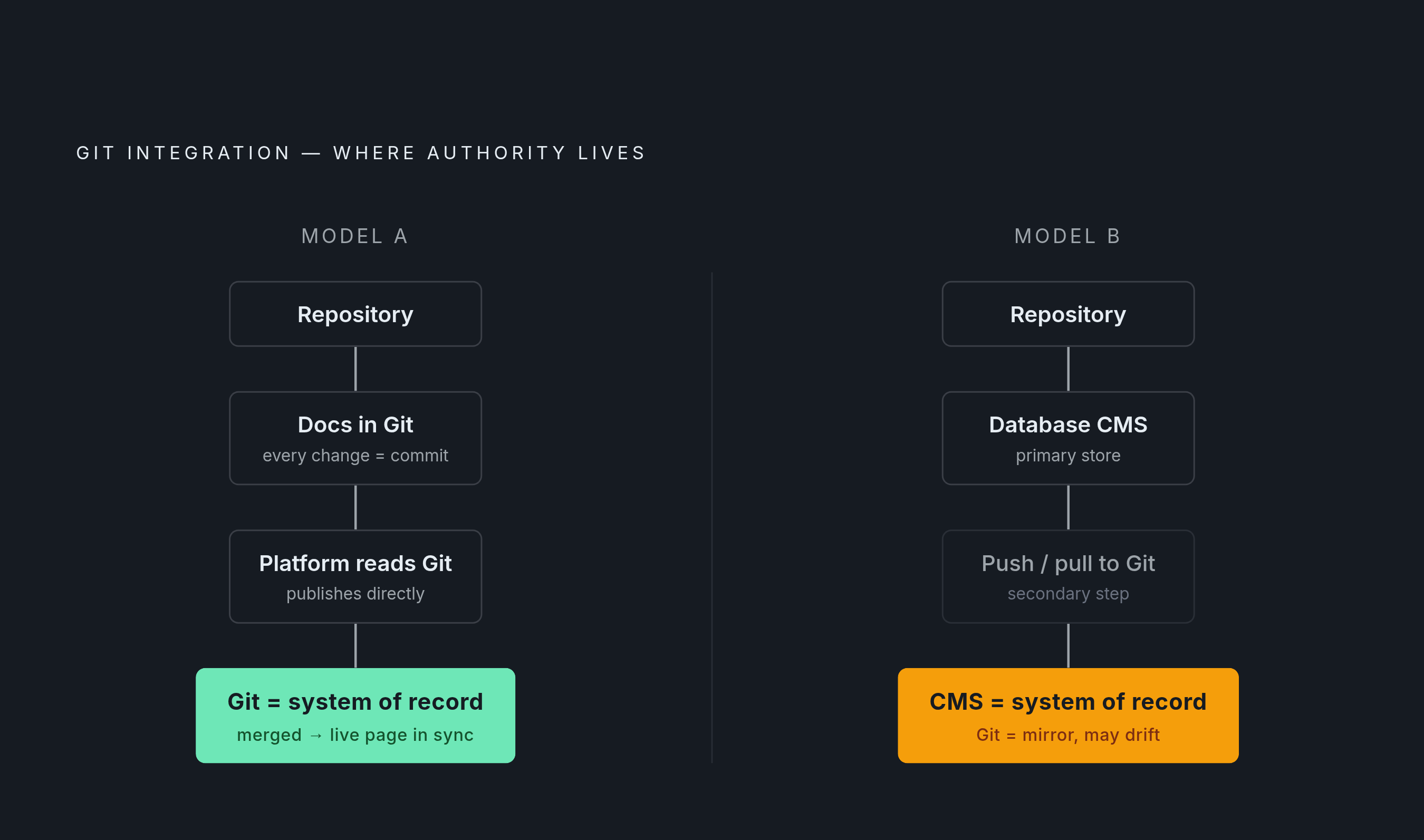
Two architectures hide under that one phrase, and they are not variations on a theme. In the first, documentation files live in the repository, every change is a commit, and the platform reads from Git and publishes directly from it. In the second, the platform runs a database-backed CMS and pushes or pulls from a Git repo as a secondary step, so Git functions as a backup or export mechanism rather than the system of record. Both models can be described, honestly, as "syncing with Git." Only one of the two architectures hiding under that phrase makes Git the authority.
The second model's practical failure mode is predictable rather than hypothetical: merge conflicts, state drift, and an unresolved question of which copy is canonical the moment the CMS and the repository disagree. Fern's own published comparison of these approaches draws the line explicitly, noting that bidirectional sync built as a layer on top of a database-backed CMS, rather than treating Git as the primary source of truth, can produce exactly this kind of drift. The distinction also reaches into who can contribute and how. When Git is the source of truth, every edit, regardless of where it originates, must eventually resolve into a commit. When Git is merely synced, a change made inside the CMS can live there indefinitely without ever touching the repository. That is not a cosmetic difference. It changes what "reviewed" and "merged" actually guarantee.
The workflow properties that separate the two models in practice
Five workflow properties reliably separate a platform that is Git-native from one that has bolted Git on as a feature, and evaluating against these five is the surest way to avoid the marketing trap built into the phrase "Git integration". Each can be asked as a direct question of any platform under consideration.
Does editing produce a Git commit, or does it just update a row in a database that happens to also sync with Git? One-way sync creates a lasting maintenance burden: two content sources that someone has to reconcile by hand, indefinitely. Bidirectional, write-back sync removes that burden by making the repository and the editor two windows onto the same file, not two copies of it.
Does every pull request trigger a rendered preview of the documentation, so a reviewer can catch a broken link or a malformed table before it reaches production? This is the same discipline engineering teams already apply to code review, extended to prose and reference pages.
Do Git branches map onto documentation versions? Teams maintaining multiple API releases already think in branches for their codebase, and a platform that mirrors that model lets them version docs the same way, rather than maintaining a second, parallel versioning system inside the platform itself.
Does a change to the API spec in the repository propagate automatically to the reference pages, or does someone have to re-upload the spec by hand? Manual re-upload after every spec change is a workflow tax that is the single most common cause of stale reference docs in a fast-moving API.
Is the documentation structured in a way that makes it legible to an AI agent as well as a human reader? Git-managed content tends to be well positioned here, because every page already exists as a clean, versionable source file, and platforms that automatically generate llms.txt, llms-full.txt, and MCP server endpoints make that content machine-readable without requiring a separate publishing step. It helps to be precise about what "readiness" means in practice right now. IDE agents such as Cursor, Continue, and Cline actively read llms.txt when pointed at a documentation site, while the major LLM crawlers do not yet request it in meaningful volume. The opportunity is real for a specific class of tool today, not yet a universal requirement, and the next two sections apply these five properties to specific platforms.
Platforms where Git is genuinely the source of truth
A small group of platforms treat the repository as the authoritative system at the architectural level. They pass the five-property test cleanly, and then diverge sharply on what they ask of the team in exchange.
Fern is the most complete expression of this model, mainly because it refuses to treat documentation and SDK generation as separate problems. Both are produced from the same API specification, so a single spec change propagates to reference docs and client libraries at the same time, through the same pipeline. Fern supports OpenAPI, AsyncAPI, and its own Fern Definition files, and generates SDKs in TypeScript, Python, Go, Java, C#, PHP, Ruby, Swift, and Rust, publishing the resulting packages to npm, PyPI, Maven Central, NuGet, RubyGems, Packagist, and other registries. Running fern generate inside a CI pipeline produces updated SDKs and API reference documentation from the spec in a single step, which is a meaningfully different operational posture than maintaining docs and client libraries as separate projects with separate release cadences. Fern also offers a visual editor that converts edits into pull requests behind the scenes, which preserves Git-based review while lowering the barrier for a non-technical contributor, though it stops short of writing back to Git directly the way a fully bidirectional sync would. The tradeoff follows from that: without a native web editor that commits back to the repo, a product manager or technical writer without Git access has no self-service path for structural changes. On the AI side, Fern auto-generates llms.txt on every build, and an MCP server is available for any documentation site with Ask Fern enabled.
Docusaurus, maintained by Meta, takes the opposite tradeoff. It is self-hosted, documentation lives entirely in Git, there is no SaaS dependency, and there are no per-seat or per-site fees. The honesty required here is about cost of ownership rather than cost of license: a production setup needs build configuration, hosting, a search solution such as Algolia, Typesense, or local search, analytics wiring, dependency updates, and plugin maintenance, all of which is engineering work that does not ship product. llms.txt support requires a plugin, and there are no built-in AI features for content audits or stale-article detection, though Docusaurus 3.9 did add native support for Algolia DocSearch v4's Ask AI, which brings intelligent search without requiring a separate plugin. Teams that chose it for ownership often look for managed alternatives a year or two later for the same reason: ownership costs time.
Read the Docs occupies a similar place in the spectrum, built for a narrower but well-served audience. Documentation lives entirely in Git, and webhook-triggered builds deploy updated docs on every push, so the sync model is native rather than layered on afterward. It fits open-source projects and engineering teams already using Sphinx, MkDocs, or similar docs-as-code toolchains particularly well. The free community tier carries EthicalAds, and moving to Read the Docs for Business removes them, as does a Gold membership for community users who want an ad-free experience without switching tiers. Its ceiling is dated UX, weak search, and no AI features, which is a real constraint, but one that plenty of projects can live inside comfortably given what else they get for free.
What separates them is what a team is willing to take on in exchange, since a technical writer or product manager without Git access has no native path to author or update content with pure docs-as-code tools like Docusaurus, Read the Docs, or Fern without its visual editor.
Platforms where Git sync is real but sits on top of a CMS
Several widely used platforms offer genuine bi-directional Git sync and strong contributor accessibility, but their underlying architecture means Git is one data path rather than the single source of truth, and that difference appears under specific conditions.
GitBook sits closest to the source-of-truth end of this group. Its architecture treats every change as a Git commit and supports branch-based workflows and PR-based change requests, which puts it meaningfully closer to a Git-native platform than a simple sync layer would be. Bidirectional sync with GitHub or GitLab keeps changes made in either the repository or the GitBook editor synchronized. In mid-2026, GitBook introduced an AI Agent feature, still in open beta, that issues pull-request-based documentation updates automatically; free-plan users get a capped number of messages per week, with full access available on Premium and above. GitBook added llms.txt support in January 2025, followed by llms-full.txt and .md page support in June 2025, all with zero configuration required, and it auto-generates MCP servers for published docs as well. Its pricing was restructured in 2024 and 2025 into a site-based model, a standard per-user tier, a custom-domain tier, and an Ultimate tier carrying the full AI feature set, with costs scaling linearly as the number of documentation sites grows; the migration path stays relatively open, since content remains in Git-compatible formats throughout.
A separate platform in this category offers bidirectional sync between GitHub, GitLab, or Bitbucket repositories and its own dashboard, with a CLI tool available for uploading OpenAPI specs and Markdown files from CI/CD pipelines. That sync is now the recommended approach for most workflows previously managed via rdme, but it still functions as a layer sitting on top of a database-backed CMS, and Git is not the authority underneath it. It supports API reference generation from OpenAPI, including interactive endpoint testing, and integrates with GitHub Actions for automated updates when a spec changes. Its dashboard-driven experience suits teams that value visual management over CLI-first workflows. It is priced at approximately $99–$150 per month. The predictable consequence of a CMS-first architecture is a higher risk of merge conflicts or state drift than a native docs-as-code workflow carries, and migrating away from it has historically been more painful than migrating away from GitBook.
The sync itself works, and works well. What a team should expect, going in, is that the canonical copy of the content lives in a database the platform controls, and Git is a faithful mirror of it rather than the other way around.
Contributor access as a real constraint
Pure docs-as-code tools, Docusaurus, Read the Docs, and Fern without its visual editor, are effectively developer-only in day-to-day practice, since a technical writer or product manager without Git access has no native path to author or update a page. That is the most common objection raised against the source-of-truth model, and it deserves to be taken seriously rather than waved off as a training problem.
GitBook resolves the tension directly. Its WYSIWYG editor and real-time co-editing let engineers and non-technical contributors work on the same live documentation, with every change still flowing through to Git underneath, and that accessibility is the platform's clearest architectural differentiator. Fern approaches the same problem from a different angle: its visual editor converts edits into pull requests behind the scenes, which preserves Git-based review and lowers the barrier to entry, but the contributor is still working inside a PR workflow rather than a free-form editing surface. Neither resolution is wrong. They are built for different assumptions about who is doing the writing.
What should a team actually weigh here? The managed platforms remove infrastructure burden in exchange for vendor dependency, while Docusaurus and the other Git-native tools keep content in formats the team fully owns, at the cost of making the team responsible for every operational concern that comes with that ownership. One might argue that contributor access is a pre-condition rather than a tiebreaker: mapping the team's actual contributor profile before evaluating any platform tells you which tradeoff is even on the table. If the people writing documentation are engineers who already live inside Git, workflow purity is the dominant criterion, and a pure docs-as-code tool loses nothing by asking for PR fluency. If product managers and technical writers own a substantial share of the content, editor accessibility is load-bearing, not a nice-to-have.
That question has gotten more urgent, not less, as release cadence has sped up. AI-assisted coding tools are accelerating how fast product behavior changes, and that widens the gap between what the product does and what the published documentation says, faster than it used to. Any workflow that adds friction to a documentation update raises that cost further, regardless of which side of the Git-native divide a given platform sits on. That friction is what the next section examines, from a different angle: who, or what, is reading the docs.
AI-agent readiness as the emerging differentiator across all platforms
Documentation now serves two distinct audiences, human readers and AI agents, and a platform's underlying architecture shapes how well it serves the second one, often independent of how well it serves the first. Git-managed content carries a structural advantage here: every page already exists as a clean source file an agent can parse directly, without scraping rendered HTML off a live page.
It helps to separate two layers that get discussed as if they were one thing. An llms.txt file is an entry point, a static file an agent reads once to orient itself. An MCP server is something deeper, a queryable knowledge layer an agent can call dynamically while it's actually working through a task. The first is a map. The second is a line it can keep dialing.
Platforms that generate both automatically, GitBook and Fern among them, require zero configuration, and their outputs update on every build without anyone remembering to republish. GitBook's timeline traces that build-out concretely: llms.txt arrived in January 2025, llms-full.txt and .md page support followed in June 2025, and MCP servers are now auto-generated for published docs. Platforms that require a plugin or manual configuration, Docusaurus and MkDocs among them, can still get to the same destination, but someone has to build the road; neither ships AI features for ongoing content maintenance out of the box. Self-updating platforms extend this logic a step further: Mintlify, for instance, treats the documentation as queryable infrastructure for both human developers and AI agents in real time, so an agent workflow built against the docs stays current with the product without a manual republishing step in between.
How big is this opportunity, really, today? The honest answer sits in the middle. The major LLM crawlers, OpenAI, Google, Anthropic, Perplexity among them, do not request llms.txt in meaningful volume yet. IDE agents like Cursor, Continue, and Cline, along with MCP integrations generally, do use it, actively and routinely. That is a real opportunity for teams building agent-powered developer tools right now, and a narrow one rather than a universal mandate. Teams evaluating a documentation platform in 2026 are not just choosing where human readers will land. They are choosing, whether they frame it this way or not, how legible their product becomes to the agents that are already reading it.