Source of Truth vs System of Record for Documentation
Docs stay accurate only when the record and the reference are explicitly linked.
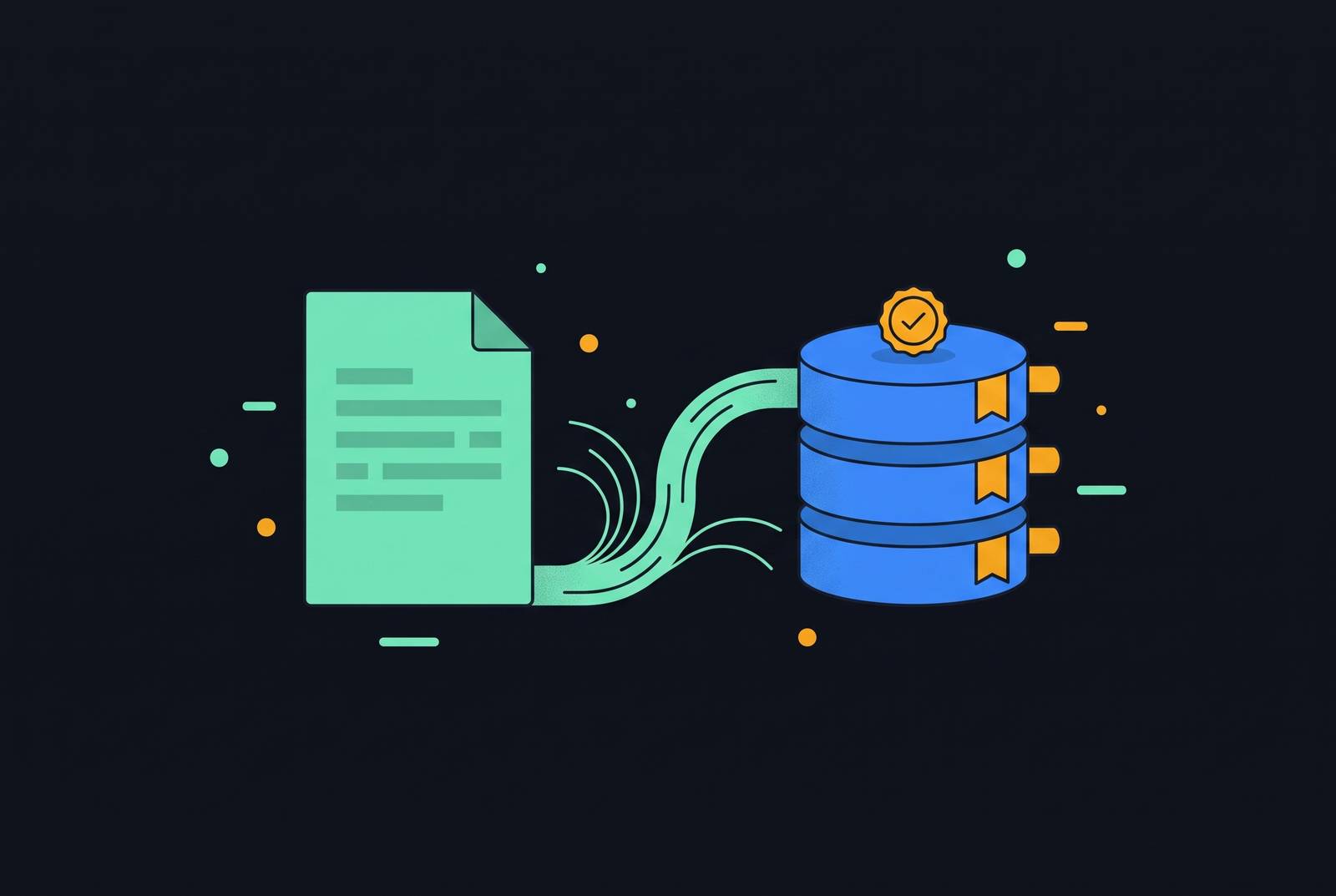
Documentation needs both a system of record and a source of truth, but they do different jobs. The first owns the authoritative content or state. The second is what people and systems consult to make decisions. Confusing them lets documentation drift from the product it describes. Reliable documentation depends not on putting everything in one place, but on maintaining an explicit connection between those roles.
Why "source of truth" and "system of record" are not the same thing
A system of record, or SOR, owns and stores authoritative data for a defined domain. Its authority concerns where that data is maintained and which record takes precedence when copies disagree. A source of truth, or SOT, serves a different purpose. It is the information that teams and systems actually consult when deciding what is true or what to do.
The operational and analytical contrast makes this concrete. A CRM can serve as the system of record for customer data because it is where those records are maintained. A warehouse can serve as the source of truth for analysis because it is what teams query when making decisions. These are different jobs, even when they use the same underlying information. The warehouse’s usefulness depends on its relationship to the authoritative records.
Does that mean the two roles must always be in separate systems? They can share a home, but each still has its own job to do. A system can keep official records without being where people look for answers, while a resource that many people use can hold information that no longer matches the official state. Authority and use do not automatically coincide. IBM’s explainer describes the underlying dependency by noting that, without an authoritative SOR, teams and applications work with inconsistent, incomplete, or inaccurate data. For documentation, the corresponding question is whether the answer a reader finds remains connected to the state it claims to describe.
How documentation collapses both roles into one system and why that creates a specific failure
A software team updates an API and ships a new version, but the technical writer is not informed. The source code has changed. The documentation has not. A developer who reads the documentation now gets an answer that describes how the API used to work, even though the API in use has changed. The page may still look authoritative and be in its usual place. Yet the system that owns the relevant state and the resource that explains it have diverged.
It is tempting to call this a communication failure. Better communication could help, but it would not by itself establish a synchronization contract between a product change and the corresponding documentation update. Without that contract, the published answer depends on someone noticing the change, seeing what needs to change in the documentation, and passing that on. The gap is architectural as well as editorial. The genuine SOR can change without forcing any change to the supposed SOT.
Documentation commonly obscures this gap by assigning both roles to a wiki or CMS. The platform stores the approved text and presents it as the trusted account of the product, although storing text does not establish its agreement with the product. A repository of pages is still only a place. A functioning source of truth depends on governed information, connections to authoritative state, and consistent delivery of answers relevant to the reader.
If no one owns a page, no one is responsible for updating it when the underlying state changes. If several teams believe they own the same subject, they can maintain conflicting accounts. Two versions of a policy in different folders illustrate the problem. Both may be actively maintained, but activity alone does not tell a reader which version has authority.
What happens when teams treat stale documentation as authoritative
In a regulated environment, a documentation conflict raises questions that a readable page cannot answer on its own. Which version was approved, who authorized it, and when did it become effective? Auditors need defensible answers to those questions. A wiki designated as both record keeper and reference does not acquire that provenance merely through the designation. The risk comes from treating a current-looking page as evidence of approval when the system does not establish the relationship between the two.
The distinction is between content and its authority. A policy can be clearly written and easy to find while leaving its approval status unresolved. Conversely, an approved version can exist without being the version people consult. That separation creates compliance exposure because the account used to guide work may not be the account the organization can defend.
Files such as AGENTS.md tell agents how to build, test, and work on a codebase. When those instructions drift from the actual system state, the document becomes more than an unreliable reference for a person. It directly steers an agent’s work toward the wrong behavior. The documentation error has crossed into the build process.
When a retrieval step selects a stale chunk, that chunk enters the prompt as input to the answer or action. The fault is therefore traceable to particular source content, rather than being only a vague decline in response quality. “Knowledge base rot” names the underlying condition in which documents indexed at launch remain untouched as policies, products, and internal definitions change. The system may still find the right document after what it says is out of date.
How docs-as-code redraws the boundary between SOR and SOT for engineering documentation
Docs-as-code gives the two roles distinct homes for engineering documentation. The repository becomes the system of record, while the published documentation site becomes the source of truth that readers consult. The same CI/CD pipeline that ships the code connects them. The crucial property is synchronization.
GitLab keeps user documentation and API references in the same Git repositories as their respective source code. Documentation updates go in the same commit as software changes, while automation checks for broken links and code examples that are out of date. The published site is downstream of a record maintained through the engineering workflow, rather than an independent account waiting for news of a release. Stripe also demonstrates the use of docs-as-code pipelines to connect authoritative changes with published documentation.
An API specification provides another way to establish that relationship. A single OpenAPI specification can serve as the SOR for an API surface, with downstream resources generated from it instead of maintaining separate authoritative copies. Fern uses a single specification to generate type-safe SDKs in more than one language and keep documentation, API references, and client libraries in sync. The specification becomes the shared point of authority. This reduces the scope for each downstream resource to develop its own account of the same API.
A change to the SOR triggers an update to what readers read, so keeping it in sync does not depend only on someone remembering to publish it separately. Pull request workflows and CI/CD pipelines make documentation part of the change process. This addresses the specific failure in which code changes and documentation remains silently detached from it, without automatically making every sentence correct.
Why declaring a single source of truth is not the same as creating one
Why not simply choose one wiki and require everyone to use it? A designation can settle where a team intends to look, but it cannot establish whether the answers there remain accurate. That takes rules for who owns the content, triggers for updates, and synchronization contracts. The label supplies none of those mechanisms by itself.
Centralization also leaves the question of authority unresolved. If the product changes elsewhere, the wiki still needs a defined relationship to that change. If several teams write about a subject, someone still needs to settle which account to use when they disagree. Moving those accounts into one platform changes their location while leaving their status unchanged.
There is also a limit to what “single” can reasonably mean. Different audiences, locales, and product tiers can require different valid accounts, rather than one account that overrides all the others. Those differences are not necessarily errors. A content model needs room to preserve them and to make clear when each applies. Forcing those accounts into one can strip away the context that made an answer correct, so keeping them consistent still means keeping the differences that matter.
When a decision is urgent, do teams consult the designated resource, or do they reach for a local copy, a Slack message, or a spreadsheet? Those alternatives reveal where the decision actually gets its answer, although their use does not prove that they are accurate. A policy naming the wiki cannot change that fact. If teams bypass it under time pressure, the designated source of truth exists in name only.
What genuine knowledge infrastructure requires: synchronization, ownership, and agent-readiness
An explicit synchronization contract defines how a change in the system of record reaches published documentation. Docs-as-code pipelines can enforce that connection, while integration layers can propagate changes from an authoritative source automatically. The connection cannot simply be assumed. IBM describes the general requirement for SORs as validating new data and quickly propagating it to every system that reads from it.
Synchronization still needs clear responsibility for the content being synchronized. Every piece of content needs one named owner who must trigger updates when the record behind it changes. That responsibility gives a change somewhere to land. Without it, even sophisticated infrastructure can leave an unanswered question about who must revise an explanation or settle a conflict.
Agent-readiness adds another need because documentation increasingly guides what gets done as well as what is understood. An agent reading a stale SOT can build the wrong behavior before anyone spots the documentation error, allowing the failure to grow unnoticed. The same content therefore needs to work for both human readers and agents without depending on either to spot that it is out of date. Searchability and automatic integration into agent workflows are useful only when the content stays live as the product evolves.
The resulting architecture treats documentation as maintained knowledge. Its authority comes from a governed record, its currency from an enforced connection, and its use from delivery to the people and systems making decisions. An automatically delivered but stale document is not agent-ready, just as an approved but unused page is not a practical source of truth.