How to Test Whether Your Docs Are Causing Agent Errors
Swap the docs, hold everything else fixed, and find the source.
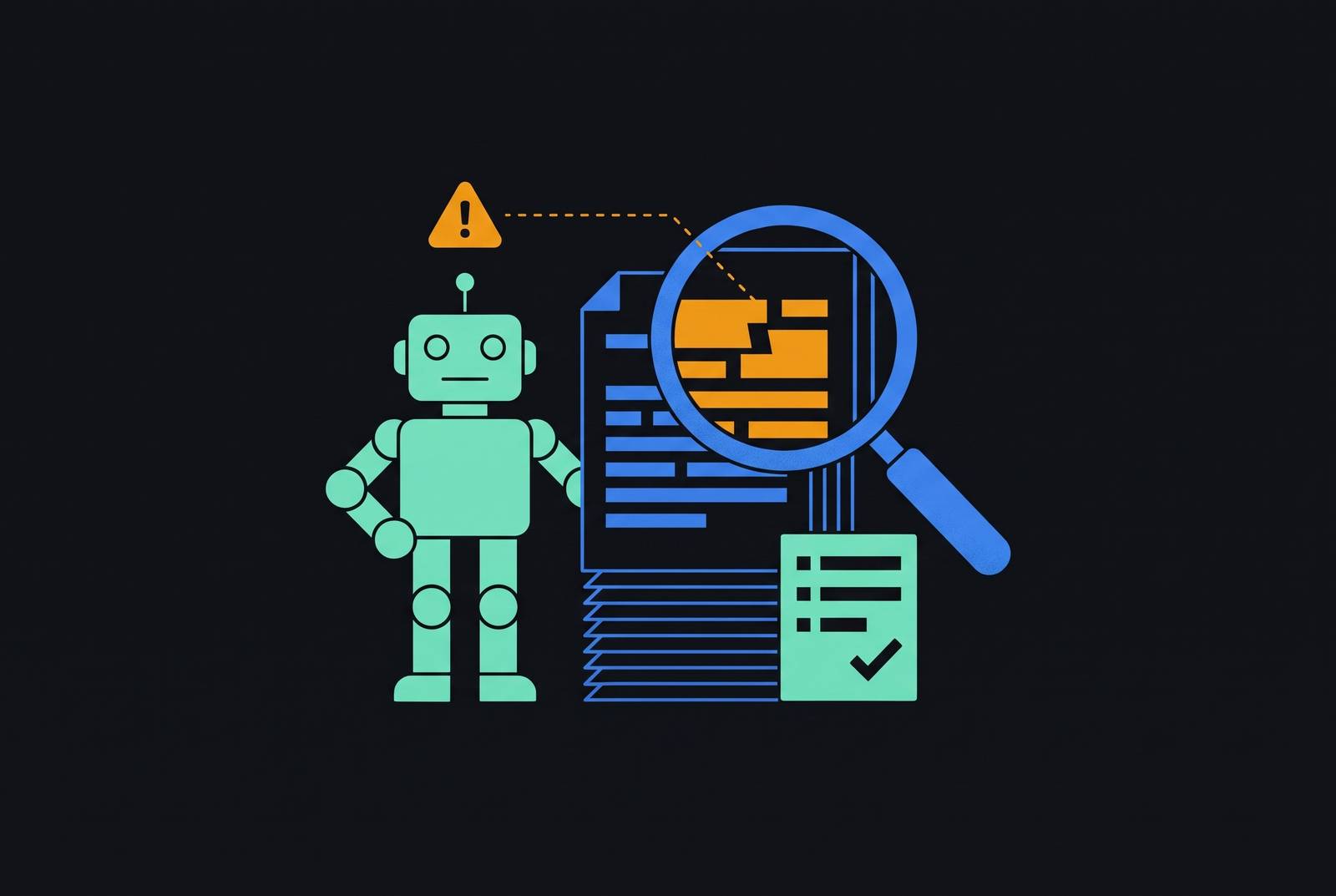
To test whether documentation causes agent errors, checking whether an answer looks right is only a start. It requires tracing what the agent read, comparing that material with its actions, and changing the documentation while holding the rest of the system constant. The central claim is testable. Some apparent model failures originate in the information supplied to the model, and a controlled documentation swap can isolate them.
Why agent errors that look like model failures are often documentation failures
An agent kept importing stripe.checkout.sessions.create with parameters from 2022. Adding the current Stripe API reference to the context fixed the error at once, with no change to the model. The failure looked like an inability to use the API. Yet the successful intervention changed the evidence available to the agent. That distinction changes where debugging should begin.
An agent may keep going even when context is missing or wrong. It may invent parameters that fit naming conventions but diverge from the actual interface. Stale documentation supplies obsolete behavior, while ambiguous documentation leaves several plausible interpretations unresolved. Poor structure creates another route to failure when retrieval selects the wrong passage from a long, mixed-topic page. In that case, accurate information exists but never reaches the agent.
These defects can also conceal execution failures. An agent may interpret the absence of an explicit failure message in an API response body as success, masking a backend crash. Its final explanation can therefore sound confident while describing an operation that failed. Diagnosis asks whether the supplied documentation gave the model an accurate basis for acting and recognizing failure.
Why standard agent testing methods do not expose documentation as the root cause
Output scoring cannot answer that question on its own. An agent can produce coherent text while sending malformed JSON to a payment API, so a text-quality check can pass even when the transaction fails. Wrong-tool calls are similarly invisible to a test that reads only the final message. The missing evidence sits in the execution sequence.
Traditional LLM evaluation also misses some of what happens with tool integration, stateful memory, planning modules, and autonomous execution loops. Documentation defects can affect each of these components without producing an obviously defective sentence. A test must distinguish selecting the wrong tool from supplying the wrong arguments or mishandling a failure. Otherwise, it detects a bad outcome without locating the source.
Gao and Chen’s study of real agentic coding sessions found no explicit documentation-based validation sequence in its corpus. Documentation consultation was also associated with less immediate testing. Reading docs is not a reliable self-correction mechanism. Nor does that association establish that consultation causes reduced testing. It shows why evaluators cannot assume that an agent will validate its work just because it consulted a reference.
A team can consequently have passing unit and integration tests while an agent loops on an untested edge case. Those tests show how the agent behaves in the conditions they cover. They do not establish that the documentation describes every decision the agent will face. To investigate that gap, the evaluation must treat documentation as an input that can itself be defective.
What agents actually do with documentation, and why it matters for diagnosis
Gao and Chen found that 35.4% of the time agents interacted with documentation, they used agent-facing instruction files such as AGENTS.md and CLAUDE.md. Their study covered 557 real agentic coding sessions and 94,813 development events. The reference manual is not the whole surface. Tests that look only at API pages can miss the instructions that guide how an agent builds, tests, and works through a task.
The same study found that agents nearly as often produced documentation as consumed it. Agent-generated documentation drift therefore belongs in the diagnosis, rather than being treated solely as a problem with human-authored pages. What did the agent actually consult, and when? A test of what the agent read cannot take for granted that it read the right document before acting or checked its result afterward. It must check what material the agent had when it made the failed decision.
The five test types that isolate documentation as the error source
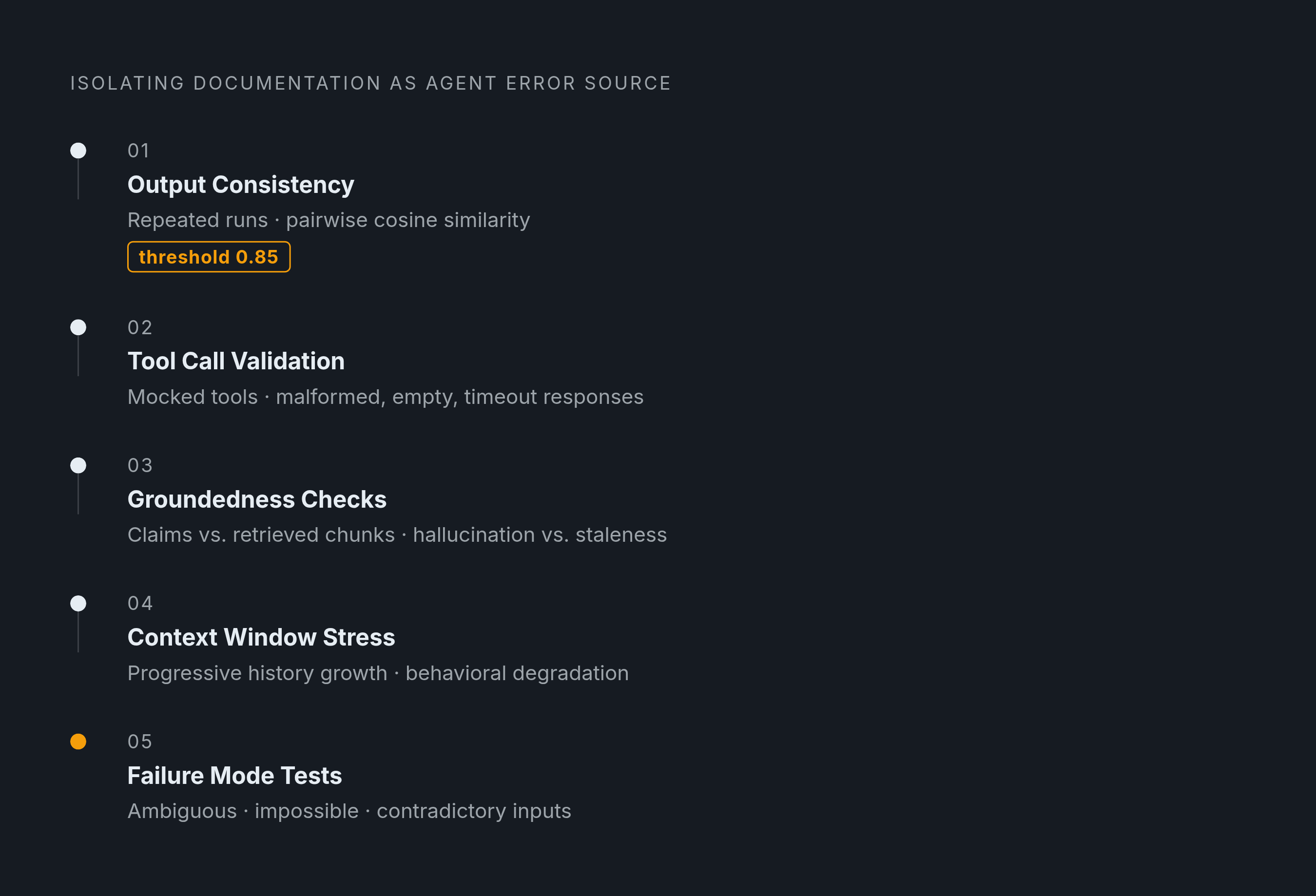
Output consistency testing starts with repeated runs of the same prompt. The procedure measures pairwise cosine similarity between embeddings of the outputs, using a value below 0.85 as a signal of consistency failure whose cause requires further testing. High variance may come from documentation that can be read in several ways. The next step is to inject a cleaner version of the relevant chunk and repeat the runs under otherwise unchanged conditions. Improved consistency then supports a documentation-based explanation, rather than a default assumption of model instability.
Tool call validation examines execution directly by mocking tools and injecting malformed responses, empty results, and timeouts. The checks cover tool selection, argument schemas, error handling, and call ordering in multi-step workflows. Descriptions belong in this test surface too. Missing or incorrect MCP tool descriptions can lead to silent wrong-tool selection, while an empty tools/list can trace to missing documentation records. A generic “Bad Request” response may leave the agent unable to distinguish a recoverable mistake from a reason to stop.
The 16-agent project included a 9-agent interview phase, during which two of nine interview agents hit API rate limits and failed silently. The original documentation gave zero guidance on detecting token limits or API errors, omitted exit code documentation, and assumed success on the first attempt. Success-path testing would not expose those omissions. Fault injection makes the missing instructions relevant to an observable decision.
Groundedness checks compare the agent’s claims with the specific documents it retrieved. A parameter, endpoint, or behavior absent from the retrieved chunk is a hallucination under this check. An outdated parameter present in that chunk is instead a staleness failure. The distinction determines what needs fixing. The Stripe case illustrates why obsolete arguments should prompt inspection of the supplied reference before the error is assigned to the model. Injected API errors, rate limits, timeouts, and empty results extend the check to invented results and silent stalls.
Context window stress tests progressively increase conversation history and measure how behavior degrades. As context depth grows, agents may start to ignore important system instructions, which can look like forgetting. More documentation is therefore not automatically better. This procedure checks both document accuracy and the agent’s ability to find and follow the behavior described as context load grows, when retrieval that fails to keep pace with the collection can make relevant content harder to surface.
Failure mode tests for undocumented edge cases set out how the agent should behave when input is ambiguous, requests are impossible, instructions contradict each other, or required context is missing. The checks then compare what the agent does with what it was expected to do. The desired failure is explicit and clean. Silent confidence is a reason to investigate missing guidance while keeping other possible causes under consideration. Where deterministic assertions cannot judge a non-deterministic response, an LLM-as-judge evaluation can grade reasoning quality and safety. That grading complements checks of actual behavior.
How to run the controlled experiment that confirms docs are the cause, not a correlate
To run the controlled experiment, replace the suspect documentation chunk with a corrected one in the agent’s context. Keep model version, temperature, system prompt, tool definitions, prompt structure, and conversation history constant. Change only the documentation chunk. Across repeated runs, measure correct tool selection, correct arguments, groundedness against the supplied document, and output consistency.
If the swap eliminates the error under those conditions, the result isolates the documentation as the cause of the tested failure. The unchanged components are the control. Without that constraint, a simultaneous prompt or tool change leaves the explanation unresolved. Repetition also separates a dependable improvement from one successful answer.
The retrieval path requires a further comparison. If direct injection fixes the error but retrieval through RAG does not, the retrieval layer is the proximate cause, and content revision alone is insufficient. Chunking or indexing needs attention instead. If retrieval supplies the correct material and the failure persists, the investigation moves upstream to the prompt or tool definition.
The three structural doc properties that most reliably produce agent errors
Staleness relative to the live API or product is a mismatch between documented behavior and current behavior. An agent can follow its source faithfully and still generate invalid code because a specification changed without a corresponding documentation update. Fabrication is not required for failure. The testable condition is whether the reference and current API schema diverge. In existing documentation, diffing the schema against the reference exposes those divergences directly.
Ambiguity in parameter descriptions, priority, or scope leaves the agent without a determinate choice. Multiple commands labeled equally “RECOMMENDED,” with no priority order, can invite a guessed selection without a request for clarification. Error descriptions can be ambiguous too. Missing error codes or a generic “Bad Request” response leave the recovery path unspecified. Detection combines inspection of those descriptions with repeated runs against the same chunk, followed by a cleaner-chunk comparison in which reduced variance supports a wording-based explanation.
Structure that defeats RAG retrieval separates correct information from the query that needs it. Long pages spanning multiple topics, inconsistent headings, and buried details can produce chunks that are thematically adjacent but operationally irrelevant. Accuracy alone cannot solve that mismatch. Detection requires inspecting the chunks returned for the failing query and comparing them with the passage needed to act correctly.
These conditions overlap, but the remedies are not interchangeable. Retrieving a current passage for the wrong question is a different fault from retrieving an outdated passage for the right one. Ambiguity is a third possible cause when the right passage reaches the agent but leaves it unsure what to do. The tests separate these cases so that a content rewrite is not mistaken for a retrieval fix.
Making docs agent-readable by default so errors stop recurring
To prevent recurrence, documentation updates need to follow product changes before another failed agent run. Machine-readable discovery is part of that infrastructure. Jeremy Howard of Answer.AI introduced llms.txt in September 2024 as a Markdown file at a domain’s root containing a curated content index with one-line descriptions. It gives agents a structured starting point that reduces their reliance on inference for discovery.
The August 2026 v2 update replaces location guessing with published link relations, including rel="alternate" and rel="describedby", and defines coverage by path. That allows /docs/llms.txt to describe only the documentation. The companion llms-full.txt puts all the documentation in a linear file that can be read without HTML parsing. Discovery still needs practical testing. Can an agent find the index, can a coding agent find build and test instructions, and can it finish the quickstart without a dead link or bad package name? A complete file does not remove the need for context stress tests.
MCP servers give agents another way to get current documentation. The Model Context Protocol exposes tools, resources, and prompt templates to compatible clients without a custom integration. Context7 gives agents current library documentation for the specific library version they are writing code against. Tool descriptions still require maintenance. If those descriptions are absent or wrong, discoverability does not prevent the agent from selecting the wrong operation.
Docs-as-code ties that upkeep to how software is shipped by keeping documentation in Git and using CI/CD to update it automatically. When a code change alters behavior, configuration, API shape, failure modes, or operator workflow, the same pull request should include the documentation update or generated artifact change. Regenerating API references, SDKs, llms.txt, and llms-full.txt in one workflow reduces drift. The update belongs with the implementation change.
Self-updating documentation extends this approach by detecting changes, identifying affected pages, drafting revisions, and routing them for human review. The supported pattern combines automated drafting with formal human verification and bounded authority. Controlled tests can identify the document that caused a failure. A maintained documentation pipeline makes that finding part of how the system changes, rather than leaving it as a repair that the next release can undo.