How to Capture Tribal Knowledge Before Someone Walks Out the Door
Document expertise through observation during real work, not exit interviews.
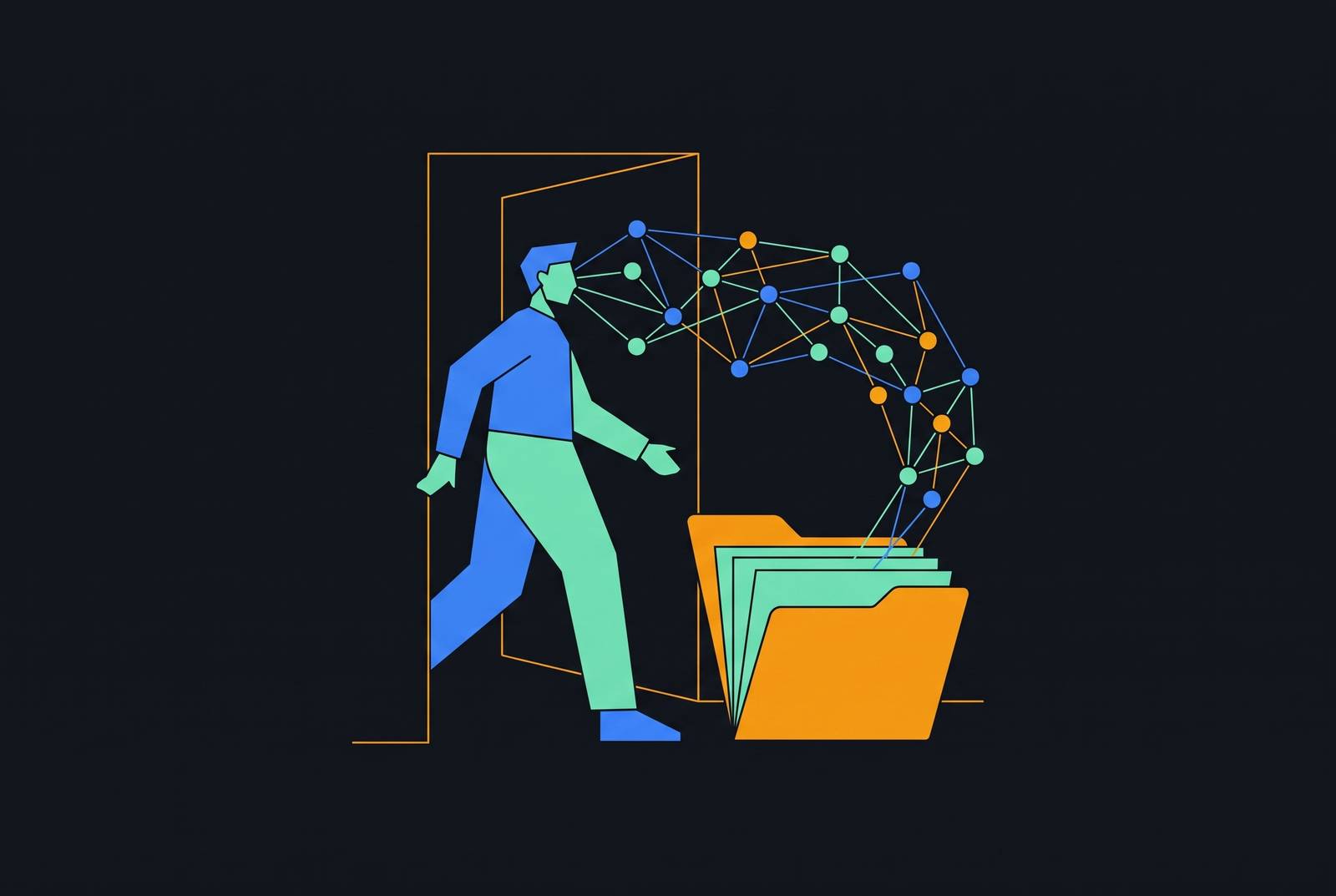
Capturing tribal knowledge before someone leaves is a problem of making expert judgment visible. The knowledge most at risk often no longer feels like knowledge to its holder, so effective capture must surface decisions during real work, preserve their reasons, and become an ongoing system.
Why expertise makes knowledge invisible to the person who holds it
A bearing sounds different, and an experienced maintenance worker hears that it is about to fail. An engineer pauses over a deploy graph before promoting a release. Neither may register a decision worth recording. AG5 uses the bearing example to illustrate tacit knowledge, which is recognition built through repetition rather than a rule already available for someone to write down. The engineer’s pause presents the same obstacle, because a meaningful check can disappear from the expert’s account of the task.
Fluency hides the steps that produced it. Explicit knowledge is already clear enough to put into words, while people often use tacit knowledge without being aware of it. Asking an expert to write everything down is therefore like asking a native speaker to list every grammar rule they follow. The automatic, pattern-driven judgment that makes someone effective also makes self-report an incomplete record of their work.
Why the window for capture is shorter than most organizations assume
When people stay in jobs for less time, organizations have less time to uncover that hidden judgment. An accelerating retirement wave compounds the problem, because departures can cluster. With 10,000 Americans turning 65 every day, the “Peak 65” wave creates a planning exposure that extends beyond the next quarter. Capture may require months or years of lead time. Demonstration, narration, and handover need opportunities that a notice period cannot reliably provide.
The exposure is also unevenly distributed across roles. AG5 identifies maintenance, setup, and quality work, where experience compounds over decades, as high-risk concentrations. Older sites are especially at risk when they have legacy equipment that vendor manuals no longer describe correctly. A young average workforce offers little reassurance if only one person can operate the oldest line. For certified manufacturers, the inability to show how critical know-how survives a departure can also become a compliance nonconformity. Planning should therefore identify which capabilities would leave with the people who might depart.
What organizations actually lose when undocumented knowledge walks out
At an aerospace manufacturer, a customer preference depended on a distinction a standard procedure would easily miss. Customer A needed parts by Thursday, earlier than “by end of week. That exception lived in one person’s head. The lost preference was part of the informal knowledge underpinning three critical accounts, illustrating how a seemingly small scheduling detail can belong to the substance of a customer relationship.
Employees can wait for an answer or recreate knowledge that a colleague still holds. Those costs are recoverable, even when the disruption is substantial. Once the only holder leaves, however, there may be no remaining source from which to recover the answer. Panopto’s Workplace Knowledge and Productivity Report found that 42% of institutional knowledge is unique to the individual who holds it. That concentration creates a different risk from information that is merely difficult to find.
On production floors, the consequences take several forms. A single point of failure can turn an absence into a stoppage, while new hires struggle because the real method exists only in veterans’ heads. Undocumented methods can drift across shifts and create quality variance. Losing the reasons behind a decision is subtler, because a successor may follow every recorded step correctly until conditions change. If the worst gaps become visible only after departure, what must capture look like while the expert is still available?
Why most capture attempts fail before they start
A documentation drive often assigns the work to the people who have the least personal need for its output. They already know how the job works. They must describe a moving system while also keeping it running, and the resulting document is a snapshot that begins to age. Asking them to document everything adds a lot of writing to their workload while leaving them with the blind spot that caused the gaps.
An exit interview adds a deadline but leaves that blind spot in place. In the final two weeks, there is little room for the demonstrations and shadowing that tacit knowledge requires. Relationship context cannot be passed on just by talking. Nor does a retrospective account reliably recover exceptions, because experts often describe how the job is supposed to go rather than how they navigate its departures from the standard path.
Recording meetings, chat, and email offers a partial alternative, but recording alone is not a capture system. It still needs workflow integration, access controls, and defined ownership. Otherwise, the organization has collected material without establishing how it will support work. Documentation needs methods that reduce dependence on unaided recall and make consequential decisions easier to notice as they happen.
Finding the knowledge worth capturing first
Much of an experienced person’s work may already be covered by procedures or be common enough for a successor to learn. The priority is the short list of gaps where one departure could stop work, put an account at risk, or create a compliance problem. Maintenance, setup, quality, and customer relationship roles offer useful starting points because their informal knowledge often accumulates through long experience.
AG5 describes filters by retirement horizon, shift, and site that help rank concentrated expertise. Instead of a vague intention to capture Frank’s knowledge someday, the matrix can show that Frank alone has the required competency in two critical skills and is approaching retirement. The gap becomes specific enough to act on. It also makes the request more manageable, shifting from an entire career’s knowledge to the few capabilities that lack a second holder.
Not all vulnerable knowledge is a skill. A lone admin account, a supplier representative who returns only one person’s calls, or a verbally negotiated customer preference requires a different kind of handover. Atlan distinguishes five useful categories for capture planning, which are process knowledge, exception knowledge, historical context, relationship knowledge, and interpretive knowledge. These cover undocumented steps, deviations, reasons for decisions, connections among people and systems, and the correct reading of outputs. The distinction helps determine what evidence to capture rather than treating every gap as a missing instruction.
Capturing what experts do, not what they say they do
Observation addresses the limits of retrospective self-report by putting the task itself in front of the expert. The practical method is to sit with the person during real work and record narration as they proceed. People can ask about a pause before it slips from memory. Why did the engineer watch that graph before going on? A question attached to an actual action can make the expert’s judgment visible in their answer where a general request for instructions would leave it untouched.
Video can show parts of the work that are hard to put into words. When process supervisors were retiring with specialized machine knowledge that had never been written down, Envases filmed experts carrying out critical procedures to make visual guides for a new generation. Aperam created visual guides for health and safety processes accessible through QR codes. The format follows the work being captured. Healthcare ambient capture offers a related demonstration of feasibility at scale, with rapid but partial adoption across major health systems by the end of 2025 and physicians recovering roughly 13–20 minutes a day.
The useful questions concern what changes at quarter-end, what differs for an old vendor, and which recurring failure requires a manual fix. These prompts target exceptions that an expert may otherwise omit as obvious qualifications. The aerospace customer’s Thursday requirement belongs to this category. Capturing the standard delivery process would not have recovered the deviation that made the process work for that customer.
Reasons require a different line of questioning. A step explains what to do, and the reason behind it helps the next person judge whether it still applies. Consider a recognized_revenue calculation that changed 18 months ago, though no one put the change in a runbook. The person in charge knows why care is needed when comparing figures from before and after that change. Without that history, a new hire or agent can produce a comparison that looks valid but is not.
Relationships cannot be transferred through observation alone. Warm handoffs to customers, suppliers, and internal contacts need the outgoing expert’s participation while trust is still transferable. Relationship mapping and handoff planning should therefore begin months before departure, well before the final two weeks. The framing of the request also deserves care. Rather than asking experts to surrender their value, capture can define which work they should no longer need to repeat personally and which cases still require their judgment.
Why undocumented knowledge is now an AI production problem, not just a continuity one
A new hire may eventually discover a missing rule by asking a colleague. An AI agent operating without that context may instead infer an answer and proceed without flagging the gap. The risk extends beyond a slow handover. An incomplete account of the work becomes an incomplete basis for automated action, with errors repeated at machine speed.
When process steps are missing, pipelines can fail silently, and when exceptions are left out, alerts can fire on healthy accounts. Absent historical context makes trend comparisons misleading. Relationship gaps can leave multi-agent systems using the same terms with different definitions, and missing interpretive knowledge can cause agents to mistake a signal for a data problem. These are not interchangeable documentation defects, because they change different parts of how an agent understands and performs a task.
Retrieval-augmented generation does not remove this boundary. Indexing wikis, Confluence pages, and Slack archives can surface information that exists in those sources. Retrieval is limited by the available evidence, which excludes any qualification that nobody recorded. The capture work must first make the missing knowledge available before retrieval can bring it into an agent’s workflow.
Availability alone is not enough if the account is stale. An agent can faithfully follow a document describing an old process without recognizing that a Slack thread from six months ago changed the answer. Knowledge infrastructure must therefore connect captured decisions to the workflows that use them and update when the underlying process changes. For teams deploying agents, that changes documentation from a continuity resource into a production dependency.
Making capture an ongoing system rather than a pre-departure scramble
A skills matrix can become the starting point for ongoing oversight. It keeps skills that only a few people hold in view before someone is about to leave. AG5 frames cross-training as the structural companion to capture, because surfaced knowledge can then be deliberately distributed across roles and shifts. Documentation lets others find the knowledge, while cross-training makes them less dependent on the person who first held it. Both are needed to address the single point of failure.
The upkeep also needs an explicit owner. When writing and updating belong to everyone in general, they may belong to nobody in practice. Ambient capture can record decisions and context in meetings, chat, tickets, and email as work changes. For agent workflows in particular, updates cannot wait for a documentation sprint if the process has already changed.
Document volume is a poor test of success. A more revealing test is whether a new team member or an AI agent encountering an exception can find the answer without asking the one person who previously knew it. That test examines both the captured content and its availability at the point of need. It also returns to the expert’s unnoticed pause, because the goal is to make the judgment hidden inside that pause visible to whoever, or whatever, must act next.