Which Docs-as-Code Platforms Replace a Legacy Wiki
A buyer's guide to platforms that fix the stale-docs workflow, not just the wiki.
Replacing a legacy wiki with a docs-as-code platform succeeds only when the replacement changes how documentation stays current, gets reviewed, and reaches its readers. The platform must repair the workflow that produced stale pages while supporting both human contributors and the agents that increasingly consume their work.
Why legacy wikis fail in a specific, structural way
A developer joins a project, follows the setup guide, and hits errors on step two. The instructions are months out of date. Before work can begin, someone must establish which parts of the guide still describe the system. The page exists, but its authority has disappeared.
That failure has a name, WikiRot, and a mechanism. Updating the wiki requires leaving the codebase, finding the right page among hundreds of stale ones, and manually reconciling it with the change just made. Under deadline pressure, that separate task is easy to drop. Unlike code, the update has no pull-request review, CI validation, or automated link checking to catch mistakes before publication.
Architecture diagrams compound the problem when they live in external drawing tools. A service or endpoint changes, but the visual remains untouched because updating it requires another separate action. These failures reinforce one another. Better writing cannot repair a workflow that makes maintenance optional and detached from development.
What docs-as-code actually changes — and what it does not
Docs-as-code lets engineers work on documentation with the tools they already use. Its foundations are plain text such as Markdown or AsciiDoc, Git version control, pull-request review, and CI/CD publishing. Each change gains an author, timestamp, and diff. Documentation can travel in the same commit as the code it describes, while automated linters catch broken links and formatting errors before readers encounter them.
Diagrams-as-code extend that model to architecture visuals. A Mermaid diagram embedded in Markdown regenerates from its text definition, so changing the definition changes the rendered diagram. The diagram can be reviewed along with the documentation around it. It no longer needs a separate drawing workflow.
But proximity is not automatic correctness. Someone still has to notice that a code change requires documentation and decide what the update should say. Git also creates a contribution barrier when writers must clone repositories, edit raw Markdown, resolve conflicts, and open pull requests. A workflow that saves engineers time can thus leave everyone else waiting for an engineer.
The evaluation criteria that separate a genuine wiki replacement from a shinier wiki
Where does the canonical document live, and which copy wins a conflict? If a CMS holds the authoritative version and merely exports to Git, the repository is not the source of truth. A visual editor can fit docs-as-code, but only if its synchronization respects Git's authority over history.
The next questions concern enforcement and access. Can pull requests require review through CODEOWNERS, provide preview deploys, and block merges when link or formatting checks fail? Can technical writers, product managers, and subject-matter experts participate without confronting raw merge conflicts? These requirements belong together because review loses reach when only engineers can contribute.
Scale adds another pair of questions. Can the platform maintain parallel documentation versions and reuse content components rather than treating every page as an isolated document? Can agents retrieve structured content through a programmatic alternative to scraping the human-facing site? In 2026, a replacement must account for both kinds of reader without sacrificing the workflow that keeps their source material trustworthy.
The self-managed tier: Docusaurus and MkDocs Material
Docusaurus places Markdown or MDX directly in the repository. The free, open-source generator from Meta uses React and MDX, making Git-native review a straightforward fit. Agents working in the repository can contribute through pull requests too. No visual editor ships with it, however, so non-technical contributors face the repository workflow unless the team supplies another route.
Operational control brings operational work with it. Search requires separate configuration, while authentication, preview deploys, and uptime remain the team's responsibility. Docusaurus also has no vendor-hosted MCP server for published pages. Its agent write path is Git, which fits teams whose agents already work there.
MkDocs Material offers a similar tradeoff in the Python ecosystem. It is free and open-source, with Markdown in Git, finished-looking theme defaults, fast local preview, and deployment to almost any host. Plugins provide llms.txt support, but extensibility still requires engineering work. Both tools suit teams that have the time and skills to run the documentation environment and a reason to own it, but they leave that work with teams that want to stop doing it.
The managed/hosted tier: what changes when the platform handles infrastructure
Managed platforms shift TLS, domain management, search infrastructure, preview deploys, and uptime to the vendor. That removes a substantial operational burden. It does not settle the questions of content authority or contributor access, because a hosted editor can still become the canonical source while Git serves only as an export. Hosting and governance are separate decisions.
The collaboration model therefore deserves close examination. Some managed platforms still make everyone work through Git, which keeps the same barrier in place for non-technical writers. Others combine visual editing with Git synchronization. The relevant distinction is whether that convenience preserves repository authority without exposing contributors to raw conflicts.
GitBook targets cross-functional technical documentation across multiple products and audiences. GitBook's 2026 technical documentation guide uses six evaluation dimensions, including structured authoring, versioning, API reference quality, docs-as-code workflow, collaboration, and AI readiness with MCP support. Its agent-readiness checker assesses whether existing documentation is structured for agents to parse and use. It also lets agents contribute through Claude Code and Codex using its SKILL.md agent-skills format, so teams can test that path as they assess the platform.
Enterprise on-premises alternatives for teams leaving Confluence
Confluence Data Center will be read-only from March 28, 2029. For organizations that cannot use managed SaaS, that deadline means plans for the move must account for where they can run the replacement. XWiki, BookStack, Wiki.js, and Outline are self-hosted alternatives considered for air-gapped deployment, enterprise authentication, and Confluence migration fidelity. Those dimensions address control and access.
Docmost positions itself as an on-premises Confluence and Notion replacement. Its stated capabilities include ITAR, FedRAMP, and GDPR compliance, with SSO, MFA, and granular permissions. These are distinct from docs-as-code review enforcement. Moving to a self-hosted wiki does not, by itself, connect documentation changes to code review.
Migration also exposes a structural mismatch in navigation. Confluence permits deep nesting without an enforced depth limit, while readers of public documentation sites get lost past two levels. A faithful export can therefore preserve an unusable hierarchy. Migration provides an opportunity to flatten the structure.
How docs-as-code platforms handle the content governance problem wikis never solved
Pull requests become governance only when review is enforced. Automated linters can run on every documentation change, catching broken internal links, dead URLs, and formatting errors before merge. Documentation validation then runs with code tests before publication.
Required ownership adds accountability to that gate. CODEOWNERS can designate reviewers for a domain, so an authentication documentation change cannot merge without security review. Git history also preserves institutional memory through commits, git log, and git blame. Engineers can look back at changes and the reasons recorded for them without always having to ask a senior colleague.
None of this requires every author to use raw Markdown. A visual editor can provide the contribution surface while Git remains the conflict-resolution authority and review remains mandatory. The constraint is whether any publishing path can silently overwrite history or bypass the controls applied to repository contributions.
Agent readiness as the emerging dividing line between platforms
Agents increasingly stand between developers and documentation. A replacement built only for people to browse risks becoming another legacy system even if its writing and review workflow works well. The machine-readable layer includes llms.txt, JSON-LD schemas, MCP servers, and agent-specific metadata. These supplement Markdown by exposing structure and retrieval paths without requiring agents to navigate noisy HTML.
Jeremy Howard and his team at Answer.ai proposed llms.txt in September 2024. By early 2026, it had become an informal standard, with support available through Docusaurus and MkDocs plugins and Hugo custom output formats. Availability is not the same as native generation. Vercel publishes llms.txt for its documentation, while generation for all Next.js/Vercel projects remains a proposed, unimplemented feature.
MCP offers a more direct retrieval interface. An agent can query a documentation server for structured responses rather than download an index and follow links itself. Google provides a remotely hosted documentation MCP server with search_documents, get_documents, and answer_query tools. AWS's Knowledge MCP Server offers documentation, blog posts, What's New announcements, and Well-Architected best practices without authentication, while Microsoft's Learn MCP Server exposes the knowledge service behind Ask Learn and Copilot for Azure.
These examples establish a concrete test beyond an “AI-ready” label. Can an agent query the content programmatically? Tool design also affects that answer, because too many overlapping tool descriptions can cause agent failures. Organizing tools around outcomes rather than endpoints helps keep the retrieval interface usable.
Emerging companion standards: AGENTS.md, auth.md, and what comes after llms.txt
Companion files extend machine readability from finding documentation to acting on it. AGENTS.md provides repository instructions for agents, using executable commands, code examples, and exact framework versions. OpenAI's repository contains multiple AGENTS.md files across its directory structure. WorkOS introduced auth.md in May 2026 to describe service registration and authentication in a machine-readable form.
These files fit naturally in a Git repository. Their usefulness depends on agents being able to retrieve them. XMCP exposes more than 200 API endpoints as callable tools, while its separate Docs MCP server lets agents search and read documentation pages.
How to audit a migration before choosing a platform
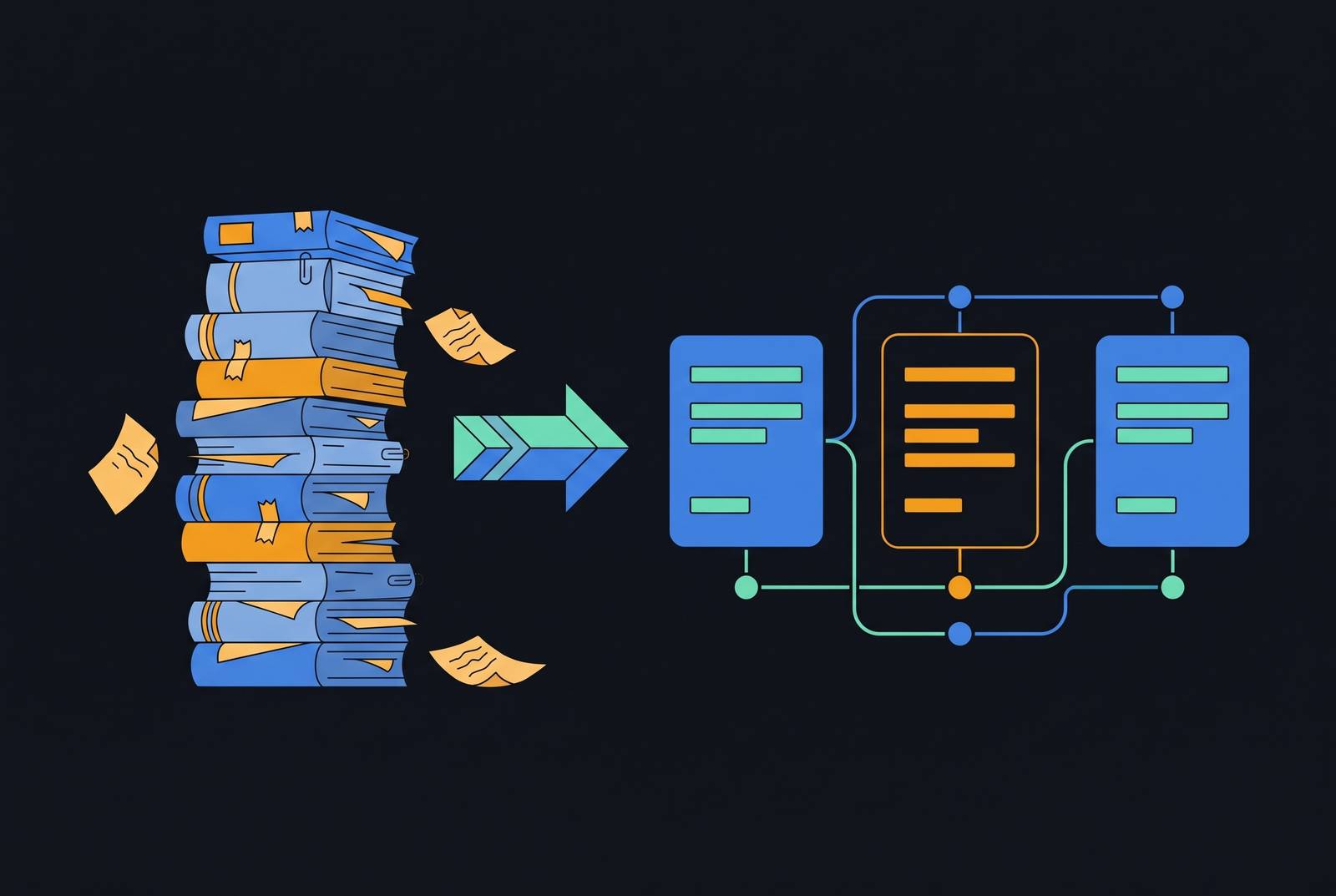
For a team preparing to migrate, the first task is to establish what deserves to survive. An audit should identify untouched pages, duplicates, instructions for retired systems, and content retained only because nobody had authority to delete it. Each category reveals a governance gap. Moving those pages as they are would carry the backlog over and leave its cause in place.
A six-level hierarchy needs to be reshaped when it moves, and a repository-only workflow must suit the people writing the content. A self-managed generator or Git-native managed platform can suit teams made up mostly of engineers. Mixed teams need visual contribution with Git remaining authoritative, and regulated organizations must establish their air-gap, FedRAMP, or ITAR requirements before narrowing the field.
Agent requirements belong in that assessment too. If they are near-term needs, MCP, llms.txt, and structured metadata must already be available natively or through supported plugins. After the audit, the migration proceeds through destination choice, export, cleanup, and a process for keeping new content current. Parallel operation, with automatic publication to the legacy platform during the transition, reduces the risk of losing access to working content. Platform selection comes last in the diagnosis.
What a docs-as-code platform must do to earn the wiki-replacement label
The strongest replacement is not necessarily the most managed platform or the one with the most editing features. Self-managed generators can provide the right foundation when engineering capacity is available, while hosted platforms can remove operational work and widen participation. On-premises tools answer a different deployment constraint. Taking in an export from the old wiki is not enough to earn any of these tools the label.
The decisive property is a continuous path from change to trusted documentation. Git authority, enforced review, pre-merge validation, accessible contribution, versioning, and content reuse make that path sustainable as the library grows. Machine-readable access extends it to agents without replacing the need for accountable authorship. A cleaner interface changes where stale documentation lives, but a genuine wiki replacement changes the conditions that allowed it to become stale.