Code Documentation Examples That Work Across Repos and CI Pipelines
Treat documentation as a versioned pipeline artifact that updates when code changes, not after.
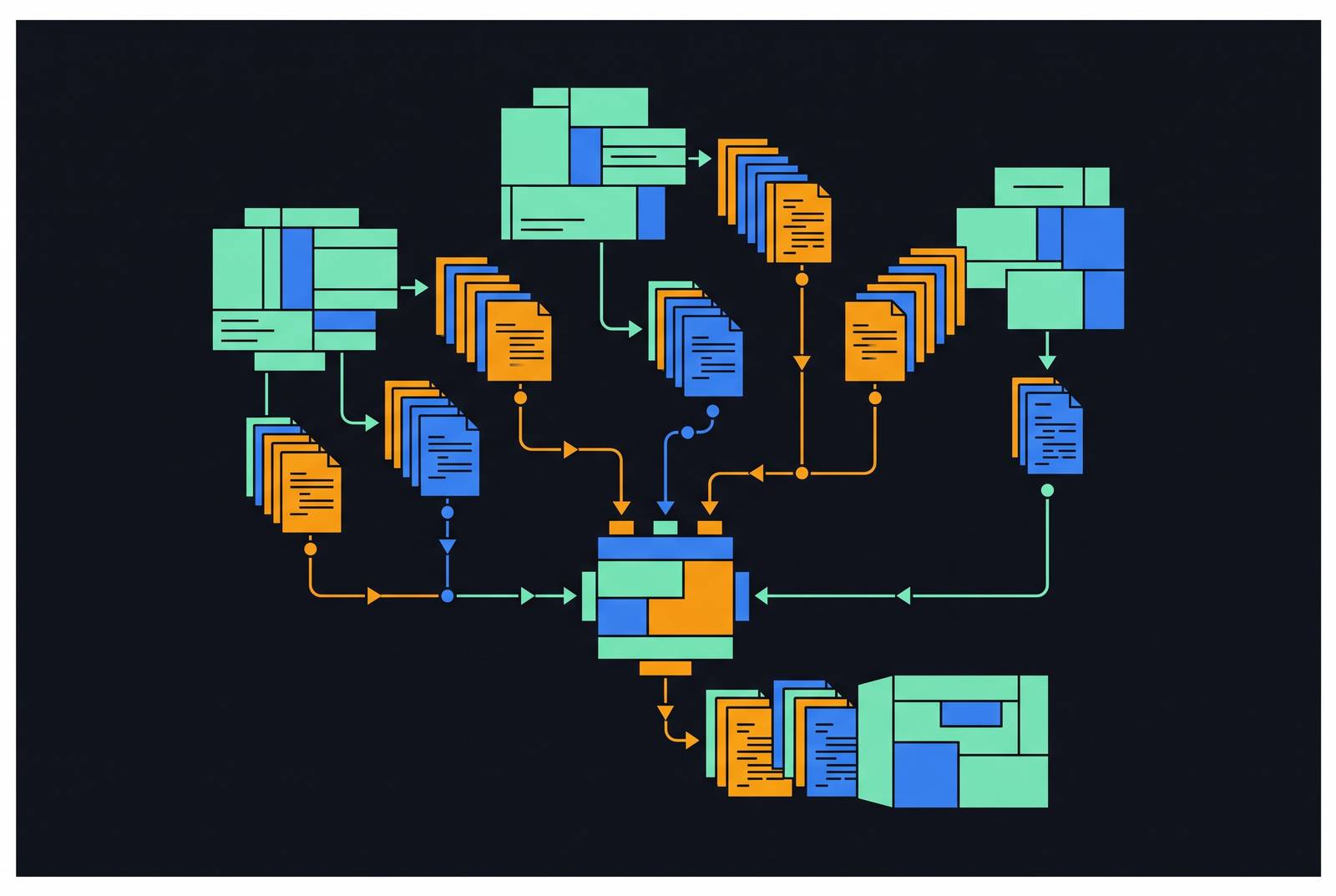
Code documentation examples that work across repos and CI pipelines share a design choice: they treat documentation as a first-class pipeline artifact, versioned with the software and triggered by the commits that change it. Keeping documentation accurate means tying it to the code’s update cycle and having people judge what the changes mean where automation cannot.
Why documentation drifts in distributed codebases and why the usual fixes fail
Documentation drift begins with a cycle mismatch. A merged pull request can change an endpoint or behavior while its documentation continues to describe the old state. The code has passed through a defined commit-and-review process, but the documentation waits for someone to notice the discrepancy. Each release can widen that gap.
Distributed code makes the mismatch harder to resolve because a single change can cross several ownership boundaries. A breaking backend API change may require coordinated updates in the frontend, shared library, and infrastructure repos. Without automation, a developer must open those pull requests by hand and put them in order. Documentation sits at the end of that queue, although it describes the behavior produced by the changes together. Its accuracy therefore depends on coordination that no individual repository fully contains.
Monorepos make it easier to use a single CI definition and track changes across components, while polyrepos put more of the work into contract testing and integration repos. Neither arrangement makes documentation update automatically. Better wikis, Slack reminders, style guides, and sprint-end documentation tasks leave the underlying mismatch intact because they operate outside the loop that governs code. They ask human memory to close a gap after the code has already merged.
What treating documentation as a first-class pipeline artifact actually means
Versioning means each software release has a corresponding, auditable documentation snapshot. That snapshot belongs to the artifact it describes and follows its publishing cycle. Rolling back the code without rolling back its documentation recreates the same mismatch under a different release state.
Event-driven generation ties documentation work to the commits and pull requests that change behavior. A scheduled job or manual step after deployment may produce fresh pages, but it does not establish that connection at the moment of change. The “build once, promote everywhere” principle extends the connection across deployment stages. The artifact tested in staging should be the one that ships, including its documentation, because a fresh generation may differ.
Enforcement makes these properties more than conventions. A missing or malformed documentation artifact belongs in the same class of pipeline failure as a failing test. The documentation generation step must be capable of failing the pipeline when it errors. Crucially, that gate belongs at the PR boundary, where it can prevent a merge, rather than after deployment, where it can only report that the standard was missed.
Four pipeline patterns that keep docs accurate across repos and stages
The first pattern is path-filtered generation under a shared monorepo pipeline definition. Nx and Turborepo have affected-target detection, which works out which parts of the dependency graph a commit touches. Documentation jobs can then run only when the paths they cover change, without scanning and rebuilding everything. One shared definition governs this behavior across the monorepo, avoiding per-team YAML files that gradually diverge. The pattern addresses both unnecessary work and inconsistent rules about when documentation runs.
The second pattern carries shared logic across repository boundaries. In a polyrepo setup, a shared workflow repository centralizes the pipeline definition that service repos call. GitLab’s trigger keyword can start pipelines in other projects directly from .gitlab-ci.yml, supporting cross-project execution on GitLab-hosted repos. The important distinction is between centralizing workflow logic and merely chaining repositories together. A sequence in which Repo A deploys and dispatches to Repo B, which then dispatches to Repo C, creates a single path where one failure blocks everything downstream.
The third pattern places a fail-fast documentation gate on pull requests. Documentation generation runs on every PR to validate that new code is commented and documented before it merges, with relevant work scoped to the change. The concrete fail condition is an error in the documentation generation step. Running that check on the PR event matters because a post-merge check cannot prevent the merge it was meant to govern. Storing generated files in version control also makes documentation changes traceable and preserves access to the documentation for previous releases.
The fourth pattern adds constrained cross-repo authorship, as demonstrated by the Aspire team’s pr-docs-check workflow. The product code is in microsoft/aspire, and the documentation site is in microsoft/aspire.dev. When a product PR merges to main or a release/* branch, the workflow starts an agent that reads the diff and decides whether documentation is warranted. This post-merge drafting flow complements the pre-merge validation gate. Its purpose is to carry the changed behavior across the repository boundary into a documentation PR.
Before the agent starts, a deterministic milestone-to-branch resolver runs in plain bash. Product-repo milestones map to release branches in the documentation repo, so the agent does not guess its destination. The workflow then uses a mirrored checkout, checking out microsoft/aspire.dev as the current workspace and again under _repos/aspire.dev. That arrangement is necessary for the agent to write to the target repository without a broad token.
The agent drafts content in the checked-out aspire.dev workspace and emits a create_pull_request safe-output. The documentation PR then goes to the subject-matter expert found through the source product PR’s reviews. This connects review to the person who already understood the change, rather than leaving ownership to be discovered afterward. For Aspire 13.3 and 13.4, the pattern produced a substantial run of feature-docs pull requests that merged quickly after their product pull requests. Every one was reviewed by the engineer who shipped the feature.
Where agentic doc generation breaks down and how to bound the failure
The Aspire example raises a distinction between generating documentation promptly and deciding correctly what deserves documentation. The team’s first prompt was too generous, drafting PRs for internal changes such as CI tweaks and logging refactors. Roughly one in eight PRs were closed without merging. The prose was readable, but that false-positive rate showed that the agent’s scope was too broad. The agent needed a sharper definition of user-facing change.
The fix was to tighten the docs-worthiness prompt with that explicit definition and negative examples, including CI changes and logging refactors as exclusions. document what changed” leaves a consequential decision underspecified. An agent needs boundaries for what counts as a documentation change alongside instructions for writing one. Even within those boundaries, however, fluent output can be subtly wrong about intent. Grammatical and structural correctness do not establish semantic accuracy.
Generation also has to stay within the team’s CI feedback budget. When feedback takes too long, developers context-switch and batch pushes, which makes later failures harder to bisect. A documentation step that routinely runs long is likely to be disabled in practice, which defeats the gate regardless of its intended rigor. Running generation in parallel with tests, limiting it to changed files, and caching outputs whose source has not changed all address that constraint. Runtime must be addressed during design, before adoption is complete.
Automation can write a lot without making anyone responsible for checking whether it is true. The Aspire pattern bounds that failure by making every generated PR a draft, with no auto-merge and a named human reviewer required before merging. Automation handles drafting and targeting, while the reviewer judges accuracy. Drawing that SME from the source PR’s review chain makes the responsibility part of the workflow.
What the pipeline needs from the documentation platform it writes into
A correct artifact is not enough if the platform receiving it treats documentation as a static destination. The pipeline can generate the right content while the published reference remains out of step. Teams therefore have to assess how the platform turns an artifact it receives into something they can use. The relevant capabilities are automatic regeneration on spec change, drift detection, and agent-readable structure. Each preserves a different part of the connection to the source.
Automatic regeneration matters when an OpenAPI spec or schema changes. The reference pages for that spec or schema should update without someone having to publish them by hand. Drift detection addresses the related but distinct problem of a page describing behavior that no longer matches the current source. The platform should surface that divergence instead of waiting for a user complaint to reveal it.
Agent-readable structure extends the requirement beyond human-facing presentation. When documentation serves as a knowledge source in retrieval or reasoning, an agent must be able to find and use the relevant section. Static, siloed documentation remains a barrier even when its original generation was sound. The pipeline patterns establish how to create and review the artifact, while the platform controls how that artifact is surfaced. Both are necessary for documentation to remain useful to humans and agents after the pipeline finishes.
A practical sequence for teams starting to wire documentation into their pipelines
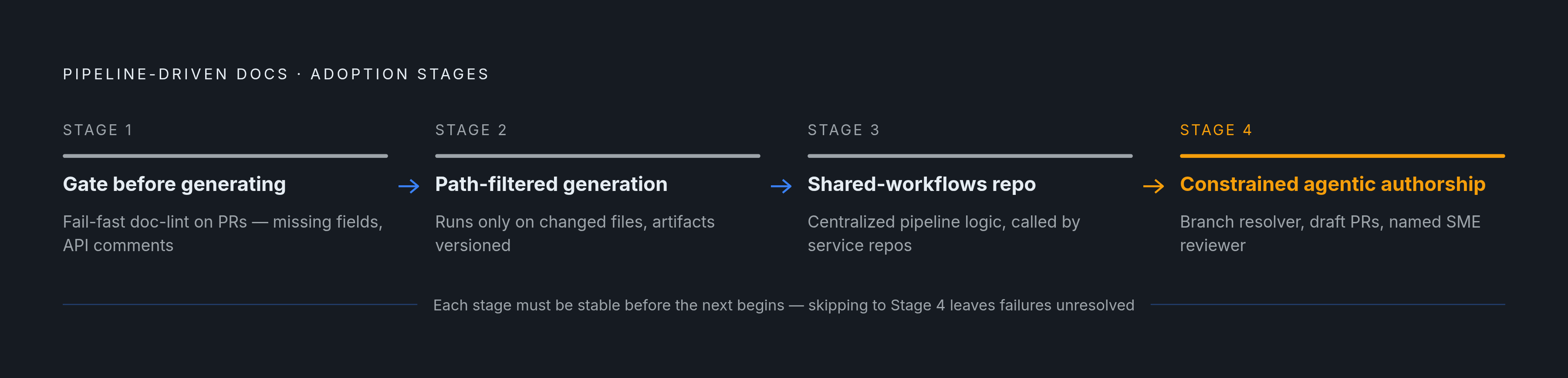
The first stage is to gate before generating. Start with a fail-fast doc-lint check on pull requests that fails when required documentation fields or API comments are missing. This provides an immediate signal without introducing the generation step’s runtime burden. More importantly, it establishes documentation as a merge requirement before the tooling becomes complex enough to produce false positives.
The second stage adds path-filtered generation that runs only for files that have changed. Limiting the work to files touched by the commit respects the CI feedback budget and avoids rebuilding the full repo. Generated artifacts should enter version control from the start so their history and rollback capability exist with the first outputs. This stage connects generation to the change that caused it while retaining a record of what each release described.
The third stage begins once the single-repo pattern is stable. Extract the pipeline logic into a shared-workflows repo that other service repositories call. Centralizing the definition reduces the coordination cost of maintaining the same documentation behavior across polyrepos. It also makes changing one shared file, rather than editing separate pipeline definitions, a practical benefit.
The fourth stage adds constrained cross-repo agentic authorship after the gate, generation, and shared workflow are stable. Before enabling it, provide a deterministic target-branch resolver, an explicit user-facing-change definition with negative examples, draft status on every generated PR, and a named SME from the source PR’s approval chain. The sequence matters as much as the practices themselves, because skipping directly to agentic authorship leaves those earlier boundaries unresolved. Sustainable accuracy comes from putting documentation in the code’s change cycle first, then expanding what automation can do within it.