Visibility of Documentation in AI-Powered Search Results
AI systems cite sources Google ranks poorly, so traditional SEO won't get your docs mentioned.
Visibility of Documentation in AI-Powered Search Results.
Why documentation teams need to rethink visibility from scratch
Documentation visibility used to mean one thing: rank position. A team shipped a guide, optimized the title tag, built some internal links, and checked where it landed on page one. The old question was where a page ranks. The new one is whether an AI system mentions the page at all when someone asks about the topic it covers⟧c3⟧. Those are not the same problem wearing different clothes. Ranking is a position on a list a human scans. Citation is a binary outcome inside a synthesized paragraph a human reads once and, more often than not, never clicks past.
The shift is visible first in where developers actually go when something breaks. An estimated 30% of programming-related searches were happening on ChatGPT as of the first quarter of 2025, which means the reflexive move for a broken webhook signature or a confusing SDK parameter is increasingly a conversational prompt https://www.arcintermedia.com/shoptalk/case-study-impact-of-ai-search-on-user-behavior-ctr-in-2026/. Google's AI Overviews reach 2 billion monthly users across more than 200 countries and roughly 40 languages, a footprint that makes the AI answer layer not an edge case https://www.frase.io/blog/ai-visibility.
What determines whether documentation surfaces inside that layer? Not keyword optimization, but how well content is structured, kept current, and made machine-interpretable. It comes down to structure, freshness, and whether a page is written in a way a language model can parse cheaply and quote confidently. Teams that understand those signals can engineer documentation to get cited. Teams that don't will keep publishing good, accurate, well-maintained docs that no AI system ever mentions. This piece is written for documentation teams, developer-relations engineers, and technical writers who want their work read by the people asking questions, whether or not those people ever load the docs site itself.
How AI intermediaries replaced ranked links as the discovery layer
Scale is the first thing to consider. 48% of tracked search queries trigger an AI Overview, a figure that reflects a 58% year-over-year increase https://www.frase.io/blog/ai-visibility. For question-based queries, the kind a developer types when debugging something specific, the trigger rate climbs to 57.9% https://www.frase.io/blog/ai-visibility. It's a behavior that extends well beyond broad informational searches. It's the exact query shape documentation exists to answer.
What happens once that AI answer appears? Users stop clicking. 58.5% of Google searches now end without any click at all, and one 2025 analysis put the zero-click rate as high as 60% https://arobis.ai/state-of-ai-search-visibility https://thedigitalbloom.com/learn/organic-traffic-crisis-report-2026-update/. Among queries that produce an AI-generated answer specifically, up to 83% resolve without the user ever visiting a website https://arobis.ai/state-of-ai-search-visibility. As AI intermediaries replace ranked links with synthesized answers, documentation visibility is determined by.
The click-through data on organic results tells the same story from a different angle. Seer Interactive's longitudinal study, built on 2.43 billion impressions across 53 brands and 5.47 million queries, found organic CTR on AI Overview queries fell from a baseline of 1.76% to 0.61% by September 2025, a 65% collapse, before recovering to 2.4% by February 2026 https://quickseo.ai/blog/google-ai-overviews-statistics-2026-60-data-points-every-seo-should-know. Pew Research's numbers sharpen the point further: with an AI Overview present, only 8% of users click an organic result, against 15% when no AI Overview appears, a 46.7% drop https://www.seo-kreativ.de/en/blog/zero-click-search/. Only 1% click the citation links embedded inside the AI Overview itself https://www.seo-kreativ.de/en/blog/zero-click-search/.
The downstream consequence for publishers is measurable, too. Organic session volumes for informational content categories have dropped somewhere between 15% and 40% since AI Overviews expanded, and 73% of B2B websites saw significant traffic loss between 2024 and 2025, with average year-over-year declines around 34% for that segment https://www.digitalapplied.com/blog/60-percent-searches-zero-click-crisis-2026-seo-strategy https://www.omnibound.ai/blog/zero-click-search-statistics. Documentation sites are squarely inside informational and B2B content categories https://www.omnibound.ai/blog/zero-click-search-statistics. Whatever traffic story those sites were telling internally two years ago, check whether the numbers still hold. When AI Mode is specifically engaged, the zero-click rate reaches 93%. CTR collapse for organic results on queries with AI Overviews.
Why your docs rank well in Google but disappear from AI answers
Roughly 60% of AI Overview citations come from URLs that don't rank in the top 20 organic results at all, a finding that should unsettle any team still treating organic rank as a proxy for AI visibility https://www.airops.com/report/the-2026-state-of-ai-search. Read that again, because it inverts the assumption most SEO practice is built on. A page can sit on page one of Google and still never get quoted by the AI answer sitting above it.
The overlap data confirms the pattern is systemic rather than anecdotal. The overlap between top Google organic results and the sources AI systems actually cite has fallen from around 70% down to below 20%, and that gap keeps widening as AI systems develop citation preferences distinct from Google's ranking algorithm https://www.botric.ai/blog/how-to-improve-ai-search-visibility-2026 https://llmrefs.com/generative-engine-optimization. Documentation pages that bury the answer below long introductory text are harder to cite accurately, since AI systems prefer content that states the answer in the first two to three sentences or a tight list. One might argue this was inevitable: a ranking algorithm optimized for click satisfaction and a citation mechanism optimized for extractable, quotable fact are not solving the same problem, even when they're drawing from the same web.
The default outcome of this divergence is invisibility. Roughly 60% of AI Overview citations come from URLs not ranking in the top 20 organic results, meaning traditional SEO performance is not a proxy for AI visibility. It has to be earned separately, on different terms.
Those terms also vary by which AI engine is doing the answering, and documentation teams cannot assume their own domain is a preferred source regardless of platform. ChatGPT leans encyclopedic, with Wikipedia its single most-cited source. Perplexity is community-driven, and Reddit dominates its citation pattern. Google's AI Overviews pull heavily from forums, Reddit and Quora chief among them. None of the three defaults to brand-owned documentation as its preferred source type. For commercial and comparison queries, the kind developers use when evaluating SDKs or API tools, 83% of commercial citations come from pages updated within the last year, and in SaaS, finance, and news, pages older than roughly three months see steep citation drops. 85.7% of businesses remain invisible in AI responses even as AI search traffic rose 1,200% in 2025, making invisibility the default outcome for most documentation.
How AI systems decide which content is worth citing
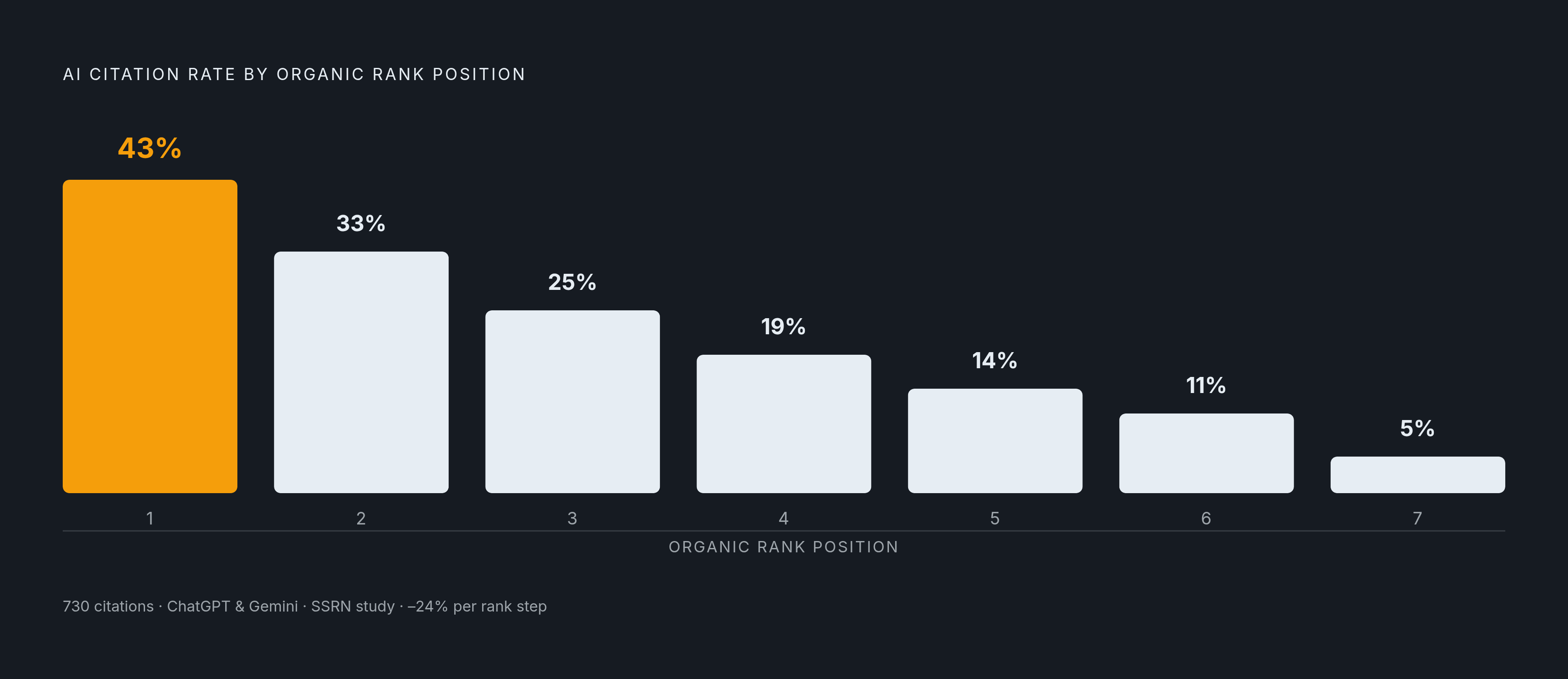
An SSRN empirical study analyzing 730 AI citations across ChatGPT (GPT-4o with web browsing) and Gemini (1.5 Pro with search grounding), spanning 75 commercial queries and 1,006 unique pages, found that position-1 pages were cited in 43% of queries in which they appeared, declining to 5% at position 7, with each rank position reducing citation odds by roughly 24%. Pages ranking at position 1 in the search backend were cited in 43% of the queries where they appeared https://www.seo-kreativ.de/en/blog/zero-click-search/. By position 7, that figure dropped to 5%. Each step down in rank reduced the odds of citation by roughly 24%.
What does that decay curve actually mean for a documentation team? It means AI citation is partially mediated by a search ranking layer that happens before any AI-level evaluation of the content ever occurs. Foundational SEO, the work of making a page technically crawlable, well-linked, and topically relevant, remains necessary. It's just no longer sufficient on its own. A page has to clear the ranking bar to even enter the pool an AI system draws from, and then it has to clear a second, different bar to actually get quoted once it's there.
That second bar responds to deliberate structural work. That's a meaningful lift from technique alone, independent of domain authority or backlink profile.
Freshness carries real weight too. For commercial and comparison queries (the kind developers use when evaluating SDKs or API tools), the pattern sharpens: 83% of commercial citations come from pages updated within the last year, and in categories like SaaS, finance, and news, pages older than roughly three months see steep citation drops. Documentation that hasn't been touched since a product's last major version bump is exactly the kind of content this pattern penalizes.
Structure is the third lever, and it's the one most teams have the most direct control over. None of that is about writing better prose. It's about whether the document's skeleton is legible to a parser.
Credibility earned off the domain affects how often a site is cited, regardless of what domain owners assume. Roughly 48% of citations come from community platforms like Reddit and YouTube, and 85% of brand mentions originate from third-party pages rather than owned domains. Documentation teams chasing AI visibility can't only polish their own site. They need a presence in the places where developers already argue about their product. A GEO study found that targeted optimization (citing sources, including statistics, promoting semantic clarity, and quoting experts) can increase visibility in generative responses by up to 40%. Pages not updated quarterly are more than 3× as likely to lose citations, while more than 70% of all pages cited by AI have been updated within the past 12 months.
Content structure signals that documentation pages routinely get wrong
Start with the single H1 rule, since 87% of cited pages use a single H1. 87% of cited pages use exactly one H1 as the page's primary anchor. Multiple H1s, or a page missing one entirely, degrade a model's ability to figure out what the page is fundamentally about. This sounds like a formatting nitpick. It's a signal that affects a page's ability to resolve to a clear topic. It's the difference between a page that resolves to a clear topic and one that reads, to a parser, like several loosely related documents stapled together.
Heading hierarchy compounds the problem when it's inconsistent. Skipping levels, jumping from an H2 straight to an H4 because it looked right visually, makes it harder for a model to reconstruct how sections relate to each other. This is a common documentation anti-pattern, largely because visual hierarchy and semantic hierarchy get conflated during drafting. A heading that looks smaller because a writer wanted less visual weight isn't the same thing as a heading that signals a genuine subsection. Models rely on the latter signal, not the former.
Then there's the question of where the answer actually sits on the page. Documentation that buries its core answer beneath several paragraphs of scene-setting and context is measurably harder for an AI system to cite accurately, because the burial itself obscures the answer the system needs to extract. AI systems favor content that states its answer in the first two or three sentences, or condenses it into a tight list near the top. Why would a model prefer that? Because extraction is a cost, not a courtesy: a model quoting a source has to identify the relevant span of text quickly, and content that defers its point past a wall of throat-clearing raises the cost of that extraction.
Modularity follows from the same logic. Short paragraphs, in the range of three to five lines, are preferred by large language models over dense blocks of prose. Numbered steps work for anything sequential, a setup flow, an integration walkthrough, while bullets suit parallel, non-ordered options. None of this is exotic. It's closer to the plain, boring hygiene that good technical writing has always rewarded, just now with a second audience checking the work.
Where schema markup and structured data help documentation
Schema's value here is narrower and more specific than most guidance suggests. The SSRN study found that pages implementing Product or Review schema, populated with concrete attribute fields such as pricing, aggregateRating, and specifications, were cited at a rate of 61.7%, compared to pages using generic schema types like Article, Organization, or BreadcrumbList. That gap is the whole story. Generic markup that just labels a page as "this is an article" gives a model almost nothing it didn't already know from the content itself.
For documentation specifically, that means slapping Article schema on a guide isn't going to move the needle much. What moves the needle is schema that expresses something concrete and checkable, an attribute a model can lift directly and use to answer a question with confidence, rather than schema that just categorizes the page's genre.
A handful of schema types map cleanly onto documentation content. HowTo schema fits step-by-step procedures, the setup guides and integration walkthroughs that make up a large share of most documentation libraries. SoftwareApplication and TechArticle schema signal content type and authorship context to a model trying to figure out what kind of source it's looking at. And author bios, alongside the broader set of experience-expertise-authority-trust signals search engines have leaned on for years, feed into the off-site credibility layer discussed earlier, since a model weighing whether to trust a claim has to weigh who's making it.
This vocabulary isn't static. Schema.org reached version 30.0 on March 19, 2026, maintained jointly by Google, Yahoo, Microsoft, and Yandex. That's an active, multi-party maintenance structure, not an abandoned spec. Teams implementing schema now are working with a standard that's still being extended, which means today's coverage gaps in schema types may close on a timeline worth tracking. FAQPage maps directly to the question-and-answer format AI systems prefer to extract.
Bot governance: the crawlability decisions that silently exclude documentation from AI answers
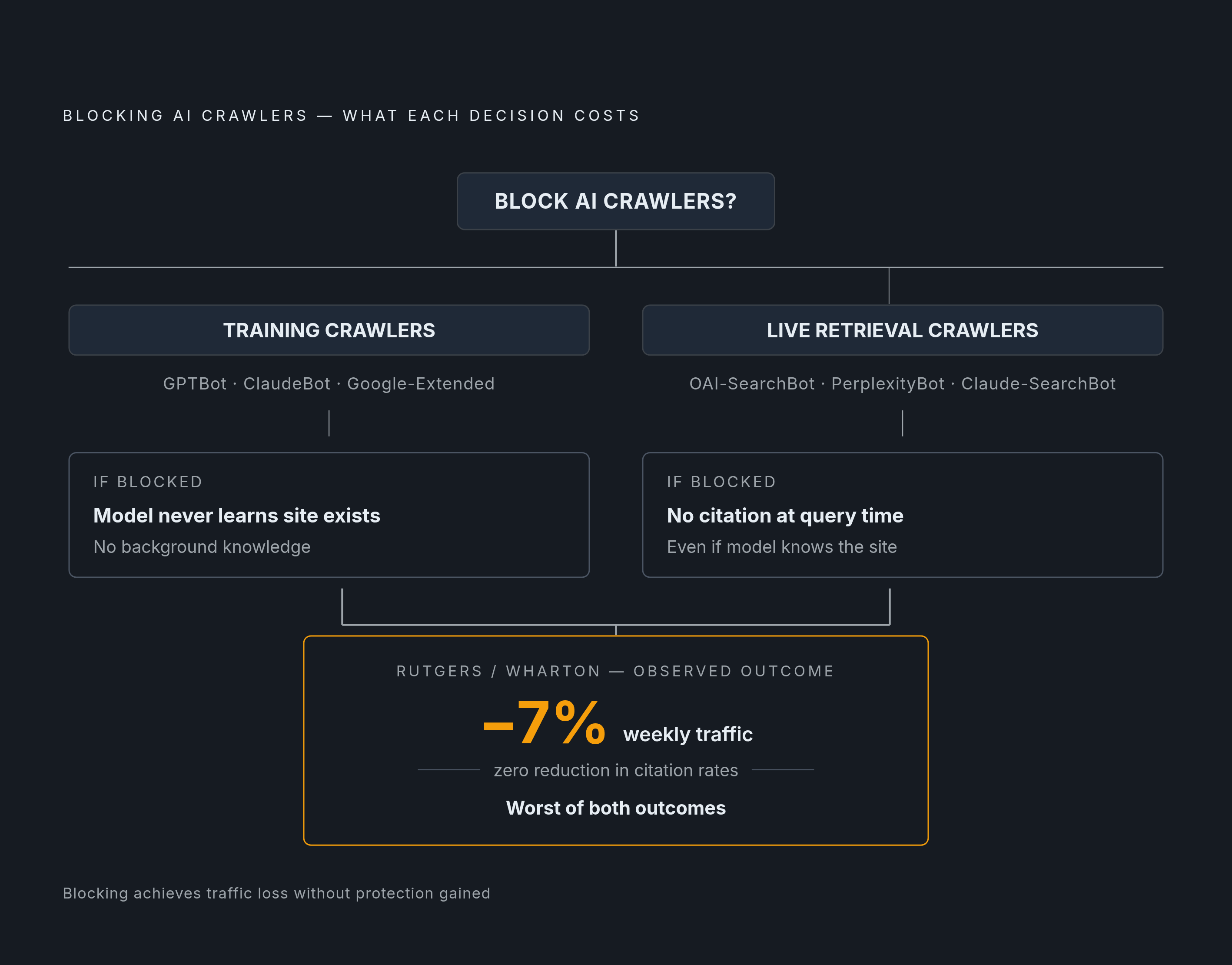
Most documentation teams don't know a critical distinction: two fundamentally different types of AI bot exist.
Training crawlers, GPTBot, ClaudeBot, Google-Extended among them, feed a model's background knowledge during its training or fine-tuning process. Block these, and the consequence is straightforward: the model simply never learns the documentation exists. It can't reference what it was never shown.
Live retrieval crawlers are a separate animal entirely. OAI-SearchBot, ChatGPT-User, PerplexityBot, Claude-SearchBot, these fetch a page at the moment a user asks a question, pulling current content to answer that specific live prompt. Block these instead, and the failure mode is different and in some ways worse: the model might know a documentation site exists, might even have trained on an old snapshot of it, but it cannot pull the current page to quote from, so no citation happens regardless.
Treating these two bot categories identically in a robots.txt file is a mistake, and it's an easy one to make because the names all sound similarly automated and vaguely threatening. But the decisions genuinely diverge. Blocking a training crawler is a bet about long-term model knowledge. Blocking a retrieval crawler is a bet about whether today's page can ever surface in tomorrow's answer.
Research out of Rutgers and Wharton found publishers who blocked AI crawlers experienced roughly a 7% weekly traffic decline, without any reliable reduction in citation rates, cutting against the intuition that blocking AI bots protects a site. The blocking cost traffic and didn't achieve the protection it was meant to deliver. That's a genuinely counterintuitive result, and it suggests that a defensive instinct many sites acted on may have simply produced a worse outcome on both axes at once.
There's a quieter risk in this, too. Cloudflare changed its default configuration to block AI bots, which means any documentation site running behind Cloudflare's infrastructure may have excluded all AI crawler traffic without anyone on the team ever making that call explicitly. Worth an audit.
What llms.txt does and does not do for documentation sites
llms.txt is a plain Markdown file placed at the root of a domain, at /llms.txt, that hands AI tools a curated map of a site's most important pages in a format cheap enough for a model to read without heavy parsing overhead. Jeremy Howard of Answer.AI proposed the format in late 2024, and it moved from proposal to quiet, informal standard among documentation and developer-tool sites over the course of 2025.
What does it actually do? It gives an AI system a shortcut, a curated index instead of a full crawl, pointing toward the pages a site's own maintainers consider most important. What it doesn't do is guarantee citation, override the structural and freshness signals covered earlier, or substitute for the schema and heading-hierarchy work that determines whether a page reads as trustworthy and extractable once a model actually reaches it. llms.txt is a map. It says nothing about whether the destinations on that map are worth visiting.
Adoption has picked up specifically among platforms serving documentation and developer tooling, Fern and GitBook among the names that took it up as the format spread. That adoption pattern makes sense given who llms.txt was built for: sites with large, structured reference content and a clear hierarchy of what matters most are exactly the sites that benefit from handing a model a shortcut instead of making it guess. It's worth implementing. It is not, on its own, a visibility strategy, and treating it as one would be a mistake symmetrical to the one teams make when they assume traditional SEO rank still predicts AI citation. The file is a map. The territory still has to earn the visit. Organic CTR dropped 61% for queries with AI Overviews, from 1.76% to 0.61% https://seomator.com/blog/ai-seo-statistics. 20% of all German keywords now show an AI Overview as of February 2026 https://www.seo-kreativ.de/en/blog/zero-click-search/. Visitors gained through AI citations convert at 14.2% https://www.botric.ai/blog/how-to-improve-ai-search-visibility-2026. AI search traffic rose 1,200% in 2025 https://www.botric.ai/blog/how-to-improve-ai-search-visibility-2026. 85.7% of businesses remain invisible in AI responses https://www.botric.ai/blog/how-to-improve-ai-search-visibility-2026.