Multi-Product Documentation Served from One MCP Server
AI assistants now retrieve documentation in real time, not from outdated training data.
Most documentation teams still treat freshness as a scheduling problem. Someone falls behind, a Jira ticket accumulates comments, a content review stalls somewhere between engineering and legal. That version of the problem is at least manageable. What exists in 2026 is different in kind.
Roughly 82% of developers use AI coding assistants daily or weekly, and approximately 41% of all code is now AI-generated or AI-assisted, according to 2025 survey data. The coding assistant has displaced the browser tab as the primary interface through which developers consult documentation. That shift turns the assistant's answer quality into a product quality problem, whether or not the documentation team has noticed yet.
Absent an MCP server, the failure mode is essentially deterministic. An AI client answers from training data. Training data reflects a snapshot of your documentation at some past date. Any update since that snapshot is invisible to the model, and the model has no awareness of the gap. It answers confidently from an outdated specification, and the developer receives a plausible explanation of an API that no longer works that way.
Confident wrongness is worse than absence. Absence produces confusion; a confident wrong answer produces a half-built integration that fails in ways the developer cannot diagnose without first knowing to distrust the source. Time to first successful API call is among the most critical metrics in developer adoption, and every minute spent verifying whether an AI's answer reflects the current spec is friction that compounds into churn.
An MCP server collapses this by giving AI clients live access to current documentation at request time. The model does not need to have encountered your docs during training. It retrieves them at the moment of the query.
The multi-product version of this problem compounds in a specific way. A product suite with separate documentation sites, versioned APIs, and overlapping terminology does not just produce staleness; it produces ambiguous staleness. When Product A and Product B both define something called "workspace," and both sites have been updated at different intervals, an AI client working from training data cannot reliably distinguish between them, let alone resolve the version question for either. A single queryable layer with explicit product boundaries is built for exactly that condition.
How a single MCP server can front an entire product suite, and where the boundary sits between a justified unified endpoint and a problematic mega-server
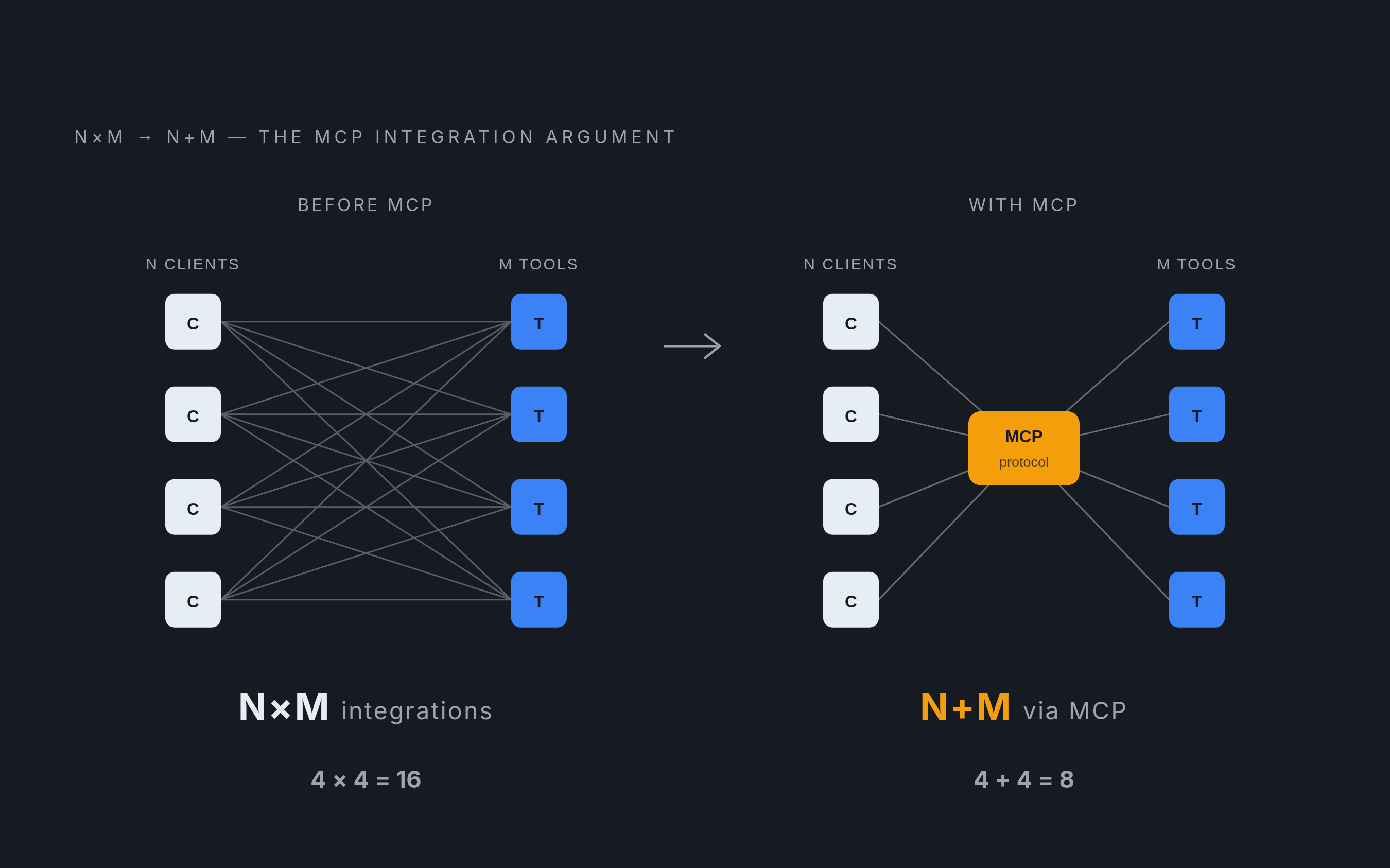
The Model Context Protocol, released by Anthropic in November 2024 and donated to the Agentic AI Foundation under the Linux Foundation umbrella in late 2025, reached over 97 million monthly SDK downloads and more than 10,000 active servers by early 2026. The core problem it addresses is combinatorial. Before MCP, a team with N clients and M tools needed N×M custom integrations. MCP reduces that to one implementation per client and one per server, with interoperability emerging from the standard. For documentation teams running large product suites, that reframing is what makes a unified knowledge layer conceivable in the first place.
The protocol exposes three primitives: tools (functions a model can invoke), resources (read-only data the host fetches or subscribes to), and prompts (reusable server-provided templates). Resources map most naturally to documentation: read-only, fetchable, structured around retrieval rather than mutation. Most community-built servers ship tools only, but vendor and reference implementations increasingly combine both. The transport layer is Streamable HTTP, which replaced HTTP+SSE in March 2025 and supports standard load balancers, CDNs, and proxies, making hosted multi-product endpoints viable at scale.
The gateway or aggregator pattern, a single MCP-facing endpoint that routes or proxies access to documentation across multiple products, has attracted enough real implementations that an April 2026 ecosystem survey could evaluate seventeen tools in the category. A baseline has converged: flat aggregation, tool namespacing, a single endpoint, and centralized authentication or role-based access control.
The official counterargument deserves a direct hearing before accepting that pattern as obviously correct. The MCP best practices documentation explicitly names the "Monolithic Anti-Pattern": one server connecting to databases, files, external APIs, and email. The recommended alternative is focused services with isolated purposes. A 110-product documentation server sounds, on its face, like precisely what that guidance warns against.
The distinction is in the capability surface. The monolithic anti-pattern is defined by heterogeneity: databases, files, APIs, and email differ in access models, mutation risks, permission structures, and failure modes. A unified documentation corpus is homogeneous, read-only, typically public, with a capability surface that reduces to search and retrieve. The condition that makes a single endpoint an anti-pattern is absent. What remains is a large volume of one type of thing, which is architecturally different from a large variety of incompatible things.
Volume alone might seem like enough to recreate the anti-pattern's problems even without heterogeneity. Two of the largest software companies in the world have tested this in production, which moves the question from theoretical to empirical.
What Autodesk's 110-product MCP server and Microsoft's Learn docs endpoint reveal about what a working unified documentation layer looks like
Autodesk's Product Help MCP Server, launched in April 2026, exposes a single remote endpoint at https://developer.api.autodesk.com/knowledge/public/v1/mcp. It covers more than 110 products, requires no authentication, and is publicly accessible from any MCP-compatible client, including Claude Code, Cursor, and VS Code, without a local install. The stated design rationale was explicit: reduce reliance on generalized model responses by grounding answers in authoritative, current content. The single-endpoint decision was deliberate. It reflected a judgment that one connection path, properly maintained, serves both the developer and the infrastructure better than per-product endpoints that each require separate discovery, configuration, and maintenance.
Microsoft's Learn Docs MCP Server, accessible at https://learn.microsoft.com/api/mcp, spans Microsoft Learn, Azure docs, and Microsoft 365 docs. What makes it instructive beyond scale is the routing behavior. A query about "containers" in an Azure context returns Azure Container Instances documentation; the same term in a.NET context returns C# collection documentation. That disambiguation happens at the server, which resolves ambiguity by context before the response is returned, not at the client. Microsoft also consolidated earlier separate repositories, archiving its distinct azure-mcp repository in February 2026 in favor of the unified catalog. The server architecture mirrored an internal consolidation decision, which suggests the single-endpoint approach was not purely about external developer experience. Internal maintainability drove it too.
Both implementations share the same properties: homogeneous capability surface, hosted infrastructure, no per-product authentication complexity, and one connection path for the client. At 110-plus products, the pattern demonstrably scales. The more interesting question is what makes it scale rather than collapse.
The three architectural decisions that determine whether a multi-product documentation server is robust or brittle: namespacing, routing, and resource scoping
Namespacing
Namespace conflicts require explicit resolution, and teams coming from content management backgrounds tend to be surprised by this. A well-structured CMS handles hierarchical organization transparently. In MCP, if two products expose a tool called getreleasenotes, the server has two tools with the same name and the collision must be managed explicitly during configuration. The April 2026 ecosystem survey found that all seventeen evaluated gateways implement tool namespacing as a baseline; the community has treated it as non-negotiable.
The conventional approach prefixes tool and resource names with a product identifier: searchautocaddocs and searchrevitdocs rather than two instances of search_docs. The alternative is to parameterize rather than multiply, which the following section takes up. Both approaches address the collision problem; they differ in their downstream effects on context window consumption and model usability.
Routing
Routing is where the architecture earns its value or quietly fails. Microsoft's context-aware behavior is the clearest illustration of it working correctly: the server does not return every document mentioning "containers" across all sources; it weights the response by context inferred from the query. For cross-product queries, the server must also combine responses from multiple sub-corpora without forcing the client to manage that assembly.
Routing is also the component most likely to be underspecified in early implementations, and the failure mode is invisible by design. Namespacing errors cause immediate naming conflicts. Poor routing returns something, just not the right thing, and the result looks like a mediocre AI answer rather than a traceable error. If routing failures surface as quality degradation rather than exceptions, a team may not know its routing logic is insufficient until a developer complains. The current tooling landscape offers no clean answer to that detection problem.
Resource scoping
Resources should be scoped to product boundaries. A client listing resources for one product should not receive a flat list of all products' resources. Beyond the user experience problem of an unmanageable list, scoping enforces a permission boundary; even in a public read-only server, it prevents one product's draft or unreleased content from leaking into another product's context. The MCP roadmap includes a namespace isolation mechanism under the "Agent Graphs" item that would control tool visibility at the protocol level. As of the April 2026 survey, this remained unshipped, meaning current implementations enforce scoping by convention rather than protocol guarantee.
No tool evaluated in the April 2026 survey provides a clean three-level hierarchy, first-class nested federation, per-client tool visibility, and lightweight self-hosted deployment simultaneously. Teams building now are making choices against an unsettled standard, and some of those choices will require revisiting.
Why exposing one parameterized search tool beats exposing one tool per product, and how tool count interacts with context window limits
One tool per product is maximally self-describing. A model scanning a tool list can identify searchautocaddocs as relevant to an AutoCAD query without additional context. One parameterized search_docs(product=X) tool is context-efficient but requires the model to know the valid values for the product parameter; the discoverability load shifts from tool names to tool descriptions.
Context windows are finite, and the arithmetic here is unforgiving. Every tool description loaded into context consumes tokens unavailable for the actual query and response. In a 110-product server, 110 separate search tools is unworkable in practice. The token cost of loading all 110 tool descriptions before any documentation content has been retrieved would crowd out precisely the content the architecture was built to deliver.
The parameterized approach handles this more gracefully. A single search_docs tool with an enumerated product parameter and a well-written description carries the discoverability load in one entry. Both Autodesk and Microsoft follow this pattern, though neither has published a detailed account of the tradeoffs considered. The MCP roadmap's "Agent Graphs" item, which would let servers control per-agent tool visibility, is the protocol-level answer: an agent working on an AutoCAD task would receive only the AutoCAD-relevant tools, regardless of how many products the server covers. That capability is absent from the current spec.
The practical middle ground production servers have landed on is a small, well-described set of tools: something like search, getpage, and listproducts, rather than per-product variants. This is where the field has converged in the absence of a protocol solution, and it will likely look different once namespace isolation ships.
How authentication requirements differ between public documentation servers and private or versioned documentation, and what the current spec requires for production remote servers
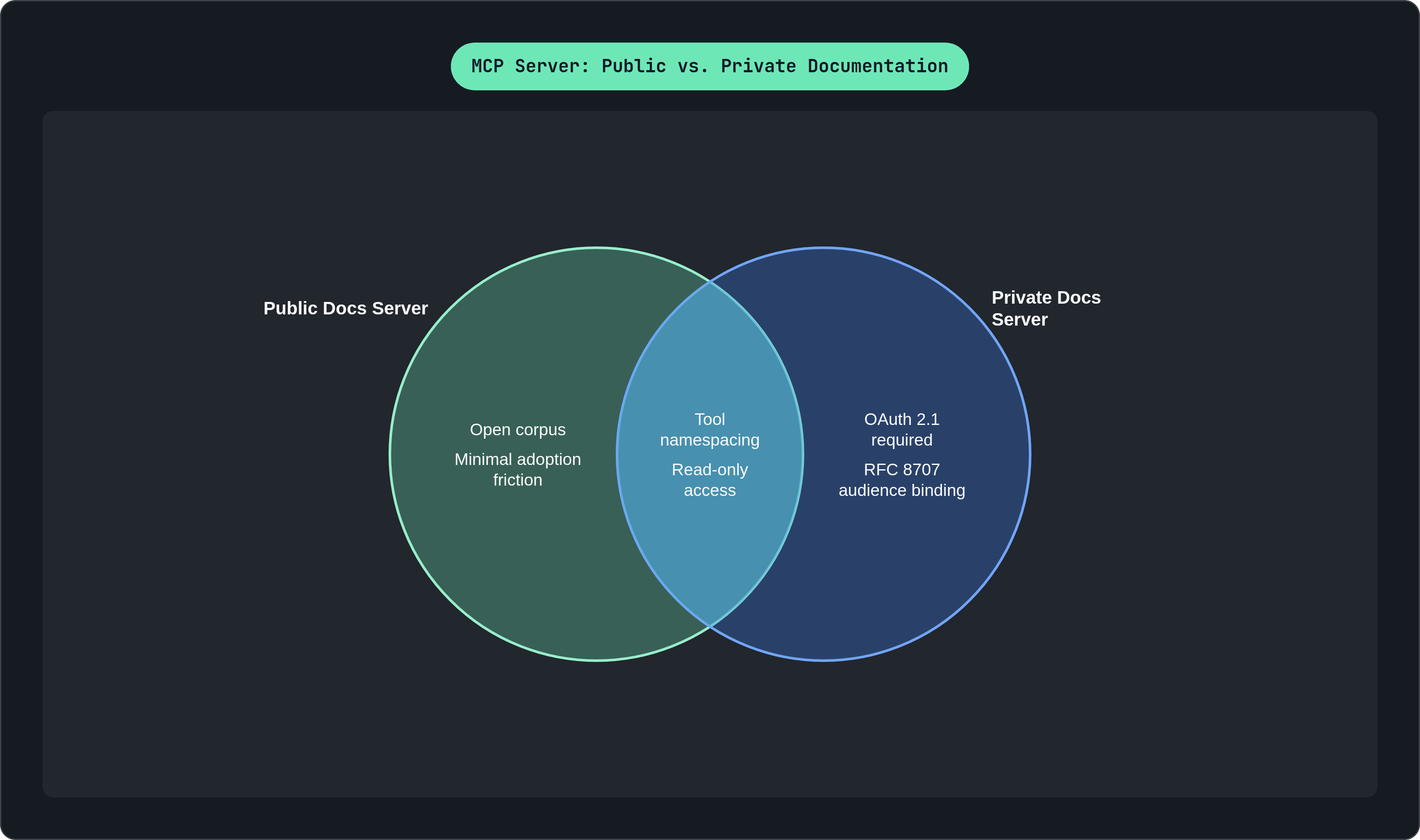
Autodesk's implementation represents the simplest case: no authentication, public corpus, one endpoint addition in any MCP client. The adoption path is minimal, and the security surface for a read-only public corpus is low enough that the simplicity is appropriate.
Private, versioned, or customer-specific documentation is a different problem. A server exposing beta API specs, internal product roadmaps, or customer-specific integration guides cannot be public. The June 2025 spec revision requires OAuth 2.1 with audience binding, specifically RFC 8707, for production remote servers. Audience binding means an access token issued for one MCP server cannot be replayed at another. Without it, a token obtained legitimately for one endpoint could be used against a different endpoint that accepts the same issuer. The constraint is meaningful, not ceremonial.
Production remote servers must also publish RFC 9728 Protected Resource Metadata at a discoverable URL. The reference architecture that has converged for SaaS vendors in 2026 combines Streamable HTTP with OAuth 2.1 audience binding, managed hosting on Cloudflare Workers or a comparable edge runtime, and one-click install support in Claude Desktop's Custom Connectors interface.
There is a security risk specific to multi-product aggregation that is easy to deprioritize under deadline pressure. Prompt injection and poisoned tools, identified in security analysis conducted in early 2025, are more acute when a single endpoint aggregates many documentation sources. A compromised or malformed entry in one product's documentation can affect the shared context for all queries passing through that endpoint. The attack surface scales with the number of products in the corpus, even when no individual product's documentation seems sensitive. Input validation and output sanitization at the gateway layer matter more at scale, not less. This is the kind of thing that gets obvious in retrospect.
The build-vs-generate-vs-buy decision for teams implementing a multi-product documentation server
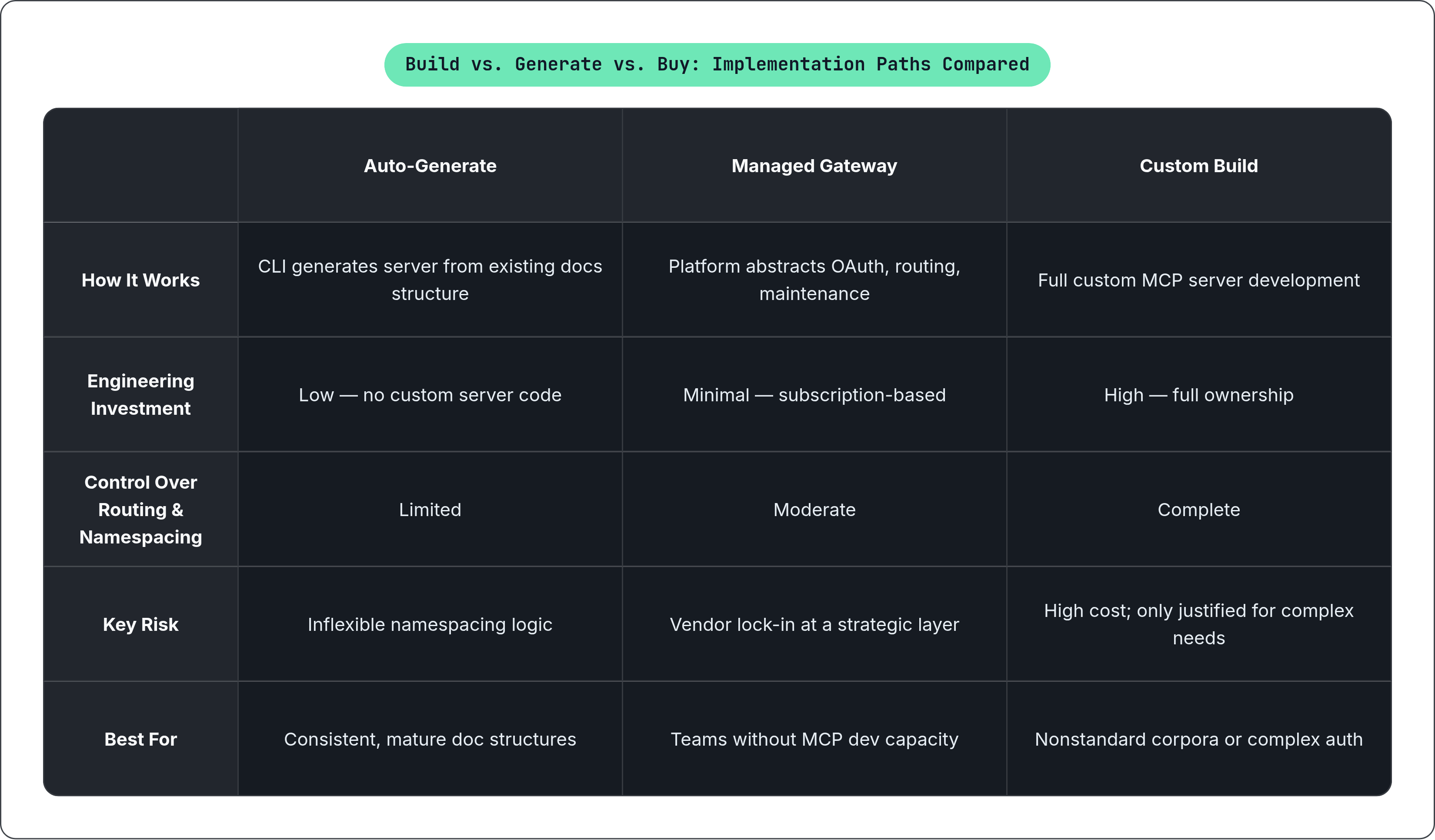
Three paths exist, and the right one depends heavily on what the team already has.
The generate path, exemplified by platforms like Mintlify, a self-updating developer documentation platform that serves both human developers and AI agents, can produce an MCP server from existing documentation structure without custom server code. If the documentation already has a consistent structure, and many teams with mature product suites do, auto-generation works directly from that structure. Engineering investment is low; the tradeoff is limited control over namespacing logic and routing behavior.
Managed gateway platforms, including Portkey and Truto among the seventeen surveyed, abstract OAuth, maintenance, and routing behind a subscription. The cost model shifts from engineering time to operational budget. For teams without specialized MCP development capacity, that tradeoff is often correct. The risk is vendor lock-in at a layer that may become a competitive differentiator as the ecosystem matures, which is worth thinking about before signing a long-term contract.
Custom MCP server development offers full control over every architectural decision discussed here. Estimated costs run in the range of $50,000 to $150,000 per integration per year. At that figure, custom development makes sense only when documentation requirements are sufficiently idiosyncratic: a nonstandard corpus structure, complex auth requirements, or routing logic that demands domain-specific intelligence a general-purpose gateway cannot provide.
Discoverability after deployment is a separate consideration that teams routinely treat as an afterthought. Registries like OpenTools, mcp.run, Cursor.directory, and Windsurf.run determine whether a server gets found by developers outside the team that built it. The Learning and Documentation category on MCP Market listed approximately 2,957 servers as of mid-2026. Standing out in that set requires both a working server and a findable, well-described listing. Building the server and neglecting the listing is a common enough mistake that it is worth naming explicitly.
Remote deployment is now the dominant pattern. Since May 2025, remote MCP server deployments have grown nearly fourfold, and the large majority of the most searched-for servers provide remote rather than local-only deployments. Teams building local-only servers are increasingly outside the mainstream.
What the Autodesk and Microsoft implementations suggest about where multi-product documentation architecture is heading as the MCP ecosystem matures
The pattern has stabilized enough that Autodesk and Microsoft now function as reference implementations rather than experiments. Twenty-eight percent of Fortune 500 companies had deployed MCP servers for production AI workflows as of early 2026, which means the organizational question of whether to engage has largely been settled; the remaining question is how.
Three open problems remain unresolved. True nested federation, where a gateway can compose sub-gateways with independent namespaces and routing policies, is unavailable in any clean form; the April 2026 survey found no tool that provides it. Per-client tool visibility as a first-class protocol dimension, the "Agent Graphs" roadmap item, is in progress but unshipped. Authorization propagation and identity federation through intermediaries, specifically how an access token flows correctly through a gateway aggregating multiple downstream servers, is architecturally unsolved in the general case.
The spec is moving toward namespace isolation controlled at the protocol level rather than by convention. When that ships, the namespacing strategies current servers implement by prefix convention will need revisiting. The naming decisions made today, how tools are named, how product boundaries map to resource scopes, whether auth is baked in from the start, are among the hardest to change later. Teams that treat these as implementation details rather than architectural commitments tend to find that out the hard way.
What the Autodesk and Microsoft cases actually confirm, looked at carefully, is something the headline numbers obscure: a well-designed MCP server over stale documentation solves the routing problem while leaving the freshness problem intact. The two problems are independent. No gateway sophistication substitutes for synchronizing documentation updates with product releases; that pipeline is the foundational requirement, and the gateway is downstream of it. Get that order wrong and you have built something elegant that reliably surfaces outdated information.