Docs Platforms With Built-In MCP Server Hosting
Native MCP hosting keeps agent-facing docs current, but governance remains separate.
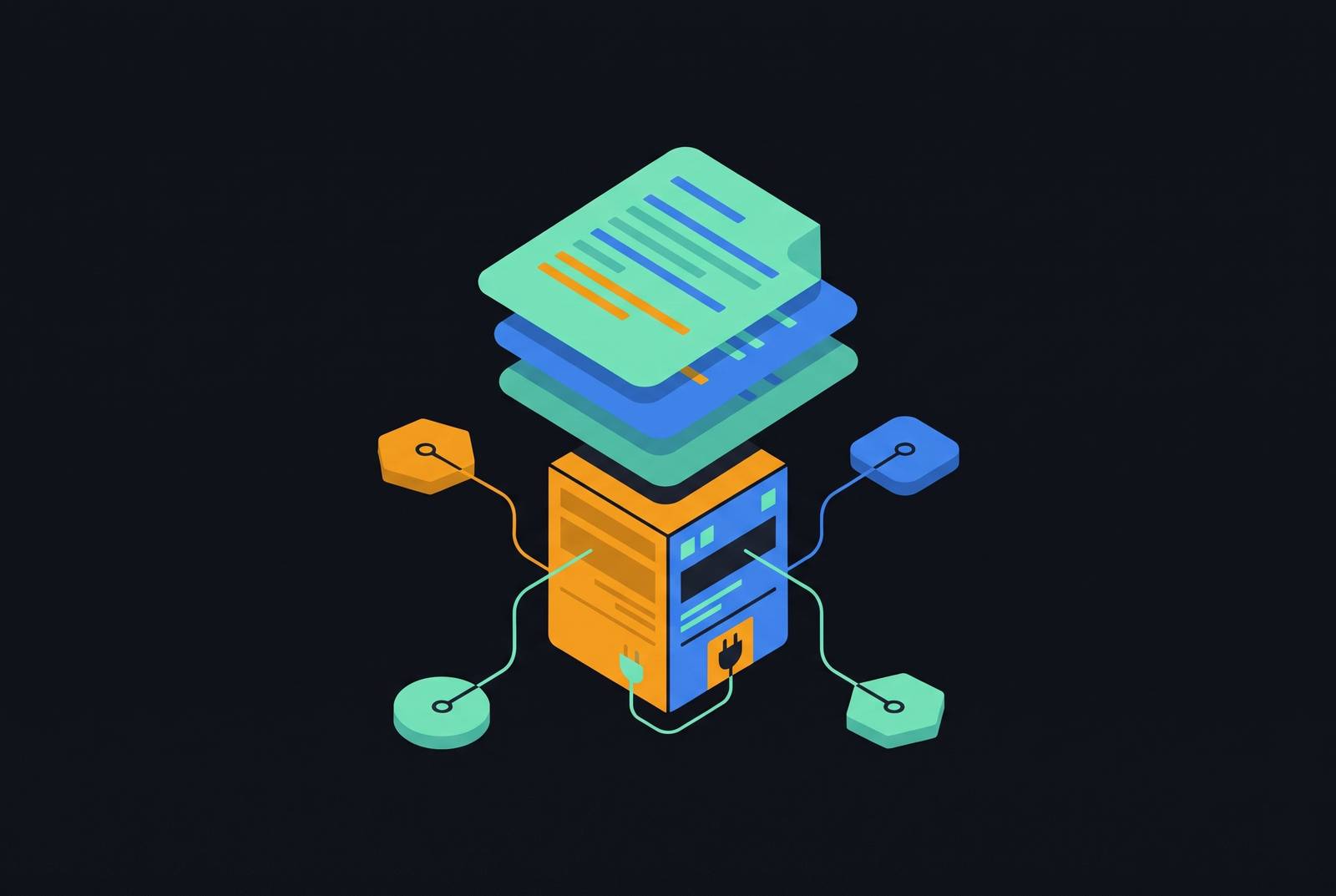
Documentation platforms with built-in MCP server hosting turn published docs into endpoints that agents can query at runtime. The important distinction is not whether a platform offers an AI-friendly file, but whether it owns the connection between published content and agent retrieval. Native hosting belongs at the documentation layer, while identity, audit, and tool policy still need a broader governance layer.
Why documentation platforms are adding MCP server hosting as a native feature
A documentation site now serves two kinds of readers. Developers need pages they can browse, while agents need a way to find the knowledge they need for a task. The Model Context Protocol is an open standard that lets AI applications connect to external services, including documentation. An agent that speaks the protocol can query a compliant endpoint rather than depend on a separately designed integration for each documentation source.
That changes what publishing documentation can mean. A platform can make its content available both as a service and as a collection of pages. The July 2026 specification revision makes that easier because it removes protocol-level session infrastructure from Streamable HTTP. Each request stands alone, so hosting an MCP endpoint is more like running an ordinary HTTPS service than keeping a specialized persistent connection open.
With the informal llms.txt convention, AI systems get a plain-text Markdown file at a domain root that points them to important content. Its companion, llms-full.txt, consolidates an entire documentation set for ingestion. Neither file executes a tool call, but both help systems find or consume the knowledge that an MCP endpoint can make queryable. The platform decision therefore concerns two related capabilities, discovery and retrieval, rather than one broadly defined claim of being agent-ready.
What "natively hosted" MCP means in practice, and why it differs from wiring your own
Native hosting has a specific operational meaning. The documentation platform implements MCP, executes tool calls, and talks directly to its underlying documentation API. It does not merely provide a connection to a separately deployed server that the customer must maintain. The distinction is ownership of the execution layer.
A standalone server remains a workable alternative. A team can deploy one on Cloudflare Workers, AWS ECS, Railway, or a VPS and connect it to the documentation API. That introduces an infrastructure dependency outside the publishing lifecycle, however, with its own deployment responsibilities. A minimal Railway instance alone runs $5–8/mo, but the larger architectural question is whether the separate endpoint remains synchronized when the documentation changes.
With native hosting, the endpoint moves with published content. New pages, deprecated endpoints, and version changes do not require a separate MCP deployment step to become reflected in the documentation service. A separately maintained layer can instead lag or drift when its connection to the source is not kept current. Native hosting removes that particular synchronization burden while leaving teams responsible for keeping the documentation itself accurate.
The same distinction applies to discovery outputs. Automatically generated llms.txt and llms-full.txt files follow published content, while manually maintained versions become additional artifacts to synchronize. Markdown twins, the.md equivalents of published pages, provide direct access without an MCP tool call. A platform that serves those files but does not execute MCP tools hosts the discovery and content-delivery layers.
The docs platforms that currently host MCP servers as a built-in feature
Mintlify provides a concrete example of the native model, implementing the protocol, executing tool calls against its underlying API, and including MCP hosting, llms.txt, llms-full.txt, and Markdown-twin serving on every plan, including Starter. Its Pro tier adds AI features including Autopilot, which monitors codebases for drift and proposes PR-based documentation updates, at $450/month billed annually or $540/month billed monthly.
The boundary around this category needs care. Fern’s enterprise security offering establishes authentication and deployment capabilities. It supports JWT- and OAuth-based authentication tied to existing login systems, with RBAC and granular role-based permissions. It also exports documentation as Docker containers for private-network deployments, including VPC or air-gapped environments. Those capabilities are relevant to regulated deployments, but they should not be treated as evidence of an MCP implementation.
Smithery and Glama occupy a different layer. Smithery combines MCP server discovery with hosting, rather than publishing documentation and exposing it through a native endpoint. Glama is likewise MCP-infrastructure-first, so documentation teams using it bring an existing documentation API. Browsing, local installation, and hosted connectors are free, while hosting a team’s own server is paid.
Manufact offers managed MCP deployment built on the open-source mcp-use SDK. Its GitHub App deploys automatically on a push, making it an infrastructure option separate from documentation publishing. FastMCP Gateway, formerly Prefect Horizon, similarly provides a managed runtime built by the FastMCP team at Prefect for Python developers. Its deployment features include GitHub-based delivery, PR previews, and optional OAuth, with organization-scoped SSO and RBAC on Enterprise.
These are alternatives at different architectural layers. A managed MCP runtime can reduce deployment work, but it does not by itself put documentation publishing and agent retrieval under the same owner.
What the July 2026 spec change means for how you evaluate platform-hosted MCP endpoints
The official MCP 2026-07-28 changelog removes protocol-level sessions and the Mcp-Session-Id header from Streamable HTTP. It also removes the initialize/notifications/initialized handshake. With that revision, each request must stand on its own. An endpoint that depends on the former session model therefore needs more scrutiny than a general claim of MCP support provides.
For buyers, the useful question is which revision the endpoint targets. Earlier implementations need updates to match the stateless model, while serverless deployments on Cloudflare Workers, Vercel Functions, or cloud functions no longer need workarounds for that former session requirement. Transport belongs in the same discussion. Streamable HTTP is current under the revision described here, while the older event-stream-only transport is deprecated.
The July changes reference OAuth 2.0 Protected Resource Metadata and OpenID Connect, rather than introducing OAuth 2.1. The latter had appeared in the earlier 2025-03-26 revision. Asking whether OAuth 2.1 protects the endpoint is still a useful evaluation step, but attributing it to the July stateless change would conflate separate developments.
Cloudflare’s September 2026 MCP portals release illustrates the adjacent infrastructure layer. Its portals put approved remote servers behind one endpoint with access control, which teams can use when they build their own MCP stack. This illustrates why protocol compliance, content ownership, and access control need separate answers.
The governance gap that docs-native MCP hosting does not close on its own
Reliable retrieval is not complete agent governance. A documentation platform can expose current content through a compliant endpoint without governing every tool an agent can invoke elsewhere. Who invoked which tool, with which arguments, under whose identity, and with what outcome?
Production deployments need controls that span those connections. An enforced tool allowlist limits what each agent may invoke. OAuth 2.1-based identity binding lets agents inherit scoped user permissions in place of ambient credentials. A centralized MCP gateway gives security teams one inventory across connected servers, instead of leaving policy scattered across individual endpoints.
That scope extends across the agent toolchain. Cursor, Claude Code, VS Code Copilot, Windsurf, and ChatGPT need unified policy across server configurations. Documentation-native hosting solves only the documentation-retrieval portion of that system. It cannot replace the gateway simply because the content it serves is authoritative.
Does that limitation weaken the case for native hosting? It would if hosting were presented as a complete security architecture, but that is the wrong standard. A gateway can govern access to a source without making that source current, just as a current source cannot establish policy for unrelated tools. The production pattern combines native documentation hosting with a gateway, assigning content currency to one layer and cross-service governance to the other.
What to evaluate when a docs platform claims native MCP server hosting
Does the platform use MCP to call its own documentation API, or does it proxy to a server the team must deploy separately? The next questions follow directly, which specification revision does the endpoint target, which transport does it use, and does it rely on session state?
Authentication deserves evidence independent of protocol support. Buyers should ask whether OAuth 2.1 protects the endpoint or whether it is open by default. They should also establish which authorization controls apply to MCP access, including any integration with existing identity systems. A platform’s support for JWT, OAuth, or RBAC elsewhere does not answer what protects its hosted endpoint.
Content currency requires two separate checks. Does the platform automatically generate llms.txt, llms-full.txt, and Markdown twins from published content, and does its MCP service reflect that same source? Then, what keeps the published source aligned with the product? Codebase monitoring and PR-based update proposals address that second problem. A live endpoint can faithfully serve stale documentation, so synchronization with publishing alone is not enough.
Teams should distinguish access to MCP hosting from access to paid AI features when evaluating tiers. Organizations that cannot expose a public endpoint need to look closely at private-network and air-gapped options. Fern’s Docker export illustrates a documentation deployment capability, but any MCP hosting arrangement still needs its own answer.
Buyers should ask whether the platform has tool-call-level audit logs or only page-view analytics, and whether the hosted service can sit behind a centralized gateway. Those questions test the boundary established earlier. The goal is not to make the documentation platform govern the entire toolchain, but to establish that its retrieval service can participate in unified policy.
Why the docs-platform layer is the right place to anchor agent-readable knowledge infrastructure
The documentation platform owns the authoritative, versioned, human-curated account of how a product works. That gives it a stronger claim to the retrieval layer than a service whose only role is to connect an agent to a separate source. Convenience is a secondary benefit. The architectural advantage comes from publishing human-readable pages and agent-readable outputs from the same content.
That shared source narrows a specific retrieval gap. When llms.txt, llms-full.txt, Markdown twins, and an MCP endpoint follow the same published documentation, humans and agents have access to the same account of the product. A separate MCP deployment introduces another surface that must remain aligned as the product evolves. Native hosting removes that handoff by design, though it cannot eliminate errors or omissions in the underlying documentation.
NIST launched its AI Agent Standards Initiative on February 17, 2026, and the FIDO Alliance announced its agentic interaction standards on April 28, 2026. These efforts add context for procurement discussions, but they do not by themselves establish that MCP support or llms.txt satisfies a particular compliance requirement. A defensible evaluation still rests on the platform’s actual protocol, deployment, and governance capabilities.
The documentation platform owns retrieval and content currency because it owns the published source. The centralized gateway owns identity, audit, and tool allowlists across the connected services.